Monday, November 14, 2011

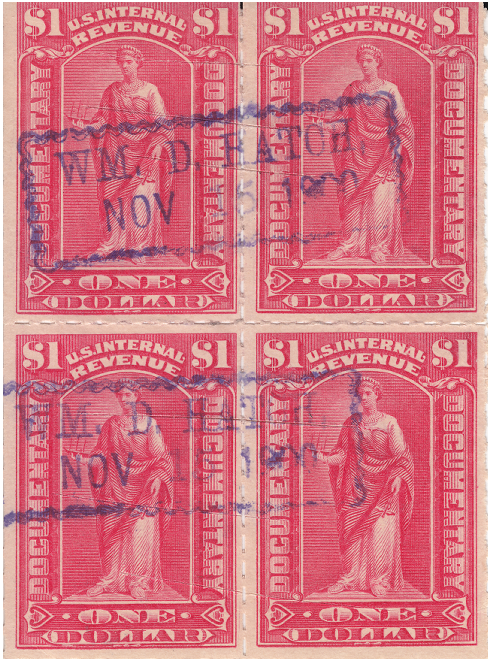
Cancel for November 15: William D. Hatch

WM. D. HATCH
NOV  15  1900

Dave Thompson Scan


D. HATCH
24  1901

Langlois scan

William D. Hatch was a member of the brokerage firm Hatch Brothers with his brother Horace Hatch until the firm's collapse in 1895.  Horace was the member of the firm with the seat on the NYSE at the time of the collapse.  By 1900 William was in business for himself. 

Sunday, November 13, 2011

Railroad Presidents: Melville E. Ingalls, Chesapeake & Ohio Railway and the Big 4


C & O RY. CO
NOV
19
1898
Comptroller.

Mr. Ingalls would begin the 1898 Revenues tax period as the President of the C&O.  But by 1900 he would move over to be the President of the Big 4, or the Cleveland, Cincinnati, Chicago, & St. Louis Railroad, where he remained until 1905.

Saturday, November 12, 2011

Cancel for November 13: National Bank, La Crosse

Nat. Bank
NOV
13
1899
La Crosse.


John M. Levy started the first bank in La Crosse in 1855. Soon after, the Green Bay Bank was organized, but both failed in the Panicof 1857. Gysbert van Steenwyk established the Batavian Bank in 1861 and re-organized it in 1883 as a national bank. The First National Bank became a competitor in 1863 but failed in 1875.20 A group of wealthy citizens, G.C. Hixon and Judge S.S. Burton among them, saw the need for another bank. They organized the La Crosse National Bank and started operations on January 3, 1877. It was capitalized at $100,000 and opened for business on the corner of Second and Main Streets. Hixon became president and a member of the board of directors. The directors obtained a new charter in 1896 designating it as the National Bank of La Crosse. Sixty years later their successors changed its name to the First National Bank of La Crosse.

From A SKETCH OF GIDEON COOLEY HIXON: LA CROSSE LUMBERMAN, A Seminar Paper Presented to the Faculty of the Graduate School Wisconsin State University at La Crosse, In Partial Fulfillment of the Requirements for the Degree, Master of Science in Education by Drucilla Kathleen Munson, July 1967

Friday, November 11, 2011

Cancel for November 12: St. Louis Dressed Beef & Provision Company


ST. L. D. B. & P. CO.
NOV
12
1898

The St. Louis Dressed Beef & Provision Company was part of group of midwestern meat packers that colluded to fix markets and prices for their dressed beef. 

Thursday, November 10, 2011

New York Stock Brokers: Sigmund H. Rosenblatt & Company


S. H. R. & CO.

Langlois scan

Sigmund H. Rosenblatt & Company


Mr. Rosenblatt got himself in a world of trouble in 1903 when he was suspended from the stock exchange for 3 months.  Apparently his partners were the guilty ones; Rosenblatt was suspended through his association with them.   The New York Times reported on November 15, 1903:


ROSENBLATT OUT OF FIRM.

Brokerage House of Zimmerman & Forshay Reorganized Under the Old Style.

Announcement of the dissolution of the brokerage firm of Zimmerman & Forshay, the Exchange members of which, Leopold Zimmerman and Sigmund H. Rosenblatt, were suspended from the Stock Exchange recently for one year and for three months, respsectively, on account of the curb deal in the bonds of the United Railways of San Francisco in the Spring of 1902, was made yesterday.

At the same time a new copartnership was announced, with the same name and a membership identical with the old firm save for the withdrawal of Sigmnund Rosenblatt...It is understood that Mr. Rosenblatt will continue in the brokerage business independently.

Corporation Trust Company of New Jersey


CORPORATION TRUST CO.
NOV
XX
1899
OF N. J.

Dave Thompson scan


The Corporation Trust Company of New Jersey was formed in 1892, and was packed with people with political connections.  The directors included the state Governor, Leon Abbett, among others.  The firm acted as a corporate transfer agent, and provided shelter and support to big businessmen that used its services. 

The company effectively helped lure companies to move to or establish themselves in New Jersey by making compliance with local laws simpler and more efficient. 

Wednesday, November 9, 2011

Railroad Presidents: Samuel R. Callaway, Lake Shore & Michigan Southern Railway


Photo of Callaway is from King's Views of the New York Stock Exchange, published in 1897.  Callaway was shortlived in his position with the LS&MS.


L. S. & M. S. RY.
AUG
15
1898
LA PORTE, MD.


Samuel Callaway's career shot like a rocket during the 1898 Revenues tax period.  He started 1898 as the President of the Lake Shore & Michigan Southern, a key link in William Vanderbilt's New York Central system.  He was promoted after a brief period by Vanderbilt and Chaucey Depew to the Presidency of the New York Central, and by May 1901 he was lured away to be the President of ALCO, the American Locomotive Company, a newly formed consortium of 8 existing locomotive builders.  ALCO would be a major force in steam locomotive construction until steam power in railroads became obsolete.


ALCO advert from the 1901 edition of Poor's Manual.  Callaway's name is listed below as the firm's President.


Tuesday, November 8, 2011

Berkshire Life Insurance Company


BERKSHIRE L. I. CO.
MAY
22
1900
PITTSFIELD, MASS.

Dave Thompson scan


The Berkshire Life Insurance Company still exists as a subsidiary of The Guardian Life Insurance Company.  You can find some of their rather leaden and poorly acted promotional videos over at You Tube..  Enjoy this one below:


Monday, November 7, 2011

Railroad Presidents: Charles E. Perkins, Chicago, Burlington & Quincy Railroad


Perkins was President of the CB&Q for 20 years from 1881 to 1901.


From The New York Times, November 9, 1907:

...Charles Elliott Perkins was born in Cincinnati November 24, 1840.  When 10 years old he went to Burlington, Iowa, and became a clerk in the office of the Assistant Treasurer of the Burlington & Missouri River Railroad.  In 1862 he was appointed Assistant Treasurer of the road, and three years later was made Superintendent.  In 1875 he was appointed a Director of the new Chicago, Burlington & Quincy System.  The following year he was elected Vice President, and in 1881 was advanced to the office of President.

At that time the Burlington system was controlled by New England men, and Mr. Perkins removed to Boston, where the head offices of the company were located.  He continued in office until 1901, when he resigned on account of the control of the road to New York interests.

Mr. Perkins was a Director in the American Bell Telephone Company....

Sunday, November 6, 2011

Saturday, November 5, 2011

Railroad Presidents: George J. Gould, Missouri Pacific Railway


George Jay Gould was the son of Jay Gould, the great railroad manipulator of the Gilded Age.  George was not only the President of the MOPAC, he also was the executive of other Jay Gould legacies, including the Denver and Rio Grande Western Railroad and the Western Pacific.


George J. Gould as depicted by Vanity Fair in 1894

Gould is famous in death as he died following a visit to Tutankhamen's tomb in Egypt.  Whether due to the curse of Tutankhamen's tomb or not, George Gould developed pneumonia shortly after his visit to the tomb and he died in May 1923.

Friday, November 4, 2011

New York Stock Brokers: Burrill & Stitt


BURRILL & STITT
MAY
8
1901
10 BROAD ST. N. Y.

Langlois scan.


From The New York Times, December 26, 1897: 

The West Will Buy Stocks.

  Mr. Edwin L. Burrill [sic. Edwin or Edward?]--I predict very strong markets next year.  This prediction does not come in the nature of a prophesy, but is simply based upon conditions which every one can see.  Confidence seems to be restored in all sections of the country, and there is nothing among the probabilities to prevent better prices.  The Cuban question is not likely to be discussed further by Congress [yikes!*], and the effect of such a discussion would not likely to be felt to any great extent.  The simple facts are that the country is enjoying prosperity, and consequently that prosperity will be in evidence in the street.  The West will be large buyers of securities.

*Editors note:  Mr. Burrill obviously did not have an accurate crystal ball.  On February 15, 1898, the battleship Maine would explode in Havana Harbor.  The war would start in mid-1898, with Theodore Roosevelt distinguishing himself well enough in battle and self-promotion that he would receive the GOP nomination for the Vice Presidency in 1900.  Congress discussing Cuba was the least of it.  Mr. Burrill was wrong about a major turn in the history of Cuba and the United States.  And Mr. Burrill would never have used the stamp above had he been right in his prediction of quiet on the Cuban front.


Thursday, November 3, 2011

Wednesday, November 2, 2011

New York Stock Brokers: Martin & Co. + Watson & Brown

Martin & CO
APR 23 1901

A photo of Augustus Fitz-Randolph Martin, the founder of Martin & CO, doesn't appear in King's Views of the New York Stock Exchange. He died at age 55 on October 16, 1897, the year prior to its publication. According to his death notice in the New York Times, he became a member of the stock exchange in 1866. Although not listed in King's, the 1901 sales memorandum shown here indicates the firm continued after his death.

Affixed to the reverse is a nice plate block of nine of the $1 gray overprint Commerce issue with three more $1 singles affixed below the block; all are cut-cancelled and handstamped with a two-line company handstamp. Used plate blocks of any the Commerce issue can't be very common -- its presence on this document makes me wonder if the person who prepared this memorandum was a stamp collector.

At the resale rate of 2-cents per $100 in initial stock value, the $12 tax indicates each of the 600 shares had an initial value of $100, or a total value of $60,000. Realizing just $7,200 ($12 each) means there was a loss of $52,800 from the initial stock value!

Martin & CO memorandum for sale of 600 shares "Linseed"
to Watson and Brown

"Linseed" most likely refers to the American Linseed Company formed December 5, 1898 in New Jersey. Information about this company's early business is scant; it paid quarterly dividends until December 1900 when payments ceased. A 1909 New York Times article indicates after losing more than $1,400,000 in 1901, the company didn't provide any annual reports until 1909. That huge loss perhaps explains the low stock price.


The company's failure to provide annual reports perhaps is explained by the fact that John D. Rockefeller and Standard Oil took control of it in 1901 as reported by the New York Times on April 25, 1901, just 2 days after this sale occurred. Hmmm! If documents could talk we'd likely get some interesting insider information! As indicated by this 1915 New York Times article, Rockefeller held the company close, controlling its Board and funding it whenever necessary, but otherwise not paying dividends.


Fast forwarding to today, we find Bestfoods, one of the largest food companies in the United States, (think Hellman's Mayonnaise and Skippy Peanut Butter), traces its roots back to American Linseed. It's a long history that includes a 1913 Sherman Antitrust Suit (shades of Rockefeller's Standard Oil situation).


It's unclear if Watson & Brown, the brokers who bought these 600 shares of American Linseed for such a low price on April 23, 1901, had knowledge of Rockefeller's pending takeover of the company or if they subsequently profited from the purchase, but the timing certainly suggests that possibility.


Tuesday, November 1, 2011

Monday, October 31, 2011

New York Stock Brokers: Faris & Thayer


FARIS & THAYER,
JAN  17  1901
NEW YORK.

Dave Thompson scan


Mr. Faris and Mr. Thayer were both members of the New York brokerage firm Henry T. Godet & Company when it failed in 1890.  Mr. Godet had died in 1887, and with the failure of the firm in his name three years later, it appears that Faris & Thayer then created their own firm, in their own names.

However, Townsend Thayer went into business with new partners by 1904, almost certainly a brother among others, but then the firm Thayer Brothers & Company failed in September 1907.  The failure of Thayer Brothers would preceed a calamitous banking and stock market crash in October 1907.  Again, as with the panic of 1901, J.P. Morgan stepped in to help stabilize markets and the banks.

The 1898 Revenues economic era was one of market booms and busts that occurred with fequency and severity.  The irony of modern New York bankers and brokers taking endless bailouts from the US Treasury for their own stupid decisions, and now rebuffing and lobbying against regulatory attempts to prevent further crises like the one of the past few years is predictable for the most cynical of reasons.  While New York capital has functioned as a bedrock for industrialists throughout the world, it in no way represents a perfect market.  We can only hope that cool heads prevail in the regulation of the greatest industrial capitalization engine the world has ever seen.  Any great talent also needs discipline and control.  Financial markets are no different. 


Wall Street, October 1907 during the "Bankers Panic"

Saturday, October 29, 2011

Auctions: 40 Cent Documentary Used Block of 12 at Spinks Shreves Galleries November 18 - 19, 2011 Sale


4X3 Multiple of R170
Est. $200-300
2011 Scott Catalogue value for a block of 4: $52.50


From the lot description: 

#R170, 40c Blue lilac, rouletted 5½, used block of twelve (4x3), cancelled with bright red Wilson & Co., Pittsburgh, Pa. June 7, 1899 c.d.s.'s, some perf. separations and a few hinge reinforcements, very fine and attractive; this is the largest recorded multiple of #R170, the next largest being a strip of ten.

*****

The strip of 10 that Spink Shreves refers to can be found in the inventory list of The Curtis Collection.  A scan of that strip can also be found below.  The block of 12 offered in the sale is certainly rare, though I wonder if there are not larger blocks of this stamp out there somewhere.  I submitted a scan of a used block of six of R172p, the slot perfed 80 cent documentary, to The Curtis Collection, and it remains the largest multiple recorded.  I have to believe that there must be a larger multiple out there somewhere.


R170 strip of 10 referred to in the lot description.  This scan can be found at the website of The Curtis Collection.  The site reports this strip as ex-Joyce.  Like the block of 12, this strip was also cancelled by Wilson & Company of Pittsburgh.


WILSON & CO.
JUN
7
1899
PITTSBURG, PA.


Dave Thompson sent a scan of a R173 with a Wilson & Co. of Pittsburg cancel.  To date, I have yet to trace much on the firm of Wilson & Company in Pittsburgh.  Please send any infomartion you might have about this cancel and the company that made it to 1898revenues@gmail.com.


WILSON & CO.
OCT
23
1899
PITTSBURG, PA.*


*A note on the spelling of "Pittsburg".  For most of its history, including the present, the City of Pittsburgh was spelled with an "h" at the end.  A declaration by the United States Board of Geographic Names stated the spelling of the city should not have an "h" at the end, so from 1890 to 1911 the city was spelled "Pittsburg".  Hence the spelling on the R170 cancels above is correct.  The official spelling reclaimed the "h" in 1911 after citizen petitions. 

Friday, October 28, 2011

New York Stock Brokers: Sharp & Bryan

It's been more than 3 months since my last submission to 1898revenues; a longer hiatus than planned. While I look forward to continuing to explore the application of the war tax law by blogging more about on-document usages of the 1898 revenues, I must say I've enjoyed the current series about New York Stock broker cancels.

Those blogs demonstrate the breath of opportunities 1898 revenue stamps offer collectors. Kudos to Dave Thompson and John Langlois for pursuing them. As a way of segueing into blogging about on-documents usages again, I thought I'd appropriate show and discuss some actual sales memoranda from some New York stock brokers.
Sharp & Bryan Stock Sale Memorandum
2500 Shares Union Pacific Railroad Stock
New York, NY April 26, 1901
Reverse of Sharp & Bryan Memorandum
Here's a sales memorandum for the resale of 2,500 shares of the Union Pacific Railroad stock properly taxed $50 with sixteen $3 and one $2 gray Commerce overprint issues (eight of the $3 stamps are on the reverse). The tax rate for the resale of stock was 2 cents per $100 of original stock value, so the $50 tax indicates that each of the 2,500 shares sold here for $108 had an initial value of $100. So the total value of this transaction was $270,000!

That Sharp & Bryan used lower dollar-value documentaries to pay the tax suggests this may have been an unusually large transaction for them. It also suggests they didn't stock, no pun intended, high value stamps, an expensive proposition for any company.

Whoever prepared this memorandum went to great lengths to keep the information about the sale unobstructed. First they encircling the critical information on the form with $26 in tax stamps, putting the remaining $24 in tax on the reverse.
All the stamps are both punch and handstamp cancelled. The stamps on the front of the document were affixed, then handstamped, and then punched. One can ascertain this by noting that the punches cut through the handstamp cancels, the stamps, AND the document itself. Note that each stamp is punched 3 times in an irregular pattern, suggesting each punch was done separately.

The sequence for the stamps on the reverse was different. Each stamp was affixed to the document separately but only after FIRST being punch cancelled. Unlike the stamps on the front the punch cancels ALL appear to be in a regular pattern suggesting that the eight indivdual stamps were "stacked up" then punched. Why? Again, whoever produced this memorandum seemed to be trying to insure that the information about it wasn't obliterated which might have occurred had the stamps been punch cancelled after being affixed.
I only noticed this when looking for the best cancel to illustrate as a detail. As the arrow in the illustration below shows, unlike the stamps on the front, the handstamp cancel was applied only after they were both punched and then affixed to the document because the holes in the stamps on the back don't cut through the document and the handstamp cancel shows in the area of the holes; note the "R" in "APR".

The stock market panic of 1901 took place on May 17, 1901, just 3 weeks after this sale. The speculative antics of Union Pacific's chairman E. H. Harriman and others interested in gaining control of the Northern Pacific Railroad reportedly caused that panic. Perhaps this April 26, 1901 sale representing $270,000 was part of the pre-panic speculation which involved the stocks of many railroads including the Union Pacific. That Sharp & Bryan had a "Union Pac." handstamp cancel suggests they actively traded the stock and may have had a folder of pre-handstamped forms ready for Union Pacific sales. Assuming there hadn't been a prior resale, the seller made $20,000 over stock's $250,000 face value, a tidy sum in 1901!
Sharp & Bryan
APR
26
1901
New York

The Sharp & Bryan firm was established in 1891. They were forced to suspend trading temporarily in August 1903; however they apparently recovered as I found an additional 1907 reference to the firm.

Thursday, October 27, 2011

New York Stock Brokers: Popper & Stern


POPPER & STERN.
JUL
9
1901
N.  Y.

Thompson scan


New York Evening Post, January 3, 1895