Showing posts with label On Beyond Holcombe. Show all posts

Sunday, February 3, 2013

On Beyond Holcombe: Youthful Tint Manufacturing Company

On Beyond Holcombe, by Malcolm A. Goldstein, is an ongoing series on the firms that used battleship proprietary revenue stamps.


Y.  T.  M.  Co.
1899


As noted in connection with the letter X, the nether end of the alphabet (with the notable exception of W) provides few opportunities actually to match cancels and patent medicine industry companies, so the Youthful Tint Mfg Co, whose boxed “Y T Co” cancel is recognized by Mustacich and Giacomelli as appearing on every value save RB20, presents both a high and obvious target for which to aim.  While the company itself left traces of its existence, its founder, C D Hess, is much harder to isolate as an individual.  This much is known: the Youthful Tint Manufacturing Company was founded and incorporated in 1884 in Rochester, NY.  Its officers in 1903 were C D Hess, President and Superintendent; F Judson Hess, Vice-President and Secretary; and S F Hess, Treasurer and General Manager.  It required so many values of the battleship revenues for its use because it manufactured extensive lines of perfumes, cosmetics and theatrical make up, and, thus, sold goods at every price level.  Its product lines were marketed under the trade names of “Hess,” “Mrs. Hess,” “R S Soule et Cie,” and “Youthful Tint.”  Among its colorfully named products were Cherryola Rouge, Exovia Paste for Facial Enamel, and perfumes such as Heather Bells, Japonotis, Roumania Damask Rose, Tonquin Musk, and Yezzo.

Albeit the names “Hess” and “Mrs Hess,” were prominently featured in the company’s advertising and on its products, C D Hess was known and identified almost exclusively by his initials, as was Mrs C D Hess. Because of this initials only usage, a mystery arises about the identity of C D Hess and his wife.  Census records seem to indicate that the C D Hess of the Youthful Tint Mfg Co was Charles D Hess. According to these records, he was born in New York State in 1844, and, by 1880, had married Delia, for whose father he was working as a clerk in the father-in-law’s tobacco store in Rochester, NY, just four years before he struck out for himself in Rochester with his Youthful Tint Mfg Co. To flesh out a portrait of this C D Hess, one might consult Civil War records, which were a touchstone for late 19th Century careers.  In fact, there are forty-one listings for Charles Hess enumerated on the National Park Service’s website of Civil War soldiers.  Because of the relatively short durations that army units served during the Civil War, more than one listing may belong to the same individual.  Even so, there were multiple individuals named Charles Hess who fought in the Civil War. The only individual actually identified as Charles D Hess served in the 28th Battery, New York Volunteer Light Artillery assigned to guard New York City’s harbor.  The unit’s war casualties were 8 men who died of disease.  A more dashing C D Hess from New York State served both as a Lieutenant and later Captain in Company G of the 13th New York Volunteer Regiment, which suffered casualties of 4 officers and 67 men killed or mortally wounded in battle as well as 29 deaths from disease.  However, that C D Hess turns out to be listed in both the National Park’s and New York State’s record of its Civil War veterans as Clarence D Hess.  His “Mrs C D Hess” rushed from their home in Dansville, NY, south of Rochester in western New York, to serve as a volunteer nurse in Washington, D C in 1861 after First Bull Run and remained there to work beside Clara Barton at nursing Union soldiers.


In fact, a “Mrs C D Hess” greeted and spoke to President Abraham Lincoln in Washington at the White House on April 14, 1865, the day of his assassination, but she is not the “Mrs C D Hess” of the Youthful Tint Mfg Co story.  This “Mrs C D Hess” was formerly Julia Grover, whose brother, Leonard Grover, was a theatrical agent in Washington D C.  According to a biographical website - which discusses at some length that this C D Hess’s first name was extremely hard to ascertain - her C D Hess was a second and different Charles D Hess. This latter Charles D Hess perhaps lived an even more flamboyant life than the former.  He was born in Cohocton, NY, a small town south of Rochester in western New York in 1838.  Like the former Charles D Hess, he also married young and went into his in-laws’ business, in this case, as an actor and singer in his brother-in-law’s theater in Washington, DC.  Performing in spite of a bad cold soon wrecked his voice, and thereafter, he switched over to theater management. Here arises a conundrum.  The biographical sketch of C D Hess, the Washington theater manager, suggests that he fought for the Union at both battles of Bull Run.  However, when examined closely that account actually borrows the war record of Clarence D Hess, a natural choice, since a soldier might naturally volunteer from his birth place and Cohocton is extremely near Dansville.  Since geography has not changed in the 150 years following the Civil War, and since the only C D Hess born in 1838 was a Clarence D Hess, and, since Clarence’s wife would have had a doubly good reason to stay in Washington after 1861 had she come from there in the first place, she, indeed, might have been the “Mrs C D Hess” known to Abraham Lincoln.


Adopting the hypothesis that the latter C D Hess was actually the aforementioned Clarence D Hess, not another Charles D Hess, unravels this part of the C D Hess puzzle relatively quickly. After his service in the Union Army, this latter C D Hess returned to Washington and resumed his activities as a theater manager now at Grover’s National Theater.  On April 14, 1865, his wife was visiting at the White House. According to a meticulous 1922 account of Lincoln’s last hours, Lincoln ran into her on his way to take a carriage ride with Mary, and apologized to her for not being able to attend her husband’s theater that evening.  The latter C D Hess shortly thereafter attained the dubious distinction of announcing on the stage of the National Theater that Abraham Lincoln had been shot at Ford’s Theater.  Tad Lincoln was sitting in the Presidential Box at the National Theater together with Grover’s son, a scene graphically portrayed in the recent film Lincoln.  This C D Hess later successfully managed the Crosby Opera House in Chicago until months before it was destroyed in the Great Fire of 1871, and then formed and managed touring companies of opera singers, which at one point in 1885 included Lillian Russell.  While he wrote a long account of the development of opera performance in America for a 1901 issue of Cosmopolitan Magazine, after 1891 he appears to settled in Indiana with a second wife, the former Clara Walton, a leading advocate of woman’s Masonry, and remained there until his death in 1909. The confirmation of his death and burial is found in a web posting about graves located in Indiana and is found under the name Clarence D Hess.


Returning to the Hesses of the Youthful Tint Mfg Co, its C D Hess seems to have resided in Rochester, NY from its founding in 1884 until his death in 1908.  Delia Hess’s actual role in the company is unknowable.  Since most of the product that the Youthful Tint Mfg Co made was for women, some of the advertising was pitched in Mrs C D Hess’s name, featuring endorsements by women addressed directly to her.  She may have actually played some role in the management of the company, for there are other ads in local upstate New York newspapers soliciting in her name for female canvassers to conduct surveys of housewives in “every city and village of New York State,” perhaps an early effort to engage in marketing research through  customer focus groups.  The F Judson Hess listed as Vice-President seems to have been a nephew of Charles D, born in 1863, son of Solomon F Hess, the Treasurer of the Company, born in 1831.  F Judson probably ran the company after Charles D’s death.  In 1924, he is mentioned in a family history of the Hess family that traced the family’s origins in America back to Johannes Hess, born in  Hesse Cassel, Germany in 1692, who emigrated to the Mohawk Valley in eastern New York State in 1722.  His oldest son, Augustine, who served in the Revolutionary War, along with five of his own sons, is identified as the ancestor of  F Judson Hess (and presumably C D Hess as well).  F Judson Hess died in 1936.            

Perhaps both Charles D and Clarence D Hess preferred to use initials in part to trade on each other’s fame, for, ironically, ads for the one C D Hess’s theatrical make-up appeared on the same theater trade magazine pages as the listings for the opera houses that the other C D Hess’s touring  companies played in.  Perhaps they both tacitly felt they benefitted from the overlap, for, make-up endorsed by a theater manager himself must be the premium goods, and a theater manager who has a side-line in perfumes and cosmetics must be wealthy enough to keep a traveling company afloat.  Ads for theatrical products carried endorsements by such notable actors as Edwin Booth and DeWolf Hopper in the form of thank you notes addressed to C D Hess.  Then again, perhaps neither man ever noticed, and it is left to those who ferret through such proverbially “dusty” records to even notice the juxtaposition.

Saturday, January 26, 2013

On Beyond Holcombe: Christan Xander

This edition of On Beyond Holcombe by Malcolm A. Goldstein is a part of a continuing series on the firms that used battleship proprietary revenue stamps:


CHRISTIAN XANDER
DEC  31  1898


The number of cancellations involving the letter “X” on battleship revenues approaches zero, and the challenge of finding one to construct a philatelically based article around is daunting.  The RB27 cancelled by Christian Xander offers such an opportunity and this writer willingly embraces it, perhaps because his family name makes researching Christian Xander considerably easier than it would be to reconstruct the life of a John Smith whose life paralleled Xander’s in every detail.  Suffice to say, Xander proves an interesting subject.

The genealogical records are sufficient and reasonably straightforward enough to sketch the broad outlines of Xander’s life, providing just enough detail to tantalize.  He appears to have been born in Grossweier, a small town in the state of Baden in southwestern, Germany, quite near Strasbourg, France, on January 10, 1837 the son of an earlier Christian Xander and his wife Magdalena Zerr (Zirn), who himself was the son of an earlier Christian Xander and his wife Maria Jorger.  By 1864, he had emigrated to the District of Columbia, and on December 22nd of that year married Caroline Blume (Blum), also a German emigree born in 1848, at the Concordia Lutheran Church in Washington, D.C.  Although the online baptismal records of the Church (corralled and posted by the Mormon Church) show a male birth (Carl Hy) in September, 1865 and a female birth (Maria Wilhelmine) in December, 1866, he listed his two children as Henry born in 1866, and Mina born in 1868, in the 1880 Census.  Perhaps he simply did not remember his children’s birth dates.


Xander listed himself as a wholesale liquor dealer in that census, but as early as 1872, he was sufficiently established as a merchant to act as an incorporator for the Boundary & Silver Springs Railway Co, a trolley system for the District of Columbia, one of a group of visionary businessmen willing to invest to build the latest transportation improvement for the city of Washington.  However, in responding to a circular letter sent out by the Senate Finance Committee to the business community inquiring about the need for change in custom duties, Xander left a portrait in his own voice of the very small manufacturing portion of his liquor business as it existed in 1893.  As background, he explained that his winery had been established in 1882 and capitalized at $18,000. For the vintage year 1893, he manufactured approximately 10,000 gallons of  “sweet reds and clarets” worth approximately $15,000. Classifying the importance of his business, he affirmed that “[w]ine is a necessity for people of sense as a nutriment and hygienically.” Responding to a series of questions aimed at ascertaining the impact of the then current economic depression, now called the Panic of 1893, on his business, Xander affirmed that he had continued to run at full capacity, had experienced no increase in competition, and had produced more goods than in 1892 “because producing exceptional quality, the demand for it is increasing.” He employed six men at $12 to $21 per week and even sniffed: “[m]y wine-making business is for quality; I care not to sell my own product wholesale - they are above trade wines in quality.” As to his view on the customs duties which were imposed only on imports, he stated, since his trade was “local,” and he feared “no import, ... [his] recommendation [was] to leave things alone.”


As a wholesaler, Xander gave a plug to one of his domestic champagne manufacturers in 1896, by issuing a hearty recommendation of its product as equal to the more expensive imported champagnes.  The manufacturer then printed Xander’s letter in a trade magazine with the following elaboration: “The Opinion of a Wholesale Dealer -  Christian Xander is the largest wholesale liquor dealer in the City of Washington, and enjoys the reputation of being one of the most careful and competent judges of wines in the United States.” Xander’s letter carefully explained that:

As many physicians constantly order your Imperial Sec for delicate patients it must be on their experience that your wine can conveniently take the place of the expensive French champagnes, which especially in the case of poor families, are rather inaccessible, and be the sickness ever so severe, your wine does take the place of the foreign brands with equal effect,

and effusively concluded: “You may use these, my assertions and experiences, for they testify simply to the high character of an honest wine.”  Xander was willing to carry the challenge to foreign imports even further by displaying his own quality wines at the Paris Exposition of 1900.


In 1905, Xander was regarded as a significant enough citizen to serve on one of the committees charged with organizing the Inauguration of President Theodore Roosevelt which took place on March 4th of that year.  However, the most revealing insight into Xander’s private life may be his long support of, and membership in, the Washington Saengerbund, a society dedicated to the promotion of German music.  His son, Henry, who often appeared as the society’s pianist, went on to serve as a longtime director of the group.  Xander died apparently suddenly on March 7, 1908 at age 71 and was buried on March 10, 1908.  His widow continued to make donations of wine to one of the local charity hospitals for years after his death.

Sunday, January 20, 2013

On Beyond Holcombe: C. Wakefield & Company

This week, Malcolm Goldstein returns with an article on C. Wakefield & Company.


C. W. & CO.
JUL  23  1900


C. W. & CO.
May  25,  '0.


Cyrenius Wakefield, the superstar of C Wakefield & Co, never intended to be either a physician or a patent medicine manufacturer.  His ambition was to homestead a farm and raise stock, and he initially molded his life to pursue this goal.  However, circumstances, both fortunate and unfortunate, led him to ownership and control of a large and prosperous mid-western patent medicine company.  Because of the westward progression of his ancestors and his own westward journey, he may be the most truly representative Nineteenth Century pioneering figure that this study so far has chanced to discuss.

Cyrenius Wakefield


Directly descended from an ancestor who had emigrated to the colonies about 1680 from the village of Wakefield, England, (the same memorialized by the 18th Century writer Oliver Goldsmith in his novel “The Vicar of Wakefield,” as Wakefield’s advertising later trumpeted),  Cyrenius (sometimes Sirenus) Wakefield was born in Watertown, NY in 1815, the fourth of the six children of Joseph Wakefield.  Joseph himself had moved west from Rutland, VT to develop his farm with his wife Susan, born in New Hampshire.  Young Cyrenius grew up in Watertown, farming in season and teaching school in winter.  In 1837, he journeyed by steamboat, stage and on foot (for the last two days, since there was no public conveyance) to Bloomington, IL, then on the western frontier, where he apparently believed he would find his opportunity to homestead. Exactly why he harbored this supposition about this particular location on the frontier is not recounted in the extant records.  Supporting himself for fifteen months as a school teacher, particularly to benefit in winter from the large stove (rare in the West) with which the schoolhouse was equipped, he eventually purchased land in DeWitt County south of Bloomington. Over the next several years, he cleared land in summer and taught school in winter, until he had created enough of a farmstead to begin his own family.  In 1843, he journeyed back to Watertown, to marry “an old schoolmate” to be his “housekeeper” (in the quaint words of the Nineteenth Century Illinois regional history book puff biographies of Wakefield).

One of Dr Wakefield’s neighbors summarized the pristine state of the region around Bloomington, IL in the pioneer era in the following poetic doggerel:

Great western waste of bottom land,
Flat as a pancake, rich as grease;
Where mosquitoes are as big as toads
And toads as big as geese.

Beautiful prairie, rich with grass,
Where buffaloes and snakes prevail;
The first with dreadful looking face,
The last with dreadful sounding tail.

I’d rather live on camel’s rump
And be a Yankee Doodle beggar,
Then where they never see a stump
And shake to death with fever ager.


In 1845, Cyrenius was visited by his older brother, Zera, a circumstance that ultimately altered the trajectory of both their lives.  After graduating from medical school in Cincinnati, OH, Zera had settled in southwestern Arkansas and had been practicing medicine there for ten years.  He was so favorably impressed by the farm that Cyrenius had develop in Illinois, that he decided to re-settle there himself, and moved to Bloomington.  In 1846, Zera lent Cyrenius money to start a country store, which Cyrenius managed successfully while Zera established his medical practice.  When the seasonal “miasmatic” fevers began in the region the next year, Zera applied the techniques he had developed “down South” in Arkansas, and was recognized immediately as an expert able to “break up the most severe cases here in a few hours.  His wonderful success created a great sensation, and his fame soon extended fifty miles around.  With the aid of a driver and a change of horses, he was quite unable to fill all of the demands upon him.”  To meet the needs of those patients he was unable to attend himself as demand grew, Zera prepared careful formulas for his medicines and taught Cyrenius how to compound them. This development, in turn, led Cyrenius to order uniform bottles and himself prepare directions so that growing number of patients could self administer the medicine that Cyrenius was preparing.  The Wakefield country store gradually transformed into a medical laboratory.  Advertising for Wakefield’s remedies always thereafter dated the founding of the company as 1846.  Then Zera died suddenly in 1848 of a “violent congestion of the lungs which carried him off in thirty-six hours.” Although devastated by his brother’s death, Cyrenius felt obliged to sell his farm, invest the proceeds into consolidating control of the business by buying out his brother’s bride of two months, and move to Bloomington to “obtain better postal and express facilities.” In this way, Cyrenius Wakefield created C Wakefield & Co out of the opportunity of his brother’s fortuitous re-settlement and the bitter adversity of that same brother’s death.


Once settled in Bloomington, Cyrenius operated a retail drug business in a storefront with a partner, while using the rear of the store as his manufacturing plant.  He “applied himself diligently to the study of medicine and pharmacy ... and here gained the title of Doctor.” In other words, Dr C Wakefield’s title was self conveyed.  By 1857, he gave up the retail drug trade and devoted himself entirely to the manufacture of the line of Wakefield remedies.  While there were setbacks along the way - a fire that burned his newly built house in February, 1853 (or 1854) (for which he was uninsured) and another great fire in October, 1855, that, in the course of destroying downtown Bloomington, destroyed most of his business location (for which he was under-insured) -  the business ultimately grew and prospered as he “extended his local agencies over all of the Western States.”  Although Wakefield never bothered to order and print his own private die proprietary stamps during the period of the Civil War revenue tax between 1863 and 1883, cancels on several RBs are identified with his company.


In 1868, Wakefield’s older son, Oscar, became “superintendent” of the company’s laboratory, and in 1871, Wakefield elevated his brother-in-law and Oscar to the status of partners and turned day to day control of the business over to them.  As a puff biography stated, by 1874, the Wakefield Co employed: 


forty persons in [its] medicine business (one-half of whom are female) and [its] annual sales amount to $100,000. [It] converts twenty-five tons of paper into almanacs every year for free distribution, for the purpose of advertising [its] remedies. [Its] largest sales are made where fevers are most dangerous and most common, particularly in new[ly settled] counties where [the doctor] is glad to know that his remedies are the means of doing great good. It seems now well recognized among advertisers that advertising is only of temporary benefit unless the product advertised presented to the public has intrinsic merit.  The  Doctor has made himself quite independent by the judicious advertising of good and reliable remedies.

By 1879, the company’s printing production numbers had doubled and its net worth was estimated at $150,000.  It was producing approximately “ten different remedies ...  mostly fever and ague specifics, balsams, cough-sirups [sic], [and] pills.”  These medicines were sold in “Illinois, Indiana, Missouri, Kansas, Nebraska, Iowa ... [as well as] the Western and Southwestern states.”  To oversee his business, Dr Wakefield maintained a separate team and  wagon in six of those states and operated the business through “six thousand local agents, mostly druggists and dealers, who sell his medicine on commission.” The business employed “twenty-five to fifty hands, according to season” and kept four printing presses running to generate the necessary almanacs and other publicity. “In 1860 he got up 100,000 almanacs for his agents to circulate,” and in 1879 he sent out “1,500,000," using “fifty tons of printing paper,” and printing them in “English, German, Norwegian and Swedish.” 

In retirement, Dr Wakefield visited Atlantic City and Philadelphia in the Centennial year of 1876 and traveled with his family to Europe in the summer of 1878.  One of the regional histories summarized his character as “a man of very firm and decided principle.” Among his most notable achievements, he was a founder of the Republican Party in Bloomington, advocating for the new political party after the repeal of the Missouri Compromise and participating in the first local meeting held on September 9, 1854.  In fact, a very recent book on Lincoln’s development as a politician in Illinois prior to his run for the presidency identifies Dr. Wakefield not only as a backer of Lincoln, but also a close friend.  He was also a “liberal supporter of the Free Congregational Church” in Bloomington, and, while declining to stand for formal public office, he did serve stints as a member of the Bloomington City School Board, and as the head of the local volunteer Public Committee on Distribution.  “As a citizen, he stands among the foremost of the best known of the many public-spirited men of our city, having a fame that extends outside the city, county or State, being, in fact, a man of national reputation.”  Wakefield died in 1885 in Bloomington.


In the 1890s, C Wakefield & Co was marketing a line of remedies which included   Blackberry Balsam, Cough Syrup, Golden Ointment, Wine Bitters, Liver Pills, Pain Cure, Eye Salve, Worm Destroyer, Nerve & Bone Liniment, Egyptian Liniment, Fever Specific and Egyptian Salve. Blackberry Balsam was advertised in a company guide to its remedies as a “sure cure” for diarrhea, dysentery, cholera morbus, cholera infantum, winter and mountain cholera, summer complaint, flux and relaxed conditions of the bowels.” It was described not only as “an astringent, checking the relaxation of the bowels, but act[ing] as a regulator, leaving the stomach and bowels in such a condition that nature again asserts control.”  The prescribed average dosage was one large tablespoonful, however, “when the liver is torpid and the stomach bilious, the action of the bowels may not be fully regulated for several days.”  Cough Syrup was prescribed as a cure for “colds, coughs, la grippe, typhoid and lung fever, croup, measles, whooping cough and all throat and lung affections.”  The syrup was administered at a rate of one teaspoonful every one or two hours, with relief reported sometimes as quickly as after “four doses during an afternoon and evening.”  Golden Ointment was described as the cure for all external applications where “soothing, softening or healing” was needed, such as burns, scalds, cuts and ‘frosted parts,’ as well as “corns, running sores, boils, felons, sore nipples, caked breast, scald head, chapped hands” and finally “no equal for sore throat.”  The Ointment was formed into a plaster and applied over diseased parts.  Wine Bitters gave “tone, energy and vigor to the digestive organs, renews the blood, increases the appetite, removes old long-standing headaches, acts as a gentle laxative, breaks up a costive heart, cures dyspepsia, boils and sores by thoroughly cleaning the blood, and will soon give renewed vigor to the whole physical system.”  Recommended dosage was one tablespoonful three times a day shortly before meals.  An advertising booklet lavished similar warm praise on all of the other remedies.  Liver Pills were classed as vegetable purgatives and averred to be “superior for liver and kidney troubles, costiveness [constipation], jaundice, sick-headache, gout and all bilious affections.”  The directions were to take one every night before bed, and depending upon one’s constitution possibly one in the morning as well.  The goal was to achieve “one action of the bowel daily, and slightly increase the quantity and fluency of that action.”


After the passing of its luminous central personality, C Wakefield & Co settled into the role of a stalwart supporting player among the many patent medicine manufacturers.  In 1897, it was listed as a member of the Proprietary Association of America (PAA), the patent medicine manufacturing trade association, and its principals were listed as the Estate of C Wakefield, Oscar Wakefield, Executor; General Manager Oscar Wakefield; directors Cyrenius’s younger son, Dr Homer Wakefield, and his younger daughter, Hattie Brady.  In 1902, the company, as a member of the PAA, specifically and voluntarily endorsed the Tripartite Agreement, the master retail price maintenance control plan entered into by the PAA, the National Association of Wholesale Druggists and the National Association of Retail Druggists later deemed illegal under the Sherman Act. 


C Wakefield & Co persevered through the muckraking era without its products ever drawing direct flak from the reformers (for containing either undisclosed poisons or water parading as a miracle drug).  However, its advertising of “sure” cures was included by the Federal Drug Administration in its large compilations of objectionable advertising appended as exhibits to its congressional testimony in 1912 pressing for the legislation ultimately passed as the Sherley Amendment. That law extended the Pure Food and Drug Act of 1906 beyond merely requiring disclosure of poisons and barring adulteration, and finally made such promises of “sure cures” also unlawful.  Yet, deprived of a dynamo at its core or even promises of “sure” cures for humans, the company continued to exist.  Since Wakefield’s remedies had been promoted equally for animals as for people, veterinary usage allowed the company to reshape its marketing policy, and by the late 1920s, Wakefield’s advertising seems to have been centered upon poultry journals, and pitched to convince farmers to use its Blackberry Balsam to cure poultry diarrhea.  Appealing to that particular audience seems to have allowed the company to carry on through the economic hard times and the era of more stringent regulation that followed.  On the Internet, one can locate an image of a box of Wakefield’s “Balsam for Diarrhea” manufactured by a C Wakefield & Co, “established in 1846,” now from a location in Levittown, NY 11756 (5 digit zip codes date from 1963, although one source concludes, perhaps on the basis of that image, that the products were being manufactured as late as the 1980s).  The final tepid word on C Wakefield & Co seems to be that it survived because its remedies did no great substantive harm to their users.

Saturday, November 17, 2012

On Beyond Holcombe: Vapo-Cresolene

On Beyond Holcombe by Malcolm A. Goldstein appears on Sundays at 1898 Revenues.


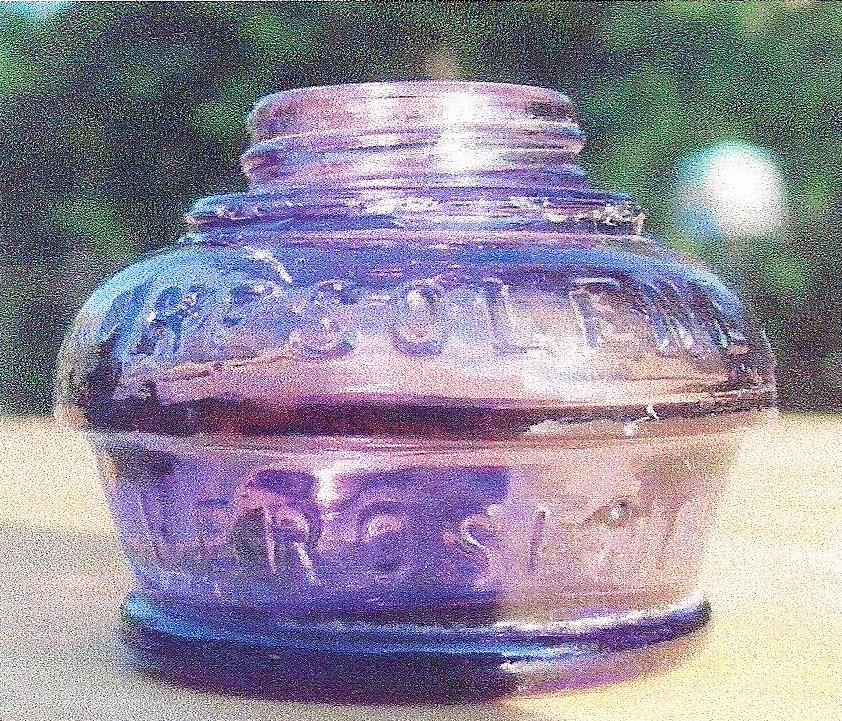
According to Mustacich and Giacomelli, the Vapo-Cresolene Company can be conclusively linked to only a single printed cancel appearing on RB 28.  Hardly worth a mention in philatelic annals, right?  Perhaps such willful ignorance animates those battleship specialists whose principal joy is discovering new intricacies in the line arrangement or millimeter spacings among printed cancels.  Since this study focuses on the wider implications of patent medicine companies, the immense volume of this company’s advertising in contemporary newspapers, magazines and journals and the lingering existence of its iconic lamps (ever discovered in dusty corners of flea markets, in antique stores and available on line), argue for its enormous success both as a patent medicine industry competitor and as a cultural force worth examining.


Even philatelically, there ought to be more to Vapo-Cresolene’s story.  The sheer enormity of its presence in both the past and present markets seem to require a larger philatelic footprint.  Mustacich and Giacomelli do identify one hand-stamped “V.-C.Co” cancel observed on an RB 28 that probably ought to be matched with this company.  Other un-attributed “V. C. Co.” cancels appear on values other than RB 28. These cancels may or may not coincide with the Company’s product line, which did include both replacement parts and replenishment bottles of the liquid used in its system.  Two un-attributed hand-stamps (only one of which appears on an RB 28) that otherwise might match - “T V C” and “T V & Co” - just miss alignment with the company’s name, even though that name sometimes appears in advertising as The Vapo-Cresolene Co.  Maybe this article will persuade collectors of all flavors - stamps, bottles, lamps, antiques - to take another look at their boxes and revenue stamp pieces to see if they can find more cancelled battleships that are definitively Vapo-Cresolene’s.


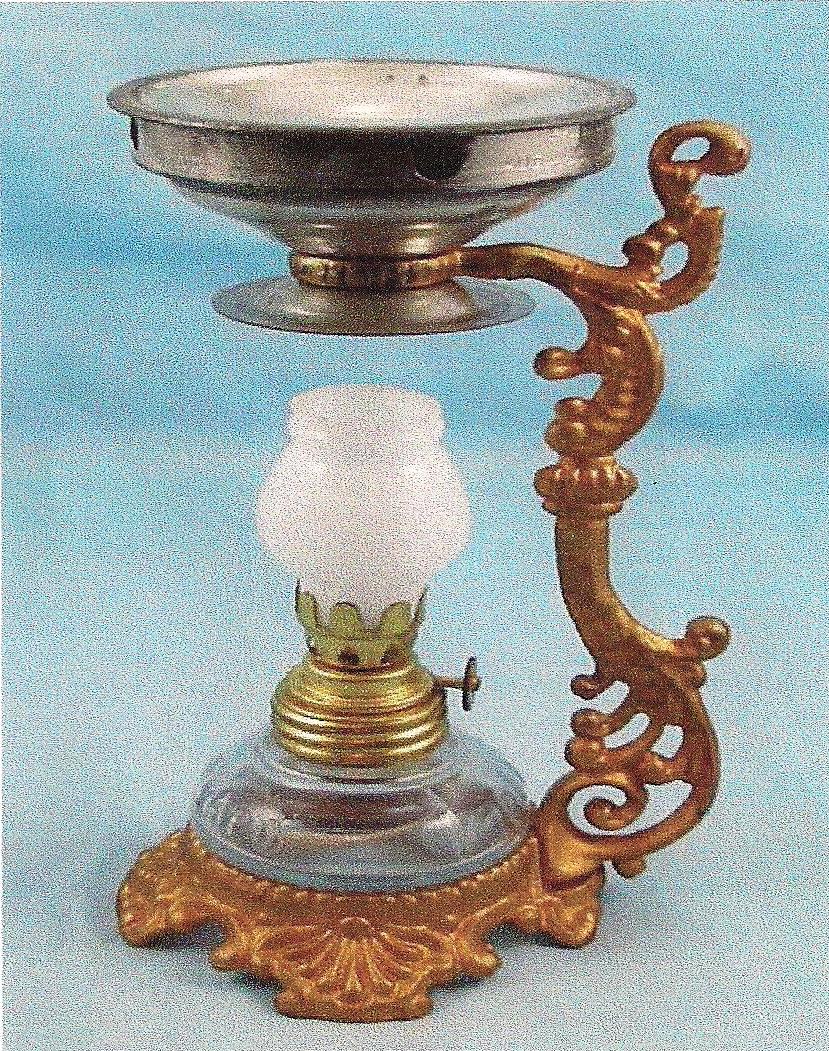
Vapo-Cresolene was popular.  The Vapo-Cresolene box appeared large, yellow, and solid on the druggist’s shelf.  When opened, it contained a small glass lamp, a sturdy, heavy, but gracefully molded, iron stand with an opening at the bottom to hold the lamp and an arm at the top suspending a vaporizer tray over the opening for the lamp, together with a bottle of Cresolene, a spare lamp wick, and instructions.  The instructions told the user to fill the lamp with kerosene only - alcohol would explode - and turn the flame up as high as manageable without causing smoke for the first fifteen minutes.  Once the lamp was producing heat, it was placed in the stand under the Vaporizer tray. 


However distinctively idiomatic the lamp and stand were and remain, it was the Cresolene, a sticky black liquid,  that constituted the therapeutic core of the device.  The Cresolene was poured into the tray and allowed to vaporize over the lamp flame in a ventilated room, and was intended to disinfect the space into which it permeated. The company advertised the Vapo-Cresolene system to be effective in treating respiratory diseases such as croup, catarrh, diphtheria, whooping cough, scarlet fever and asthma, by destroying the disease producing microbes in the patient’s system when the vapor was inhaled.  While Cresolene was the company’s proprietary formulation, the American Medical Association’s analysis in 1908 found it to be no more or less than garden variety cresol as described in the United States Pharmacopoeia, the official scientific compilation of medical compounds used in the United States. (Recall that the eminent scientist, Dr. Lyon of Nelson, Baker & Co, served on the 1900 decennial revision committee for that document.) 

Cresols are organic compounds characterized by a methyl group (CH3) attached to a phenol molecule (a benzene ring with a hydroxyl radical (OH) already bonded to it).  By definition, they occur in nature as components of pitch and bitumen, and had been used without specific identification as parts of these undifferentiated materials for medicinal purposes since antiquity. First recognized as separate chemicals and refined in the 1830s, these compounds themselves were, as will be discussed below in detail, produced by distilling coal tar, itself originally regarded as a useless by-product of the reduction, or controlled burning, of wood or coal.  The medicinal utility of cresols was debated throughout the 19th Century.  They were employed as antiseptics and disinfectants, but as the concentration of the cresols increased in a substance, the potential to burn also rose in direct proportion. While a number of companies that cancelled battleship revenues built their fortunes on clever uses of cresol compounds (and those companies will be encompassed by this study), eventually, the compounds themselves were replaced for most medical purposes by others that had the same beneficent power to disinfect without the concomitant danger of injury.

As for the public’s use of the Vapo-Cresolene vaporizer system, since the therapy was accepted as potentially medically useful, although marginal at best since the inhalant had to be kept quite mild to avoid being poisonous, all the AMA article could conclude - much in the same manner as Consumer Reports does now for consumer goods - was that the Vapo-Cresolene system was unnecessarily expensive without producing any greater beneficial effect than any inexpensive generic equivalent cresol compound: “ This report indicates that Vapo-Cresolene is a member of that class of proprietaries in which an ordinary product is endowed, by the manufacturer, with extraordinary virtues.  The type is so common and has been referred to so frequently that but for the dangers attendant on the inhalation of any of the phenols, this particular product need not have been mentioned.”


Vapo-Cresolene, as a patent medicine business, resulted from the merging of the talents of one James Henry Valentine, the inventor of the vaporizer system, and George Shepard Page.  Sadly, Valentine’s character and personality do not emerge clearly from current records.  In a history of Chatham, NJ, he is portrayed as the man who singularly and successfully used a “coal tar acid named Cresolene” as a vapor to relieve the discomfort of his child suffering from whooping cough.  However, because he did not have sufficient money to follow through with his idea, he soon turned the operation of the vaporizer business over to Page.  The government issued its first patent for the vaporizing system in 1881 to one Elias H Carpenter.  Carpenter immediately assigned the patent to Valentine, who, in turn, assigned a one-half interest to George Page.  Valentine owned parts of several patents obtained from the 1880s to 1903, in connection with improvements made the lamp apparatus as well as for the bottles used for Vapo-Cresolene, and, although he ought to have drawn some monetary benefit for himself (as well as his sick daughter) from these patents, he is remembered now only for his intuitive tinkering and otherwise fades quickly from the history of the Vapo-Cresolene Company.  A possible consequence of his exit is that a James H Valentine is listed as a director of the Vaporia Medicine Co, which filed in New Jersey for a corporate certificate in 1900, and in 1901 maintained its own offices in New York City. This company, which, coincidently, also marketed a coal tar derivative vaporizing system, became the Varoma Medicine Co in 1902, and promptly appointed as its agent another battleship cancelling company, wholesale druggist W H Schieffelin & Co (yet another story for another day).


George S. Page

George S Page (1839-1892) was already rich when he first encountered Valentine.  Born in Redfield, ME in 1839 and educated in Chelsea, MA, by 1879, Page had both control of the essential ingredient, Cresolene, and the financial expertise and means to fully develop Valentine’s vaporizer idea. Because of his own comfortable situation, he was delighted to finance Valentine’s vaporizing venture as a side business to his own.  Because the Pages conducted the Vapo-Cresolene business, had the wealth, and attracted its attendant contemporary publicity, they have earned whatever kind of immortality articles such as these produce.

Page’s career and fortune arose from the production of coal gas and the discriminating refinement of coal tar.  After briefly attempting to make his fortune in the West as a young man, he returned to work with his father at Samuel Page & Son of Boston, MA, a company which specialized in the distillation of paraffin oils, wax and mineral oil then used as the purest and choicest of illuminating materials, from the by-products of that reduction, of wood, certain minerals or coal.  By 1800, scientists also had discovered the secret of extracting coal gas as another by-product from the reduction of coal.  This process, in turn, became one of the growth industries of the first half of the Nineteenth Century because coal gas was the first product that could be both manufactured and distributed cheaply to illuminate the lamps of cities at the dawn of the “gas light era.”  (Natural gas came decades later.)  Coal gas production became, in essence, the first indispensable utility.  Coal tar, itself a mixture of some two hundred different substances, was also a by-product of the reduction of coal. To virtually all of those who were busy cashing in on the coal gas boom to illuminate cities, coal tar was an oily, thick, dirty substance often considered worse than useless. Page not only applied the talents he had learned working for his father to jump into the field of coal gas production, but he also made the vital connection that coal tar itself could be further refined into usable pitch, a material then most notably used as a water-sealant for caulking ships, or in Page’s observation, as a paving material to lay a sidewalk.

Page himself often recounted the story of his life-altering discovery. He noticed a group of workmen laying a pitch sidewalk during a visit to Salem, MA, and took from them some of the pitch they were using.  He then went to the local Salem gas works, where he procured some coal tar.  On the following morning, he returned to the paving site and presented the foreman of the job with the sample of pitch the foreman had given him together with a sample of pitch he had produced from the coal tar by-product of the Salem gas works.  The foreman chose Page’s product as superior, and a new paving material industry was born in that instant. Necessity might also have driven Page’s brilliant insight because just at the same moment he experienced his epiphany in Salem, commercial petroleum was becoming available from Pennsylvania to supplant paraffin as the finest and most brilliant illuminating material. Page was bright and quick enough to observe that he had to expand his horizons beyond paraffin production.


By 1865, as well as his coal gas production interests, Page was associated with the firm of Page, Kidder & Fletcher, which in 1872 morphed into a stock corporation, the New York Coal Tar Chemical Co, known for producing roofing and water proofing material, as well as a range of commercially useful chemicals, such as carbolic acid, naphtha, benzol, and ammonia sulfate, all from coal tar.  Page’s fortune was created by his clever application of scientific advances and redoubled by his shrewd investment in the capricious stock market of his era, although his career in industry also continued from highlight to highlight.  He was responsible for introducing to the United States several new generations of European technology for improving the refinement of coal tar to produce purer and more precise derivative compounds, each of which rewarded him with a fresh fortune. He also played a significant role in the gas industry itself, negotiating at one point, for example, among warring factions of gas producers in St. Louis to resolve their differences and form an efficient (and probably monopolistic) combine.


Page played as hard as he worked.  He was, as an obituary characterized him, “an ardent sportsman, and his love for the rod, gun, dog and field was second only to his fealty to the gas industry.” By 1888, he had created an estate of several hundred acres called “Stanley” in honor of his mother’s maiden name, in the Orange Hills near Chatham, in Morris County, NJ, had settled down to the life of a country squire and had separated himself from the day to day operations of his chemical company. He was a driving spirit behind the U.S. Fish Commission, a government agency which was among the earliest to apply scientific methodology to fish breeding, was the president of the Chatham, NJ Fish and Game Protective Association, and vice-president of the American Fish-Culturist Association. He was instrumental in the development of Rangeley, ME as a fishing and hunting destination.  The breeding records of his kennels, also developed with his son Albion as a commercial business and known as the Dunrobin Kennels, are enshrined in the archives of the American Kennel Club.  After his father’s death, Albion carried on in his father’s footsteps as a sportsman.  In 1900, his racing horses, which garnered second prize at the Morristown Field Club, in Morristown, NJ, team trials, were two chestnut mares named Vapo and Cresolene.           

George S Page was also a noted philanthropist in his time, serving as the president of the Howard Mission and Home for Little Wanders .  He was an active member of his Congregationalist Church, superintendent of its Sunday School, and a vocal advocate and supporter of public education. He was also a founder of the New Jersey Temperance Association and its president for several years.  When he died, quite suddenly at age 52, his funeral was held, as the same contemporary obituary noted, at his “manor house ... amid a throng that represented every phase of the life of the district for miles around.”  That obituary, published in the American Gas Light Journal issue of April 4, 1892, noted that his death:

caused a shock to many of our readers; for it is hard to realize that a splendid physical development nourished by carefully trained habits of abstemiousness and by strict attention to the laws of nature and culture could be so closely allied to the swiftest summons of death.  In the prime of a vigorous manhood, Mr. Page passed away, almost without warning, on the morning of Saturday, March 26th, and with this going out was terminated the life that animated the body of an impulsive though consistent, of a just but generous, of a decided but not bigoted man. In fact, to write of him as dead is somewhat difficult now.  The time that separates him from us does not seem sufficient to reconcile us to the knowledge that his marked personality is at an end.


Strangely enough, aside from his mention in connection with its funding, George S Page’s name does not really ever appear again in the Vapo-Cresolene Company’s records.  However, Page had four sons and a daughter and there can be no doubt this business, among all of George’s various interests, was carried on as a family affair. By the 1880s, George Page’s oldest son Albion Lambert Page, had become the President of the Company. Forty years later, a listing of the Vapo-Cresolene Company’s directors in 1919 shows that Albion was still entrenched as President and Manager of the Company as well as a director.  George’s second son Harry de Bacon Page, was Vice-President, Treasurer and a director.  George’s third son Lawrence S Page was Secretary and a director of the Company.  The remaining directors were Raymond F Page, George’s fourth son, and George’s only daughter, Florence P Ensign.  The Company had begun operation in 1879, had offices in New York City at different addresses on Fulton, Wall and Cortlandt streets, and located its manufacturing plant in Chatham, NJ, undoubtedly where George S could keep an eye on it as long as he remained alive.  It soon had its own offices in Montreal, Canada and Durban, South Africa.  Its London agent was Allen and Hanburys, Ltd, already profiled in this column.  In 1901, its capitalization was $75,000; by 1919 capitalization had doubled to $150,000.

Vapo-Cresolene’s vaporizer system was, and continued to be, advertised widely for approximately 80 years.  Of course, used improperly, Vapo-Cresolene units could, and did, cause harm.  There was always the danger of fire posed by an open flame in any lamp, and upset Vapo-Cresolene lamps and stands accounted for some number of fires.  There were periodic reports in medical journals of near poisonings caused by using the Vapo-Cresolene lamp in an improperly ventilated room, although Vapo-Cresolene’s advertising stressed that it was most efficaciously used in a closed room. On a least one occasion, in 1912, an infant died from drinking the contents of an unattended Cresolene bottle, which everyone understood to be poisonous if ingested.  By the 1920s, the Company branched into producing tablets to broaden its product offerings, and by the 1940s, the government forced the company to tone down its promises of cures for respiratory illnesses. Yet with all these drawbacks, Vapo-Cresolene vaporizer units, eventually with electric heating elements supplanting the kerosene lamps, continued to be produced until the 1950s.  Why did the public embrace such an inefficient and potentially dangerous system for so long?  That question probably cannot be answered precisely, but it can equally asserted that nothing has really changed.  Medicine is often predicated on refining poison.  After all, Botox, the miracle anti-aging drug of our times, is merely diluted botulism toxin, among the most fatal and deadly substances known to man.

The major figure that emerges from the history of Vapo-Cresolene is George S Page, who really plays only an indirect role in its story.  While today, to the extent he is remembered at all, he is known as a sportsman, he was also a pioneering businessman, and deserves his place among the industrial barons of the Nineteenth Century, with all of the both good and bad connotation that title evokes. If Vapo-Cresolene was an afterthought or off-shoot of a more important venture to him, it has endured to eclipse his memory and lives on in our collective imagination, because of  its still available advertisements and vaporizers, and is stitched into our collective image of art nouveau.   


Vapo-Cresolene cancels from the collection of Henry Tolman

Saturday, November 10, 2012

On Beyond Holcombe: United States Pharmacal Company

On Beyond Holcombe, by Malcolm A. Goldstein, appears on Sundays at 1898 Revenues.


As Monty Python would say: “and now for something completely different.”  One immediate apparent difference is that the impetus for this article about the United States Pharmacal Co (USPCo) arises from a documentary battleship stamp cancel, one found on a company check, rather than a proprietary battleship cancel.  Not that USPCo proprietary cancels do not exist.  Mustacich and Giacomelli identify several different ones that the company employed, including both printed and hand-stamped, and one of the printed varieties is also illustrated here.  The company obviously had a sufficient volume of business to warrant use of enough stamps to cause the different cancels, although its name is now principally identified with IXL Hair Restorer and New Century Scalp Tonic.


However, the real point of distinction between USPCo and the other manufacturers previously discussed in this column is in its ownership.  The success of the proprietary medicine companies heretofore examined has largely been driven by the aspirations of some shrewd businessperson/huckster (ala Radam) who, having fixated on the idea that his or her elixir would vanquish disease, strove to convert that vision into a fortune.  USPCo was born of a more practical goal: to build the fortunes, not of the creators, but rather the ultimate sellers of those nostrums to the public.  The Illinois Pharmaceutical Association (IPA), an association of retail druggists, authorized the formation of the company in a resolution passed at its meeting held in Peoria, IL, in July, 1894.  IPA’s idea was to create a “mutual or cooperative manufacturing pharmaceutical company owned, operated and controlled directly by retail druggists.”  By organizing and owning their own pharmaceutical supply source, the IPA’s members hoped to attain perfect retail price control maintenance for their products. Establishing a single set of prices would guarantee a larger profit margin to the retailer by conserving a larger percentage of the consumer’s fixed final cost to the retailer.  After all, money not owned to the manufacturers or the wholesalers for the basic cost of their products was money in the retailers’ pockets.  However, because of the large number of nostrums and patent  medicines potentially available, and the need for continuous, heavy barrage of advertising then thought necessary to keep any brand fixed in the public’s mind - normally a cost borne by the manufacturer of the product  - cooperatives were formed only by a distinct minority of retailers.

USPCo was one of the most long-lived and successful of these retail owned cooperatives. The method that IPA devised for the operation of USPCo was as harsh and restrictive as any devised by the manufacturers and the wholesalers themselves, for the IPA adopted a price control plan (IPA Plan) called the Direct Contract and Serial Number plan (DCSN plan). IPA even prided itself on being the organization that introduced this particular scheme to the United States. If IPA was, indeed, the first to adopt it, the DCSN plan was quickly and widely copied thereafter by manufacturers and retailers themselves.  A DCSN Plan provided that the manufacturer signed an individual contract with each retailer to supply product already priced for retail sale that also bore a unique serial number traceable to the individual retailer.  If the manufacturer’s product was purchased thereafter at any price other than the printed price or from anyone other than the retailer to whom the serial number had been allocated, the leak in the closed system could be traced immediately by consulting the manufacturer’s master list of serial numbers.  The manufacturer enforced its plan by issuing periodic “cut-lists,” usually monthly, of those retailers who had undersold the marked price or who had let product stray from their stock (such that it was ultimately vended by someone else for less than the marked price), and these offending retailers were barred from further purchases of goods from any member of the plan, until they pledged again to uphold the plan.


Because of USPCo’s success, its representatives were given a place of honor among the speakers at one of the sessions attendant to the Convention held in St. Louis in 1904 by the National Association of Retail Druggists (NARD) to explain the IPA Plan’s workings to all of the assembled retailers.  The IPA Plan operated so well that IPA celebrated its tenth anniversary of actual operation in 1906 with special resolutions asking each retail member to institute a special advertising promotion called “U S P Co week” during the first weeks of September, December, March and June of that year, and each subsequent year, where member pharmacists would “give the goods of the U. S. Pharmacal Co. special advertising, special display in their stores, special window space, and in other ways extra and unusual prominence, with a view to increasing the sales on their goods.”  Shortly after the passage of these resolution, the NARD’s Notes trade circular reported that the September, 1906 “U S P Co” week was extremely successful.  On the very same page, the circular published a complete list of all those companies and organizations that had adopted DCSN plans.  It summarized the then successful current state of affairs created by DCSN plans by saying: “The preparations of these manufacturers, protected as they are by direct contract and serial numbering identification marks, are being successfully kept out of the hands of mail order houses and other price demoralization agencies by their respective makers and retail profits on the sale thereof are being maintained on a healthy basis.”

The only potential shadow on USPCo’s future was the possibility that the legality of DCSN plans might successfully be challenged in the courts. For twenty years those “mail order houses and other price demoralization agencies,” whose names regularly appeared on the monthly “cut-lists” of DCSN plans kept arguing that these DCSN plans were an illegal restraint of trade.  They continually sued, asking the courts to “specifically compel” by injunction the sponsors of DCSN plans to sell to them on the same basis as plan members. These excluded wholesalers and retailers insisted that DCSN plans prevented competition because they could not freely sell the products protected under these plans (no matter how they acquired them) for less than the sponsors’ required retail prices, even though they were satisfied to receive from their sales a smaller profit margin than plan members.


This line of reasoning consistently puzzled the state courts to whom it was argued.  At their most friendly, courts are always reluctant to issue orders compelling parties to do specific acts - so-called “mandatory” injunctions - because they are accustomed to remedying harm by awarding sums of money as damages, figuring that such monetary damage awards compensate for actions not performed.  Courts issue injunctions only where circumstances are irreversible. For example, if there were questions surrounding ownership of a historic house, and the house was about to be torn down, a court might enjoin the demolition, pending a full review of the circumstances, on the theory that the house, once demolished, cannot be reassembled, and so is “irreparable.”  Even this kind of injunction is not “mandatory” but “preventative,” preserving the house intact only until the disputed issue is resolved. A mandatory injunction compels an unwilling party to act when it would otherwise not act.   Courts could never find such “irreparable” harm in the exclusion of “cut-listed” retailers by sponsors of DCSN’s plans.  Citing defendant manufacturers’ “liberty” to sell only to those with whom they chose to do business, and treating the plaintiff wholesalers and retailers as interlopers who had somehow unfairly meddled with the harmony of the DCSN plans by procuring the protected products under shady circumstances, the courts fairly consistently upheld the legality of DCSN plans, endorsing them as legitimate business models. 

However, with the advent of President Theodore Roosevelt’s attempts to control the overreaching of manufacturing trusts of all stripes by having the US Justice Department enforce the federal Sherman Act, the legality of DCSN plans began to come under attack.  Building on success in earlier antitrust suits brought against other industries, in May, 1907, the federal government achieved in the drug industry the “Indianapolis Decree,” the settlement of an Sherman Act antitrust suit against the Proprietary Association of America representing manufacturers, the National Wholesale Drug Association representing the wholesale druggists, and the NARD representing retailers (as well as specifically named companies, such as Gilbert Bros & Co, previously mentioned in an earlier column), which began to erode the control manufacturers could exercise on retail prices through DCSN plans.  Nevertheless, within months after this settlement was negotiated an article in the Pacific Pharmacist, a new drug trade journal, flatly asserted: “The D.C. and S.N. plan is not affected [by the settlement], provided the manufacturer will put the plan into effect individually, and not “in collusion” with other manufacturers, or any other agency or agencies” (italics in original).


This viewpoint proved to be wishful thinking.  Focusing upon the result that consumers were forced to buy at the single price set in retail price maintenance plans, which it found to be maintained artificially higher than it otherwise would have been had the cut-rate retailers sold at the price they chose (rather than adhering to the state court rulings favoring the “liberty” of manufacturers to sell only to those whom they liked), in 1911, the Supreme Court of the United States ruled retail price maintenance plans, such as the DCSN plan, illegal restraints upon trade pursuant to the provisions of the Sherman Act. (Since analyzing the nuances of all the cases which led to the 1911 decision, both pro and con, is extremely complex, the various court decisions will be examined in greater detail as this column visits the specific companies involved in them).

The IPA Plan itself was never ruled illegal in a specific court decision, and it is unclear when USPCo finally discarded it, although presumably it was shortly after the Supreme Court’s ruling in 1911. Other questions not answered in the extant records are when or whether IPA’s members ever separated themselves from ownership of USPCO, and exactly when USPCo manufactured the IXL Hair Restorer and New Century Scalp Tonic.  USPCo was still listed in trade indexes as late as 1927 as a Chicago based manufacturer of household patent medicines, and these products probably date from the teens or the twenties. Whether this company actually still exists cannot be proven from the extant records.  The name, however, has continued to exist.

At some date after 1927, the USPCo name appears to have unmoored from the IPA and the Chicago location. In 1940, a company with the USPCo name was to be located in Newark, NJ.  In 1942, the federal government seized as misbranded a shipment of citrate of magnesia, a patent medicine staple, manufactured by the USPCo in Newark, NJ and released it to a Philadelphia company for re-branding.  In 1959, a USPCo registered its ownership of the trademark Syr-Tane for use on cough syrup. In 1963 USPCo showed up in a drug trade listing as a corporation located in Brooklyn, NY.  In a 1976 trade compilation, the USPCo name was associated with a product called Ban-Itch (a product name which was later itself associated with Sheffield Laboratories, the successor to another company that cancelled battleship proprietary stamps - but that is a story for another day).  In 1980, a USPCo is listed as a division of another pharmaceutical company, and in 1988, the Syr-Tane trademark expired without being renewed.  A website named Bizapedia lists the United States Pharmacal Co name as “active” as of January 3, 2012, in connection with a address listed broadly as Philadelphia, PA and taken from a filing made in Pennsylvania in 1958.   Another website, Manta, shows that a United States Pharmacal Co, LLC, incorporated in Colorado in 2005, is located in Erie, CO, just outside of Boulder, CO.  This USPCo presently maintains its own website and advertises a product called Cann-Ease Nasal Moisterizing Gel on several websites.  Yet another website, Cotera, shows the USPCo as a testing laboratory incorporated in 2003 and headquartered Lafayette, CO, next door to Erie, CO. Although the Colorado company has no direct connection to the namesake Chicago company, its own website continues the tradition of building its sales upon testimonials from satisfied customers, now posted on line instead of reproduced in print ads.  The spirit of over-the-counter cures soldiers on.