Showing posts with label R182 1 Dollar Documentary. Show all posts

Sunday, November 10, 2024

New York Stock Brokers: "BB & CO": Brown Brothers & Co., Brown, Bruns & Co., or Blake Brothers & Co.?

Identical corporate initials can confound the identification of firms that used 1898 revenue stamps, as the cases of H&H and AS&Co have demonstrated.  In the case today, we consider B.B & Co on the 1898 dollar values, likely used to pay taxes on stock trades.  At least three firms with these initials traded stocks on the NYSE during the 1898 tax period, and it is certain that all three of them used their initials to cancel documentary stamps.  The best known of the two was Brown Brothers & Company, a multinational firm with offices trading on the exchanges in Boston, Philadelphia, New York, and Baltimore.  Blake Brothers & Company also had members with seats in New York and Boston, while  Brown, Bruns & Company, appears to have traded only on the NYSE.  Brown Brothers would, through a merger, become Brown Brothers Harriman, one of the best known Wall Street firms of the 20th century.

A stock sale memo from Brown, Bruns & Company:  300 shares of a +$13 stock were sold, requiring $6 worth of documentary revenue stamps.  6 copies of Scott R182 were used, each with the same cancel: B. B. & CO.  Below is a single stamp from that memo:


B. B. & CO.
NOV  7  1900

A prominent B. B. & CO. cancel is used on the stamp above, much like that on the copy of R174 below:

B. B. & CO.
JAN XX 1899
BOSTON

We know the R182 stamp with the BB cancel is from Brown Bruns as the stamp is tied to a Brown Bruns memo of sale.  The $3 stamp is a bit trickier without the underlying document.  However, the cancel includes "BOSTON", indicating the stamp was cancelled in that city, where Brown Brothers and Blake Brothers had members with seats on the exchange there. 

I have mounted the R174 on page labeled Brown Brothers, but that could be in error.  This may be a Blake Brothers cancel.  

So we are left for now without any sort of evidence-basis possibility for the identity of the cancel above.  The two BB&Co cancels below show up occasionally.  The top two are in my collection:


Meanwhile, David Thompson sent the following scan awhile back:          

Brown Bruns ceased to exist and stopped trading by later 1990 or early 1901, making it less likely that the cancels on the four stamps above came from that firm.  My guess would be that one of the cancel types above belong to Brown Brothers, and the other to Blake Brothers.  Someday sale memoranda might show up that provide confirmation.

The 1905 year on the second stamp was clearly caused by an incorrect adjustment of the year date slug.  

Saturday, March 18, 2023

Cotton Brokers: Weld & Neville


WELD & NEVILLE
DEC
4
1900
HOUSTON, TEXAS

Weld & Neville was a unit of the large American cotton broker Weld & Company, with branches in Liverpool, New York, Boston, Houston and Bremen.


1909 Advert for Weld & Co., one of the largest importers of cotton into Liverpool in the late ninetweenth and early twentieth centuries. (Source of advert: Auguste Bruckert, Cotton Pamphlet
relating to the Liverpool Cotton Market, Liverpool: 1909, page 112):

Thursday, February 14, 2013

New York Stock Brokers: Cuyler, Morgan & Company


1901 Poor's Manual advertisement


CUYLER, MORGAN & CO.
NOV
XX
1900
N. Y.

David Thompson scan & highlight


Friday, January 4, 2013

The Pennsylvania Steel Company


The Pennsylvania Steel Company was originally organized in Pennsylvania in 1865.  Affiliated with the Pennsylvania Railroad, the main plant in Steelton, PA, manufactured steel rails and other railroad material.  


THE PENNSYLVANIA STEEL CO.
APR
27
1901

Langlois scan

In January 1901, a plan of financial reorganization was adopted and the company was reincorporated with a much larger authorized capital base.   The stamp above was likely used on documents associated with this reorganization.  

In 1916 the Pennsylania Steel Company was merged with other firms to form Bethlehem Steel.

Tuesday, November 27, 2012

New York Stock Brokers: Henry I. Dittman


HENRY I. DITTMAN
JUN
18
1899
NEW YORK.


H.  I.  D.
OCT  25  1900


H. I. DITTMAN,
New York.

Langlois scans


From The New York Times of April 5, 1902, Henry Dittman sued the Distilling Company of America, a trust that apparently was operating in less than a transparent manner.  This is part of a much larger article that can be found at the NYT website.


Friday, April 13, 2012

New York Stock Brokers: William L. Stow & Company


W. L. STOW & CO.
OCT    4    1900
NEW YORK

David Thompson scan


Mr. Stow was apparently a gracious and well-liked gentleman among the members of the New York Stock Exchange.  See the New York Times story below.


The New York Times, July 4, 1886:

SOME HIT AND MISS CHAT!

STRAY BITS OF GOSSIP FROM AN OBSERVER'S NOTEBOOK.

A company of Wall-street men were down at the pier to see one of the European steamers sail out of port yesterday.  Gallant Howell Osborn was one of the number.  His partner, William L. Stow, was saying goodbye to New York for a year or two to enjoy a trip around the world.  Mr. Stow is one of the really popular young men in Wall-street.  He was an office boy not so very many years ago; swept out an office and ran errands for something like a dollar and a half a week.  Now, after having been a member of the Stock Exchange for 8 or 10 years, he finds a fortune of over a quarter of a million dollars to his credit, and, with practical sense that does not often come to relieve the Wall-street fever, he quits buying and selling stocks and proceeds to map out a programme for enjoyment.

"Will" Stow had ambitions to be a doctor once, and disgusted with his chances of ever getting ahead in wall-street he went into an uptown physician's office, reveled in text books for a year or so, and then spent another in one of the city's hospitals, but just as he was ready to take a diploma and obtain a license to peddle quinine he dropped into Wall-street again.  Charles J. Osborn, shrewd in his estimates of manly qualities, took a sudden fancy to the young fellow.  Stow had good principles, he had no loud tastes, neither woman nor wine were temptations to him; he was just such a young man as the elder Osborn wanted as a friend for the budding Howell.  There was a good-bye then to drugs and patients; young Mr. Stow as soon making money as he had never expedited to make it.  He didn't need much coaching; opportunity was all he asked; his own intelligence, push, and enterprise did the rest.  He and Howell Osborn saw Europe together, spending a year abroad, after their return forming the stock brokerage firm of W. L. Stow & Co.  The result is that now, but a little over 30 years of age, Mr. Stow has a fortune big enough to retire upon and live in a handsome style.  He will take things easily in the tour of the world that he began yesterday, and will remain at every notable place that especially interests him long enough to see more of it than is to be had in the usual guidebook surface glance.

Mr. Stow used to be a clerk in the brokerage firm of E. D. Stedman & Co., and the poet-banker tells a story much the successful young man's credit.  He was not very hopeful of riches in the old days when he was keeping books for Mr. Stedman, and nobody would have been likely to mark him then as the prospective possessor of hundreds of thousands of dollars of his own.  There was no forwardness about him; favors shown him were always fruitful of thankfulness.  When he left Mr. Stedman's employ--to go to the doctor's office, I think it was--Mr. Stedman bade him not only a kindly goodbye, but expressed the hope that if ever it were possible to for him to lend the young man assistance he would be gland to do his utmost to help the young clerk along.

Time went on.  Stow was getting up in the world, back in Wall-street again; misfortune fell upon Mr. Stedman.  Everybody, of course, remembers the unexpected failure of the poet's brokerage firm a couple of years or so ago.  But one man who learned the news found more interest in it than the ordinary citizen, and a messenger within an hour of the announcement of the financial trouble handed a note to Mr. Stedman, which ran something like this:

Dear Mr. Stedman:  I have $30,000 more than I want.  Will you please take it?  W. L. Stow.

Mr. Stedman fortunately was better off than at first supposed, and he declined the big-hearted offer, though not without the expression of a gratitude that had no lack of earnestness in it.           RALSTON.

Thursday, March 29, 2012

Bank of Hawaii

David Thompson sends in the scan below of a R182 block of four with Bank of Hawaii box cancels:


BANK OF HAWAII,
JUL  25  1901
Honolulu, H. I.


Hawaii became a territory of the United States in July, 1898, while the Bank of Hawaii got its start the year before in 1897.  The bank remains in operation today.

Any speculation out there about why a new bank would use dollar tax stamps in this manner?  Are there any on-document examples from the Bank of Hawaii during this time period?  Please send examples or comments to 1898revenues@gmail.com.


Saturday, January 28, 2012

New York Stock Brokers: Edward L. Oppenheim & Company


E.  L.  O.  & Co.
NOV    16    1900
NEW YORK

Dave Thompson scan


The New York Times, January 1, 1886:

E. L. OPPENHEIM & CO.
BANKERS & BROKERS.

Among the prominent banking and brokerage firms of New York that of E. L. Oppenheim & Co. has always been looked upon as one of the very strongest.  It was established in 1862, and has always promptly met each and every one of its engagements.  The offices of E. L. Oppenheim & Co. are at Nos. 51 and 53 New street and No. 42 Broadway, with a branch at No. 91 Leonard Street.  They transact a general banking and brokerage business in stocks of all kinds, bonds, petroleum, cotton, grain, provsions, etc.  They are members of the Cotton and Stock Exchanges of New York, and also of the Chicago Board of Trade, the latter place being connected with their New York office by private wire.  The members of the firm are Edward L. Oppenheim and Walter Del Mar.

Monday, November 14, 2011

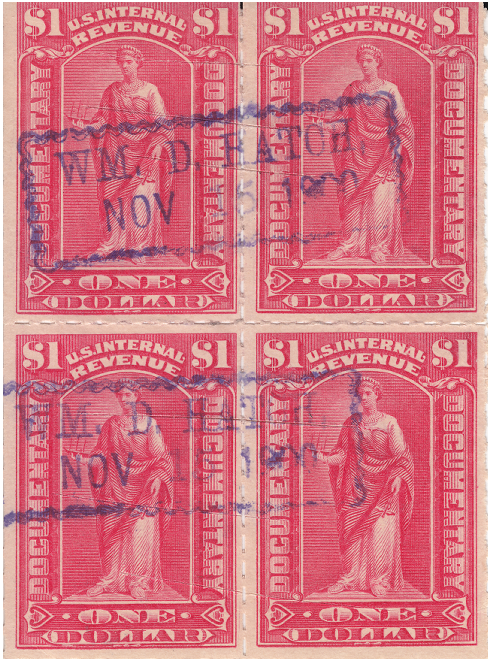
Cancel for November 15: William D. Hatch

WM. D. HATCH
NOV  15  1900

Dave Thompson Scan


D. HATCH
24  1901

Langlois scan

William D. Hatch was a member of the brokerage firm Hatch Brothers with his brother Horace Hatch until the firm's collapse in 1895.  Horace was the member of the firm with the seat on the NYSE at the time of the collapse.  By 1900 William was in business for himself. 

Wednesday, October 19, 2011

Sunday, October 16, 2011

New York Stock Brokers: Dickinson, Grummon & Company


DICKINSON, GRUMMON & CO.
OCT
1
1900
New York.

Langlois scan


DICKINSON, GRUMMON & CO.
JUL
20
1899
New York.

Dave Thompson scan


Wednesday, September 14, 2011

New York Stock Brokers: Alfred de Cordova & Company


A. de C. & CO.
OCT.  8  19xx

Langlois scan

The Alfred de Cordova & Company was run by Alfred de Cordova with his brother Eustace.  Alfred de Cordova was on the Governing Committee of the New York Stock Exchange for 1897-1898.


From the New York Times, May 16, 1897:

CAUGHT IN A SWOLLEN RIVER

Alfred de Cordova Has a Narrow Escape in Somerville.

  SOMERVILLE, N. J., May 15.--Alfred de Cordova, the New York broker, whose office is at 36 New Street, had an exciting experience here on Thursday night.  He has a fine country residence four miles west of Somerville, located on the North Branch of the Raritan River.  On Thursday nith the river was much swollen by the heavy rains and overflowed its banks and crossed the road.  Mr. de Cordova's coachman met him as usual at the Somerville Station and started to drive him to the De Cordova home.

  In crossing the river, the buggy and horse were caught in the current and carried down the stream for some distance.  Mr De Cordova and his coachman both jumped.  The former struck a fence and managed to save himself.  the hourse and buggy were thrown against some trees.  The coachman cut the harness from the horse and the animal got ashore and ran home.  The broker and his coachman got a good soaking, but otherwise escaped.

Saturday, July 17, 2010

Cancel for July 18: Baring, Magoun & Company


R182 One dollar documentary


BARING, MAGOUN & CO.
JUL
18
1900
NEW YORK.

From Dorothy R. Adler, British Investment in American Railways 1834-1898 (Charlottesville, Va.: The University Press of Virginia, 1970), p. 144:

Barings was strictly an English firm until 1891 when a New York firm comprised of a family member was established (Baring, Magoun & Co.) by Alexander Baring, formerly of Kennedy, Tod & Co. (NY) and George Magoun, formerly of Kidder, Peabody & Co. The English firm dealt with Baring & Magoun in New York and Kidder, Peabody in Boston. The Baring family had migrated to Exeter, England from Bremen, Germany in 1717, and their descendants, Alexander and Henry Baring, married Americans. Barings had been one of the first English firms to handle American railroad bonds, and had a long-standing relationship with the B&O Railroad in Maryland.

Monday, April 19, 2010

Cancel for April 20: C.T.I. & T. Company

Scott R182 carmine used
2009 Scott value: 55 cents


C. T. I. & T. Co.
APR   20     1901


The initials are long enough for this company that they should inspire immediate recognition to to anyone who knows the firm.  Who canceled this stamp?