Showing posts with label R188 10 Dollar Documentary. Show all posts

Thursday, November 3, 2022

Gilded Age Portraits: Mr. & Mrs. Henry Marquand


Henry Gurdon Marquand by John Singer Sargent, 1897


R188 Block of 4 cancelled by Henry Marquand & Company, 
January 28, 1901
Block retains full original gum

Henry Gurdon Marquand held a seat on the New York Stock Exchange during the Gilded Age, including the years of the 1898 Spanish American War tax period.  He was extremely wealthy and had a passion for fine and expensive art, for which he built a grand Manhattan mansion in which to hang it all.  And like many of New York's wealthiest at the time, he had his portrait and that of his wife painted by the go-to Gilded Age portrait artist of the time, John Singer Sargent.  


Elizabeth Allen Marquand (Mrs. Henry Marquand) 
by John Singer Sargent, 1887

Yesterday I put up Sargent's Benjamin Kissam portrait up on the right side of this site, and I started wondering how many Gilded Age brokers might have had their portraits done in oil, by Sargent or any other accomplished oil portraitist.  The Marquand's were the first couple I could think of, but I'll see how many more I can find.

Meanwhile, the curious issue of Marquand cancelled stamps remains:  every stamp I have ever seen cancelled by Marquand has a light, neatly applied cancel, with the stamp or stamps almost always retaining their original gum.  The R188 block of 4 is one example.  Here are more:


There is not much more to add, except: 

  • I'll be looking for on-document uses of these stamps by Marquand & Company, and
  • Why would a company cancel high value stamps but not apply them to documents?  Was there something nefarious happening?

Saturday, March 9, 2013

Gilbert M. Speir

Regulars have likely noticed the lack of posts or more substantive posts over the past week or so.  The last two posted entries I have now taken down as they went up in error.  I have been on a 16 hour a day pace for about the last 10 days and have not had a literal minute to get to the web site.  So sorry about the lack of new material.  

As some of you know, I live and work in Kenya, where national elections were held on March 4, and the announcement of a putative winner was made yesterday.  Uhuru Kenyatta, the son of the first president of Kenya, won a first round victory on the strength of 50.07 margin.  However, there were more than 100,000 votes in dispute at the time of the announcement, and legal challenges are beginning at the Supreme Court in Nairobi, especially since the .07 is on the strength of only 8000 votes  For the international community, the drama is increased by the fact that Kenyatta is now under indictment for Crimes Against Humanity at the International Criminal Court in The Hague for organizing violence during the last elections in 2007.  

As for today''s entry, I don't know much about Gilbert Speir save for that he adjudicated and oversaw legal property transactions.  But the piece is cool, with the 1, 5 and $10 stamps.


G. M. SPEIR,
JUN
7
1901
62 WALL ST. N.Y.

Langlois scans


Wednesday, June 6, 2012

New York Stock Brokers: Halsted & Hodges


HALSTED & HODGES
JUL
7
1898
NEW YORK.


HALSTED & HODGES
______190____


HALSTED &
HODGES.
APR
3
1901

Langlois scans


Wednesday, May 16, 2012

New York Stock Brokers: Woerishoffer & Company


Charles Woerishoffer was one of the most significant brokers and power players on Wall Street during the gilded age.  While he died in 1886, his legacy was still being recounted in the 1897 publication King's Views of the New York Stock Exchange.  His firm continued to operate for some years after his death.  Frederick Renner was an understudy of Mr. Woerishoffer and ran the firm during the 1898 tax period.


WOERISHOFFER & CO.
MAY
16
1901
NEW YORK.

David Thompson


Sunday, March 18, 2012

New York Stock Brokers: Laidlaw & Company


LAIDLAW & CO.
JAN 21
1902
NEW YORK.

Langlois scan


Charles Laidlaw was a Governor of the New York Stock Exchange for 13 years.

Sunday, December 4, 2011

New York Stock Brokers: H. Content & Company


H. CONTENT & CO.
DEC  20  1901
NEW YORK


H. CONTENT & CO.
MAY  2  1901
NEW YORK

Dave Thompson scans


Thursday, November 24, 2011

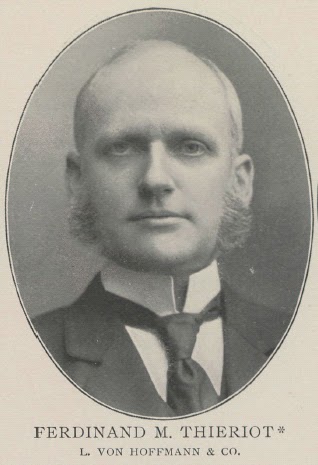
Arbitrage Brokers: L. Von Hoffman & Company

According to the 1897 King's Views of the New York Stock Exchange, L. Von Hoffman & Company, among other brokerage houses on Wall Street, was an arbitrage firm.  The company played the difference in prices on the stock exchanges of London and New York to make trading profits.  The rapidly developing and improving capabilities of transatlantic telegraph transmission made this kind of London-New York arbitrage possible. 

The first transatlantic cable was laid in 1858, just prior to the Civil War.  But the signal and cable failed after only a few days, and an attempt to lay a new cable was not made again until the mid-1860s.  By the end of the 1800s there were multiple cables and reliable transmission. 


L. Von H. & Co.
AUG
6
1898
N. Y.

Thompson scan


L von HOFFMAN & CO.
JAN
8
1902
NEW YORK.

Langlois scan


L von HOFFMAN & CO.
MAY
1
1901
NEW YORK.


Tuesday, September 6, 2011

New York Stock Brokers; The Provost Brothers


PROVOST BROS.
& CO.

Dave Thompson scan


There were many brother and father & son combinations that had seats and traded stocks on the New York Stock Exchange.  The Provost Brothers were one pair.


The New York Times, November 22, 1901:

HORSE PLAY ON 'CHANGE.

Brokers in Frock Coats and Silk Hats Put Through Their Paces.

  The Stock Exchange yesterday was reminded that this is Horse Show week.  Despite all traditions, whether respected in observance or neglect, to the contrary, two brokers appeared on the floor clad in frock coats and silk hats.  While there was no disposition to indulge in hazing tactics, brokers felt called upon to pass critically upon the question of the two offenders who was better groomed.

  Accordingly, C. W. Provost of Provost Brothers and Philip T. Brown of H. L. Horton & Company, the offending members, were induced to go through their paces.  High stepping, but not side stepping, was demanded of the victims, as they walked down a long lane of brokers.  The blue ribbon was given to Mr. Provost, who bore his honors gracefully, while Mr. Brown, by way of consolation, received a red ribbon.


The trading floor of the New York Stock Exchange in 1897.

Wednesday, August 17, 2011

Atlantic Mutual Insurance


ATLANTIC MUT. INS. CO.

R.I.P.
1842 - 2011


David Thompson scan


Atlantic Mutual Insurance was liquidated earlier this year, after surviving nearly 170 years as a business.  The firm, which paid a $100,000 claim on the hull of the Titanic in 1912, could not survive a wave of workmen's compensation claims under commercial policies that the firm had sold years ago.  By 2010 New York State insurance regulators revoked Atlantic's licenses because of a negative surplus (an oxymoron if there ever was one). 


The above screen capture from the now defunct Atlantic Mutual Insurance website was taken by me when the first post on this company was published on this site a little over one year ago.

Wednesday, April 27, 2011

High Value Stocks with the Portrait Issues The $100 John Marshall Issue

To date only one 1898Revenues blog has referenced the Portrait Issues of 1899. It featured a $125,000 stock certificate for The Baldwin (Piano) Company submitted by Tim Kohler. It's such a great certificate with examples of the $5 and $10 gray overprinted Commerce issues of 1900 in addition to the $100 John Marshall Portrait stamp, we're picturing it again below to introduce the subject of high value stocks. For more details about it, read the original August 17, 2010 blog.

$125,000 Baldwin Company Stock Certificate #1
Issued December 31, 1901
Cincinnati, Ohio
Tim Kohler scan


As their availability at the beginning of the 1898 tax era wasn't deemed crucial, and usage was projected to be limited, the bi-colored $100, $500, and $1,000 Portraits weren't introduced until 1899 when the print demands on the BEP were diminished from the initial requirements placed upon them by passage of the War Revenue Law.

Most were used on high value stocks, but they also can be found on other highly taxed documents like conveyances of valuable property and mortgages underlying bond offerings. As we suspect extant examples are rather scarce we plan to conduct a census of on-document usages as we did for on-document usages of the 1/2 cent Orange documentary stamp.

If you possess any on-document usages of R179, R180, or R181, the $100, $500, or $1,000 Portrait Issues please send scans of the entire documents to 1898revenues@gmail.com.


$500,000 Schuylkill and Juniata Railroad Company Stock Certificate
Original Issue June 1, 1900
Philadelphia, PA


Properly taxed $250 with two $100 Portrait issues and a single R178 $50 Commerce Issue, the stock was issued to The Pennsylvania Railroad Company (PRR). Actually, The Schuylkill and Juniata Railroad Company was formed June 1, 1900 from the consolidation of five subsidiaries of the Pennsylvania Railroad. The predecessor component railroads were the Pennsylvania Schuylkill Valley; the Nescopec; North and West Branch; the Sunbury, Hazleton and Wilkes Barre; and the Sunbury and Lewistown. These lines all served the Coal Region of northeastern Pennsylvania. The company was absorbed into the PRR in 1902.


Detail showing straightline cancel:
Schuylkill & Juniata Railroad
June 1, 1900

$364,000 James S. Kirk Company Stock Certificate
Original Issue March 1, 1900
Chicago, Illinois


Properly taxed $182 with a single $100 John Marshall Portrait stamp, one $50, three $10, and two $1 Commerce stamps, the certificate was issued to James B. Kirk, Evanston, presumably a relative of the founder James S. Kirk. A third James, James A. Kirk, a son of James S. was president of the company at this time. Although the firm was located in Chicago, it was incorporated in New Jersey and this stock was issued through the firm's transfer agent, the Corportation Trust Company of New Jersey.

Originally founded in Utica, New York in 1839, James S. Kirk moved his soap manufacturing company to Chicago in 1859 where it competed with Proctor and Gamble who would eventually buy out Kirk's ancestors in the 1930s. The company however is again in business as Kirk's Natural Products Corporation.

I've seen period trade cards for Kirk's Jap Rose Soap. The firm also produced some perfumery products. Bob Mustacich's Battleship Desk Reference indicates they used the 3/8, 5/8, 1 1/4, 2 1/2, 3 3/4, and 5 cent proprietary issues. Perhaps we'll see more about James S. Kirk & Company in the future. For now we can enjoy the documentary stamps on its stock.


Cancellation Detail from James S. Kirk Stock:
Corporation Trust Co.
APR/27/1900
of N. J.


Bob Patetta again has provided a most interesting usage example for the $100 Portrait Issue.


$6,999,200 Saint Paul and Northern Pacific Stock Certificate
Original Issue May 13, 1897 (pre-tax era)
Brainerd then St. Paul, Minnesota
Bob Patetta scan


Had the original issue taken place during the War Tax era the tax would have been a whopping $3,499.60! Even the .02/$100 tax on its transfer, which did occur during the War Tax period, amounted to $1,399.84. The colorful payment, shown below consists of 13 $100 R179 John Marshall Portrait Issues including two full strips of four of that issue. (We discuss how these stamps were issued in a future blog). The payment also includes one R178 $50 Commerce; four R188 $10 gray overprinted Commerce; one R175 $5 Commerce; four $1 gray overprinted Commerce, plus the following battleship stamps: one 1-cent, four 2-cent, one 25-cent, and one 50-cent.

The 13 copies of the $100 John Marshall stamp are stunning, but wouldn't a $1,000 James Madison in place of 10 of them have been even moreso!


NOR. PAC.
1901
Railway CO.
Bob Patetta scan


Again, we are conducting a on-document usage census of ALL three Portrait stamps, the $100, $500, and $1,000 issues. If you have other on-documnet examples please send scans of the entire document to 1898revenues@gmail.com

Tuesday, August 17, 2010

Certificate for Preferred Stock: The Baldwin Piano Company

Revenue collector Tim Kohler from State College, PA, sends in this spectacular item from his collection and adds the background and explanatory notes below: 


The Baldwin Company was started in the mid 1800s by Dwight Hamilton Baldwin. Dwight’s first enterprise was as a teacher of piano, organ, and violin in Cincinnati, Ohio. In 1862, Baldwin started a retail piano/organ dealership. In 1873, his clerk, Lucien Wulsin becomes a partner in the D.H. Baldwin & Company. In 1891, Baldwin offers for sale its first piano. In 1901, the Baldwin Company is established with Lucien Wulsin as its first president. Under his leadership, the Baldwin Company became the largest piano dealer in the Midwestern United States.


The stock Certificate is Baldwin Company Preferred Stock #1 for 2500 shares ($100/share) issued to R. Jenkinson issued 31 December 1901. Signed by Baldwin President, Lucien Wulsin.  The war tax on the initial sale of original issue stock certificates was five cents per each hundred dollars in face value or fraction thereof. The tax on this $250,000 certificate thus was $125, correctly paid by a single $100 John Marshall stamp from the 1899 Portrait issues, R179, plus two R188 $10 and one R187 $5 stamps from the 1900 surcharged Commerce issues.


Friday, April 2, 2010

Cancel for April 3: Halsted and Hodges

R188 $10 Gray Documentary

I've never been able to figure out why Scott labels these stamps as gray in color.  Sepia maybe.  And like many guys, I can't tell most colors apart.  But I am sure this series of dollar documentaries is not gray.

HALSTED &
HODGES.
APR
3
1901

New York stock brokers Halsted and Hodges were located at 7 Wall Street.  The firm was established by partners Amory Glazier Hodges and Richard Halsted.  This stamp almost looks as if it was cancelled by a dot matrix printer.  Could this be a typed cancel and the dot pattern be an artificat of the inking ribbon, or could it be a handstamp with the dot pattern as an artifact of the ink pad background or the handstamp background?