Showing posts with label Taxes: Documentary: Power of Attorney. Show all posts

Friday, April 29, 2011

High Value Stocks with the Portrait Issues The $500 Alexander Hamilton Issue

We continue our review of high value stocks by considering ones bearing the $500 Alexander Hamilton Portrait Issue, Scott R180. I've always considered it to be the most attractive of the three portrait issues outshining the other two issues with its brillant red color.

Although I have a couple of R180 on-document usages, none are on stocks, so my thanks go to fellow collectors Bob Patetta, Mike Mahler, and Tim Kohler, each of whom have graciously provided material for prior blogs, for also providing the three R180 stock certificates shown today.

We are conducting a census of on-document usages for all three Portrait Issues, Scott R179, R180, and R181 so if readers either have, or know of, other examples of the $500 issue on-document, please contact us at 1898revenues@gmail.com.

Yesterday's blog about usages of the $100 issue brought news of three additional examples and, as all three of today's stocks also bear $100 stamps, the total number of stocks bearing $100 John Marshall stamps now stands at nine.


$1,690,650 Choctaw, Oklahoma, and Gulf Railroad Stock Certificate
Issued through Girard Trust, Philadelphia, Pennsylvania
July 5, 1900
Bob Patetta scan


Samuel Dickson, William Jenks, George Colket, Effingham Morris, and Charles Ingersoll, Voting Trustees are listed jointly as owners. The certificate was cancelled when the company came under the control of the Chicago, Rock Island, and Pacific Railroad in May 1902.


The $845.35 tax on the original sale was paid with one $500 Portrait Issue, three $100, one $30, one $10, and one $5 Commerce issues plus one 25-cent and one 10-cent Battleship stamps. An additional 25-cent Battleship pays the Power of Attorney tax for the September 25, 1900 transfer to Charles Hampreys. If that transfer did occur, the tax may have been paid, albeit improperly, via a separate memo or on the books of the company.


Detail showing July 5, 1900 pencancel


Mike Mahler provided a similar Choctaw, Oklahoma and Gulf certificate. This one curiously is dated May 6, 1902, the very day the CO &G was brought under the control of the Chicago, Rock Island and Pacific Railroad and just two days prior to its cancellation. The Watonga (Oklahoma) Construction Company is listed as the owner. There must be a good story here, but I'm not finding it. Anyone knowing the history of the CO & G is invited to contact us at 1898revenues@gmail.com


$1,027,500 Choctaw, Oklahoma and Gulf Railroad Stock Certificate
Issued through Girard Trust Company, Philadelphia, Pennsylvania
May 6, 1902
Mike Mahler scan


Mike Mahler scan


In this instance the original issue tax of $513.75 was paid, at left, with one $500 Portrait, one $10 Commerce, one $2 and one $1 gray overprinted Commerce, and three 25-cent Battleship stamps. The transfer tax of $205.50 was paid on the right side with two $100 Portrait, one $5 Commerce, and one 50-cent Battleship stamps. This certificate, too, was transferred to Charles E. Hamphreys via a Power of Attorney transaction, but the 25-cent tax POA tax appears not to have been paid.

The stamps paying the original issue tax bear a double ring C. O. & G. R. Y. Co. circular datestamp cancel of May 6, 1902. The stamps paying the transfer tax appear to also be dated May 6, 1902 handcancelled by W.(atonga) C.(onstruction) Co.


Closeup view of stamps
Mike Mahler scan


Tim Kohler's Chicago and Eastern Illinois Railroad stock is the only one clearly showing all the proper taxes were paid.


$1,237,000 Chicago and Eastern Illinois Railroad Stock Certificate
Issued through the Metropolitan Trust Company, New York, NY
February 16, 1900
Tim Kohler scan


Reverse showing all three taxes were paid
Tim Kohler scan


The certificate was issued jointly to the President and Treasurer of the C& EI Railroad with the original issue tax of $618.50 paid with one $500 and one $100 Portrait issues, one $10, one $5, and one $3 Commerce, plus a 50-cent Battleship stamp.

As stated in the transfer form on the reverse only 10,000 shares ($1,000,000) of the original issue was transferred to the Flower & Co. with the remaining 237 shares to be otherwise reissued, so the transfer tax was just $200, paid by two $100 Portrait issues. The transfer is dated December 15, 1900, but the two $100 Portrait stamps paying the tax are dated more than a month later, January 18, 1901.

The stamps paying the original tax are pen cancelled C & E I Rd. 2/16/00. The two $100 stamps paying the resale tax are pencancelled C & E I Rd. / F & I Co. with the date handstamped below.

The 25-cent Battleship paying the Power of Attorney tax is the only issue to bear a handstamp: C. & E.I.R.R. CO./DEC 15/1900, obviously a variable date boxed dater cancel. It is tied to the document so it wasn't precancelled, but clearly must have been applied by some functionary other than those applying the other stamps.

Friday, April 22, 2011

Stock Transfer + Power of Attorney by Separate Memorandum + The Panic of 1901

General trade practice at the end of the 19th Century held that stock could be transferred in three ways. The War Revenue Law of 1898 describes the three modes of transfer in detail and specifies how the $.02/$100 stock resale tax was to be paid in each instance. In stark contrast the Law otherwise is particularly mum on how the the $.05/$100 tax on original stock issues was to be paid. Students of the War Revenue Law are often frustrated by its cloudy definitions and sometimes ambiguous language. But that's a subject for another blog.

According to the Law, if the "...evidence of transfer is shown only on the books of the company the (tax) stamp shall be placed on such books." If, as was the case with The Katy railroad stock we previously discussed, "...the change of ownership is by transfer (of the stock) certificate the stamp shall be placed on the certificate." Finally, "...in cases of an agreement to sell or where the transfer is by delivery of the certificate assigned in blank there shall be made and delivered by the seller to the buyer a bill or memorandum of such sale, to which the stamp shall be affixed." The Law goes on to detail the information required to be included.


$500 Chicago, Burlington, and Quincy Railroad Company Stock Certificate
Originally Issued November 4, 1899
Transferred by Memorandum of Sale May 4, 1901


Issued to Charles L. Walker, not by the Burlington railroad itself, but rather through The National Bank of Commerce in New York, the original issue tax would have been 25-cents; 5-cents per each $100 in value or fraction thereof. As the 25 cent original issue tax obviously wasn't affixed to the certificate, it presumably was paid on the books of the company as maintained by the bank; although no mention of exactly how the original issue tax was to be paid appears in the War Revenue Law.

Not only was the stock issued through the National Bank of Commerce, it's also signed by one of the Bank's Cashiers, J.S. Alexander (lower right), and the Bank's Transfer Clerk, Perry Townsend (lower left). As we'll see below, Mr. Townsend played a prominent role in the stock's subsequent transfer.


Reverse side of Burlington stock with boxed handstamp
SURRENDERED/JUL 18 1901/AND CANCELLED


Note the preprinted form for transferring the stock has been left blank. As such its transfer, if otherwise not done on the books of the company, necessitated a separate memorandum of sale.


Memorandum of Sale
Signed by Charles L. Walker
May 4, 1901


As specified in the Law the $.02/$100 resale tax of 10-cents was paid by two 5-cent battleship revenue stamps affixed to the memorandum. As the memorandum also named a third party to act as an attorney to effect the transfer an addition 25-cent tax for that power of attorney appointment was due, paid here by a single 25-cent battleship revenue.

But this is no general memorandum of sale, and the seller, Charles L. Walker didn't initiate it, nor was the transfer attorney a disinterested functionary. No, this stock sale was linked to a serious financial crisis that led to the Panic of 1901, Wall Street's first crash. Mr. Walker was most fortunate to sell this stock on May 4, 1901 as The Panic started May 17, 1901, less than two weeks later.

Essentially this memorandum was a offer to buy Charles Walker's Burlington stock tendered by the Northern Pacific Railway Company, listed on the memorandum as the buyer, through Perry Townsend, the National Bank of Commerce Transfer Agent. Ah, if paper could talk what a tale this memorandum might spew!

We're all too familar with the dot.com and housing bubbles of the 21st Century; this early 20th Century bubble was driven by speculation in railroad stocks. And it was the Burlington's stock that started the market decline that day.

I don't pretend to be an expert and leave the fine points regarding the origin of the Panic of 1901 to those who are, however, the problem seems to have begun with a struggle between the Union Pacific Railroad and the Northern Pacific for control over the Chicago, Burlington & Quincy (Burlington) line. When the Northern Pacific won that battle, the Union Pacific's President, E. H. Harriman, tried to gain control of the Northern Pacific itself further fueling the speculative bubble in railroad stocks. To fend off Harriman's attack on the Northern Pacific, it joined forces with the Great Northern railroad through even more stock purchases and the formation of a holding company, Northern Securities Company, which merger fell afoul of US Antitrust laws. For more information visit the links provided.

And Mr. Walker? According to some sources he may have gotten as much as $200 per share for his five shares, double what he paid for them. All this has me wondering if I should be filling my gas tanks tomarrow, or if I should stay home instead and buy oil stocks.

Tuesday, April 19, 2011

Stock Sales via Power of Attorney

As explained in prior blogs, the tax on an initial sale of stock was .05/$100 in face value or fraction thereof; and the tax on a resale of stock was .02/$100 in face value or fraction thereof. If, however, an owner appointed a third party to sell the stock then an additional tax of 25-cents was due. The War Revenue Law levied a 25-cent tax on all power of attorney appointments that involved financial transactions.


Actually we've blogged previously about the power of attorney tax on a stock sale. Before becoming a regular guest on 1898revenues, I helped answer a reader's query about the tax on some Mexican Telephone Company stocks.


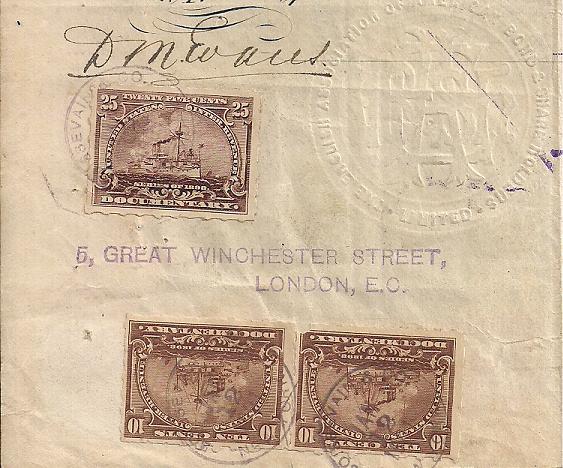
Now I'm the one needing help. The $1,000 stock certificate for the Kansas, Missouri, and Texas Railway Company (The Katy) shown below was initally issued October 31, 1890 well before the Spanish American War tax era. So its initial sale to the English Association of American Bond and Shareholders Ltd. (EAAB&S) wasn't taxed, but a resale was taxed in the US on January 12, 1901 and that resale included a power of attorney transaction. It's what transpired between those two events that's hazy.


$1,000 Stock Certificate Kansas, Missouri, and Texas Railway Company
Originally issued 31 October 1890


A single Great Britain Transfer Duty 2 shilling revenue stamp appears in the upper right corner. Presumably it paid the tax on the transfer of this stock to P. J. O'Brien on 17 November 1900, just 17 days after EAAB&S purchased it. I'm guessing P. J. O'Brien was an EAAB&S member who requested registration of this certificate in his personal name, an EAAB&S option as described in their advertisments appearing in The Railway News and Joint-Stock Journal.


Great Britain Transfer Duty 2 Shilling Blue


An undated circular handstamp cancel depicting the heraldic lion and crown from The Netherlands coat of arms flanked on the left by the numerals "7,50" and on the right by the letters "Gl" with the letter "l" underlined also appears on the front of the certificate.


Can anyone identify and explain the exact significance of this handstamp?
It likely is related to Boissevain & Co. as described below.
UPDATE April 21: Mike Mahler advises the handstamp is from the Netherlands province of "Noord Holland", and that's the wording appearing at the top of the handstamp. He, too, believes it to document a tax payment there of 7.50 guilders. Amsterdam, home office of Boissevain & Co., is located in Noord (North) Holland.


Completed transfer form on reverse side

As with this stock certificate, a preprinted transfer form often appears on the reverse side. EAAB&S used it to effect the aforementioned transfer to P. J. O'Brien on 17 November 1900. Deveremy Toler is faintly handstamped in the space provided for naming the transfer attorney. Both the Director and Secretary of the EAAB&S, along with one witness, signed the transfer authority. Those signatures are tied with a raised impression of the EAAB&S corporate seal. The address of the EAAB&S, 5, Great Winchester Street, London, E.C. is handstamped below the seal toward the left side.


So what's with the battleship revenues in the bottom left corner straddling the handstamped address of the EAAB&S? Well.....I'm not exactly certain, but obviously this certificate was returned and cancelled at some point as it was pasted back into the railroad's original stock stub book. When that occurred is unclear, but most likely on or around January 12, 1901, the date the battleship stamps were cancelled.


Cancellation Detail of Boissevain & Co.
Jan/12/1901
New York
and impression of the EAAB&S seal


Boissevain & Co., a Dutch firm with offices in Amsterdam, New York and London presumably was responsible for the curious 7,50 Gl handstamp on the front.


Further, as their New York CDS appears on the battleship stamps, they appear to have effected the return/repurchase/redemption/cancellation of this certificate by "The Katy", although the specific reason for its return is not identified.


Did Boissevain hold the certificate in trust for Mr. O'Brien on behalf of the EAAB&S ever since 1890? Or did Mr. O'Brien hold the certificate and simply use Boissevain to effect its eventual return/resale to The Katy?


Obviously, Boissevain felt obligated to pay both a resale tax of 20cents represented by the two 10-cent battleship stamps, as well as a power of attorney tax of 25 cents represented by the 25-cent battleship stamp. Numerous pinholes suggest additional instructions may have been attached at some point, but they are now lost to time.


My explanation, like the document itself, is a bit hazy, but it does illustrate payment of the resale and power of attorney tax during the Spanish American War Tax era.


This certificate demonstrates a multiply taxed doument by three national taxing authorities: Great Britain, The Netherlands province of Noord Holland, and the United States.


"The Katy" was first organized in 1865 and mostly provided passenger and freight service to Texas from the middle America market, eventually providing access to the Texas port of Galveston. Today it is part of the Union Pacific Railroad.

Wednesday, August 11, 2010

Power of Attorney

Power of Attorney Josiah Focht to Mrs. Sarah E. O'Brien
Reading, PA December 9, 1898


closeup view of correction of the improper use
of four 1/4-cent proprietary stamps with a 1-cent R154
provisional I.R. overprint cancelled in a different hand


A power of attorney, whether for a specific transaction like a stock sale, or universal, as is the one pictured above, was taxed 25 cents according to the War Revenue Law.

This one is particularly interesting because of the number and variety of stamps used on it. Usually one finds a single R169, 25-cent battleship stamp affixed. Here, eleven 2-cent provisional R155 I.R. overprint issues, and one regular R164 2-cent battleship along with four 1/4-cent RB21 proprietary issues paid the 25 cent tax.

One can almost see the parties scrounging among themselves for the stamps. They came up with 25 cents, but the use of the four 1/4-cent proprietary was improper. The War Revenue Law specifically required that only documentary stamps be used to pay documentary taxes and only proprietary stamps be used for proprietary taxes. Clearly the Treasury Department wanted to track the specific amount of revenue generated by each of those two tax categories.

A single 1-cent R154 I.R. provisional overprint stamp was subsequently added over the strip of proprietary issues to correct the error. It too is dated 12/9/1898, but the handwriting is different. So a total of 26 cents ultimately was affixed to this document. Use of proprietary issues on a document is uncommon, and a correction even more so. Generally their use either went unnoticed or was tolerated.