Showing posts with label R172 80 Cent Documentary Battleship. Show all posts

Friday, April 9, 2021

New York Stock Brokers and Bankers: Muller, Schall & Company


MULLER, SCHALL & CO.
JUN
19
1901
New York.


R172p block of six
Removed from a bill of exchange fragment


MULLER, SCHALL & CO.
SEP
12
1901
New York.


MULLER, SCHALL & CO.
FEB
24
1902
New York

Bill of exchange document fragment

Wednesday, March 17, 2021

Cancel for March 17: Tradesmen's National Bank

In 2009, when this site first began, and into 2012, I regularly posted a "cancel of the day".  A stamp was posted with a cancel for that day (except for the year, of course), and a bit of history was often given about the company or individual that applied the cancel.  That hasn't been done in years, partially because I haven't posted in so long, but also because I just stopped organizing posts around the dates of the cancels.

Today's stamp is a rather random stamp that fell out of a packet that has been in storage for over a decade.  The cancel is so clean that I figured I needed to feature it here, but it took me a couple of days before I realized that the cancel's date, March 17, was soon approaching and that I could run the first cancel of the day post in at least 7 years.  


TRADESMENS NAT'L BANK,
MAR 17 1902
PHILA.

The stamp is on an incomplete document fragment.

I was getting ready to write about Tradesmens National Bank when I took a second look at the copy of R184 above and wondered about the color of this series of stamps.  Is this the color gray as Scott tells us it is?  I don't even see a gray undertone.  More like a light, yellow khaki or tan.  As a young collector I was confused by this color designation, and I still am today.  Whatever the case, this series of dollar documentary stamps, due to their color and size, are perfect backgrounds for cancels, partially explaining why so many stamps from this series are highlighted on this site.

Back to the point of today's March 17 cancel.  Tradesmens National no longer exists as a bank.  But it never closed;  it became part of a series of mergers that has led to the creation of PNC, the seventh largest bank in the United States, based in Pittsburgh, Pennsylvania.  In 1958, Tradesmens and Provident Trust merged to form Provident Tradesmens National Bank, thereafter through further mergers becoming today's PNC.  

In a post from 2010, Provident Life and Trust Company was highlighted.  The focus of the post was on the dating style of the cancels they used, which employed Quaker style dating that did not used the romanized pagan names of the months, and instead used numbered months.  The stamp below was included in the post and is a good example of Quaker dating:


THE PROVIDENT LIFE & TRUST COMPANY OF PHILADELPHIA

11 Mo

25

1898


Wednesday, October 15, 2014

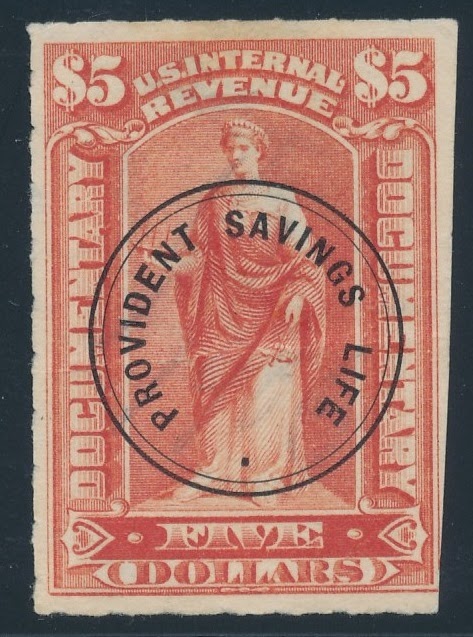
Documentary Printed Cancels: Provident Savings Life Update


Red and black Provident Savings Life cancels on 1898 series revenue stamps.  All are printed cancels except for the bottom right stamp, which displays a handstamp cancel.  Five different documentary values are shown here with Provident Savings Life printed cancels.  Are there more?


Provident Savings Life cancels have featured on this website over the years.  New examples continue to emerge and expand the list of the use of printed cancels on 1898 documentary revenue stamps. The standard reference for documentary printed cancels, the Fullerton List, only covers documentary printed cancels by railroads and express companies.  Provident Savings Life and Assurance Company is the only known insurance company to use printed cancels.

In addition to the stamps seen above that are found in my collection, David Thompson sent in a scan of the R170 pair below:


R170 Pair
David Thompson scan

Several years ago I had an email discussion with Frank Sente regarding the status of these cancels and whether they were printed are not.  This post from 2010 includes some of that discussion, and the argument was made then that these cancels were printed.  The above pair of stamps does a fine job of presenting proof of their status as having been printed, which the orientation and the precision, placement and clarity of the cancels makes clear.  One hitch though is that the separation between the cancels is not proportional to the stamp dimensions.  The cancel on the right stamp above is centered to the left relative the the stamp on the right.

Below are larger versions of the stamps shown above.  I've included three copies of R170 in the stamps above because of color issues with the cancels.  There are two red and one black, and between the reds, there is a clear color difference.


R170 roulette, orange-red printed cancel


R170 roulette, red printed cancel


R170 roulette, black printed cancel


R172 roulette, black printed cancel.   

This stamp has been featured in the stamp montage at the top of this website for years.


R173p hyphen-hole, red printed cancel


R174p hyphen-hole, red printed cancel


R175 black printed cancel


R175 roulette black handstamp cancel

All of the examples of Provident Savings Life printed cancels that I have seen with a date have shown a 1900 year date.  Where are other years of the 1898 series?  Even if the firm did not begin printing cancels until 1900, shouldn't there be 1901 examples?  Or did they simply run out and chose to print no more, necessitating the production of the handstamp illustrated immediately above?

A question I have is why these cancels, now shown on many documentary values, are orphans?  By orphans I mean their apparent neglect by established collectors and catalogs.  Fullerton and others raised the status of the documentary railroad and express printed cancels; while the proprietary printed cancels have always had a special place in the revenue hobby.  Where have these stamps and their cancels been?  Have they just been ignored?  Does anyone know of an old philatelic article on the subject or a collector that may have had a small collection of these?

The small collection above began with the R170, and has been pieced together over several years through multiple purchases and one gift from Bob Hohertz.

I am always looking for new Provident cancels like these, on new stamp values or with new colors.  If you have examples, please write 1898revenues@gmail.com.

Sunday, February 3, 2013

Equitable Life Assurance Society, Portland, Oregon


L. S A M U E L .
GENERAL MANAGER,
Equitable Life Assurance Society,
OREGONIAN BUILDING
Portland,                  Oregon

manuscript date:
June 30, 1899

David Thompson scans and highlight


Mr. Henry Hyde
New York-based President of the Equitable Life Assurance Society in 1898, his last year as President


From the website Funding Universe:

Equitable was started in Manhattan in 1859 when Henry Baldwin Hyde, an ambitious young cashier for the giant Mutual Life Insurance Company of New York, left that firm to found his own. Life insurance ran in Hyde's family; his father was one of Mutual's top salesmen and would sell many policies for Equitable. Hyde organized his new firm as a joint-stock company, enlisting his friends to help sell shares. William Alexander, a lawyer and minor politician whom Hyde knew through their mutual association with the First Presbyterian Church of New York, was chosen as the firm's first president, with Hyde running its day-to-day affairs through the office of vice-president.


Equitable got off to a good start, selling 769 policies worth a total of more than $2.6 million in its first year. Business boomed during the Civil War, as the ravages of armed conflict impressed upon many the wisdom of insuring their lives. In 1865, the last year of the war, the firm had $27.6 million worth of coverage in force. Equitable had begun selling policies overseas almost immediately after its founding. It had an agent in Southeast Asia as early as 1860, and over the next two decades it established its presence elsewhere in the Far East, in Europe, the Middle East, South America, and Canada.

William Alexander died in 1874 and was succeeded by Henry Baldwin Hyde. Business continued to skyrocket during Hyde's active stewardship, and in 1886 Equitable surpassed Mutual to become the largest life insurance company in the world. That year, it sold $111.5 million worth of policies, giving it a total of $411.8 million of coverage in force. During those boom year, the firm could boast of having among its directors Ulysses S. Grant and financier John Jacob Astor.

Henry Hyde retired in 1898 and died the next year.

Thursday, January 12, 2012

New York Bankers, Banks & Trusts: John Munroe & Company


Classified Advertisement, New York Evening Post


JOHN MUNROE & CO.
OCT
8
1899
*

Dave Thompson scan


JOHN MUNROE & CO.
MAR
29
1901
*


Langlois scan


Tim Kohler scan.  This document first appeared on this site on November 20, 2010, in a Frank Sente post, "Maurice Grau Heads for Paris."


John Munroe & Company was a banking house with offices in New York and Paris.  It seems that the firm was a prodigious receiver and forwarder of mail from the United States and to and from its office in Paris.  You can find one such cover at the Philamercury site here. Many of the Munroe covers are highly collectable.  The following two covers have been for sale at recent auctions:


Saturday, January 7, 2012

Sunday, November 20, 2011

New York Stock Brokers: Ladenburg, Thalmann & Co.

As John Langlois noted in his cancel of the day blog for May 3, 2010, Ladenburg, Thalmann & Co. was founded as a Wall Street securities firm in 1876 by American banker Ernst Thalmann and German banker Adolph Ladenburg. Thalmann maintained the seat on the New York Stock Exchange. Today the firm continues to operate with headquarters in Miami and offices in more than 10 other US cities.  And Ladenburg Thalmann Financial Services is part of the current Russell 3000 Index. 


On its face the broker memo below appears to be a straight forward purchase of 200 shares of Mobile & Ohio Railroad stock by Ladenburg, Thalmann.  Given the stock resale tax rate of 2cts/$100 in original share value, each share had an original value of $100.  That these 200 shares sold for just $48.50 per share, or $9,700, means there was a loss of $10,300 from the $20,000 original value.  But there's more to the story.

I've always enjoyed collecting on-document usages.  Documents provide an historical perspective that stamps alone cannot.  While these cancels provide the name of the firm and the date of the transaction, without the document we'd not have known that the stamps represented the tax on the sale of M&O Railroad stock at such a loss, and we'd further not have been able to speculate that Ladenburg, Thalmann likely turned a significant and immediate profit on this transaction.  And speculate, I believe, is what Thalmann was doing when he purchased these M&O shares.  

Stock Purchase Memo
Ladenburg, Thalmann & Co.
double-line, stamp-like boxed cancel
L. T. & Co./JAN/29/1901

Allowing us to speculate about Thalmann's M&O purchase was having access, via this blog, to a critical mass of M&O stock sales memos.  Earlier this year John blogged about six M&O stock sales memos dated between December 30, 1898 and February 1, 1901 documenting that the stock languished in the low 30s and 40s during 1899 and 1900 until February 1, 1901 when it spiked and sold for as much as $70.50 per share on news that the M&O had agreed to a stock swap offer with the more financially sound Southern Railroad.  So the 200 shares Thalmann purchased for $9,700 at $48.50 on  January 29, 1901 could have been sold for around $14,100, or a tidy profit of $4,400 just three days later! 

The name Johnstone doesn't appear in King's Views of the New York Stock Exchange so presumably the seller wasn't a recognized broker.  Was this simply a serendipidous purchase, or did Thalmann have knowledge of the pending stock swap and go looking for M&O stock in late January 1901?  We'll never know for sure.  Considering M&O had been trading in the 30s and low 40s for the past two years, Johnstone may have been pleased with, and perhaps also may have turned a profit when Thalmann bought at $48.50.  Clearly, documents and the information they provide can offer a sense of historical context and a glimpse into the cultural tapestry of this colorful era.  

All of this also serves to demonstate the great value of the 1898revenues blog and the synergy it creates, where information pooled from numerous sources and participants enhances our capability for understanding, not only the material we choose to collect, but also the socio-economics of the Spanish American War era.  Thank you John for having the foresight to start blogging about 1898 revenues and for all the time and energy you devote to it.

Here's a Ladenburg, Thalmann sales memo documenting the sale of 200 shares of the Southern Pacific Railroad to another New York broker, William B. Wadsworth.    
  

 Stock Sales Memo
circular cancel
Ladenburg, Thalmann & Co.
JUL/18/1901

Again, given the $4 tax, the initial value of these 200 shares was $20,000, so this sale represents a loss in value of $9,400 or nearly 50% from the initial value of the stock! 

Like the M&O, Southern Pacific shares had been selling in the 30s and 40s during 1900.  The speculation in railroad stocks in advance of the May 9, 1901 Wall Street Panic had run the SP's price up to $67 as of May 1, 1901.  Selling 10 weeks later for $53 represents a 20+% drop from that speculative high. 

Either Ladenburg, Thalmann had two NY offices, or it moved sometime between January 29, 1901 and July 18, 1901, as the purchase memo has them at 46 Wall Street, and the sales memo, a couple of blocks away at 25 Broad Street.  

Not surprising, given Adolph Ladenburg's European banking connections, the firm did business overseas.  The piece shown below is a clip from a foreign bill of exchange.   Enough of the bill remains to indicate it was written in Pounds Sterling so the transaction likely involved a British bank.  The handwritten date on the other side is Jan 25, 1901 so it would appear the year date on the circular cancel wasn't properly updated to 1901.  Assuming the bill was drawn as part of a "set" (the clip does bear the word "FIRST") the tax rate was 2cts/$100 in value.   The bill's value in dollars then had to be between $24,100 and $24,200.                

Clip from Ladenburg, Thalmann Bill of Exchange 

Unlike the stock memos where the Commerce issues were both cut and handstamp cancelled, the dollar Commerce issues used here, as well as the 80cent battleship, were perfin cancelled before being applied to the document. That suggests access to the stamps used for bills of exchange was open to a wider number of employees -- the main purpose of perfins being a security against internal theft. The perfin is most easily read on the enlarged 80 cent battleship issue shown below. 

perfin cancel:
L T Co

Tuesday, March 8, 2011

Cancel for March 9: R. J. Johnston & Company

R. J. JOHNSTON & CO.
MAR
9
1900

A member of the New York Cotton Exchange.  The firm failed in 1903 as reported by the New York Times.

Wednesday, November 24, 2010

Cancel for November 25: Provident Life & Trust Company Of Philadelphia

THE PROVIDENT LIFE & TRUST COMPANY OF PHILADELPHIA.
11  Mo
25
1898

Interesting big cancel, with a long name spelled out in a CDS.
Top it off with "11 Mo" for November, a Quaker dating method in which the names of the months are not used.  Provident Life and Trust was likely a Quaker owned and operated company.


David Thompson sent me this image of an R175 with a similar cancel to that above.


Another example of a Provident Life cancel. 


From Wikipedia:
The Quaker "plain calendar," or "scriptural calendar," differs from what Quakers refer to as the "world's calendar".  The plain calendar uses numbers to denominate the names of the months and days of the week. It emerged in the 17th century in England in the general non-conformist movement but became closely identified with Friends by the end of the 1650s and continuously since that time.

The plain calendar does not use names of calendar units derived from the traditional names due to their derivation from pagan deities. Instead, it uses ancient terminology as found in the bible where the days of the week were numbered; for example, Jesus' followers went to the tomb early on the First Day of the week. From this, the plain calendar week begins with First Day (equivalent to the traditional Christian Sunday) and ends on Seventh Day (Saturday). Similarly the calendar's months run concurrently with the traditional months albeit named First Month, Second Month, etc..

***

Provident Life and Trust Company:  In 1922 The Provident Life and Trust Company split into two companies: the Provident Mutual Life Insurance Company and the Provident Trust Company.  Eventually through mergers and name changes the Provident Trust Company would become the Provident Naional Bank and eventually the Provident National Corporation.  After Provident National Corporation merged with Pittsburgh National Corporation in 1982, the merged companies became PNC, one of the largest banks in the United States today.


Provident Life & Trust Company building,
409 Chestnut Street, Philadelphia
Built in 1879 and demolished in 1959
Designed by architect Frank Furness

Sunday, June 13, 2010

Provident Savings Life cancel on R172: Printed Cancel?


PROVIDENT SAVINGS LIFE
XXR 20 1900

This looks like a printed cancel, though I would like confirmation and a story behind this cancel if one exists. 

In answer to this query, Frank Sente sent in the following image and analysis explaining why the cancel was likely printed:


"A clear sharp cancel certainly is suggestive of a printed cancel. Note that although my Provident isn't socked on the nose like yours it does exhibit the exact same axis orientation as yours.  If they were handstamped it would be hard to maintain an EXACT axis like that. Having a third confirming example would be helpful.  The exactness of the axis orientation, at least to me, also suggests that some type of print master was set up to make this cancel. We need someone familar with early 20th Century printing techniques to take a look at these."

For background on Provident Savings Life is this clip from The Monetary Times of March 27, 1903:


Sunday, May 30, 2010

Cancel for May 31: Company Unknown

R172 80 cent documentary
Red CDS for May 31, 1899
Company unknown

Thursday, May 13, 2010

Cancel for May 14: J. P. Morgan & Company

Approximately 3 years ago a series of lots were offered on Ebay by a seller in the United Kingdom.  The lots consisted of 1898 series revenues on document fragments.  All seemed to be from firms engaging in equity transactions.  Below is a prime example of one of those fragments, cancelled by J. P. Morgan and Company. 

Cancels on document fragment by J. P. Morgan and Company

Hyphen-hole versions of:
R166 4 cent documentary
R172 80 cent documentary
R185 2 dollar documentary


Reverse side of fragment with corporate branding for
Drexel & Company in Philadelphia
and
Morgan, Haries & Company in Paris


Drexel and Company:  Founded in 1838 by Francis Martin Drexel.  The company experienced early success from opportunities created by gold discoveries in California.  A. J. Drexel, the son of Francis Martin Drexel,  became the head of Drexel & Company when his father died in 1863. A.J.  partnered with J.P. Morgan and created one of the largest banking companies in the world, Drexel, Morgan & Co., which might explain the formal association with Morgan, Haries on the transaction fragment posted above.