Showing posts with label Taxes: Documentary: Bank Checks. Show all posts

Tuesday, April 18, 2023

Tax Collector Pays the Tax?


Farmers & Mechanics National Bank of Georgetown $131.00 check to E. G. Davis, the Washington, D. C. Collector of Taxes.  The tax collector canceled the stamp.


COLLECTOR OF TAXES
MAY
23
1900
D.C.

It can't be confirmed that the tax collector paid the 2 cent tax on the check, but we do know that the tax collector canceled the 2 cent federal tax stamp.
 

Monday, April 29, 2013

1898 Revenue Exhibits at ARIPEX all Garner Gold Awards and Another Phoenix Check

1898 Revenue exhibits did well at ARIPEX!  All four of the 1898 revenue exhibits garnered Gold Medals! 

Additionally, Hermann Ivester's single frame exhibit, The Saint Louis Provisionals 1898, won the show's Single Frame GRAND AWARD, the ARA's award for the best revenue single frame exhibit, and the American Association of Philatelic Exhibitor's special award for the exhibit having the Best Title Page. 

Winning the ARIPEX single frame grand award, automatically qualifies Hermann's exhibit for the national single frame "Champion of Champions" competition at Ameristamp Expo in Little Rock Arkansas in February 2014!  Congratulations Hermann!! 

The ARIPEX multi-frame RESERVE GRAND award went to Frank Sente's 10 frame exhibit, Spanish American War Fiscal History: The US Documentary Taxes 1898-1902.  Sente's exhibit also was awarded the American Revenue Association Grand Award as the best overall revenue exhibit.       

Standing in front of Len McMaster's exhibit from left to right are:
Frank Sente, Len McMaster, Hermann Ivester, and Bob Hohertz
 
1898Revenue blog readers can enjoy much of the material in these four exhibits vicariously. 
 
Len McMaster's, "I. R." Overprinted 1898 1cent Franklin Postage Stamps, exhibit is available online here at 1898Revenues.
 
Many of the 1898 Saint Louis Provisional Issues in Hermann Ivester's exhibit and much more information about them can be found here on 1898Revenues.  And now that Hermann's wonderful material is in exhibit format, we'll be asking him to scan those 16 pages to put up on 1898Revenues.  
 
It was a thrill for me to view Hermann's exhibit as all I've ever been able to do is read about these stamps. Previous owners of the material never exhibited it, Hermann being the first ever to do so! 
 
Bob Hohertz  has blogged extensively about the revenue stamp paper of the 1898 tax era on 1898Revenues. Much of the material in his exhibit, Revenue Stamped Paper of the Spanish American War Tax Era, may be found in his blogs.
 
And finally, individual blogs about some of the items from my exhibit, Spanish American War Fiscal History: The Documentary Taxes 1898-1902, can be found among the On Document Uses blogs on 1898Revenues.    
 
Shows aren't just about exhibits and awards however; more importantly they provide a venue where collectors, exhibitors and dealers can meet, trade information, and discuss mutual interests.  The camaraderie and good fellowship developed from face to face meetings with others having similar interests far outweighs awards. 
 
I finally got to meet 1898 revenue contributor Sean Roberts.  Len McMaster and I discussed a joint article about bisect stamp usages from the 1898 tax era, and I attended the meetings of the American Revenue Association.  And I would be remiss if I didn't provide a link to the American Revenue Association website; it's their annual meeting that I'm attending at ARIPEX prompting these Phoenix-related blogs.
 
Here's an interesting bank check.  Other than being datelined Phoenix, Arizona, it's a generic printed form; essentially it could have been used at any bank!
 
Bank of Arizona check on generic check form
January 27, 1899
 
Drawn by John Lawler against the Bank of Arizona, Prescot, Aziz. (Note mis-spelling of Prescott) it was made payable to "Valley Bank" or bearer.  The pair of one-cent large I. R. overprint stamps paying the 2cent check tax apparently were applied at the bank as they bear a double ring cancel reading: "The Valley Bank"/ "Phoenix, Arizona"
 
John Lawler was a prominent Prescott businessman who had extensive cattle and mining interests.  His papers are available at the University of Arizona.  Perhaps he was on business in Phoenix and picked up this form check at the Valley Bank to secure $200 cash. 
 
As I now live in Prescott, Arizona it's a treasured item in my 1898 collection.


Tuesday, March 15, 2011

Use of Officially Returned and Redeemed Stamped Paper

Frank Sente and I have been exchanging emails concerning the volumes of Compilation of Decisions rendered by the Commissioner of Internal Revenue under the War Revenue Act of June 13, 1898, which contained a list of printers licensed to furnish imprinted paper. I have been wanting to see the January, 1902 edition to see which printers were still listed, presumably to continue imprinting parlor car tickets until the end of the tax period on June 30, 1902. Frank found a copy online for me, and I eagerly downloaded it. Unfortunately, it didn't contain the usual list of printers, probably assuming that any on the list in the 1901 edition could continue to function for an extra year if requested by a user. However, one section of it did shed some light on another thing that has been puzzling me.
On July 1, 1901 checks and drafts payable on order or at sight were no longer taxable. Imprinted paper could be sent in for a refund of the tax paid. Checks with a round hole punched through the imprint indicate that it was sent in for redemption and returned to the owner for subsequent use. I have been looking for an example used in 1901, or even 1902, without success. The check below, used in April of 1903, is the earliest I have come across so far.


One item in the 1902 Compilation explains why I never will find a 1901 example, and why 1902 use may exist, they will be few and far between. From pages 193 - 194:
(403)
Redemption of imprinted stamps.
Under existing laws it is not possible to return checks to the owners after the imprinted stamps have been redeemed, but they will be preserved subject to future action of Congress.
TREASURY DEPARTMENT,
OFFICE OF COMMISSIONER OF INTERNAL REVENUE,
Washington, D.C., August 15, 1901


To collectors of internal revenue and others concerned:
Application having been made to this office by banks and bankers for the return, after redemption of the stamps, of checks on which stamps have been imprinted, you are advised that when the war-revenue act imposing a tax on checks and notes went into effect, at the request of the bankers, and to meet their convenience, a system of imprinting the 2-cent stamps on checks was devised by this Bureau, which was a great saving of annoyance and trouble to the banks and their customers.

Upon the repeal of the stamp tax on checks by the Act of March 2, 1901, the question arose as to the redemption of such imprinted stamps, and instructions were issued March 22, 1901 (Circular N. 596), relative to redemption of documentary and proprietary stamps.

This office has been requested to cancel the imprinted checks, after allowance of the claim for redemption, in such a manner as to render their future use possible, and return them to the original owner in order to effect a saving to the owner or bank of the cost of stationery and the binding of the checks and drafts in book form.
The extent to which these imprinted stamps are being presented shows that a large pecuniary loss will fall upon banks and owners if the checks and drafts are destroyed, after refund is made for the stamps thereon.
After careful consideration of this whole question, the conclusion reached is that, under existing laws, it is not possible to return these instruments to the owners, but this office will proceed as rapidly as possible to consider the claims for redemption, and refund to the owners the amounts due by reason of the stamps imprinted; will cancel those instruments so as to allow their future use; will preserve the various checks, and will recommend to Congress, at its session in December next, to pass a law under which it will be possible and legal to return these checks and drafts to the claimants and owners.

It is understood that the banks will also petition Congress for relief, and in this way it is believed speedy action may be had.
J.W. YERKES, Commissioner
*****

The 1903 Compilation volume contains the following:

(509)
Cancellation of imprinted stamps and return of imprinted instruments to their owners.
[Circular No. 42 - Int. Rev. No. 623]
TREASURY DEPARTMENT,
OFFICE OF COMMISSIONER OF INTERNAL REVENUE,
Washington, D.C., April 25, 1902.
The joint resolution authorizing the Commissioner of Internal Revenue to return bank checks, drafts, and certificates of deposit, and orders for the payment of money, having imprinted stamps thereon, to the owners thereof, approved February 26, 1902 provides:
That the Commissioner of Internal Revenue be, and is hereby, authorized to return said imprinted instruments to the owner or owners thereof, where said return is demanded within one year after the passage of this Act, after the redemption and cancellation of stamps printed thereon, and said cancellation and return to the owner or owners shall be made in such manner and under such regulations as may be prescribed by the Commissioner of Internal Revenue and approved by the Secretary of the Treasury. All such checks and drafts, and so forth, remaining unclaimed by the owner at the expiration of one year after the passage of this Act shall be destroyed in such manner as may be prescribed by the Commissioner of Internal Revenue and approved by the Secretary of the Treasury.
In pursuance of the authority conferred by the resolution aforesaid, it is herein provided that all revenue stamps imprinted upon checks, drafts, and other instruments shall, after their redemption and before the return of the said instruments to the owners thereof, be canceled by perforating or cutting a round hole about one-fourth of an inch in diameter therein, or through the instruments on which the said stamps are imprinted. After the redemption and cancellation of the stamps as aforesaid, the imprinted instruments may, upon the request and at the expense and risk of the owners thereof, be returned to said owners either by freight or express, as may be desired.

Requests for the return of imprinted instruments must be made in writing, addressed to the Commissioner of Internal Revenue, signed by the owner or his duly authorized agent, and shall specify distinctly by description and number the instruments to be returned, the manner of return, whether by freight or express, and give plainly the address to which the instruments shall be forwarded.

All imprinted instruments remaining unclaimed by the owners on February 26, 1903, shall be destroyed by burning under the supervision of the committee appointed by the Secretary of the Treasury to superintend the destruction of stamps, notes, bonds, and other Government securities.

Imprinted instruments may be destroyed as aforesaid at once upon receipt of notice from the owner that the return of such instruments is not desired.
ROBT. WILLIAMS, Jr., Acting Commissioner,
Approved: L.M. Shaw, Secretary of the Treasury

*****

Since Congress did not pass the IRS recommendation until February 26, 1902 there cannot be any redeemed check uses in 1901. The IRS did not act until April 25, 1902, and, as a practical matter, the process adopted then had to be announced to the banks and made available to the public.

In the meantime, as banks were using their drafts they might be falling below the required hundred necessary for redemption - the same being the case with individual users. This may account for many of the imprinted ones used after 1901 without the stamp having been redeemed. At first people didn't want to lose their checks, and later they didn't have enough to send in.

At any rate, it appears possible for checks to have been returned to users in time to be used in the last half of 1902, but not much before that. I'll continue to look for one dated in that year, but I now know why they are not so common as I thought they should be.

Wednesday, September 29, 2010

Checks Free From Tax

Section 17 of the War Revenue Law exempted Federal, State and all Local Governments from the stamp taxes in "...their ordinary governmental, taxing, or municipal capacity." Thus checks issued by government agencies were not subject to taxation. The untaxed check drawn on the Orphans' Home Fund of the State of Nevada below illustrates this exemption.

State of Nevada Orphans' Home Fund Check
Carson City, Nevada, November 7, 1898

An even better example is this seven-cent check issued by the US Treasury for interest due on an 1898 War Bond. While the taxes imposed by War Revenue Law raised significant funds to help finance the Spanish American War effort, most of the funds that actually paid for the war effort came via $200,000,000 in Treasury War Bonds authorized by Congress at the same time the War Revenue Law was enacted. The bonds were popular with the public even though they only paid 3% interest and the entire subscription sold out in just a few days. Both coupon and registered bonds in values as small as $20 were authorized. Details of the subscription may be found in this contemporary New York Times article.
U.S. Treasury Check A200289
Washington, DC August 1, 1898
for Interest Due on Deposits for Bonds

Thousands of these checks were issued, but as the vast majority were cashed in at the recognized Treasury offices, the only extant examples are UNCASHED checks like this one. Although David Tischler endorsed this one, he apparently never actually cashed it. Interest was to be paid quarterly but as this check is dated August 1, 1898, barely a month after the bond it represents could have been issued, it likely paid for one month's interest on a $20 registered bond. Perhaps Tischler kept it as a souvenir, or simply failed to cash it within the four month redemption period. I've only seen a couple other examples. Can anyone offer an illustation of an actual 1898 War Bond?
Endorsement Detail of Treasury Check A200289
Signed, But Not Cashed

Internal company pay vouchers, if cashed directly at the company's offices by the payee also were exempt from taxation. The Victor Colorado Independence Mine time check shown below illustrates the exemption. Curiously, while $3.00 was earned, only $2.95 was paid with five cents deducted from the payment for some reason. Remains of the Independence Mine may be toured in Victor, Colorado.

$3.00 Independence Mine Time Check September 8, 1900
$2.95 Payment Effected at the Orpha May Mine on the Same Day

Because Arthur Chapman endorsed his $30 Pacific Live Stock Co. monthly pay voucher over to C.W. Madden, thus establishing a third party taxable event, Madden had to affix a 2-cent revenue stamp before he could cash the voucher at the company offices in Burns, Oregon. Note the "This Voucher Must Bear A Two Cent Revenue Stamp If Presented By Any Other Than The Employee Named Herein" notice in the upper left corner of the voucher below.

Undated Pacific Live Stock Co. Pay Voucher

Endorsements on Reverse of Pacific Live Stock Voucher

The bank counter withdrawal receipt below illustrates that if one simply went to the bank and withdrew funds directly from their account they could avoid paying the required two cents bank check tax. If they instead wrote and cashed a check payable to "self", a two cent tax stamp would have been required as checks were taxable, but withdrawal receipts were not.

Sunday, September 26, 2010

Bank Checks with Proprietary Stamp Usage

We've reviewed the acceptance and rejection of postage stamps in payment of the two-cent documentary tax on checks in prior posts. Today we'll review the likewise improper use of proprietary tax stamps to pay the documentary tax on checks.

The War Revenue Law provided for two separate sets of stamps; stamps inscribed "DOCUMENTARY" were to be used only on legal documents with details provided in Schedule A of the Tax Act.

Stamps inscribed "PROPRIETARY" were to be used only on proprietary medicines and other items with proprietary formulas as described in Schedule B of the Tax Act.

The two sets of stamps were not to be used interchangeably. Because of the small odd fractional tax rates charged on proprietary items, use of documentary stamps to pay any of the proprietary taxes would have been highly impractical, and I'm not aware of any extant examples of such usages.

However, it is not uncommon to find proprietary tax stamps used on documents. Such usage was not legal, but generally it was condoned. While mis-use of postage stamps often was disallowed because the money for the stamps went to the Post Office Department instead of the Treasury, the use of proprietary stamps on documents was seldom challenged because the fees paid for them did accrue to the Treasury, albeit to an incorrect account.

Most such incorrect usage of the proprietary stamps occurred in the first few months of the tax period, i.e., July, August, and September, 1898. Confusion about the law and the initial inadequate distribution of the proper stamps both led to misusages.

However, to find a check such as the Teutonia National Bank check illustated below, written in 1901, more than two years into the tax period, bearing propietary stamps is unusual, and it is surprising that it was not questioned.
Teutonia National Bank Check
Dayton, Ohio, February 27, 1901
with two RB24 proprietary stamps

If you carefully look at the closeup detail of the two stamps below, it appears that they may have been reused. Looking closely at the area of the "01" in "1901" and the "00" in "15.00" on the bottom stamp one can discern what appears to be evidence of a prior cancellation. Perhaps the stamps were strategically placed so the amount of the check would help cover that prior cancel. I've viewed thousands of checks and never before have seen one placed in the area where the check amount would serve as a partial cancel. That the stamps feel unusually stiff and there are tell-tale signs of gum stains showing through on the reverse further suggests the probability that they were reused.

The person who wrote the check was an independent insurance agent in Dayton and thus would have had ample access to various denominations of documentary issues. But two-cents in 1898 was not an insignificant amount and one could easily be tempted to reuse a couple of lightly cancelled stamps on a check payable to a singing society. The penalty for reusing stamps though, was stiff; a conviction could have brought a fine of up to one thousand dollars and up to five years hard labor! That's a lot to risk to save two cents.

Detail of Possibly Reused Proprietary Stamps

The usage of a single 2-cent proprietary issue on the Arkansas Construction Company check below is much more understandable. It's a July 1, 1898 first day of tax period use and likely it may have been the only stamp available there on that day. Distribution of the tax stamps was uneven all over the country and not all the values were even available for distribution on that day. So even if the bank had wanted to challenge the usage of the proprietary stamp, it may not have had the proper documentary stamps available to do so!

Arkansas Construction Company Check
Kansas City, Missouri July 1, 1898
First Day Usage of 2-cent Proprietary Stamp, RB27

Detail of Arkansas Construction Company Check
Showing July 1, 1898 Handstamp Cancel of A. L. Howe

The September 15, 1898 usage of a 2-cent proprietary on this Brotherhood Wine Company check is also somewhat understandable. They likely would have had a large suppy of the 2-cent proprietaries as there was a two cent tax on bottles of wine exceeding one pint. So for Brotherhood Wine it likely was simply a matter of convenience to just stock 2-cent proprietary stamps rather than both proprietary and documentary issues. I've seen later Brotherhood Wine Co. checks with 2-cent documentaries, so at some point they probably were instructed to use the documentary stamps instead of relying upon the proprietary issues.

Brotherhood Wine Co. Sight Draft
New York City, September 15, 1898

The following Nebraska National Bank Check was submitted by JW Palmer. As he points out it's a bit taddy, but it's also the only example of a challenged proprietary usage on a check I've ever seen. The 2-cent proprietary in the upper left corner was affixed and pen-cancelled by N. R. Sagers on February 2, 1900, the same date as the check. However when O. M. Burrus cashed it on February 7, 1900, Nebraska National required a corrective 2-cent documentary be affixed and it was cancelled by the bank on February 7. Thanks JW, for sharing this nifty item; it 's the perfect piece to cap today's subject.

Nebraska National Bank Check Omaha, Nebraska
written February 2, 1900 (2-cent proprietary)
cashed February 7, 1900 (2-cent documentary)

Tuesday, September 21, 2010

Checks Taxed At The Bank

The War Revenue Law required all checks processed on or after July 1, 1898 to be taxed 2-cents. The law didn't specify exactly what party should pay the tax, but if a document was left untaxed, BOTH parties were liable for a penalty. Usually, the owing party in a transaction paid the tax. So generally the person or firm drafting a payment paid the tax, however, as the checks shown below illustrate, that didn't always happen.

Although written on June 17, 1898, two weeks prior to the tax period effective date of July 1, 1898, this First National Bank, Columbus, Indiana check of Williams and Collins wasn't cashed until July 21. At that time, the Drovers' & Mechanics' National Bank of Baltimore required a 2-cent tax stamp be affixed as any check processed on or after July 1 was liable for the tax. The stamp wasn't dated and initialled as required, but the purple period bar cancel defacing the stamp matches the period bar ornamentation at the top of the Drovers' and Mechanics' endorsement on the back of the check, shows that the stamp was added when presented there for payment.

First National Bank, Columbus, Indiana
Williams & Collins Check, June 17, 1898
2 weeks prior to tax period

detail of endorsement on Williams & Collins check
with period bar ornamentation at top

Mary L. Hotchkin either didn't have a stamp available, or forgot to affix one to this October 4, 1898 Agricultural National Bank check written to W. R. Morton. Morton wisely cashed the check at the same bank, for in this instance the bank simply added the 2-cents due for the tax to the amount of the check and charged it against Hotchkin's account.
Agricultural National Bank, Pittsfield, Massachusetts
Mary L. Hotchkin Check, October 4, 1898


Detail Images of Hotchkin Check showing
stamp added and canceled by bank at left, and
"stamp .02" added to check amount at right

Most likely Edward A. Mitchell wasn't aware of the tax, or simply didn't have the obligatory tax stamps when he wrote this check on the Essex National Bank of Haverhill on July 2, 1898, the second day of the tax period. That the stamp was initialled W.J.H. and dated July 9, indicates the payee, Willard J. Heale, instead paid the 2-cents tax when he presented the check for payment on that day.
Essex National Bank of Haverhill, Massachusetts
Edward A. Mitchell Check, July 2, 1898
second day of tax period


Detail of Mitchell Check
stamp initialed and dated July 9
by Willard J. Heale, the payee

Sunday, September 19, 2010

Another Bank Check With Postage Use Corrected

A fiscal history mentor once told me to buy items I didn't completely understand or couldn't explain as they likely sheltered interesting stories. I've benefitted from that advise on many occasions.

At a quick glance the check illustrated below is just another example of a check bearing a 2-cent postage stamp in payment of the check tax that was not honored until a corrective 2-cent revenue stamp was added.

The postage as revenue usage was nice, but it was the payee that drew my attention and piqued my interest. Not 2nd Lt. Lanning Parsons personally, but rather the reference to the 9th Calvary. The 9th Cavalry, I knew, was a Buffalo Soldier unit that saw action in the Spanish American War. I wondered where this check might have been written? Denver, the location of the bank upon which it was drafted didn't make sense, nor did Los Angeles where it was cashed.

I started with Wallace Sabin, the payor and Lanning Parsons, the payee. Sabin spent a 40 year career as a contract surgeon with the Army. Lt. Parsons graduated from West Point in 1896 and retired on disability. He later taught military science and tactics at various institutions. From his career notes I learned that in 1899 when this check was written he was stationed at Ft. Apache, Arizona Territory. The 9th Calvary it turns out was stationed there in 1899 in between stints fighting in Cuba and the Philippines.

First National Bank of Denver check
March 23, 1899

Could the check possiby have been written there? I became very interested in what the pen-cancel hidden under the revenue stamp might show. Because of the red ink bank cancel I was reluctant to remove the stamps and my quest remained dormant.....for a while.


check detail showing 2-cent Bureau Issue postage stamp
beneath added 2-cent battleship documentary

I asked my former collegue at APS, Mercer Bristow, for assistance. Using a crimescope and working from the back side of the check, he was able to highlight the text of the pencancel. He then reverse-printed the result and, voila, the check indeed was written at desolate Ft. Apache where Contract Surgeon Sabin did his best to pay the tax by using a postage stamp.

reverse-printed backlit image of
Ft. Apache/Arizona/March 23/99/W.E.S. pencancel

What remained was to determine how the check ended up at the First National Bank of Los Angeles. As shown on the back of the check, Lt. Parsons made the check payable to a third party, J. V. Vickers, who cashed it in Los Angeles.


note transfer endorsement to
J.V. Vickers at top

Vickers was an entrepreneurial rancher and businessman. With two partners he operated a successful ranching operation in Arizona, the Empire Land and Cattle Company, from headquarters in Los Angeles. The disposition of the check finally made sense.

Because of a collapse the Kansas City beef market in 1898 Vickers began scaling back his Arizona operations. Perhaps he was trying to sell beef to the Army at Ft. Apache in 1899.

In 1901 he and Walter Vail bought property on Santa Rosa Island and started a ranching enterprise under the name of Vail and Vickers that continues today. In 1986 the company sold the island to the US government and it became part of the Channel Islands National Park. The firm retained the right to operate private hunting excursions on the island that are due to expire next year.

J.V. Vickers @1898

Friday, September 17, 2010

Bank Checks - Postage Not Accepted for Tax

In my last blog about the tax on bank checks we illustrated examples of postage stamps used in lieu of revenue stamps. Because of problems distributing the new tax stamps, the practice of using postage stamps to pay the two cent tax indeed often was tolerated. However using postage stamps wasn't legal and just as often banks would not process checks until a proper tax stamp was added. Processing documents not properly taxed was a misdemeanor punishable by a fine of up to $200 upon conviction.

When the Citizens National Bank check illustrated below was presented to the C.C.S. Bk. (Capital City State Bank) of Des Moines, that bank required a proper tax stamp before cashing it.

The use of a 2-cent Trans Mississippi postage stamp seems particularly odd in this instance. Although dated July 14, 1898, just two weeks into the taxation period, one would have expected C. F. Fox, manager of the Postal Telegraph-Cable Company to know that use of a postage stamp to pay the check tax was improper. His company certainly must have had tax stamps available by this time to pay the taxes on telegraphic dispatches and money wires. Anyway, J. Gibron, the payee, likely paid the two cents for the correct revenue stamp to be added before collecting his $10.

Citizens National Bank Check, Des Moines, Iowa
July 14, 1898

detail of stamps on Citizens National Bank check
postage stamp is pen-cancelled 7-14-1898, the same date as the check

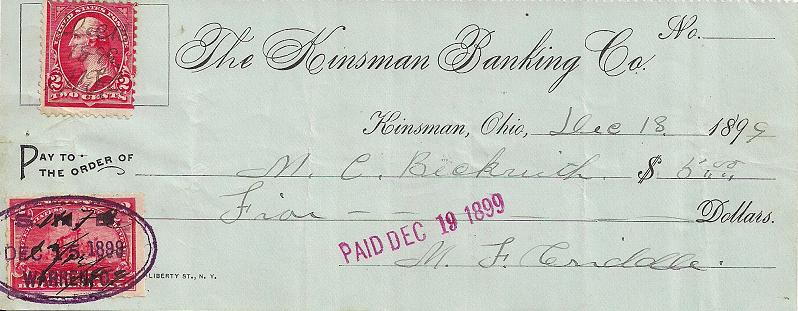
The following Kinsman (Ohio) Banking Company check is dated December 13, 1899, nearly 18 months into the tax period. Given the late date, it's not surprising that the use of a postage stamp was rejected. However, that someone would attempt to use a postage stamp 18 months into the tax period also suggests the use of postage stamps still was often tolerated.

Kinsman Banking Co. Check December 13, 1899

In this instance however the payee, M. C. Beckwith, probably didn't pay the tax. Instead the check likely was held until the payor, M. F. Cridelle, paid for the corrective 2-cent revenue stamp. Looking carefully at the detail of the stamps below, one notes that the added revenue stamp bears the initials of the payor, M.F.C., although not in the hand of either Cridelle or Beckwith, whose signature appears on the back of the check.

Because the revenue stamp also bears a December 15, 1899 S.N.B. oval cancellation from the Second National Bank of Warren, Ohio where Beckwith presented it for payment, a bank clerk probably added the revenue stamp after receiving word that Cridelle paid the 2-cents. Interestingly the added revenue stamp was also pencancelled December 13 although it likely wasn't added until December 15, the date of the S.N.B. handstamp.

The bank's cost to collect the the tax likely exceeded 2-cents. Trying to avoid such processing costs, rather than ignorance of the tax laws, might in part explain why some banks allowed checks bearing postage stamps to clear unquestioned.


detail of Kinsman Banking Company check


reverse of Kinsman Check showing signature of M. C. Beckwith
and bank endorsements

Tuesday, August 31, 2010

Bank Checks - Postage Used to Pay Tax

In the May-June 2010 issue of The American Revenuer, published by the American Revenue Association there is an excellent article by ARA member Len McMaster entitled, Revenue use of postage stamps during the Spanish-American War. Below are pictured four examples of postage used to pay the bank check tax, but first some background from McMaster's article.

Using contemporary newspaper reports and correspondence McMaster documents the failure of the government to adequately distribute tax stamps by July 1, 1898, the date the new tax laws took effect. He further documents the confusion that situation created for the public and district tax collectors, and how some citizens and firms lacking the proper tax stamps resorted to using postage stamps, postage due stamps, and even devalued revenue stamps from the Civil War era in "good faith" attempts to comply with the current law.

I've never seen usages of postage due stamps, or previously devalued revenue stamps used to pay Spanish-American War taxes and McMaster doesn't show any, but the use of postage stamps, the subject of his article, was widespread. Because of the problems with distributing the appropriate tax stamps the use of postage, at least for a while, was generally accepted and tolerated.

The practice, however, raised serious concern for the Department of Internal Revenue because when postage was used the revenue accrued to the Post Office and not to the Treasury. To forestall further loss of revenue, IR Commissioner Scott, with the approval of Treasury Secretary A.D. Gage, issued rules relative to the payment of the taxes that specifically forbid the use of “ordinary postage stamps”. The rules, pictured below, were part of Commissioner Decision 19935 dated August 22, 1898. By then the tax stamps were well distributed and widely available to anyone needing them.

Rulings relative to documentary and proprietary stamps

from Internal Revenue Decision 19935 dated August 22, 1898

Cloverdale Creamery, Ellensburg, Washington

July 1, 1898 First Day of Tax Period check

with ordinary 2-cent Bureau Issue postage stamp

detail of check showing the stamp was not an official I.R. overprint

Apparently tax stamps were not available in Ellensburg, Washington on July 1, 1898 and the Bank of Ellensburg choose to accept without question the use of a 2-cent Bureau Issue postage stamp in payment of the war tax.

Fuhrmann & Schmidt, Eagle Run Brewery, Shamokin, PA
July 9, 1898 check with 2-cent Bureau issue postage stamp

detail of Fuhrmann & Schmidt check showing stamp

with manuscript I. R. endorsement


Postage stamps manually endorsed I.R. by customers attempting to pay the internal revenue tax did not qualify under the Internal Revenue rules as the funds expended for such stamps still accrued to the Post Office and not the Treasury Department. Only postage stamps officially imprinted I.R. by the Bureau of Engraving and Printing and distributed by the Internal Revenue qualified as the funds used to purchase those stamps did accrue to the Treasury Department.


September 9, 1898 Ross & Williams' Bank, Mansfield, PA check
with two 1-cent Bureau Issue postage stamps used to pay the war tax


detail of Ross & Williams' Bank check
showing abbreviated signature cancel of Katharine Swan and 9/8/98 date

By September 9, 1898 revenue stamps were well distributed and as this use was after Commissioner Scott's published decision expressly forbiding the use of postage stamp, the bank should not have accepted them. Clearly though, the practice continued to be tolerated in many locales.

January 18, 1899 Rutland (VT) Savings Bank check
with ordinary 2-cent Bureau Issue postage stamp


detail of Rutland Saving Bank check showing
"Attach 2c Revenue Stamp as required by Law" endorsement
and a postage stamp with a manual "I. Revenue" endorsement

I find the use of a ordinary postage stamp on the Rutland Saving bank check particularly amusing in view of the bank's printed "Attach 2c Revenue Stamp as required by Law" endorsement. Clearly the bank's officials knew the law required appropriate revenue stamps, and likely the clerk who processed this check did too, but ignored the infraction.
Tomarrow we'll examine some checks where the clerks processing them were less tolerant and required proper revenue stamps be affixed in addition to the illegally used postal issues.


Saturday, August 28, 2010

Bank Check Tax

notice regarding the upcoming tax on checks and promissory notes
mailed to customers by Kingston, New York area banks
postmarked June 23, 1898

Beginning July 1, 1898 bank checks, drafts, or any orders for the payment of any sum of money, whether drawn upon or issued by any bank, trust company, or any person or persons, companies, or corporations at sight or upon demand were taxed two cents. As there had not been a tax on checks since the early 1880s, some banks sent out notices, like the one above, alerting customers of the new tax. As discussed in a prior blog about a cashier's check there were problems with the distribution of the tax stamps in some areas of the country.

The new tax stamps, however, did reach Fort Smith, Arkansas in a timely manner as evidenced by the July 1, 1898 Merchants Bank check pictured below. Note that both the check and the initialed stamp affixed to it are dated July 1. As shown by the double-ring Merchants Bank PAID cancel in the center of the check it also was processed on July 1, 1898.

As we'll explain in a future blog the most important element confirming that this is a first day of taxation check is the bank's dated PAID cancel, and not the date written on the check or the stamp.

July 1, 1898 First Day of Bank Check Tax Period
Merchants Bank, Fort Smith, Arkansas


June 30, 1901 Last Day of Bank Check Tax Period
Yellow Aster Mining and Milling Co., Randsburg, California

The documentary tax on bank checks, and many other legal documents ended June 30, 1901. Taxes on some other documents including shipping receipts and bills of lading continued for another year until June 30, 1902.

Last day usages of the bank check tax are scarce, especially so from a business, as June 30, 1901 was a Sunday. Likely this check was for a bill due at the end of the month, or was an end of month paycheck prepared prior to, but dated, June 30 so as to prevent it from being cashed beforehand.


check detail showing
Y.A.M. & M. Co. June 30,1901 cancel

Like many California gold mines, the Yellow Aster in the Randsburg Mining district had a colorful history. It eventually would produce more than $12,000,000 in gold.

Friday, August 20, 2010

R161 Used on a Check

I recall how excited I was about 10 years ago when I obtained my first on-document usage of R161, the 1/2-cent Orange Documentary. I had been searching for one for at least that long. And I was thrilled to find a second usage just last year. But my jaw literally dropped when I opened the scan of the check shown below provided by fellow 1898 revenue collector Bob Patetta.

The 1/2-cent battleship documentaries were issued specifically for use on insurance-related documents as the tax on most insurance policies, other than life insurance, was 1/2-cent per dollar of premium paid. To find both the R161 Orange and R162 Gray 1/2-cent values used together on a check with an R163 1-cent battleship to pay the two-cent bank check tax is extremely unusual.

The battleship revenues were the most colorful stamps of their era and usages featuring more than one denomination can be visually attractive. This one is simply stunning. Thanks, Bob, for sharing it.


George C. Arnold Worsted Yarns Check
Providence, R.I. November 4, 1898

The small strip of tape on the back of the check likewise is unusual. Its red color highlights the $200$ security punch used to confirm the amount of the check.

George C(arpenter) Arnold was a life-long resident of Rhode Island whose ancestors first arrived in 1635 and were associates of Roger Williams. Subsequent ancestors fought in the American Revolution and George, himself, was an officer in the Rhode Island Militia.

Arnold was engaged in the worsted yarn business for more than twenty-five years and also served as an officer or director in several other Providence businesses. He was interested in numismatics and geneology. A brief biographical sketch can be found in the
1919 SAR National Yearbook.

Bob Patetta has provided two other R161 uages that we'll show in coming days. The census of reported on-document usages of the R161 1/2-cent orange documentary stands at seven. If you are aware of additional usages please email us, with scans if possible, at
1898revenues@gmail.com

Tuesday, August 10, 2010

Bank Checks

Cashier's Check The Merchants National Bank
Burlington, Vermont
July 1, 1898 First Day of Tax

Note the "IMPOSSIBLE TO PROCURE PROPER
REVENUE STAMPS FOR THIS INSTRUMENT"
endorsement above the stamp.

Bank checks, drafts, or any orders for the payment of any sum of money, whether drawn upon or issued by any bank, trust company, or any person or persons, companies, or corporations at sight or upon demand were taxed 2 cents. This cashier's check drafted on July 1, 1898, the first day of the Spanish American War Tax, illustrates how difficult it was for many to obtain the necessary tax stamps in time for use on July 1, 1898.

Presumably stamps were not available at the bank when the check was obtained as it was endorsed by the bank, "IMPOSSIBLE TO PROCURE PROPER REVENUE STAMPS FOR THIS INSTRUMENT". That the bank had this endorsement handstamp ready for use on July 1 indicates they knew stamps might not be available and had planned ahead for that possibility.

The stamp is pen-cancelled B.G.L.Co. and bears several handstamp cancels including one of JUL 1, 1898 tying the 2-cent I.R. provisional overprint issue to the check. It is likely that B.G.L. was able to secure the necessary tax stamps later in the day before dispatching the check. There is a faint July 5, 1898 "Teller Cashed" handstamp of the Merchants National Bank at the top above "Burlington".

Perhaps someone familiar with the history of Burlington Vermont can identify the B.G.L. Company for us.

The Merchants Bank was first organized in 1849 and became a nationally chartered bank in 1865. It's still in business today as a state chartered institution. For a more detailed history, go here.