Thursday, January 6, 2011

The Delaware, Lackawanna & Western Railroad Company

"Every mile is picturesque."

That was the slogan of the Delaware, Lackawanna & Western in 1901. This well-kept and financially sound railroad was a bitter rival of the much larger New York Central and Pennsylvania lines, but it managed to remain independent from 1853 until 1960, when it merged with the Erie to form the Erie-Lackawanna.

In 1901 the line ran from Buffalo to Hoboken, New Jersey, conveniently adjacent to new York City, with short spurs to Oswego and Utica in New York and Northumberland in Pennsylvania, just under 1,000 miles of track. It was described by Edwin Herbert (jcrhs.org/dlw.html) as being "the cleanest and most carefully maintained high iron in this country."

The paymaster's draft below was used to transfer payroll funds to the Lackawanna's office In Scranton, Pennsylvania. Scranton was the point on the Buffalo - Hoboken line where the route to Northumberland branched off, and the Scranton Division had its own Superintendent at the time.


The handstamped cancel is rather faint, but hopefully can be seen.


The earliest Lackawanna check in my collection is this one made out to the Northern Steamship Company in December of 1898. It does not specify any bank, but was cleared through the Marine bank of Buffalo and the National Bank of North America in New York city. There is a nice cancel of the railroad Treasurer's Office just above the imprint.


In 1899 the Lackawanna appears to have gone hog-wild so far as check styles are concerned. I haven't made any effort to collect all of them, but here are four used during the year, all with different colors and type styles, and none specifying a bank. The lack of a bank would not be unusual if these were merchant's drafts, collecting amounts from other railroads or merchants, but they are not.

February, 1899, a check signed by W.F. Holwill, General Passenger Agent, to purchase one first class ticket from Philadelphia to Plymouth on the competing Pennsylvania Railroad. It was presented to the Girard National Bank of Philadelphia and cleared through the Chemical National Bank of New York.


February, 1899, a check signed by H.C. Hicks, General Freight Agent, to pay a car service charge claim to one M.I. Archibald. It does not appear to have been cleared through any banks. Petty cash?

The check is quite different in style to that used by the General passenger Agent the day before, though both were operating out of the New York City office.


March, 1899, another check to the Northern Steamship Company, this one for twenty-two claims. It was signed by H.C. Hicks and originated in the General Freight Department like the check above, both for use with claims. Apparently the check style changed completely in the intervening month.

The check was presented to the Marine Bank and cleared through the National Bank of North America, as was the one from 1898.


April, 1899, a third check signed by Hicks, entirely different again. This was written to one C.L. Hackstaff, probably the General East Freight Agent at the time, who cashed it at the Ninth National Bank of the City of New York.


All of these checks show Fred H. Gibbens as treasurer. By 1901 he had resigned, died, or retired, as Fred F. Chambers, previously Secretary, is listed in the Official Guide of the Railways for February 1901 as both Secretary and Treasurer. Hicks had been replaced by P.J. Flynn, and Holwill by T.W. Lee.

One last Lackawanna "check", actually a merchant's draft asking the Indiana, Illinois & Iowa Railroad to reimburse them for ticket sales. It is signed by O.C. Post, General Auditor, who was still around by the time the 1901 Guide was published.


A map of the Lackawanna routes.

Wednesday, January 5, 2011

The Pittsburgh and Western Railway

The Pittsburgh and Western Railway ran as a self-controlled entity from its founding in 1873 until the B&O took it over in 1902, having had a controlling interest in the road since 1884. It had around 200 miles of track in Western Pennsylvania, some of which was narrow (3 foot) gauge. The railway already shows as being in receivership in the 1901 Official Guide of the Railways. At that time its service from Pittsburgh to Cleveland left from the B&O depot, and continued on from there to Chicago via the B&O.

In 1898 when this freight receipt for a barrel of hinges was written the railroad was still running on its own steam, so to speak.


The road's handstamp cancel was striking, if short-lived.

R164 Layout Dot on the "C" of CENTS

Will we ever escape Lake Shore & Michigan Southern Railway cancelled stamps?  Here are three more, cancelled over a 10 month period from April 1900 to February 1901, but with an interesting plate anomaly.  The black arrows are placed to call your attention to the lower right section of the "C" in CENTS.  In each case there is a prominent mark or layout dot  in the letter.  The three stamps have very different shades, and were likely purchased for use by the LS&MS over the 10 month period in which the stamps were used, demonstrating persistence in the use of this plate and this plate variety.


The January 2, 2011 posted copy of R164 also has this same layout mark
******

Last year at this time I was writing to you from Diani, on the south coast of Kenya.  Now I am writing to you from Kilifi, on Kenya's north coast.  This is a great place to spend the new year: hot, sunny and lots of quiet beach.  No snow! 


The view from the back porch this morning.

Tuesday, January 4, 2011

Cancel for January 4: Lake Shore & Michigan Southern Railway

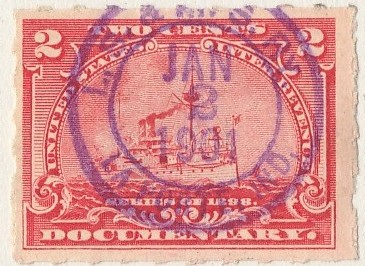
L. S. & M. S. R'Y
JAN     4    1900


New York Central Lines video from the 1940s, with scenes running over former LS&MS tracks.

Monday, January 3, 2011

Cancel for January 3: Lake Shore & Michigan Southern Railway

L. S. & M. S. RY.
JAN    3   1901

William Henry Vanderbilt
1821-1885
Son of Cornelius Vanderbilt, sole heir of Cornelius Vanderbilt's railroad empire by designation in Cornelius Vanderbilt's will.

Sunday, January 2, 2011

Cancel for January 2: Lake Shore & Michigan Southern Railway

L. S. & M. S. RY.
JAN
2
1901
LA PORTE, IND.


Cornelius Vanderbilt
1794-1877
Builder of the New York Central railroad empire including the LS&MS

Friday, December 31, 2010

Happy New Year from 1898 Revenues!

L. S. & M. S.
JAN  1  1901
RY. CO.


The New Year by 1898 Revenues time zones:
John  GMT +3   Nairobi
Bob GMT -6    Minnesota
Frank GMT -7   Arizona
  

******

I spent New Year's Eve here.

Thursday, December 30, 2010

Cancel for December 31: Charles D. Miller, New England Mutual Life Insurance

CHAS.  D.  MILLER, Gen. Agt.
DEC
31
1898
N.  E.  M.  L.  I.  Co.


In 1996, NEMLI was merged into METLIFE and ceased to exist as a separate entity.  


New Home Office Building in Copley Square in Boston.  Former home of The New England Mutual Life Insurance Company.
 

Wednesday, December 29, 2010

1898 Revenues Greatest Hits

2010 is over and its time to see how we play out there in cyberspace.  Nobody would ever call this highly specialized website viral.  However, despite relatively low numbers that visit 1898 Revenues, the year has shown steady upward progress in the number of people that visit the site.  I was playing with numbers for our web traffic, and produced the chart below:


I've plotted the number of page views by week over the course of the year, omitting January for which I have no data (bad planning on my part).  From a simple visual analysis, I see three phases in page view rates on this chart. 
  • Through late May, page views tracked in a band between 200 and 300;
  • mid-summer experienced a jump up to the 300-400 band (with a major anomaly for one week of nearly 600);
  • and from August there was a strong jump up to +400 page views per week, with jumps above 500 views.
I am a trained statistician, but I don't have it in me to dust off those skills to analyze this limited data set.  However, there are some events that can be plotted against the data that might help explain some of the changes over time:

  • February: Dave Thompson starts following the site
  • August:  Frank Sente becomes a co-blogger.
  • Late August:  BALPEX/ARA Meeting
  • December: Bob Hohertz becomes a co-blogger
 ******
With the growing number of page views, there should be changes in the ranking the site receives from Google when conducting specific searches:
1898 series revenue stamps   Google #1
battleship revenues:  Google #2
2 cent documentary   Google #1  (Google #13 in March 2010)
US revenue stamps  Google #17  (Google #76 in March 2010)
revenue cancels   Google #12  (Google #28 in March 2010)
Some improvement here, partially explained by longevity of the site as well as growing numbers of visitors.
*******
2011 should be an interesting year for the site.  Given work and family obligations I can't be too sure how soon major projects can be completed, like producing a revised catalog of documentary printed cancels.  But with the launch of a major project and the addition of a few more specialists interested in the site, numbers of page views should continue to grow.  Frank and Bob have added real experience and expertise to the site, and I am certain that the legitimacy they add to the site is a significant source of draw.  What is more, the steady addition of their thoughts and material to this public forum steadily increases the site's status as a source of searchable philatelic information.  Thanks again to them for their help, and for the steady contribution of material and moral support from Dave Thompson.  Happy New Year to all!!

Cancel for December 30: Bay Terminal Railroad

The B. T. R. R. Co.
DEC 30
=1898=

An Ohio short line.

Tuesday, December 28, 2010

Lake Shore and Michigan Southern Railway Proprietary Use

As regular readers of the site might have noticed, I've got a ton of Lake Shore and Michigan Southern cancels, particularly on R164, the 2 cent documentary.  Christmas Eve featured a large LS&MS CDS on a R164.  Today is something different.  Frank Sente sent in the 1 cent proprietary below cancelled with an LS&MS handstamp.  Why would a railroad use a proprietary stamp?  Could this have been used on a waybill when copies of the 1 cent documentary were in short supply?  Did the LS&MS make its own sparkling wine?  I doubt the latter.  We do know however that the handstamp used on this proprietary stamp was in regular use on the 2ct documentary.  I've included a single example of this exact same cancel used on R164, and the September 1898 page from a R164 calendar composed mainly of railroad and other transport related cancels.  The calendar shows 11 examples of this type of handstamp.


L. S. & M. S.
SEP 24 1898
RY. CO.

Frank Sente scan


L. S. & M. S.
SEP 27 1898
RY. CO.


Monday, December 27, 2010

Cancel for December 27: Demary, Heintz, and Lyman

 R174 $3 Dark Brown Documentary


DEMARY, HEINTZ & LYMAN
DEC
27
1898

General service brokerage house.


From The Buffalo Express, December 14, 1899

Cancel for December 27: The Christian Moerlein Brewing Company


3 copies of R171 50 cent documentary on document fragment with
Christian Moeriein Brewing Company cancel

The  C.  M.  B.  Co.
DEC
27
1898
Cincinnati,  O.


Christian Moerlein was born in Truppack, Bavaria, in 1818. He immigrated to the United States in 1841, eventually settling in Cincinnati, Ohio, in 1842. In 1853, Moerlein established a brewery in Over-the-Rhine, a predominantly German neighborhood in Cincinnati. In its first year of operation, the Christian Moerlein Brewing Company produced one thousand barrels of beer. In just over a decade, the brewery produced more than twenty-six thousand barrels of beer per year. Between 1812, when the first brewery opened its doors in Cincinnati, to the enactment of Prohibition in 1920, more than fifty different breweries had operated in the city. Moerlein was the most prominent brewer in the city. He sold his product across the United States as well as to other countries. During this time, no other Cincinnati brewery entered the international marketplace. His most popular beer was "Old Jug Lager Krug-Bier." The brewery made Moerlein a wealthy man. In 1884, he invested some of his profits in the Cincinnati Cremation Company. Investors in the company hoped that cremation would become more popular than burials of deceased persons. They argued that cremation was more sanitary and would benefit the living by limiting the spread of diseases. The Christian Moerlein Brewing Company continued to operate after his death in 1897. The brewery closed its doors forever with the enactment of Prohibition.

Sunday, December 26, 2010

Civil War Facsimile Imprints on Checks used during the Spanish-American War Tax Period

Most checks payable on sight or demand were taxed from October 1, 1862 until July 1, 1883, then again from July 1, 1898 to July 1, 1901. From late 1875 until the end of the Civil War tax period the only imprint design used was diamond-shaped and printed in orange. A last day use of that design is shown below.


Several companies immediately offered banks facsimile designs that could be printed on checks and drafts, presumably to avoid a feeling of something missing on the part of the general public. A. Gast & Company, of Saint Louis and New York, was one of these. The draft below was one of a set sent out to various banks on July 1, 1883. It features a state seal inside a diamond about the same size of the revenue imprints recently used.


Some accounts used these facsimiles until the 1920's. Invariably, some were used in the Spanish-American war tax period. The handsome draft below, used September 12, 1898, has a Texas state seal in the facsimile, or FAC, and a two-cent provisional tax stamp. It was used by the receivers of the J.B. Watkins Company, which was founded in Lawrence, Kansas.

A Watkins family website provides the following information: "J. B. Watkins was born in Pennsylvania in 1845, law graduate of the University of Michigan, moved to Lawrence in 1873 to start a real estate title and loan business which he later incorporated as the J. B. Watkins Land Mortgage Company. He raised money in the eastern states and in England which he invested in large tracts of land. He also organized a bank to handle his many financial transactions."


Some FACs were more on the order of logos for a particular company. This one was designed specifically for Carter, Rice, who ran a paper company in Boston. When their check was used in July of 1898 a provisional revenue stamp was added.


Several companies had an imprinted revenue added to a check with a facsimile imprint instead of using an adhesive revenue. On most of them the new imprint was added to the lower left to avoid conflict with the FAC.


The user of the check below should have told the imprint printer to do something, since they apparently were not inclined to take it upon themselves to avoid the mess that occurred when they printed it on top of the FAC already on the check. The FAC imprint is shown below it.


Thursday, December 23, 2010

Wednesday, December 22, 2010

Pe-ru-na Issues a Merchant's Draft

The Peruna, or Pe-ru-na, Drug Manufacturing Company was big business at the turn of the twentieth century. The illustrated $259.00 draft called for payment on three days' sight, so was properly taxed at six cents - two cents for each hundred dollars or fraction thereof.


Peruna was located in Columbus and the Stein Vogeler Drug Company was located in Cleveland, but the Western German Bank apparently received the draft on the day it was written, February 23rd, and sent it by runner to Stein Vogeler, where it was accepted the same day and paid into the Peruna account at the bank promptly.

Many merchant's drafts did not allow extra time for the paying company to process them, expecting it to be done "on sight." By giving three days Peruna may have been exercising good business practices but it cost them four cents more in taxes to do so.


And what was Pe-ru-na? From Collier's Weekly, October 28, 1905: "Peruna, or, as its owner, Dr. S. B. Hartman, of Columbus, Ohio (once a physician in good standing), prefers to write it, Pe-ru-na, is at present the most prominent proprietary nostrum in the country." The following material is from the same source, liberally abridged:

"What does Peruna cure? Catarrh. That is the modest claim for it; nothing but catarrh. To be sure, a careful study of its literature will suggest its value as a tonic and a preventive of lassitude. But its reputation rests on catarrh. What is catarrh? Whatever ails you. No matter what you've got, you will be. not only enabled. but compelled, after reading Dr. Hartman's Peruna book 'The Ills of Life,' to diagnose your illness – as catarrh and to realize that Peruna alone will save you. Pneumomia is catarrh of the lungs; so is consumption. Dyspepsia is catarrh of the stomach. Enteritis is catarrh of the intestines. ... Bright's, disease is catarrh of the kidneys. Heart disease is catarrh of the heart. Canker sores are catarrh of the mouth. Measles is, perhaps. catarrh of the skin, since "a teaspoonful of Peruna thrice daily or oftener is In effectual Cure." ... Similarly, malaria, one may guess, is catarrh of the mosquito that bit you.

"Peruna is not a cure-all," virtuously disclaims Dr. Hartman, and grasps at a golden opportunity by advertising his nostrum as a preventive against yellow fever! That alcohol and water, with a little coloring matter and one-half of 1 per cent. of mild drugs, will cure all or any of the ills listed above is too ridiculous to need refutation. Nor does Dr. Hartman himself personally make that claim for his product. He stated to me specifically. and repeatedly that no drug or combination of drugs, with the possible exception of quinine for malaria, will cure disease. His claim is that the belief of the patient in Peruna, fostered as it is by the printed testimony, and aided by 'gentle stimulation,' produces good results.

"Any one wishing to make Peruna for home consumption may do so by mixing half a pint of cologne spirits, 190 proof, with a pint and a half of water, adding thereto a little cubeb for flavor and a little burned sugar for color." The article goes on to cite some lurid stories involving alcohol poisoning.

The Pure Food and Drug Act was not passed until 1906.

Tuesday, December 21, 2010

Cancel for December 22: Hawkeye Fire Insurance Company

Hawkeye
Fire Ins. Co.
DEC 22 1899

The Hawkeye Fire Insurance Company of Des Moines, was organized in 1865, by E. J. Ingersoll, B. F. Allen, J. B. Tiffin, F. W. Palmer, and James Callanan. Mr. Ingersoil was chosen President, and Mr. Allen, Treasurer.

Hawkeye Insurace Map of Des Moines, Iowa with picture inset of E.J. Ingersoll

from the PIONEERS OF POLK COUNTY, IOWA AND REMINISCENCES OF EARLY DAYS
BY L. F. ANDREWS, Volume II, DES MOINES, BAKER-TRISLEE COMPANY 1908:

E. J. INGERSOLL:  Of the many old settlers of Polk County who impressed themselves upon the community, few were more conspicuous than Ebenezer Jared Ingersoll.

Born in Pulaski, Oswego County, New York, March Twenty-eighth, 1828, of English ancestry, which embraced the names of men eminent as ministers, lawyers, and statesmen. He lived with his parents until twenty-one years old, and acquired a thorough academic education. After reading law in the office of Judge Huntington, of Pulaski, he entered the United States Law School at Balston Springs, and was graduated in 1852, with the degree of Bachelor of Law, and was admitted to practice in the state and federal courts. He opened an office in Adams, Greene County, New York, where he secured a large and profitable practice.

In the fall of 1858, he joined the tide of emigration westward and came to Des Moines, where he was admitted to the Bar and at once took high rank with the members of the profession. A man of optimistic temperament, remarkable force and energy, he soon discovered greater possibilities for the Capital City, and became a booster and promoter of business enterprises, not only in the town, but throughout Central Iowa. He demonstrated his faith in their growth and prosperity by engaging in several business enterprises. He also purchased several farms and engaged extensively in raising thoroughbred stock.

One day, in 1860, Ingersoll, S. R. Ingham, J. M. Elwood, and John Browne were sitting in a social game of whist in the old Exchange Building, at Third and Walnut. Browne had been the Western agent of the Globe Insurance Company, of Utica, New York. During the play, insurance was discussed, quite naturally, as the Globe Company had just collapsed, and Browne said to his friends: "Why don't you start an insurance company?" Ingersoll at once began to consider it, but the Civil War came on, during which there was little inducement to undertake enterprises of that kind. He, however, with his usual pertinacity, stuck to it, and March Sixth, 1865, with B. F. Allen, Frank W. Palmer, James Callahan, and J. B. Tiffin, organized the Hawkeye Fire Insurance Company. For three years, the company did business as a partnership. Ingersoll was elected President, and held the office until his death, in 1891. He was the pioneer in a business system which has expanded until Des Moines is now known as the "Hartford of the West."

April Seventh, 1868, the company was incorporated under the laws of Iowa, the following persons signing the Articles of Incorporation: F. W. Palmer, J. B. Tiffin, B. F. Allen, James Callanan, Junior, W. S. Pritchard, and E. J. lngersoll. Mr. Callanan was elected Treasurer, and held the place several years. The capital stock was fixed at one hundred thousand dollars.

In 1870, Mr. Ingersoll abandoned his other enterprises, and devoted his time and energy to build up the Hawkeye. It was uphill work. The older Eastern companies, represented by agents, interposed every possible obstacle to his progress, but they reckoned without their host when they struck Ingersoll, for he was a man of indomitable will and courage, denoted in every line of his face, which, like an electric current, became stronger as resistance against it increased. Opposition only intensified his force. The Hawkeye was his creation. He was the moving spirit of it, making it one of the strongest financial institutions of the state, but he had to fight for it, step by step.

As a business man, he was eminently successful. He was a person of athletic build, nervous, lymphatic temperament, brusque and plain of speech, often using very vigorous swear-words; was no hero-worshipper; was strong in his convictions, which, once fixed, were not easily removed. I remember an incident which occurred soon after the Legislature had made a change in the insurance laws, tending to protect the public against the watering of stock, and among other requirements was one that joint stock companies must have the words, "Stock Company," prominently printed on the face of their policies. His supply of blank policies having become exhausted, he ordered several thousand printed by Mills & Company, and one day when they were running through the press I called his attention to the omission of the words, "Stock Company," which the statute required put in, supposing that it was an error which sometimes occurs in the best-regulated printing offices, and that he would order the presses stopped to make the correction, but, instead, he retorted: "I don't care a d — n what the d— n fools over at the State House require. I'll have my policies printed the way I want them." The job was finished, but a few days after, he ordered another lot printed, with the required words in place, but he never changed his opinion resisting the Legislature.

Politically, he was a Democrat, of the ultra variety, but abjured politics entirely. He was not built for a politician, and would have failed had he attempted to play the game.

Socially, he was a person of high ideals. Brusque and blunt as he was, his heart pulsated with tenderness and sympathy for those in want or suffering, and his purse was always open to such for relief. He was not a good mixer, but his friends were those who knew him as he was, a man of probity, honesty of purpose; and they never faltered in their attachments. He was not a member of any clubs or fraternal organizations.

He died in 1891.