Saturday, November 17, 2012

On Beyond Holcombe: Vapo-Cresolene

On Beyond Holcombe by Malcolm A. Goldstein appears on Sundays at 1898 Revenues.


According to Mustacich and Giacomelli, the Vapo-Cresolene Company can be conclusively linked to only a single printed cancel appearing on RB 28.  Hardly worth a mention in philatelic annals, right?  Perhaps such willful ignorance animates those battleship specialists whose principal joy is discovering new intricacies in the line arrangement or millimeter spacings among printed cancels.  Since this study focuses on the wider implications of patent medicine companies, the immense volume of this company’s advertising in contemporary newspapers, magazines and journals and the lingering existence of its iconic lamps (ever discovered in dusty corners of flea markets, in antique stores and available on line), argue for its enormous success both as a patent medicine industry competitor and as a cultural force worth examining.


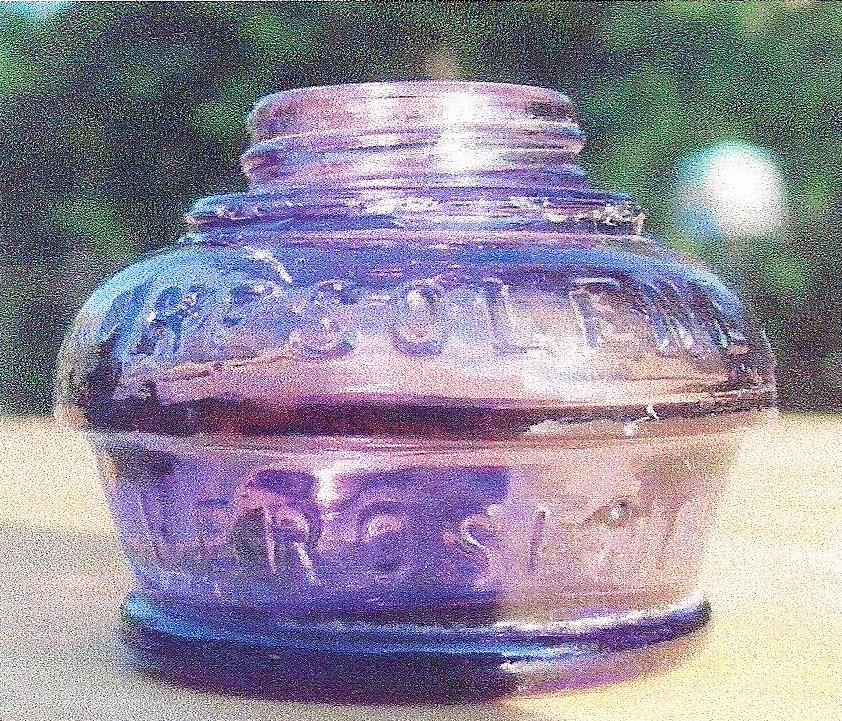
Even philatelically, there ought to be more to Vapo-Cresolene’s story.  The sheer enormity of its presence in both the past and present markets seem to require a larger philatelic footprint.  Mustacich and Giacomelli do identify one hand-stamped “V.-C.Co” cancel observed on an RB 28 that probably ought to be matched with this company.  Other un-attributed “V. C. Co.” cancels appear on values other than RB 28. These cancels may or may not coincide with the Company’s product line, which did include both replacement parts and replenishment bottles of the liquid used in its system.  Two un-attributed hand-stamps (only one of which appears on an RB 28) that otherwise might match - “T V C” and “T V & Co” - just miss alignment with the company’s name, even though that name sometimes appears in advertising as The Vapo-Cresolene Co.  Maybe this article will persuade collectors of all flavors - stamps, bottles, lamps, antiques - to take another look at their boxes and revenue stamp pieces to see if they can find more cancelled battleships that are definitively Vapo-Cresolene’s.


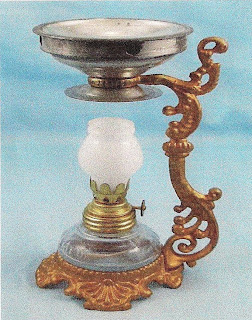
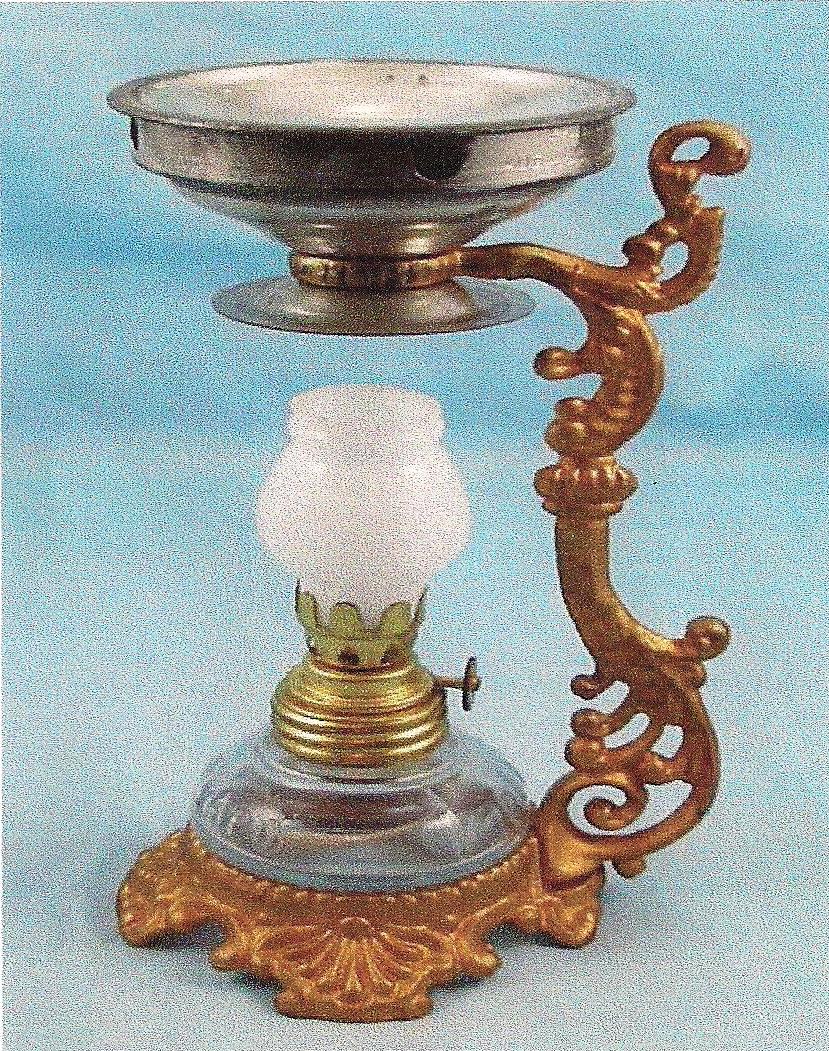
Vapo-Cresolene was popular.  The Vapo-Cresolene box appeared large, yellow, and solid on the druggist’s shelf.  When opened, it contained a small glass lamp, a sturdy, heavy, but gracefully molded, iron stand with an opening at the bottom to hold the lamp and an arm at the top suspending a vaporizer tray over the opening for the lamp, together with a bottle of Cresolene, a spare lamp wick, and instructions.  The instructions told the user to fill the lamp with kerosene only - alcohol would explode - and turn the flame up as high as manageable without causing smoke for the first fifteen minutes.  Once the lamp was producing heat, it was placed in the stand under the Vaporizer tray. 


However distinctively idiomatic the lamp and stand were and remain, it was the Cresolene, a sticky black liquid,  that constituted the therapeutic core of the device.  The Cresolene was poured into the tray and allowed to vaporize over the lamp flame in a ventilated room, and was intended to disinfect the space into which it permeated. The company advertised the Vapo-Cresolene system to be effective in treating respiratory diseases such as croup, catarrh, diphtheria, whooping cough, scarlet fever and asthma, by destroying the disease producing microbes in the patient’s system when the vapor was inhaled.  While Cresolene was the company’s proprietary formulation, the American Medical Association’s analysis in 1908 found it to be no more or less than garden variety cresol as described in the United States Pharmacopoeia, the official scientific compilation of medical compounds used in the United States. (Recall that the eminent scientist, Dr. Lyon of Nelson, Baker & Co, served on the 1900 decennial revision committee for that document.) 

Cresols are organic compounds characterized by a methyl group (CH3) attached to a phenol molecule (a benzene ring with a hydroxyl radical (OH) already bonded to it).  By definition, they occur in nature as components of pitch and bitumen, and had been used without specific identification as parts of these undifferentiated materials for medicinal purposes since antiquity. First recognized as separate chemicals and refined in the 1830s, these compounds themselves were, as will be discussed below in detail, produced by distilling coal tar, itself originally regarded as a useless by-product of the reduction, or controlled burning, of wood or coal.  The medicinal utility of cresols was debated throughout the 19th Century.  They were employed as antiseptics and disinfectants, but as the concentration of the cresols increased in a substance, the potential to burn also rose in direct proportion. While a number of companies that cancelled battleship revenues built their fortunes on clever uses of cresol compounds (and those companies will be encompassed by this study), eventually, the compounds themselves were replaced for most medical purposes by others that had the same beneficent power to disinfect without the concomitant danger of injury.

As for the public’s use of the Vapo-Cresolene vaporizer system, since the therapy was accepted as potentially medically useful, although marginal at best since the inhalant had to be kept quite mild to avoid being poisonous, all the AMA article could conclude - much in the same manner as Consumer Reports does now for consumer goods - was that the Vapo-Cresolene system was unnecessarily expensive without producing any greater beneficial effect than any inexpensive generic equivalent cresol compound: “ This report indicates that Vapo-Cresolene is a member of that class of proprietaries in which an ordinary product is endowed, by the manufacturer, with extraordinary virtues.  The type is so common and has been referred to so frequently that but for the dangers attendant on the inhalation of any of the phenols, this particular product need not have been mentioned.”


Vapo-Cresolene, as a patent medicine business, resulted from the merging of the talents of one James Henry Valentine, the inventor of the vaporizer system, and George Shepard Page.  Sadly, Valentine’s character and personality do not emerge clearly from current records.  In a history of Chatham, NJ, he is portrayed as the man who singularly and successfully used a “coal tar acid named Cresolene” as a vapor to relieve the discomfort of his child suffering from whooping cough.  However, because he did not have sufficient money to follow through with his idea, he soon turned the operation of the vaporizer business over to Page.  The government issued its first patent for the vaporizing system in 1881 to one Elias H Carpenter.  Carpenter immediately assigned the patent to Valentine, who, in turn, assigned a one-half interest to George Page.  Valentine owned parts of several patents obtained from the 1880s to 1903, in connection with improvements made the lamp apparatus as well as for the bottles used for Vapo-Cresolene, and, although he ought to have drawn some monetary benefit for himself (as well as his sick daughter) from these patents, he is remembered now only for his intuitive tinkering and otherwise fades quickly from the history of the Vapo-Cresolene Company.  A possible consequence of his exit is that a James H Valentine is listed as a director of the Vaporia Medicine Co, which filed in New Jersey for a corporate certificate in 1900, and in 1901 maintained its own offices in New York City. This company, which, coincidently, also marketed a coal tar derivative vaporizing system, became the Varoma Medicine Co in 1902, and promptly appointed as its agent another battleship cancelling company, wholesale druggist W H Schieffelin & Co (yet another story for another day).


George S. Page

George S Page (1839-1892) was already rich when he first encountered Valentine.  Born in Redfield, ME in 1839 and educated in Chelsea, MA, by 1879, Page had both control of the essential ingredient, Cresolene, and the financial expertise and means to fully develop Valentine’s vaporizer idea. Because of his own comfortable situation, he was delighted to finance Valentine’s vaporizing venture as a side business to his own.  Because the Pages conducted the Vapo-Cresolene business, had the wealth, and attracted its attendant contemporary publicity, they have earned whatever kind of immortality articles such as these produce.

Page’s career and fortune arose from the production of coal gas and the discriminating refinement of coal tar.  After briefly attempting to make his fortune in the West as a young man, he returned to work with his father at Samuel Page & Son of Boston, MA, a company which specialized in the distillation of paraffin oils, wax and mineral oil then used as the purest and choicest of illuminating materials, from the by-products of that reduction, of wood, certain minerals or coal.  By 1800, scientists also had discovered the secret of extracting coal gas as another by-product from the reduction of coal.  This process, in turn, became one of the growth industries of the first half of the Nineteenth Century because coal gas was the first product that could be both manufactured and distributed cheaply to illuminate the lamps of cities at the dawn of the “gas light era.”  (Natural gas came decades later.)  Coal gas production became, in essence, the first indispensable utility.  Coal tar, itself a mixture of some two hundred different substances, was also a by-product of the reduction of coal. To virtually all of those who were busy cashing in on the coal gas boom to illuminate cities, coal tar was an oily, thick, dirty substance often considered worse than useless. Page not only applied the talents he had learned working for his father to jump into the field of coal gas production, but he also made the vital connection that coal tar itself could be further refined into usable pitch, a material then most notably used as a water-sealant for caulking ships, or in Page’s observation, as a paving material to lay a sidewalk.

Page himself often recounted the story of his life-altering discovery. He noticed a group of workmen laying a pitch sidewalk during a visit to Salem, MA, and took from them some of the pitch they were using.  He then went to the local Salem gas works, where he procured some coal tar.  On the following morning, he returned to the paving site and presented the foreman of the job with the sample of pitch the foreman had given him together with a sample of pitch he had produced from the coal tar by-product of the Salem gas works.  The foreman chose Page’s product as superior, and a new paving material industry was born in that instant. Necessity might also have driven Page’s brilliant insight because just at the same moment he experienced his epiphany in Salem, commercial petroleum was becoming available from Pennsylvania to supplant paraffin as the finest and most brilliant illuminating material. Page was bright and quick enough to observe that he had to expand his horizons beyond paraffin production.


By 1865, as well as his coal gas production interests, Page was associated with the firm of Page, Kidder & Fletcher, which in 1872 morphed into a stock corporation, the New York Coal Tar Chemical Co, known for producing roofing and water proofing material, as well as a range of commercially useful chemicals, such as carbolic acid, naphtha, benzol, and ammonia sulfate, all from coal tar.  Page’s fortune was created by his clever application of scientific advances and redoubled by his shrewd investment in the capricious stock market of his era, although his career in industry also continued from highlight to highlight.  He was responsible for introducing to the United States several new generations of European technology for improving the refinement of coal tar to produce purer and more precise derivative compounds, each of which rewarded him with a fresh fortune. He also played a significant role in the gas industry itself, negotiating at one point, for example, among warring factions of gas producers in St. Louis to resolve their differences and form an efficient (and probably monopolistic) combine.


Page played as hard as he worked.  He was, as an obituary characterized him, “an ardent sportsman, and his love for the rod, gun, dog and field was second only to his fealty to the gas industry.” By 1888, he had created an estate of several hundred acres called “Stanley” in honor of his mother’s maiden name, in the Orange Hills near Chatham, in Morris County, NJ, had settled down to the life of a country squire and had separated himself from the day to day operations of his chemical company. He was a driving spirit behind the U.S. Fish Commission, a government agency which was among the earliest to apply scientific methodology to fish breeding, was the president of the Chatham, NJ Fish and Game Protective Association, and vice-president of the American Fish-Culturist Association. He was instrumental in the development of Rangeley, ME as a fishing and hunting destination.  The breeding records of his kennels, also developed with his son Albion as a commercial business and known as the Dunrobin Kennels, are enshrined in the archives of the American Kennel Club.  After his father’s death, Albion carried on in his father’s footsteps as a sportsman.  In 1900, his racing horses, which garnered second prize at the Morristown Field Club, in Morristown, NJ, team trials, were two chestnut mares named Vapo and Cresolene.           

George S Page was also a noted philanthropist in his time, serving as the president of the Howard Mission and Home for Little Wanders .  He was an active member of his Congregationalist Church, superintendent of its Sunday School, and a vocal advocate and supporter of public education. He was also a founder of the New Jersey Temperance Association and its president for several years.  When he died, quite suddenly at age 52, his funeral was held, as the same contemporary obituary noted, at his “manor house ... amid a throng that represented every phase of the life of the district for miles around.”  That obituary, published in the American Gas Light Journal issue of April 4, 1892, noted that his death:

caused a shock to many of our readers; for it is hard to realize that a splendid physical development nourished by carefully trained habits of abstemiousness and by strict attention to the laws of nature and culture could be so closely allied to the swiftest summons of death.  In the prime of a vigorous manhood, Mr. Page passed away, almost without warning, on the morning of Saturday, March 26th, and with this going out was terminated the life that animated the body of an impulsive though consistent, of a just but generous, of a decided but not bigoted man. In fact, to write of him as dead is somewhat difficult now.  The time that separates him from us does not seem sufficient to reconcile us to the knowledge that his marked personality is at an end.


Strangely enough, aside from his mention in connection with its funding, George S Page’s name does not really ever appear again in the Vapo-Cresolene Company’s records.  However, Page had four sons and a daughter and there can be no doubt this business, among all of George’s various interests, was carried on as a family affair. By the 1880s, George Page’s oldest son Albion Lambert Page, had become the President of the Company. Forty years later, a listing of the Vapo-Cresolene Company’s directors in 1919 shows that Albion was still entrenched as President and Manager of the Company as well as a director.  George’s second son Harry de Bacon Page, was Vice-President, Treasurer and a director.  George’s third son Lawrence S Page was Secretary and a director of the Company.  The remaining directors were Raymond F Page, George’s fourth son, and George’s only daughter, Florence P Ensign.  The Company had begun operation in 1879, had offices in New York City at different addresses on Fulton, Wall and Cortlandt streets, and located its manufacturing plant in Chatham, NJ, undoubtedly where George S could keep an eye on it as long as he remained alive.  It soon had its own offices in Montreal, Canada and Durban, South Africa.  Its London agent was Allen and Hanburys, Ltd, already profiled in this column.  In 1901, its capitalization was $75,000; by 1919 capitalization had doubled to $150,000.

Vapo-Cresolene’s vaporizer system was, and continued to be, advertised widely for approximately 80 years.  Of course, used improperly, Vapo-Cresolene units could, and did, cause harm.  There was always the danger of fire posed by an open flame in any lamp, and upset Vapo-Cresolene lamps and stands accounted for some number of fires.  There were periodic reports in medical journals of near poisonings caused by using the Vapo-Cresolene lamp in an improperly ventilated room, although Vapo-Cresolene’s advertising stressed that it was most efficaciously used in a closed room. On a least one occasion, in 1912, an infant died from drinking the contents of an unattended Cresolene bottle, which everyone understood to be poisonous if ingested.  By the 1920s, the Company branched into producing tablets to broaden its product offerings, and by the 1940s, the government forced the company to tone down its promises of cures for respiratory illnesses. Yet with all these drawbacks, Vapo-Cresolene vaporizer units, eventually with electric heating elements supplanting the kerosene lamps, continued to be produced until the 1950s.  Why did the public embrace such an inefficient and potentially dangerous system for so long?  That question probably cannot be answered precisely, but it can equally asserted that nothing has really changed.  Medicine is often predicated on refining poison.  After all, Botox, the miracle anti-aging drug of our times, is merely diluted botulism toxin, among the most fatal and deadly substances known to man.

The major figure that emerges from the history of Vapo-Cresolene is George S Page, who really plays only an indirect role in its story.  While today, to the extent he is remembered at all, he is known as a sportsman, he was also a pioneering businessman, and deserves his place among the industrial barons of the Nineteenth Century, with all of the both good and bad connotation that title evokes. If Vapo-Cresolene was an afterthought or off-shoot of a more important venture to him, it has endured to eclipse his memory and lives on in our collective imagination, because of  its still available advertisements and vaporizers, and is stitched into our collective image of art nouveau.   


Vapo-Cresolene cancels from the collection of Henry Tolman

Wednesday, November 14, 2012

Oil Companies: The Standard Oil Company - John Rockefeller and Ida Tarbell


What was the Standard Oil Company?  Standard Oil was established in 1870, became the largest oil refiner in the world, and was broken up for anti-trust reasons by the Supreme Court in 1911.  John D. Rockefeller was the founder and chairman of the company, and with his control and ownership became the richest man in  the world.

Standard Oil and John Rockefeller became famous, and in some quarters infamous, for the firm's and its chairman's voracious appetite for its competition.  Rockefeller managed to undercut, weaken, and then find ways to control, buy-out, or destroy competition.  These behaviors would ultimately stimulate the work of muckraking journalists, and lead to anti-trust litigation that would break up the firm.  

The first great American investigative journalist, Ida Tarbell, would essentially establish the craft of investigative journalism through her work on the case of Standard Oil.  

John D. Rockefeller
1839-1937

For all the approbation cast upon Mr. Rockefeller for his aggressive business practices, Rockefeller was one of the greatest philanthropists in history and his legacy still benefits the world today.  Rockefeller lived a long time: 98 years.  He retired from business while still in his sixties, giving him more than 30 years to practice and structure formal philanthropy.  As one of the richest men in history, combined with his extended "retirement", John Rockefeller ultimately became a boon to the pursuit of the arts and sciences in the United States and throughout the world.

Ida Tarbell
1857-1944


Though published as a book, Tarbell's original work on Standard Oil appeared in a magazine called McClures, serialized in 19 parts.  McClures was quite popular in turn of the century United States, and distinguished itself by publishing a series of muckraking articles, including Ray Baker's investigation of United States Steel.


The famous 1904 Standard Oil octopus with a grip on everything within its reach, including the Congress, and with its eyes on its next target, the White House.

Tuesday, November 13, 2012

Oil Companies: Producers Oil Company Limited


P. O. Co. Ltd.
JUN  11  1900


From The Official Railway Equipment Register of 1901:


The Producers Oil Company represented a group of independent oil producers long in the sites of John Rockefeller's Standard Oil.  For years the company maintained its independence despite constant hostile takeover attempts by Rockefeller. 

By 1897, Standard Oil interests owned a majority of Producers' stock.  But the voting and controlling shares of the firm remained with the forming owners of the company, and legal actions by Standard to seize control through majority ownership were rebuffed by the courts.

The travails of the Producers Oil Company were documented by Ida Tarbell in her muckraking classic, The History of The Standard Oil Company.

*****

The year of this cancel, Producers Oil Company became part of a larger holding company called the Pure Oil Producing Company.   Eventually Pure Oil would become a national name brand in the petroleum industry.  The company was independent and successful through the mid-1960s, when it was absorbed by Union Oil, which in turn branded itself Union 76.  Union 76 was the property of Unocal, which merged with Chevron in 2005.

Monday, November 12, 2012

Oil Companies: Cornplanter Refining Company


CORNPLANTER
JUN
10
1899
REFINING CO.


CORNPLANTER
FEB
3
1900
REFINING CO.

Langlois scans

Cornplanter Refining Company was a small, Warren, Pennsylvania based oil company.  The firm not only refined oil but prospected for and produced crude oil in the northwest Pennsylvania oil patch. 


Chief Cornplanter, portrait by Frederick Bartoli, 1796

Chief Cornplanter was a Seneca Indian chief during the early history of the United States, including the periods of the French and Indian War and the Revolutionary War.  The US Government "gave" Cornplanter a grant of 1500 acres along the Allegheny River in Pennsylvania near the boundary with the State of New York.  I presume what would become part of the Pennsylvania oil patch included the territory of this original grant.

Sunday, November 11, 2012

Linseed Oil


Golden and Brown Flax Seeds
In Old English, lin was the word for flax


What is linseed oil?  The production of the oil, and its use in paints, were once major industries in the United States.  Cartels were built, and major fortunes were made for men like Spencer Kellogg.  But now the oil is largely obsolete for large scale industrial use, and the old firms extinct.

It is now fall in the northern hemisphere, and the summer clothes should all be put away.  As a man whose boyhood was spent in the south, this meant that the linen was put away:  linen jackets, pants, and suits.  And where does linen come from? From the same place that linseed oil comes from, the flax plant.  Flax was grown not just for the fibers, but for the oil that came from the seeds.  Oil paints used flax seed oil as the base, and millions of gallons were produced each year in the United States for the production of paint.  


SPENCER KELLOGG
AUG  27   1899
BUFFALO, N. Y.

Spencer Kellogg was one of the largest linseed oil producers in the US and the world.  

Linseed oil dries, or polymerizes, into a solid.  And it is the drying and solidifying action that made it an important part of paints before the discovery and synthesis of alkyd resins.  Today, water-based paints predominate, further reducing the use of linseed oil.

In 1860, Frederick Walton invented something called linoleum, which used linseed oil as a binder for ground particles of wood and other materials.  Linoleum was a common home and industrial floor covering for nearly 100 years, until its replacement with PVC floor coverings.


Nat'l Linseed Oil Co.
AUG   4   1898
CHICAGO


Notoriety:  Linseed oil is the oil that made paint rags notorious for spontaneous combustion.  Rags soaked in the oil and then left to sit provide a large surface area for rapid oxidation of the oil.  The reaction is so rapid that it creates heat, in some cases so much that the rags can spontaneously combust.  One Meridian Plaza in Philadelphia was the most famous building in recent history to be destroyed by a fire started by the spontaneous combustion of linseed oil soaked rags.

Saturday, November 10, 2012

On Beyond Holcombe: United States Pharmacal Company

On Beyond Holcombe, by Malcolm A. Goldstein, appears on Sundays at 1898 Revenues.


As Monty Python would say: “and now for something completely different.”  One immediate apparent difference is that the impetus for this article about the United States Pharmacal Co (USPCo) arises from a documentary battleship stamp cancel, one found on a company check, rather than a proprietary battleship cancel.  Not that USPCo proprietary cancels do not exist.  Mustacich and Giacomelli identify several different ones that the company employed, including both printed and hand-stamped, and one of the printed varieties is also illustrated here.  The company obviously had a sufficient volume of business to warrant use of enough stamps to cause the different cancels, although its name is now principally identified with IXL Hair Restorer and New Century Scalp Tonic.


However, the real point of distinction between USPCo and the other manufacturers previously discussed in this column is in its ownership.  The success of the proprietary medicine companies heretofore examined has largely been driven by the aspirations of some shrewd businessperson/huckster (ala Radam) who, having fixated on the idea that his or her elixir would vanquish disease, strove to convert that vision into a fortune.  USPCo was born of a more practical goal: to build the fortunes, not of the creators, but rather the ultimate sellers of those nostrums to the public.  The Illinois Pharmaceutical Association (IPA), an association of retail druggists, authorized the formation of the company in a resolution passed at its meeting held in Peoria, IL, in July, 1894.  IPA’s idea was to create a “mutual or cooperative manufacturing pharmaceutical company owned, operated and controlled directly by retail druggists.”  By organizing and owning their own pharmaceutical supply source, the IPA’s members hoped to attain perfect retail price control maintenance for their products. Establishing a single set of prices would guarantee a larger profit margin to the retailer by conserving a larger percentage of the consumer’s fixed final cost to the retailer.  After all, money not owned to the manufacturers or the wholesalers for the basic cost of their products was money in the retailers’ pockets.  However, because of the large number of nostrums and patent  medicines potentially available, and the need for continuous, heavy barrage of advertising then thought necessary to keep any brand fixed in the public’s mind - normally a cost borne by the manufacturer of the product  - cooperatives were formed only by a distinct minority of retailers.

USPCo was one of the most long-lived and successful of these retail owned cooperatives. The method that IPA devised for the operation of USPCo was as harsh and restrictive as any devised by the manufacturers and the wholesalers themselves, for the IPA adopted a price control plan (IPA Plan) called the Direct Contract and Serial Number plan (DCSN plan). IPA even prided itself on being the organization that introduced this particular scheme to the United States. If IPA was, indeed, the first to adopt it, the DCSN plan was quickly and widely copied thereafter by manufacturers and retailers themselves.  A DCSN Plan provided that the manufacturer signed an individual contract with each retailer to supply product already priced for retail sale that also bore a unique serial number traceable to the individual retailer.  If the manufacturer’s product was purchased thereafter at any price other than the printed price or from anyone other than the retailer to whom the serial number had been allocated, the leak in the closed system could be traced immediately by consulting the manufacturer’s master list of serial numbers.  The manufacturer enforced its plan by issuing periodic “cut-lists,” usually monthly, of those retailers who had undersold the marked price or who had let product stray from their stock (such that it was ultimately vended by someone else for less than the marked price), and these offending retailers were barred from further purchases of goods from any member of the plan, until they pledged again to uphold the plan.


Because of USPCo’s success, its representatives were given a place of honor among the speakers at one of the sessions attendant to the Convention held in St. Louis in 1904 by the National Association of Retail Druggists (NARD) to explain the IPA Plan’s workings to all of the assembled retailers.  The IPA Plan operated so well that IPA celebrated its tenth anniversary of actual operation in 1906 with special resolutions asking each retail member to institute a special advertising promotion called “U S P Co week” during the first weeks of September, December, March and June of that year, and each subsequent year, where member pharmacists would “give the goods of the U. S. Pharmacal Co. special advertising, special display in their stores, special window space, and in other ways extra and unusual prominence, with a view to increasing the sales on their goods.”  Shortly after the passage of these resolution, the NARD’s Notes trade circular reported that the September, 1906 “U S P Co” week was extremely successful.  On the very same page, the circular published a complete list of all those companies and organizations that had adopted DCSN plans.  It summarized the then successful current state of affairs created by DCSN plans by saying: “The preparations of these manufacturers, protected as they are by direct contract and serial numbering identification marks, are being successfully kept out of the hands of mail order houses and other price demoralization agencies by their respective makers and retail profits on the sale thereof are being maintained on a healthy basis.”

The only potential shadow on USPCo’s future was the possibility that the legality of DCSN plans might successfully be challenged in the courts. For twenty years those “mail order houses and other price demoralization agencies,” whose names regularly appeared on the monthly “cut-lists” of DCSN plans kept arguing that these DCSN plans were an illegal restraint of trade.  They continually sued, asking the courts to “specifically compel” by injunction the sponsors of DCSN plans to sell to them on the same basis as plan members. These excluded wholesalers and retailers insisted that DCSN plans prevented competition because they could not freely sell the products protected under these plans (no matter how they acquired them) for less than the sponsors’ required retail prices, even though they were satisfied to receive from their sales a smaller profit margin than plan members.


This line of reasoning consistently puzzled the state courts to whom it was argued.  At their most friendly, courts are always reluctant to issue orders compelling parties to do specific acts - so-called “mandatory” injunctions - because they are accustomed to remedying harm by awarding sums of money as damages, figuring that such monetary damage awards compensate for actions not performed.  Courts issue injunctions only where circumstances are irreversible. For example, if there were questions surrounding ownership of a historic house, and the house was about to be torn down, a court might enjoin the demolition, pending a full review of the circumstances, on the theory that the house, once demolished, cannot be reassembled, and so is “irreparable.”  Even this kind of injunction is not “mandatory” but “preventative,” preserving the house intact only until the disputed issue is resolved. A mandatory injunction compels an unwilling party to act when it would otherwise not act.   Courts could never find such “irreparable” harm in the exclusion of “cut-listed” retailers by sponsors of DCSN’s plans.  Citing defendant manufacturers’ “liberty” to sell only to those with whom they chose to do business, and treating the plaintiff wholesalers and retailers as interlopers who had somehow unfairly meddled with the harmony of the DCSN plans by procuring the protected products under shady circumstances, the courts fairly consistently upheld the legality of DCSN plans, endorsing them as legitimate business models. 

However, with the advent of President Theodore Roosevelt’s attempts to control the overreaching of manufacturing trusts of all stripes by having the US Justice Department enforce the federal Sherman Act, the legality of DCSN plans began to come under attack.  Building on success in earlier antitrust suits brought against other industries, in May, 1907, the federal government achieved in the drug industry the “Indianapolis Decree,” the settlement of an Sherman Act antitrust suit against the Proprietary Association of America representing manufacturers, the National Wholesale Drug Association representing the wholesale druggists, and the NARD representing retailers (as well as specifically named companies, such as Gilbert Bros & Co, previously mentioned in an earlier column), which began to erode the control manufacturers could exercise on retail prices through DCSN plans.  Nevertheless, within months after this settlement was negotiated an article in the Pacific Pharmacist, a new drug trade journal, flatly asserted: “The D.C. and S.N. plan is not affected [by the settlement], provided the manufacturer will put the plan into effect individually, and not “in collusion” with other manufacturers, or any other agency or agencies” (italics in original).


This viewpoint proved to be wishful thinking.  Focusing upon the result that consumers were forced to buy at the single price set in retail price maintenance plans, which it found to be maintained artificially higher than it otherwise would have been had the cut-rate retailers sold at the price they chose (rather than adhering to the state court rulings favoring the “liberty” of manufacturers to sell only to those whom they liked), in 1911, the Supreme Court of the United States ruled retail price maintenance plans, such as the DCSN plan, illegal restraints upon trade pursuant to the provisions of the Sherman Act. (Since analyzing the nuances of all the cases which led to the 1911 decision, both pro and con, is extremely complex, the various court decisions will be examined in greater detail as this column visits the specific companies involved in them).

The IPA Plan itself was never ruled illegal in a specific court decision, and it is unclear when USPCo finally discarded it, although presumably it was shortly after the Supreme Court’s ruling in 1911. Other questions not answered in the extant records are when or whether IPA’s members ever separated themselves from ownership of USPCO, and exactly when USPCo manufactured the IXL Hair Restorer and New Century Scalp Tonic.  USPCo was still listed in trade indexes as late as 1927 as a Chicago based manufacturer of household patent medicines, and these products probably date from the teens or the twenties. Whether this company actually still exists cannot be proven from the extant records.  The name, however, has continued to exist.

At some date after 1927, the USPCo name appears to have unmoored from the IPA and the Chicago location. In 1940, a company with the USPCo name was to be located in Newark, NJ.  In 1942, the federal government seized as misbranded a shipment of citrate of magnesia, a patent medicine staple, manufactured by the USPCo in Newark, NJ and released it to a Philadelphia company for re-branding.  In 1959, a USPCo registered its ownership of the trademark Syr-Tane for use on cough syrup. In 1963 USPCo showed up in a drug trade listing as a corporation located in Brooklyn, NY.  In a 1976 trade compilation, the USPCo name was associated with a product called Ban-Itch (a product name which was later itself associated with Sheffield Laboratories, the successor to another company that cancelled battleship proprietary stamps - but that is a story for another day).  In 1980, a USPCo is listed as a division of another pharmaceutical company, and in 1988, the Syr-Tane trademark expired without being renewed.  A website named Bizapedia lists the United States Pharmacal Co name as “active” as of January 3, 2012, in connection with a address listed broadly as Philadelphia, PA and taken from a filing made in Pennsylvania in 1958.   Another website, Manta, shows that a United States Pharmacal Co, LLC, incorporated in Colorado in 2005, is located in Erie, CO, just outside of Boulder, CO.  This USPCo presently maintains its own website and advertises a product called Cann-Ease Nasal Moisterizing Gel on several websites.  Yet another website, Cotera, shows the USPCo as a testing laboratory incorporated in 2003 and headquartered Lafayette, CO, next door to Erie, CO. Although the Colorado company has no direct connection to the namesake Chicago company, its own website continues the tradition of building its sales upon testimonials from satisfied customers, now posted on line instead of reproduced in print ads.  The spirit of over-the-counter cures soldiers on.

Wednesday, November 7, 2012

First National Bank, Charlotte, Michigan


FIRST NATIONAL BANK
MAR
28
1900
CHARLOTTE, MICH.

Langlois scan


The hazards of living and working in the Michigan logging business, even for a white-collared owner and banker, are made clear by this story from the Fulton, Michigan Patriot.  First National Bank President William Smith came to a rather gruesome end in 1889:

Fulton Patriot, Sep 26, 1889

Bank President Killed

Charlotte, Mich., Sept 25 - President William Smith of the First National Bank of this city, was killed at Wolverine by being thrown from a log carrier against a moving saw. Mr. Smith held vast lumber interests in Cheboygan county and went to that point to make general arrangements for the transfer of the property to a Chicago man, who was with Mr. Smith at the time of the accident. Besides controlling the stock of the First National bank he was rated as one of the richest men in the county.

Tuesday, November 6, 2012

Denver Fire Clay Company

The identity of this cancel is based on an educated guess and needs a confirmatory on-document example.  If you have a D. F. C. Co. cancel on-piece, please write to me at 1898revenues@gmail.com.


D. F. C. CO.
APR  7    1899
DENVER

Langlois scan


The Denver Fire Clay Company had its origins in a drugstore owned and operated by Joab Otis Bosworth at 411 Larimer St. in Denver.  The year was 1876 and Bosworth had already began experimenting with fire clay hoping to develop assay products including scorifiers, crucibles and muffles to compete with those being imported from Europe. The assay business was booming and Bosworth quickly created a product line.  He formed a partnership known as Bosworth, Babcock & Co and began supplying Colorado assayers with a variety of products including chemicals, mining equipment and supplies, and clay crucibles under the name Denver Fire Clay.

In 1878, Bosworth enlisted William Hover, an assayer from Salt Lake City, to become a business partner in the drugstore and Bosworth devoted full time to the fire clay business. The Denver Fire Clay Co. at 31st and Blake Streets was incorporated in 1880 with a capital stock of $20,000. Bosworth was elected President, F. M. Case, Secretary, George Snyder, Jr., Assistant Secretary, and A. E. Smith, Plant Foreman. Much of DFC’s early production was of fire-resistant bricks for the construction of smelters. In 1890, Bosworth was killed in an explosion at the DFC store on Larimer St. and his widow continued the business constructing a new downtown building to house the retail store at 1742 Champa Street.

*****

Monday, November 5, 2012

Election Day 2012 -- New York Stock Brokers: Wardwell & Adams and Election Returns

New York Times classified, Feb 12, 1901


WARDWELL & ADAMS,
APR  8 -  1901
NEW YORK

Langlois scan


Wardwell & Adams, among other Wall Street firms, stayed open late on election nights as they had their own telegraph wires for the conduct of business which allowed for nearly instant reporting of returns as they were available in Washington.  Presumably their better customers were given access to their offices after hours.  From The New York Times, November 6, 1910:


Sunday, November 4, 2012

Tracking Values: RB27 2 Cent Battleship Proprietary

Over the weekend, I was contacted by a reader of this site located in Tokyo Japan regarding my interest in, and the potential value of, multiples of the 2ct proprietary battleship revenue stamp.  This is a good opportunity to look at the current and commonly listed values for this stamp, in single, multiple, unused, and used form.

As with all stamps in the battleship revenue series, there is nothing especially rare or valuable about this stamp.  Let's take a look at current values:


R164 2ct Battleship Documentary rouletted and RB27 2ct Battleship Proprietary rouletted

As many readers of this site know, there are two 2ct battleship stamps, one from the documentary series and  another for the proprietary series.  The documentary 2 cent stamp was largely used to pay the 2ct tax on bank checks, and the majority of used 2ct documentaries were used this way.  100s of millions of the documentary stamp were printed, and in both used an unused form the stamp is fairly common.  The 2ct proprietary is a bit different, as far fewer were printed and used.  

Demand for the proprietary 2 center was a small fraction of that for the documentary stamp.  Normal patent medicine items did not have an accompanying tax schedule that required the use of a 2 cent stamp, so the famous patent medicine or "snake oil" preparations of the day did not use this stamp.  There were designated uses, though, including the taxation of chewing gum (chicle was a recent discovery at the time of use of this stamp) and taxable wines, in particular sparkling wines like champagne.  On this site you can find many copies of this stamp canceled by Mumm, the champagne maker, by clicking on the Mumm stamp in the far right column (scroll down a bit to find the stamp).

Perforation types:  two types of separation schemes were used on the battleship stamps, and the 2ct proprietary included both.  The stamp above is an example of rouletting, in which a roulette wheel, or a wheel consisting of short razor blades, cuts a series of staccato lines in the sheet.  No paper was removed from the stamp sheet in process.  Hyphen-hole perforating, however, does remove paper, and cuts a series of slots in between the stamps.  The plate block below contains very clear and evident hyphen hole perforations.  This distinction is important, as the value of many stamps in the battleship series varies greatly depending on whether the stamp is rouletted or hyphen-holed.  

Values:

2012 Scott US Specialized Catalogue:


                                                  unused                 used
Rouletted single                          1.40                     .35
Roultted block of four                6.75                      no value

Hyphen hole single                      7.25                     1.00
Hyphen hole block of four          27.50                    no value

In the case of the reader from Tokyo, his unused hyphen holed strips, assuming the gum on the back of the stamps is intact and undamaged, can value his stamps at retail by multiplying $7.25 times the number of stamps he has.  One minor tragedy associated with his stamps are that they were once in block form, and had the selvage with plate number attached.  As with all the battleship revenue stamps, intact complete plate blocks are scarce, and the 2ct proprietary is no exception:


2ct battleship proprietary plate block, hyphen hole
Current EricJackson.com price: $650.00

Not shown:
2ct battleship proprietary plate block, rouletted
Current EricJackson.com price: $450.00

On Beyond Holcombe: Dr. Taft Brothers Medicine Company


On Beyond Holcombe, by Malcolm A. Goldstein, appears Sundays at 1898 Revenues:


The Drs Taft, who owned the Dr Taft Bros Medicine Company, based their patent medicine business in the upstate, western New York city of Rochester.  The company’s principal product  was Asthmalene, which was meant to cure asthma, hay fever and other bronchial disorders, but the it also sold Sure Relief, Balm of Gilead and other remedies. One of its principal boosters was the Rev. Dr. Morris Wechsler, rabbi of Congregation Bnai Israel in New York City.  His testimonial letter is featured second only to a minister’s in virtually all of the Asthmalene ads the company ever ran, and he vouches that “after having it carefully analyzed, we can state that Asthmalene contains no opium, morphine, chloroform or ether.”  No information is provided as to how or why the company chose a rabbi as so prominent  a proponent, nor under what circumstances, the rabbi had the product analyzed before endorsing it.  Note also that alcohol is not included in the list of excluded substances.  Perhaps the rabbi was a closet tippler.


The Taft brothers were Albert S and Gilbert T.  They  were children of Lewis and Sarah (Brown) Taft, born in Windon [Windham?], VT, Albert in 1824 and Gilbert in 1826.  Albert later moved to Bristol, NY, just south of Rochester, to study medicine with a Dr. Daniel Durgan. There is strong evidence to suggest that in 1866, Gilbert, also a physician, was selling Rosenberger’s German Magnetic Oil and Balm of Gilead at Seneca Falls, NY, another small town southeast of Rochester,  under the name of G T Taft & Co.  After they apparently purchased the Rosenberger brands and renamed them, both he and Albert settled in Rochester in 1868, where they formed their medicine company in joint name.  Gilbert died in 1885 and his body was solemnly transported from Rochester to Auburn, NY, as the local paper noted, with all the accompanying honors of a high degree mason, to be buried near his in-laws.  In 1885, the name of Dr Henry D. Taft, Gilbert and Albert’s younger brother, was also associated with the company, but Henry died in 1890 at age 57.  For all of its Western New York connections, by 1890 the company had a Canadian office, and, in 1892, an ad for Asthmalene appeared in the local paper in North Otago, New Zealand!  By 1899, the company had incorporated with Albert as president.  That year, its annual report showed capitalization of $50,000, all in issued stock,  assets of $3,171.31 and debts of $400. Albert continued to hold the title of president until his sudden death in 1900. 
 
Almost immediately after Albert’s death, the company moved its offices from Rochester to New York City.  Control of the corporation appears to have passed to Gilbert’s son, William B. Taft,  and he must have engendered this sudden transition. In 1901, from its newly acquired New York City address, the company authorized placement of its ad for Asthmalene featuring the minister, the Rev Dr Wechsler, and a few more stalwarts, in publications as varied as the International Railway Journal, the Yale University literary magazine, the Rosary (the magazine of the Dominicans), the Coopers [barrel makers] Journal, and the Menorah (the magazine of the Jewish Chautauqua Society), among others.


In 1905, Asthmalene was re-registered as a trademark, now of the Taft’s Asthmalene Company of New York City, and, by 1909, the name of one B S McKean  “as sole agent,” located at the same New York City address as Taft’s company,  replaced its name on the Asthmalene box and wrapper.  While the younger Taft still owned both the company and the product’s  name in the banner on the box, he must have decided to interpose McKean’s name between himself and the increasingly more wary public.
 
Bernard Slagle McKean (1863-1914) seems to have been a character in his own right, and to have traveled in fast circles, beyond the patent medicine industry.  He was an attorney, who, in 1900, issued a circular to a large number of companies alleging that they were paying their corporate taxes incorrectly based upon his study of the tax returns they had filed with the State Controller.  After a number of companies grumbled loudly and angrily about how and why the Controller was permitting someone to study their confidential tax returns, and the Controller had denied that any such review had taken place, a New York Times reporter tracked McKean down at the local Republican club where he cooly asserted that his opinion was based purely on the State Controller’s public reports and his letter was merely a offer to save them money by correcting the returns.  In 1898, he had acted as receiver of the assets of the huge, failed United Life Assurance Company, whose members included some of New York City’s most important people, including Mayor Van Wyck and Teddy Roosevelt’s successor as police commissioner. In 1904, his office - at the same address as the Taft company - was the venue for several meetings with witnesses and press conferences held in connection with one of the most sensational shootings of that year (or, perhaps, of any year, prior to Harry Thaw’s 1906 shooting of the architect Sanford White in the rooftop restaurant at his own Madison Square Garden building over the showgirl Evelyn Nesbit Thaw - the timeless beauty immortalized as the “girl on the velvet swing,” - the entire story of which is unfolded again in the pages of E L Doctorow’s book Ragtime). 


McKean was involved in the Patterson matter because it was his brother-in-law, Francis “Caesar” Young, a notorious gambler and bookie, who was punctured by a fatal pistol bullet while riding in a cab on his way to board the S.S. Germanic bound for Europe with his wife.  Almost as great as the public’s frisson at Young’s abrupt demise, was its surprise at the identity of the person in the cab with him, the “Floradora” actresses Nan Patterson, with whom, it was revealed, he had been carrying on a torrid clandestine affair for two years.  Ms. Patterson was arrested and indicted for murder, but claimed Young shot himself because he was distraught over the prospect of parting from her.  Despite strong evidence that Ms. Patterson had brought the pistol to the rendezvous (although it was recovered from the dead man’s pocket!), after two trials and two hung juries, Patterson was finally released in 1905 despite the District Attorney’s howls that the press had whitewashed the beautiful young woman’s case in the newspapers.  One modern writer has even speculated that Ms. Patterson’s story was so flimsy that Sherlock Holmes must have assisted the defense team during his absence from England after disappearing at Reichenbach Falls while fighting with Moriarty. 

McKean was not entirely unacquainted with nostrums even before his stewardship of the Taft company.  He had been a founding director of the American Carlsbad Mineral Sprudel Bath Company of New York in 1894, a mineral water concern.  This industry gradually must have drawn more of his attention, and by 1909 he was the “sole agent” of Taft’s Asthmalene. When, in 1913, a doctor in Florida sought guidance from a medical publication as to the bona fides of Asthmalene, that publication forwarded the inquiry to the “Propaganda for Reform” Department of the Journal of the American Medical Association, then in full tilt as this country’s primary chasers and exposers of quack medicine.  The doctors there conducted laboratory tests on patent medicines, published their findings in the Journal of the AMA and passed the results on to the fledgling federal FDA. The department answered that while it had not fully analyzed the compound, so long as McKean’s label disclosed its alcohol content (10%), and the modified language on the box did not guarantee sure cures, it was “the old story of a ‘lie direct’ being replaced with the ‘lie with circumstances’.” It concluded that since the labeling did not violate current regulations, the reformers could do nothing to bar Asthmalene’s sale, no matter how ineffectual the concoction otherwise might be.  In fact, no formal denunciation of the product ever appeared in the AMA’s Nostrums and Quackery, the 25 year, three volume compilation of the articles on dangerous patent medicines that the “Propaganda for Reform” Department published between 1911 and 1936. While the third and last volume leads with a section reproducing the articles exposing the misleading asthma and hay fever cures identified between 1921 and 1936, Asthmalene ultimately escaped the AMA’s rigorous scrutiny.  That alcohol was a major ingredient of Asthmalene and the company’s other advertised medicinal preparations cannot be doubted, for in 1913 the Assistant Secretary of the Treasury authorized the Customs Collector in New York to make a routine refund of import duty to the company in connection with the export of its medicines, up to the amount of tax previously paid by the company on the imported alcohol now contained in its medicine.  In 1916, the Dr Taft Bros Medicine Co was still listed in the Druggist’s Index as a patent medicine manufacturer.  Soon, thereafter, the Asthmalene wrapper showed the manufacturer as the B S McKean Co of Mamaroneck, New York. In 1941, that company was still advertising Asthmalene, and tracing its founding to 1868. In 1946 that McKean company “re-renewed” the 1906 Asthmalene trademark in its own name. However, by that time, that company was also registering trademarks other than Dr Taft’s and Asthmalene to advertise its products, and the Taft name eventually faded away.  Asthmalene now lists as an “expired” trademark.

Thursday, November 1, 2012

Eureka Springs Railroad

For several years I have been studying the cancels in the 2c battleship calendar that is linked on this site (see the right side column and scroll down).  One stamp has a set of four question marks immediately below it, presumably put there by Henry Tolman.  For years I've had the same set of question marks in my head about this cancel.  But recently, and quite literally, I had a eureka moment, and saw very clearly that this stamp was of course canceled by the Eureka Springs Railway.


EUREKA SPRINGS RY. CO.
W. XXXXS
SEP
28
1898
CASHR. & AUD.
EUREKA SPRINGS, ARK.

some of the above is suppositional
Langlois scan


From the City of Eureka Springs website:

"The Eureka Improvement Company can be credited with at least two major contributions to the development of the town as a popular resort. The first was funding and constructing the Eureka Springs Railroad. In 1880 the nearest railroad terminal was the St. Louis and San Francisco Railroad depot in Pierce City, Missouri, 55 miles from Eureka Springs. The people coming to the springs had to depend on a nine hour coach ride from Pierce City to complete the trip. The following year the railroad line reached Seligman, Missouri, only 20 miles from the resort area. Seeing the need for a railroad line into Eureka Springs, the Eureka Improvement Company began promoting and planning for what became the Eureka Springs Railroad. Completed in 1882, the railroad brought great prosperity to the town not only in the health trade but in the commercial industry as well. The railroad terminal was the nearest depot for the isolated counties to the east and southeast. Therefore, Eureka Springs became an important commercial center for the area. Another benefit, in connection with the railroad was the establishment of a St. Louis and San Francisco Railroad shop. The benefits of the railroad and its running of as many as six trains a day seemed to assure the future economic success of the town."


1886 ES RY timetable showing times and station stops from Seligman, Arkansas to Eureka Springs.  Seligman Arkansas was named after Joseph Seligman, scion of the Seligman banking family and the banker of Jay Gould, a baron of railroads in the US southwest.  Seligman interests would make heavy use of 1898 revenues stamps through their financial operations in New York, while Gould controlled railroads would use a major share of battleships on waybills and checks throughout the southwestern United States.