Saturday, October 23, 2010

$200 and $500 Bonds

Neither of the bonds shown below, again courtesy of JW Palmer, were good investments. Both offered an attractive 5% return in an era when 3% was the norm, likely in an effort to secure speculative investors. The lower $500 and $200 face values also may have spurred some toward these chancy investments.

They nonetheless serve to show interesting usage of the 25-cent and 10-cent battleship revenues respectively paying the 5-cent per $100 in face value tax rate.

Kansas City Northwestern Railroad Company
$500, 5% 40-Year Bond
Issued April ?3, 1899
JW Palmer scan


The Kansas City Northwestern Railroad was never a successful venture. Troubled from its start as the Kansas City Wyandotte Northwestern Railroad, it came under the control of the Missouri Pacific (MOPAC) Railroad with service being suspended in 1919, years before this bond was scheduled to mature in 1933.


K. C. No. W. R. R. Co.
APR ?3, 1899
JW Palmer scan


The American Tropical Planting Company, incorporated in Delaware with offices in Philadelphia, offered a 5% annual dividend for its bond plus pro-rata payments on any additional net profits on its produce(bananas) operations on some 5,123 acres in La Mosquitia, Colon, Honduras. Considering the environs of La Mosquitia, this appears to have been a scandelous investment scheme.


That only the first annual coupon, due January 1, 1901, has been clipped from any of the several known surviving bonds and the tax on the original issue was not paid until February 14, 1901 further suggests was not a successful venture. The bond, though, features an attractive vignette of a man picking bananas.


The American Tropical Planting Company
$200, 5% + pro-rata profits First Mortgage Bond
Issued December 21, 1899
JW Palmer photo
Cancel Dated: FEB 14 1901
more than a year after bond was issued
JW Palmer photo


Friday, October 22, 2010

The St. Louis Provisionals. Featuring Hermann Ivester's Scott 2008 US Specialized Article


Example of Scott RS387
T.M. Sayman 1 1/4c in dark blue ink
"St. Louis Provisional"

As Hermann Ivester explains below, the St. Louis Provisionals were produced as a result of delays in proprietary medicine firms receiving tax stamps by the beginning of the tax period on July 1, 1898.  Several firms in St. Louis and one in Macon, Georgia produced similarly worded self-printed stamps on authority of US government tax collectors.  Scott began to list these stamps in the private die section of the Specialized catalog in 2008, and printed a Special Feature by Hermann Ivester on these provisional issues.  The text of that article is included in this post. 

Scott lists a total of 12 companies that issued these provisional revenues.  An overview of these companies can be found at Bob Hohertz' site.  Those firms and their stamps include:

Antikamnia Chemical Co., St. Louis

RS320  1/8c, black ink, yellow paper
RS321  2 1/2c, black ink, white paper
RS323  Free sample stamp, black ink, yellow paper

As Hermann explains in his article below, the number RS322 is reserved in case a 2 1/2c on yellow paper shows up.  Bob Hohertz' site considers these stamps here.  Antikamnia is best known as a user of fancy printed cancels on the battleship proprietary stamps.

I have copies of RS321 and RS323 in my collection but am looking for RS320.  Does anybody have one to spare?

Fairchild Chemical Laboratory Co., St. Louis

RS325  5/8c, black ink

W. R. Holmes, Macon, Georgia

RS330  2 1/2c, green ink

Lambert Pharmacal Co., St. Louis

RS335  2 1/2c, red ink


Meyer Brothers Drug Co., St. Louis

Example of RS340a
Meyer Brothers 1/8c, green ink on white paper

RS340a  1/8c, green ink, white paper 
RS343b  5/8c, green ink, buff paper
RS345c 1 1/4c, green ink, rough manila paper
RS349a   5c, green ink, white paper
RS350b 11 1/4c, green ink, buff paper 

Example of RS351a
Meyer Brothers black ink on white paper

RS351a  1/8c, black ink
RS352a  1/4c, black ink
RS353a  3/8c, black ink
RS354a  5/8c, black ink
RS355a  1c, black ink
RS357a  2c, black ink
RS358a  3c, black ink
RS359a  4c, black ink
RS360a  5c, black ink
RS361a 11 1/4c, black ink

The most common of all of the St.Louis Provisionals are the Meyer Brothers stamps printed in black ink.  Bob Hohertz provides more background and images of all of the Meyer Brothers stamps here.


John T. Milliken & Co., St. Louis

RS365  1/8c, black ink
RS366  5/8c, black ink

Phenique Chemical Co., St. Louis

RS370b  1/8c, black ink, buff paper
RS371a  1/4c, black ink, yellow paper
RS372a  5/8c, black ink, yellow paper
RS372b  5/8c, black ink, buff paper
RS375a  2 1/2c, black ink, yellow paper
RS376b  3 1/8c, black ink, buff paper
RS377b  3 3/4c, black ink, buff paper

Read more about this company and these stamps at Bob Hohertz' site.


Prickly Ash Bitters Co., St. Louis

RS381  2 1/2c, green ink

T. M. Sayman, St. Louis

RS385  1/4c, dark blue ink
RS386  5/8c, dark blue ink
RS387 1 1/4c, dark blue ink

Van Dyke Bitters Co., St. Louis

RS390  2 1/2c, blue ink, bluish glazed paper

Walker Pharmacal Co., St. Louis

RS395  2 1/2c, black ink


The following text originally appeared in the
2008 Scott US Specialized Catalog
Special Feature, pp 597-599.


The St. Louis Provisionals
A Tribute to Charles A. Nast
by Hermann Ivester

The Spanish-American War tax act was signed into law by President William McKinley on June 13, 1898. It was enacted to “provide ways and means to meet war expenditures, and for other purposes.” It increased certain existing taxes and imposed new ones. One of the new taxes was a tax on a wide variety of products falling under the broad category of “medicinal proprietary articles and preparations.” Manufacturers were required to affix a tax stamp to each such article offered for sale. The tax rates were based on the selling price of their products as follows:


Selling Price                                                                  Tax

5 cents or less                                                                1/8 cent
More than 5 cents to 10 cents                                         1/4 cent
More than 10 cents to 15 cents                                       3/8 cent
More than 15 cents up to 25 cents                                  5/8 cent
For each additional 25 cents or fraction thereof               5/8 cent

These rates were less than those imposed on proprietary articles under the Civil War Revenue Act of 1862, passed to finance the Civil War, that were repealed in 1883. The new taxes became effective July 1, 1898, and the Internal Revenue Department was unable to supply the huge quantities of stamps needed. Among the devices used to meet this emergency was that of Dr. Kilmer & Company of Binghamton, New York, who in frustration resorted to overprinting 1c, 2c, and 3c postage stamps. The amount paid for the postage stamps used exceeded the amount of the taxes owed. The Kilmer company was rewarded for its efforts by having at least one shipment of its famous “Swamp Root” medicine bearing the stamps seized, and the company was subjected to the threat of prosecution.

Medicine manufacturers in St. Louis (plus one in Macon, Georgia) avoided such difficulties by striking a deal with the local collector of internal revenue. The agreement allowed them to print their own stamps for temporary use and to pay their taxes by sworn returns until the government-issued stamps were available. These stamps are commonly referred to as the St. Louis Provisionals.


The St. Louis Provisionals eventually became known to revenue stamp collectors, who began to seek them out. The most determined effort was made by Charles A. Nast** of Denver, a collector, columnist for Mekeel’s Weekly Stamp News, chronicler of new revenue stamps, and one of the great philatelists of all time. It is Nast to whom we are indebted for most of the knowledge we now have of these provisionals. Through the medium of his regular column in Mekeel’s, Nast became the focal point for all discoveries during 1903-1905. Upon learning of each newly discovered provisional, he wrote the drug company seeking information as the company’s use of the provisionals and examples of the stamps. When he was unable to obtain to obtain satisfactory answers to his questions, he called upon a friend, W. A. Sisson, who lived in St. Louis, to visit the company. In the case of ten values of the Meyer Brothers Drug Co., new Scott Nos. RS351-361, it was Sisson who obtained the stamps during his personal visit. In response to Nast’s first letter, the manager had, incorrectly, stated that all remainders had been destroyed. The ones we have today certainly would have been destroyed had it not been for Nast’s diligent efforts to learn all about these stamps.

Nast also looked forward to the day that the St. Louis Provisionals would be properly catalogued, although he despaired of their being listed in the standard Scott catalog. In his column in the August 8, 1903, issue of Mekeel’s he noted “there can be little doubt as to their being veritable provisional revenue stamps, having every requisite to entitle them to admission under this head to our albums – I will not say catalogue, as so many good things are now missing in that ‘good book,’ which will only find their proper niches when we…publish our own catalogue.” And Nast did, indeed, edit “A New And Complete Catalogue Of The Revenues Of The United States, Embracing All Documentary And Proprietary Stamps…And A List Of All Known Varieties Of Provisional...Stamps Of The Spanish-American War Period,” published by George J. Carter, circa 1907. Included in this Catalogue are new Scott Nos. RS320-321, RS335, RS350-355, RS357-RS361, RS379 (a reserved number because the existence of this stamp has never been confirmed), RS381 and RS385-387. Ironically, the Dr. Kilmer provisionals, whose use the government deemed unlawful, have been listed in the Scott Specialized Catalogue of United States Stamps and Covers since 1957 but were not included in Nast’s catalogue. Alas, a later issue of Nast’s catalogue never appeared. Although several subsequent listings of the stamps have appeared in philatelic periodicals, Nast’s beloved St. Louis Provisionals were banished from a current catalog for more than 100 years – until now. With the accompanying listing in the 2008 Scott U.S. Specialized Catalogue it can be said that Charles Nast’s vision has finally become reality.

Catalogue Numbers

Skips in numbers [in the Scott listings] are to allow for new discoveries of previously unknown denominations or types, previously unknown users, and denominations listed in previous lists that were not in the auctions of the Gaudio Collection in 1982 (John W. Kaufman Auction 85, June 5, 1982) or the Joyce Collection in 1991 (Daniel F. Kelleher, Inc. 589th Sale, June 4-6, 1991) and are presently unknown. For example, No. RS325, the Fairchild Chemical Laboratory Company stamp, came to light after the Joyce sale, and No. RS349, the 5 cent green Meyer Brothers, a previously unknown denomination in green, showed up in State Revenue Society Auction 16 in 2000. Fairchild was a previously unknown user. With the appearance of this listing, additional stamps will almost certainly be reported. The specific numbers reserved are the following:

RS322: 2 ½ cent Antikamnia, black on yellow. Lot 1049 in the Gaudio sale was described as “2 ½ c black on yellowish.” It was purchased by Joyce. However, it was not included in the Joyce sale, which must be presumed from the fact that the two 2 ½ cent Antikamnia stamps in the sale were not pictured and were described as black but with no indication that the paper was other than white. The stamp listed in the Gaudio sale may have been on toned paper rather than yellow paper. In Nast’s column in the August 8, 1903, Mekeel’s, he reprinted a letter from the Antikamnia company indicating that the 1/8 cent stamps were printed on yellow paper “to distinguish them form the 2 ½ cent provisionals which were printed on white paper,” so it is highly improbable that the 2 ½ cent was printed on yellow paper.

RS226: 2 ½ cent Lambert, black on white. Nast referred to a letter from the Lambert company indicating it used a total of 6,500 of these stamps, all printed in black on white, in his column in the August 8, 1903 Mekeel’s. In his listing of these stamps in the 1908 United States Revenue Society Year Book, Nast also listed the stamp as black on white, and did not list the red on white. Joyce listed both types in the May 1956 The American Revenuer, but he dropped the black on white listing in his list in the December 1970 Scott’s Monthly Stamp Journal. The black-on-white listings are clearly erroneous, as the black on white is presently unknown, and the red on white is common relative to most of the other St. Louis Provisionals, a fact consistent with the large number of 6,500 cited by Nast.

RS341, RS342, RS344, RS346, RS347, and RS348 1/4 cent, 1/8 cent, 1 cent, 2 cent, 3 cent, 4 cent, Meyer Brothers, green. The fact that the printing in black contained all of these denominations indicates that the earlier printings in green may have also. The 5 cent green was not publicly known prior to 2000, so the possibility of further discoveries still exists.

RS356 1 ¼ cent Meyer Brothers, black. The company used this denomination in green, so it could also exist in black.

RS362 No Value, Meyer Brothers, black. Joyce listed a no-value black stamp in the February 1950 American Revenuer but not in the May 1956 American Revenuer nor in the December 1970 Scott’s Monthly Stamp Journal.

RS373 and RS374 1 ¼ cent and 1 7/8 cent Phenique. These were listed by Nast in the 1908 US Revenue Society Year Book, and by Joyce in the February 1950 and May 1956 issues of The American Revenuer. Joyce referred to them in the December 1970 Scott’s Monthly Stamp Journal as having been listed by Nast. They probably do exist.

RS379 and RS380 ¼ cent and 1 ¼ cent Prickly Ash Bitters. In his Mekeel’s column of march 25, 1905, Nast quoted a letter from the Prickly Ash Bitters Co. indicated it used a 1 ¼ cent stamp. In his listing in the 1908 US Revenue Society Yearbook that updated the known stamps as listed in his catalog, Nast listed a ¼ cent stamp and described it as being on “very rough paper, same as Meyer Bros’ Drug Co. used.” He may have presumed this because that is how he described the paper of the 11 ¼ cent Meyer Brothers stamp, and the Prickly Ash Bitters Co. acknowledged in a letter that the same printing company produced both their stamps and the Meyer Brothers stamps. Joyce stated that he did not know of either denomination of Prickly Ash Bitters in the December 1970 Scott’s Monthly Stamp Journal.

Meyer Brothers, Nos. RS351-355, RS357-361 The Meyer Brothers stamps printed in black were undoubtedly prepared for use, although none has ever been found in used condition. Apparently the regular stamps became available before many, or perhaps any, were used. In his January 14, 1905 column in Mekeel’s, Nast described how these unused stamps were unearthed by a company clerk after days of searching by the clerk and Nast’s friend, W. A. Sisson. Nast wrote that “no doubt these were all used, but only for a very short time.” Nast further observed that “having been authorized by the government under and by an observance of the proper regulations of the Internal Revenue Dept. the must be classed as provisional proprietaries of the ’98 series.

The other question about these stamps is why 1 cent, 2 cent, 3 cent, 4 cent, 5 cent, and 11 ¼ cent denominations were printed, since no single item would require that amount of tax. The 1 cent and higher values could well have been for packages of multiples of lower priced articles. A package of four 10 cent items would have required a tax of 1 cent, eight items a tax of 2 cents, 12 items a tax of 3 cents, 16 items a tax of 4 cents, 20 items a tax of 5 cents, and 45 items and tax of 11 ¼ cents. It is known that the 11 ¼ cent in green, No. RS350b was used, and Nast’s correspondent who sent him the stamp recalled getting off a package, not a bottle, while employed in a drug store. The 5 cent stamp in green is also known in used condition. Shipping multiple articles in packages requiring only one stamp would have saved time and effort of applying a stamp to each article, although that is how government-issue stamps were to be used. Nevertheless, the denominations do have a plausible explanation.

Phenique Chemical Company, Nos. RS370-371, RS375-377 These stamps were printed on yellow paper, type a, and on buff or brown paper, type b. The three type a stamps known on yellow paper are uncanceled, and the four type b stamps known on buff paper are all canceled with a round date stamp of August 5, 1898. This date was unquestionably after the regular issue stamps became available, as a letter from Meyer Brothers printed in Nast’s February 25, 1905 column states that Meyer Brothers used provisionals from July 1 to July 21, 1898. A letter from Prickly Ash Bitters Co. printed in Nast’s March 25, 1905 column also confirms usage of its provisionals until July 21,1898. From these facts it is fair to infer that the stamps on yellow paper were used and that the stamps from a later printing on buff paper with the August 5, 1898, datestamps are remainders canceled after their use was suspended by the regular issue stamps.

Rarity

Only one known example is known for many of the St. Louis Provisionals. Except for Nos. RS351-RS355 and RS357-361, most of the others are rare. From my own unscientific tracking of the appearance of these stamps on the market for more than 25 years I am aware of only the following numbers of the rarer stamps:

One known:     RS325, RS330, RS340a, RS345c, RS349a, RS350b, RS370b, RS371a, RS372b, RS375a, RS376b, RS377b, RS385, RS387, RS395

Two known:    RS343b and RS386

Three known:  RS372a and RS381

Five known:    RS390

Additional examples of some and perhaps all of these undoubtedly exist, but they will always be rare. In particular, a letter from the Prickly Ash Bitters Co. to Nast indicated that 4.062 examples of RS381 were used, so more than three stamps should have survived.

Text

Finally, there are six different variations of the wording on the stamps. The text [and examples] of each are shown below, with the variations underlined.

Type I, used by Antikamnia and Phenique
Stamps not being obtainable at time of sale and shipment of this package, will be paid on sworn returns thereof to COLLECTOR of INTERNAL REVENUE, 1st District of Mo.


Type II, use by Van Dyke

Stamps not being obtainable at time of sale and shipment of this package, will be paid on sworn returns thereof to COLLECTOR OF INTERNAL REVENUE, 1st District of Mo.


Type III, used by Fairchild, Lambert, Milliken and Walker

Stamps not being obtainable at time of sale and shipment of this package, will be paid on sworn returns thereof to Collector of Internal Revenue, 1st Dist. Mo.


Type IV, used by Meyer Brothers and Prickly and Prickly Ash Bitters

Stamps not being obtainable at time of sale and shipment of this package, the tax will be paid on sworn returns thereof to Collector of Internal Revenue, 1st Dist. Mo.


Type V, used by Holmes

Stamps not being obtainable at time of sale and shipment of this package, the tax will be paid on sworn returns thereof to Collector of Internal Revenue, Macon, Ga.


Type VI, used by Sayman
Stamps not being obtainable at time of sale and shipment of this package, Revenue will be paid on sworn returns thereof to Collector of Internal Revenue, 1st Dist. Mo.


The Author

Hermann Ivester is a lawyer in Little Rock, Ark. He began collecting stamps at the age of 7 or 8. He soon became interested in revenue stamps and was a confirmed revenuer when he joined the American Revenue Association in 1955 at the age of 13. He acquired his first St. Louis Provisional at the age of 16 and has been intrigued by them ever since. His collecting interests include all aspects of United States and United States-related revenue stamps. It is requested that discoveries of new varieties or additional examples of the rarer St. Louis Provisionals be reported to the Scott editor and to Mr. Ivester.


**Charles A. Nast lived from 1857 to 1931 in Cincinnati, Ohio and Denver Colorado. He worked as a reporter and photographer.  Charles A. Nast was born in Cincinnati, Ohio, in September 1857 to parents of German origin. He arrived in Denver, Colorado, in 1875.  He initially worked as a reporter for the Denver Tribune and covered the Black Hills Gold Rush where he fought with Captain Jack Crawford and Wild Bill Hickock with the Sioux.  Later, he worked as a photograph retoucher for A.E. Rinchart.  By 1920 he owned his own photography studio.  He married Catherine and they had six children. Nast died in 1931 in Denver.

Thursday, October 21, 2010

$5,000 and $10,000 Bonds

$1,000 Railroad bonds were a popular investment vehicle in the late 19th and early 20th centuries. Bonds in other denominations existed, but the $1,000 bond was by far the most common.


JW Palmer has provided properly taxed examples of much less common $5,000 and $10,000 bonds for today's post.


New York Central and Hudson River Railroad
$5000, 3 1/2% 100-Year Lake Shore Collateral Gold Bond
Issued July 14, 1898


Properly taxed $2.50 at the rate of 5-cents per $100 or fraction thereof in face value, the above $5,000 bond from the New York Central and Hudson River Railroad was backed by a mortgage on the Lake Shore and Michigan Southern Railroad , then a wholly subsidiary of the NYC&HRRR. It's interesting to note that the purchaser was a Briton. That British government bonds only paid 2 1/2% to 2 3/4% at the time made American railroad bonds a popular alternative for many Britons.


double-ring cds cancel
TREASURER
JUL
14
1899
N.Y.C. & H.R.R.R.


New York and Harlem Railroad Company
$10,000, 3 1/2%, 100-Year Gold Bond
Issued May 1, 1900


A nice single usage of the $5 Commerce issue paid the proper tax on the $10,000 New York and Harlem Railroad Bond shown above.


The railroad and mining industries were often intertwined as they depended upon each other for success. So it's not surprising that this $10,000 was owned by the Coxe Brothers Incorporated, a mining enterprise.

cut and cds handstamp cancel
N.Y. & H.R.R. Co.
May
1
1899


It is not unusual to find cut-cancels, in addtion to company datestamps, on the dollar values of the Spanish American War era revenues; added protection against reuse.


Wednesday, October 20, 2010

The Fullerton List: Railroad 100, The Sioux City and Pacific Railroad

This post is part of a continuing series on Richard Fullerton's 1952 Catalog of Railroad Company, Street Railway & Express Company Printed Cancellations on the 1898 U. S. Revenues.

Examples of the cancels, when available, are posted.

RR100: The Sioux City and Pacific Railroad

From the historical information at the back of the Fullerton Catalog:  Chartered August 1, 1864.  Road opened March 1 1868 to California Junction, Iowa; and to Fremont, Nebr. February 11 1869.  Operated the FE&MVRR (RR045) since 1871 upon completion of its first 51 miles of rail.  Came under C&NW (RR055) control in 1884 and operated under its own name until 1901 when it was completely absorbed into the C&NW.

The SC&PRR operated within the states of Iowa and Nebraska, and was built to connect Sioux City to the Union Pacific at Fremont, Nebraska.  As stated above, the line became a part of the Chicago and North Western in 1880s.  It is now a main line of the Union Pacific.  The "Blair Subdivison" of what is now the Unions Pacific was part of the old SC&PRR line and was also once part of the FE&MVRR.
Fullerton lists two types, on only the 1ct denomination.  An unlisted and no year date cancel is included below:

Type 1:  Two lines of plain type all caps 3 1/2mm high.  RR initials 23mm long.  A line of 16 dashes 22mm long and 6.5mm below.  Date 1899 is 2mm high, 6mm long and 8mm below RR initials.  Figure 1 of date is serifed.

1ct  Pale Blue             a.  Normal   (1)  Roulette


Type 1, 1ct a.(1)
1899 roulette
Sente scan

Type 2:  Same as above except that date 1900 is 7mm long and 8.5mm below RR initials.  Figure 1 of date is not serifed.

1ct Pale Blue              a.  Normal  (2)  HH
No image/scan available
 
 
Unlisted Type: No year date

SC&PRR - no year date, hyphen hole
unlisted by Fullerton
Richard Friedberg scan

Tuesday, October 19, 2010

Bonds with Battleship and New York State Tax on Investment Tax Stamps

This is the final installment of a three-part post about the usage of Battleship revenues in combination with the New York State Mortgage Endorsement, Secured Debt, and Tax on Investment stamps of 1911-1920.

We've covered the Mortgage Endorsement and Secured Debt usages previously. Today we'll look at two Cleveland, Cincinnati, Chicago, & St. Louis (aka The Big Four) Railway bonds taxed during the final, Tax on Investment, phase of New York State's tax on mortgage bonds.

Again, for more details about how all of these three New York State stamp issues were used, I invite readers to Michael Mahler's series of articles on the American Revenue Association's website. The specific article about the Tax on Investment stamps may be found here.


Cleveland, Cincinnati, Chicago, & St. Louis Railway
$1,000, 4% Gold Bond Issued June 1, 1900
$4 NY Tax on Investment Stamp added 1918
Michael Mahler scan


The $1,000 bond above was originally issued June 1, 1900 during the Spanish American War tax era and was then properly taxed 50-cents (5-cents per $100 in value or fraction thereof) with an R171 50-cent Battleship revenue. The $4 Tax on Investment stamp, paying New York State's 20-cent per $100 per year mortgage bond tax for two years was added June 12, 1918 when the bond was registered with the Comptroller's office. This is the only bond currently known showing a joint usage of a Battleship revenue with a New York State Tax on Investment stamp.

Octagon $4 Tax on Investment Stamp Cancel:
TAX EXEMPT FOR TWO YEARS
JUN/12/1918
Boxed 50-cent Battleship Stamp Cancel:
C.C.C. & ST. L. RY. Co.
JUN/1/1900
Michael Mahler scan

As Mahler notes in his definitive article, the New York Tax on Investment actually was simply a renewal of the Secured Debt tax, albeit with new increased tax rates and a new set of stamps. Because the new stamps weren't immediately available the old Secured Debt stamps were used for several months. The "carryover" usage of the Secured Debt stamps is illustrated on the C.C.C. & St. L. Railway bond shown below.

It was originally issued on November 1, 1899 and then properly taxed 50-cents with an R171 Battleship revenue. On September 18, 1917 when the owner decided to register it with the State of New York and pay the then current Tax on Investment fee of $10 for five years, a $10 Secured Debt stamp from the 1911 issue was used to pay the fee.

Cleveland, Cincinnati, Chicago, & St. Louis Railway
$1,000, 4% Gold Bond Issued November 1, 1899
with $10 Secured Debt Stamp Paying Later 1917 Tax on Investment 5-Year Rate


Boxed 50-cent Battleship Stamp Cancel:
C.C.C. & ST. L. RY. Co.
NOV/1/1899
Boxed $10 Secured Debt Stamp Cancel:
TAX EXEMPT FOR FIVE YEARS
SEP/18/1917

Monday, October 18, 2010

Bob Hohertz on 1898 Series Stamped Paper Part 5: Scott RN-X6

Bob Hohertz' series on 1898 stamped paper continues here with examples of Scott RN-X6:


Starting on the two-cent X designs, RN X6 is fairly simple. There are many different shades of the two-cent imprints, but only three are listed, two under X6: yellow and pale olive.


Figure 32.


Unlike the Civil War imprints, some X’s do appear to be pure yellow. Which ones may depend on the eye of the beholder. To me, the imprint on this ornate check is a good example.  In the area of imprinted revenues, any murky color that cannot be readily identified is classified as “olive.”


Figure 33.


This check is the only one currently considered to have an imprint colored “pale olive.” I have seen an one on a check of another user that could be classified as such as well. There was no regulation specifying imprint colors, so anything could be used providing it did not interfere with the function of the document.
Two-cent imprint trial color proofs are known in brown, green and black at least, though none of these colors were used in practice.

Figure 34

Trial color proof in brown.


Figure 35. Trial color proof in green.
No actual use of green for two-cent imprints is known.

Sunday, October 17, 2010

A Bond with Battleship and New York State Secured Debt Tax Stamps

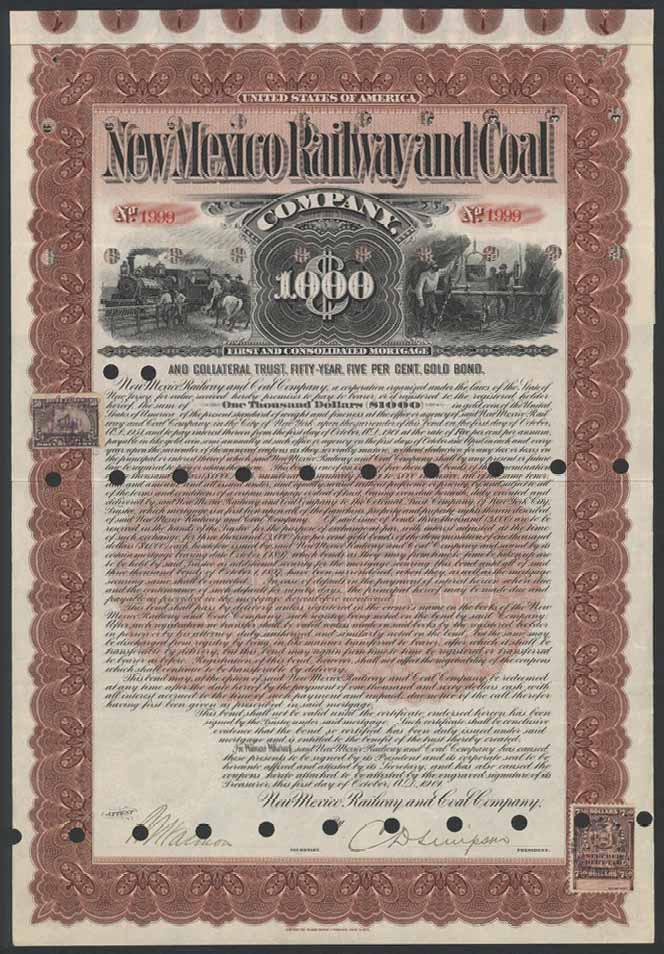
New Mexico Railway and Coal Company
50-Year, 5%, Gold Bond
Issued October 1, 1898
Michael Mahler scan


The New York State Mortgage Endorsement tax stamps shown in a previous blog applied only to bonds secured by a mortgage of properly located wholly or partly with the State of New York.


Bouyed by the success of that tax, New York widened the scope of its exemptive tax program in 1911 by offering State residents the same permanent exemption from the annual personal property tax for all mortgage bonds provided they pay a one-time Secured Debt tax of 0.5%; later increased to 0.75%


The full story is not that simple. The details of this on-again, off-again Secured Debt tax show how the State of New York struggled to find an equitable solution that would provide a revenue stream for the state's coffers, yet be accepted by the majority of its residents. As with the Mortgage Endorsement tax, Michael Mahler has done a masterful job of spelling the fascinating story behind the Secured Debt tax within its historical context while at the same time providing profuse illustations of bonds demonstating how the tax was paid. Mahler's Secured Debt tax article is available on the ARA website.


Unlike the generic Mortgage Endorsement stamps, a series of denominated stamps was issued for the Secured Debt tax, thus showing exactly how much tax had been paid on each bond. More than 100 bonds bearing the Secured Debt tax stamps are known, but only one is known in combination with a Battleship stamp from the 1898-1902 Spanish American War tax era. As illustrated above, a $1000 New Mexico Railway and Coal Company bond originally issued on October 1, 1901 and then properly taxed 50-cents with an R171 Battleship stamp, also bears a $7.50 Secured Debt tax stamp properly paying the 0.75% state tax in effect when it was applied on September 21, 1898.


Thanks Michael for sharing this unique usage!

Saturday, October 16, 2010

The Fullerton List: Railroads 70 and 85

This post is part of a continuing series on Richard Fullerton's 1952 Catalog of Railroad Company, Street Railway & Express Company Printed Cancellations on the 1898 U. S. Revenues.

Examples of the cancels, when available, are posted.


RR070:  The Kansas City, St. Joseph & Council Bluffs Railroad

From the historical information at the back of the Fullerton Catalog:  This road is a consolidation of the Platte County, the Atchison & St. Joseph, the Weston & Atchison, the Missouri Valley, the St. Joseph & Council Bluffs, and the Council Bluffs and St. Joseph railroad companies.  The Platte County was chartered February 24, 1853 and was consolidated with the first three above listed lines as the Missouri Valley RR on March 6, 1867.  This line and the remaining lines above were consolidated under the new name as above on July 11, 1870.  Consolidated into the CB&Q (RR020) in 1880.

Fullerton lists two types, on only the 1ct denomination:


Type 1:  One line of plain type caps and lower case letters 24.75mm long.  Caps 2mm high.  Undated.

1ct Pale Blue        a.  Normal          (1)  Roulette
                                                      (2)  HH
                           as.  Varieties       (1)  "B" broken at top, roulette
                                                     (4)  No period after second R of "R.R.", HH

Type 1, 1ct, a.(1)
roulette
Frank Sente scan


Type 1, 1ct, a(2)
hyphen hole

Type 2:  Same as type 1 except length is 23.25mm.

1ct  Pale Blue            a.  Normal            (1)  Roulette

No image for type 2

RR085:  The St. Louis, Keokuk & Northwestern Railroad

From the historical information at the back of the Fullerton Catalog:  A reorganization on July 1, 1875 of the Mississippi Valley and the Western RR opened under the new name as above on September 11, 1879.  The Keokuk & Northwestern was nominally leased but practically owned by this line which has itself been controlled by the CB&Q (RR020) since 1884.

Fullerton lists two types on cancel on only the 1ct denomination:

Type 1:  One line of plain type caps and lower case letters 24.5mm long.  Caps 2mm high.  Undated.

1ct  Pale Blue   a.  Normal         (1)  Roulette
                                                 (2)  HH
                      as.  Varieties       (1)  Two periods after "L"  roulette
                                                (3)  Without period after second R, roulette
                                                (4)  Wtihout period after second R, HH


Type 1, 1ct, a(1)
roulette

Type 2:  Same as above except 22mm long.

1ct  Pale Blue  a.  Normal         (1)  Roulette
                      as.  Varieties       (1)  Diamond shaped period after the 2nd R, roulette
                                                (3)  Period after comm after "St.", not after "L", roulette


Type 2, as. (1)
roulette, initials 22mm across, variety with diamond shaped period after second R
Lesher scan

Friday, October 15, 2010

Bonds with Battleship and New York State Mortgage Endorsement Stamps

Using primary source material and contemporary reports from the New York Times, Michael Mahler has meticulously researched the history of New York State's confusing early 20th century property tax laws. And in doing so he has unclouded the mysteries surrounding the usage, between 1911 and 1920, of the New York State Mortgage Endorsement, Secured Debt, and Tax on Investments stamps.

Until Mahler's definitive works about these stamps most collectors, myself included, had scant knowledge about them and little understanding of how they were used. I feel fortunate, over the years, just to have acquired a number of bonds bearing stamps from both the 1898-1902 Spanish American War federal tax era and New York's 1911-1920 personal property tax era.

So just how did it come to pass that some mortgage bonds taxed during the Spanish American War era also have NY State property tax stamps affixed? The story is too long and involved to tell here, so I invite readers to read Mike Mahler's four articles about them on the American Revenue Association's website. It's a fascinating story and Mahler tells it with clarity and profuse illustrations.

Let's look at the bonds that show the 1898 federal stamps and the earliest of New York's stamps, the Mortgage Endorsement issues. Mahler’s census of usage of the New York Mortgage Endorsement stamps on mortgage bonds total about 700 including some anecdotal usages. Of those only three bonds are also known with a 50-cent 1898 Battleship stamp.

I’m pleased to show all three combo usages below. For the specific article about usages of the Mortgage Endorsement issues shown in this blog, go here.

Outside Front and Back of New York Central and Hudson River Railroad
100-Year, 3 1/2%, $1000 Gold Bond of 1897
Issued February 10, 1899 -- Michael Mahler scan

Detail showing R171 50-cent Battleship with cds reading:
N. Y. C. & H. R. R. R. Co.
FEB/10/1899 -- from Michael Mahler scan

Detail from Bond Face Showing Green NY Mortgage Endorsement Stamp
Cancelled in New York County SEP 27, 1912
from Michael Mahler scan

I only showed scan details for the bond above as the full face is exactly the same as the bond below, also from the 1897 New York Central and Hudson River Railroad Company bond offering. This one features the later orange NY State Mortgage Endorsement stamp that replaced the green issue in 1915. It also benefits from having both stamps on its face.

It was originally sold on September 15, 1898, about 5 months prior the the example above and in this instance the R171 50-cent Battleship revenue was affixed and cancelled by the Trustee for the bond offering, the Central Trust Company of New York. Apparently by February 1899, when the bond shown previously was sold, the NYC & HRR company itself was handling sales.

New York Central and Hudson River Railroad

100-Year, 3/12 %, $1000 Gold Bond of 1897

Issued July 15, 1898

Detail Showing Orange NY Mortgage Endorsement Stamp
Cancelled in New York County DEC 23, 1915
and
R171 50-cent Battleship with decipede cancel
reading: C. T. Co./JUL/15/1899/OF NEW YORK

Vignette of Cornelius Vanderbilt II, President of NYC&HR
who died September 12, 1898, three days prior to the issuance of this bond


Mohawk and Malone Railroad
100-Year, 3 1/2%, Gold Bond of 1902
Issued April 9, 1902
Michael Mahler scan


Detail of Cancel
M. & M. RY. CO.
APR 9 1902
from Michael Mahler scan

The orange New York State Mortgage Endorsement stamp on the Mohawk and Malone bond was cancelled May 26, 1919 in Oneida County, NY.

Thursday, October 14, 2010

The Fullerton List: Railroads 65, 75, 80, 90, 95 and 105

This post is part of a continuing series on Richard Fullerton's 1952 Catalog of Railroad Company, Street Railway, & Express Company Printed Cancellations on the 1898 U.S. Revenues:

Examples of the cancels, when available, are posted.

I've grouped these six railroads as the final five in the Fullerton Catalog plus an unlisted railroad that were a part of the Gould railroad holdings.  The MOPAC was one of the most important railroads in the Gould's empire, along with the I&GNRR and the St. Louis and Southwestern.

Railroad experts and historians are needed to help clarify these associations.  If you are one of these experts and can shed light on these railroads and their connections, please contact us at 1898revenues@gmail.com.
 
RR065:  The Kansas City, North Western Railroad Company

From the historical information at the back of the Fullerton catalog:  Chartered December 30, 1895 to take over the property of the Kansas City, Wyandotte & Northwestern RR.  On January 1, 1897 the Kansas City & Beatrice RR owning the lines from Summerfield, KS to Virginia, Nebraska (20.6 miles) was merged into this company.  The property is controlled by the interests of the MOPAC (RR75). 
 
Fullerton lists a single type on a single denomination:

Type 1:  A 14.5mm diameter semi-circle of plain type all caps 2mm high.  Undated.

1ct   Pale Blue       a.   Normal   (2)   HH

     No image available

RR075:  The Missouri Pacific Railway Company

From the historical information at the back of the Fullerton catalog:  The original Missouri Pacific Railway Company was incorporated October 21, 1867 as the successor to the Pacific RR of Missori.  On August 11, 1880 this company consolidated with the St. Louis & Lexington RR, the Kansas City & Eastern RR, the Lexington & Southern RR, the St. Louis & Arkansas RR, the Missouri River RR, the St. Louis Cansas & Arizona RR, and the Leavenworth, Atchison & Northwestern RR.  Later consolidations included the Kansas & Colorado Pacific Railway, the Central Branch Railway, the Rocks County RR, the Nevada & Minden Railway, the Kansas & Southwestern Railway, the Le Roy & Caney Valley Air Line RR, and the Boonville, St. Louis & Southern Railway.  Absorbed the St. Louis, Iron Moutain, & Southern Ry in 1915.

Fullerton lists a single type on two denominations: 

Type 1:  A 16mm diameter semi-circle of plain type all caps 2mm high.  Undated.

1ct  Pale Blue               a.  Normal    (1)  Roulette
                                                        (2)  HH
                                    av. Invert       (2)  HH
                                    as. Varieties   (1)  Split period after "CO."

2ct  Carmine Rose        a.  Normal    (1)  Roulette
                                                         (2)  HH

1ct roulette


2ct hyphen hole
Frank Sente scan


RR080:  The St. Louis, Iron Mountain & Southern Railway
 
From the historical information at the back of the Fullerton catalog:  This line was a result of the consolidation on May 6, 1874 of the Cairo & Fulton and St. Louis & Iron Mountain, and Cairo, Arkansas, & Texas RR.  The southern portion of this line was built by the I&GNRR (RR055).  Now (1951) it is completely owned by the MOPAC (RR075).

Fullerton lists one type on a single denomination: 

Type 1:  A 16mm diameter semi-circle of plain type all caps 2mm high.  Undated.  Overprint varies in color from orange red to carmine.

1ct  Pale Blue               a.  Normal      (1)  roulette
                                                          (2)  HH
                                   aw. Double      (2)  double  Not Verified


Type 1 1ct a.(1)
1ct roulette


RR090:  The St. Louis, Southwestern Railway Company
 
From the historical information at the back of the Fullerton catalog (combines RR090 & 095):  The Texas & St. Louis Railway organized November 12, 1881 in Missouri, was reorganized on April 15, 1886 in Arkansas and Missouri to become the St. Louis, Arkansas & Texas Railway.  Finally reorganized again on January 12, 1891 in to companies to conform to the corporation laws of Texas.  The latter road (RR095) is completely controlled by the former (RR090) and both total 1500 miles of rail.

Edwin Gould, a son of Jay Gould, was the Vice-President of the railroad in 1891 at the time of its reorganization to conform with Texas corporation law.

Fullerton lists one type on the 1 cent stamp:

Type 1:  A 16mm diameter semi-circle all caps 2mm high.  Undated.

1ct    Pale Blue            a.  Normal           (1)  Roulette
                                                               (2)  HH


Type 1, 1ct a.(1)
1ct roulette


RR095:  The St. Louis, Southwestern Railway Company of Texas

Fullerton lists on type only:

Type 1:  A 16mm diameter semi-circle all caps 2mm high.  Undated.  Printed in red ink.

1ct Pale Blue            a.  normal        (1)  roulette
                                                       (2)  HH

1 cent roulette
1ct a.(1)

1 cent hyphen hole
1ct a.(2)
Frank Sente scan


Unlisted RR105:  Tyler Southeastern Railway

Part of the "Cotton Belt" family of Gould railroads, the Poor's map above shows the TSE combined with the routes of the two St. Louis, Southwestern Railways. 

Fullerton does not list this cancel.  So, a new listing:

Type 1:  A semi-circle all caps.  [measurements later].  Undated.  Printed in red ink.

1ct Pale Blue:               a.  Normal       (1)  roulette


Type 1, 1ct a.(1)
Richard Friedberg scan