- Home
- About
- Documentary Printed Precancels
- The Fullerton List
- NYSE Brokers 1898-1902 A thru K
- NYSE Brokers 1898 - 1902 L thru Z
- Insurance Agents
- Insurance Companies
- CBOT
- Railroads
- On-document Uses with Frank Sente
- Revenue Stamped Paper with Bob Hohertz
- On Beyond Holcombe with Malcolm Goldstein
- Graded Stamps
Sunday, March 28, 2021
New York Stock Brokers: Frederick W. Perry
Saturday, March 27, 2021
New York Stock Brokers: Welles, Herrick & Hicks
Friday, March 26, 2021
New York Stock Brokers: Edmund & Charles Randolph
Thursday, March 25, 2021
New York Stock Brokers: Wilson, Watson & Herbert
Wednesday, March 24, 2021
New York Stock Brokers: W. T. Hatch & Sons
Tuesday, March 23, 2021
New York Stock Brokers: W. E. Tunis & Company
This ball and pins, this shirt sleeved travesty
And angler old, as nothing seem to me;
For there are cheerier balls and angling too,
King Pin of which this Phantom seems to be.
Monday, March 22, 2021
Margin Curiosities: Speculative Follow-up
Two weeks ago, I posted a series of battleship margin pieces with mysterious numbers added. While I've learned nothing definitive,
there has been some back-and-forth speculation worth noting. Dave
Thompson found that the Durland catalog references additional numbers that were
added to the plates for the Pan American issue. These were almost
certainly added to reduce confusion and error during the bicolor printing
process, so they may or may not be related to the added numbers on the
battleship plates.
Bob Mustacich offered other possibilities. I'll turn it over to him:
Of the various speculations regarding these extra printed features in the margins, I do favor those built around 2 ideas: (a) these stamps were produced in great haste [while the BEP had started some work in anticipation of the War Revenue Law of 1898, they still only had 17 days to produce and distribute stamps. This was responsible for the familiar shortages and overprinting other other stamps.] and (b) the acceptable production quality may have been lowered for expediency. This situation happened in the production of revenues called for during the Civil War, and errors and quality problems abound. So one speculation is that plates with markings on the edges or abandoned experiments with plate numbering/labeling may have deemed "good enough" under the circumstances. And the same for paper -- paper that had some inconsequential printing in the margin perhaps passed unnoticed in the rush, or maybe this was another short-lived experiment in labeling/marking/number that was abandoned for expediency. The 1/2c documentary pair is identified as plate # 7971, the first plate listed in Durland, so this likely was an early production plate. The items are also rouletted which places them earlier in the production of battleships.
David Thompson sent to me some material from the Durland catalog regarding markings on the plates for the Pan Am 2-color engravings to make sure that the plate combinations and orientations were correct for this more complicated production. I don't know why any of this should end up on the single color engraving plates for the battleships unless they decided to ignore plates that they had pre-marked on the edges for 2-color printings and decided to use these instead for the battleship plates. If they were otherwise good plates, why not? They may not have cared about some inconsequential extra markings on the plate margins.
Friday, March 19, 2021
Chicago Board of Trade Members: Bartlett, Frazier & Company
Back in 2012 I was looking for confirmation of a cancel involving a likely Chicago Board of Trade firm with the initials BF&Co. Turns out there were two major firms during the 1898 period with those initials: Barrett, Farnum & Co., and Bartlett, Frazier & Co. The 2012 post shows a standard issue Barrett, Farnum cancel with the firm's name spelled out. Also displayed was a fancier BF & Co initial cancel, which I couldn't confirm was linked to Barrett, Farnum.
David Thompson has a found a Bartlett Frazier sale memo showing that the fancy initials belong to that company. Problem solved!
Wednesday, March 17, 2021
Cancel for March 17: Tradesmen's National Bank
In 2009, when this site first began, and into 2012, I regularly posted a "cancel of the day". A stamp was posted with a cancel for that day (except for the year, of course), and a bit of history was often given about the company or individual that applied the cancel. That hasn't been done in years, partially because I haven't posted in so long, but also because I just stopped organizing posts around the dates of the cancels.
Today's stamp is a rather random stamp that fell out of a packet that has been in storage for over a decade. The cancel is so clean that I figured I needed to feature it here, but it took me a couple of days before I realized that the cancel's date, March 17, was soon approaching and that I could run the first cancel of the day post in at least 7 years.
THE PROVIDENT LIFE & TRUST COMPANY OF PHILADELPHIA
11 Mo
25
1898
Tuesday, March 16, 2021
E. E. Hamilton Possibilities
This post has been updated during the day on March 16 to take into account a late contribution by Malcolm Goldstein.
Readers have come up with two possibilities for the identity of E. E. Hamilton.
David Thompson found Mr. Edward Elwood Hamilton, of the Baltimore, Ohio and Southeastern Railroad. There is a write up on him in the Baltimore and Ohio employees magazine upon his promotion to head up analysis and statistics for the railroad. It is possible, but it seems a bit strange that his position would have him canceling many 2 cent stamps, so I'm not sure. However, we do have this picture, with the appropriate initials and name:
Meanwhile, Malcolm Goldstein found that an E. E. Hamilton was the Secretary and Treasurer of the New Castle [PA] Traction Co. I can't find much more on this lead, but it would seem that this E. E. Hamilton (and maybe they are the same person) would have used more 2 cent documentaries. A little more digging is at hand.
And Malcolm kindly did so, and came to this conclusion:
A further Google search makes me think that Dave Thompson and I have found the same person. In 1898, Hamilton was in New Castle PA, north of Pittsburgh, connected with a traction company. As you are undoubtedly aware, a traction company was a streetcar, or possibly an interurban railway, company. The new search, coupling Hamilton's name directly with the B&O Railroad, shows he resigned that position in 1902, and in 1903, an EE Hamilton is an incorporator of a small railroad in Castle Shannon, PA, which is a small town south of Pittsburgh. That small railroad was, in turn, a feeder line to the B & O Railroad, and by 1904 an E E Hamilton was a "freight inspector" for the Wheeling W VA division of the B&O Railroad. He seems to have moved up through the ranks at the B&O at least until 1919, and then, in a 1934 Report to Congress from the Chairman of the Interstate Commerce Commission, his name reemerges as the "executive assistant" to the President of the M[Missouri]-K[Kansas]-T[exas] RR, who served on some federal advisory panel to prepare a technical questionnaire to collect shipping data needed to assess the need for further federal regulation of railroads. Sounds to me like the same guy all the way through.
Thanks to Malcolm and Dave. My guess is that we are almost certain to have a set of 2 cent documentaries on checks issued by his urban railway employer. It would be great if somewhere there were some of those checks still in existence.
Monday, March 15, 2021
Ebay Sales: An R173 with an R190 Inverted Surcharge
The dealer buystamps currently has for sale on Ebay what appears to be a copy of an R190 with an inverted surcharge:
Now we're getting somewhere. Mr. Henry Stolow was an infamous stamp dealer with a history of fakes, forgeries and made up stamps. An examination of the back reveals the extensive thinning. But we can also see the J&H Stolow brand at the bottom right:
If this is in fact a real Stolow piece of fakery, the stamp would be an interesting curiosity to have in an 1898 revenues collection. Just don't put it into an album spot marked R190a! Also, don't pay $299.99 for it. Maybe $5.00?
Thanks to David Thompson for calling my attention to this item.
Sunday, March 14, 2021
Who was E. E. Hamilton?
Saturday, March 13, 2021
Railroad Printed Cancels: A Milwaukee Road Receipt Book
Wednesday, March 10, 2021
New York Stock Brokers: Stephen V. White
Sunday, March 7, 2021
Margin Curiosities: What is a number like you doing on a plate like this?
Courtesy of Bob Mustacich, via the prompting of Dave Thompson, is presented to you a series of margin curiosities collected and hand annotated by Anthony Giacomelli. The battleship series is known for denomination/series margin inscriptions, eg the 1/8 CP, 3/8 CP and similar markings, that enabled the printers to better identify the values they were working with, since battleship series stamps were all of similar design and size.
The markings in questions are numbers, mostly in reverse, independent of the values of the stamps on the plates. What appear to be fours are not reversed. Giacomelli located numbers 1-4 on various values.
I've looked over some of my collection, and over items posted to this site, and have found markings/numbers similar to those below. In Frank Sente's American Philatelist article you can find what appears to be a 4 on a 3/8c proprietary pair.
Below are four examples, with Giacomelli's notes. I'm interested in any explanation that might exist for these markings/numbers. If you have one, please comment below or write to 1898revenues@gmail.com.
Saturday, March 6, 2021
New York Stock Brokers: William L. Stow
William L. Stow first appeared here at 1898 Revenues in 2012. Here today is a Stow memo from the Eames and Moore pile I wrote about a few days ago for the sale of shares in what appears to be the Texas Pacific Railroad.

William L. Stow from The Stock Exchange in Caricature, 1904
The memo for 100 shares of Texas Pacific @ 38.50.
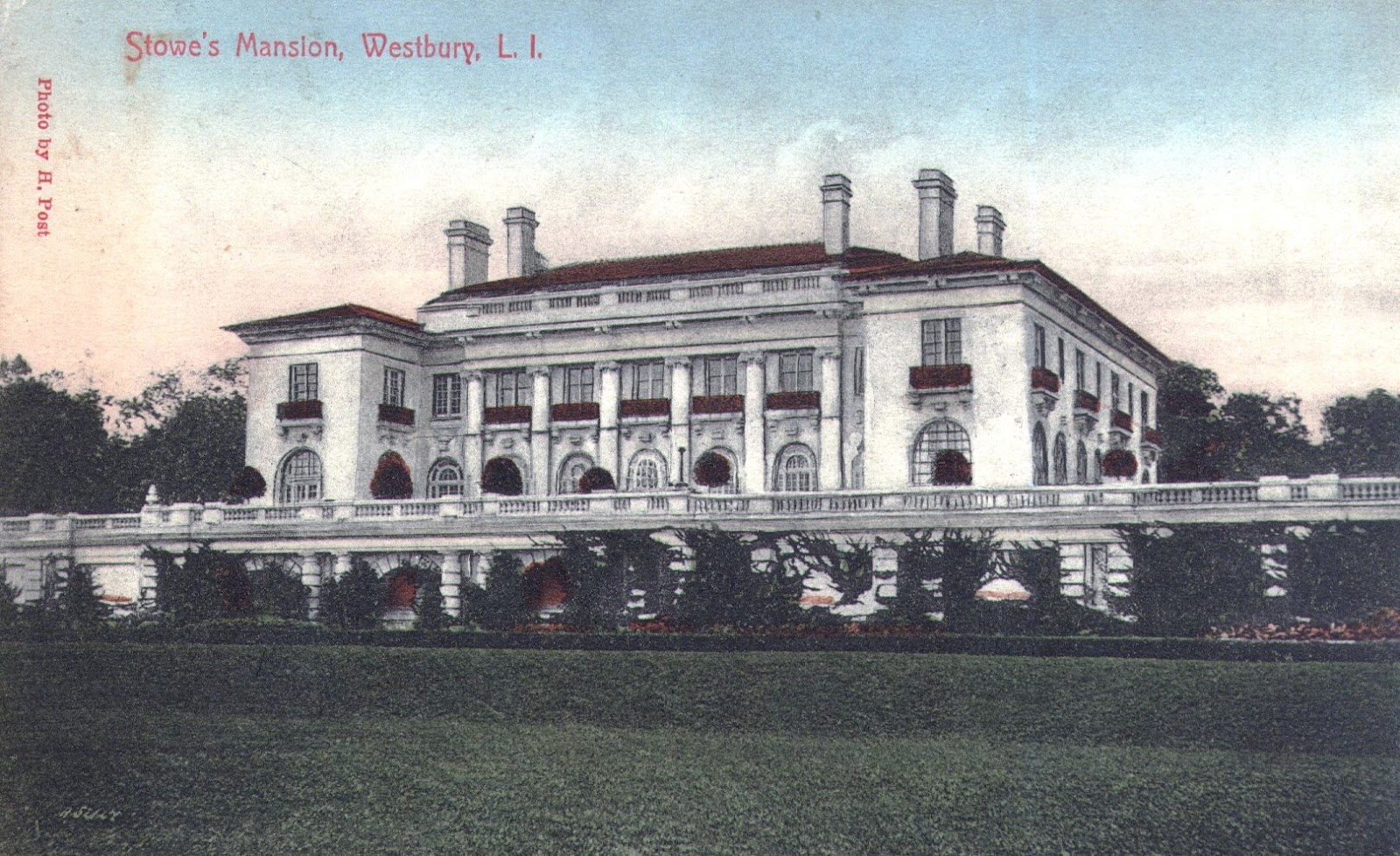
Stow was wealthy enough to build an enormous Long Island mansion, called Stowe's mansion in his time, but which would be renamed Spring Hill by Henry Carnegie Phipps after he purchased the property in 1906. The architect John Russell Pope designed the house and completed it in 1903 for Mr. Stowe. I'm not sure what happened that Stowe could only hang on to it for three years.