Saturday, September 17, 2011

The Northern Pacific Railway and the 1901 Stock Market Panic


Northern Pacific Railway Company check with tax imprint.  Check written for 60 cents!

During the years of use of the 1898 series tax stamps occurred one of the first crashes on Wall Street.  The crash centered on the trading of the stock of Northern Pacific.  The A. A. Housman post from yesterday hints at the role of Arthur Housman in helping to stabilize the market after it had begun to crash. 

The Northern Pacific was a railroad built to run from the midwestern United States and the twin cities of Minneapolis and St. Paul to the Pacific coast, cutting across the northern tier of US states.  Despite the great distance from the financial center in New York City, the stock of the Northern Pacific would have a major impact on the New York Stock Echange's operations in 1901.

****

Gilded Age barons fought for control of the Northern Pacific Railway.  The main characters included James J. Hill, builder of the Great Northern Railway, J.P. Morgan, the greatest financier of the time and arguably of any age, Edward H. Harriman, the Chairman of the Union Pacific, William Rockefeller, the brother of John Rockefeller of Standard Oil, and Jacob Schiff, a leading New York financier.

Harriman used his holdings of Union Pacific to speculate in and attempt to monopolize rail traffic in and out of Chicago.  James J. Hill, the St. Paul, Minnesota-based head of the Great Northern Railway fought Harriman to prevent his control.  Hill had J.P. Morgan as an ally, while Harriman had resources from Standard Oil via William Rockefeller. 

Attempts to buy up Northern Pacific stock on the NYSE started a panic on May 17.  Investors and brokers began to dump stocks and prices began to fall dramatically, especially in railroad issues like the Chicago, Burlington & Quincy, the Missouri Pacific, and the Union Pacific.  Arthur Housman showed up on the floor and began buying for J.P. Morgan, helping to stabilize the market. 

In the end Harriman and Hill decided to join forces and created a holding company to control the NoPac, Great Northern, and the Burlington.  The holding company was broken up through the application of the Sherman Antitrust Act of 1890.

****

Frank Sente discussed the 1901 crash and the precursor trading in the Chicago, Burlington & Quincy Railroad in this post from April 23, 2011.

****

Meanwhile, many of the corporate players in this stock market meltdown were users of 1898 series revenue stamps.  Let's take a look:

Great Northern Railway:


Chicago Burlington & Quincy Railroad:


Union Pacific:


Standard Oil:


J. P. Morgan:


Arthur Housman:


Friday, September 16, 2011

New York Stock Brokers: A. A. Housman & Company
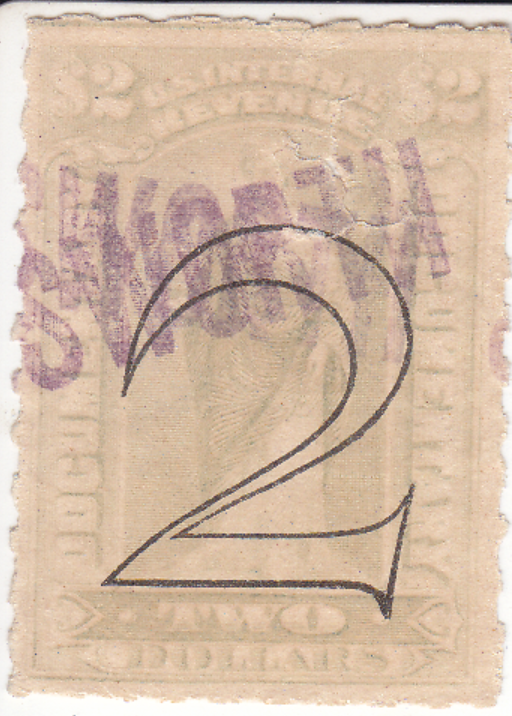
HOUSMAN

Cancel from the firm A. A. Housman & Company.  A. A. Housman was Arthur A. Housman.


This firm puts us squarely in the middle of Wall Street history.  Arthur Housman was a partner of William Burrill in the firm Burrill & Housman, formed in 1885 (the firm Burrill & Stitt will feature in a future post).  Arthur Housman formed his own firm called A. A. Housman & Co. in the 1890s and under this name was a broker for J. P. Morgan.  He is credited with playing a prominent role in restoring calm during the Panic of 1901. 

The panic of 1901 was the first crash of NYSE and occured due to a fight over control of the Northern Pacific Railway.  Arthur Housman would eventually take on Edward A. Pierce and Bernard Baruch as partners.  After Housman's death in 1907, Edward Pierce would control the firm and it would be renamed E. A. Pierce & Company.  This company would be the largest brokerage in the US through the 1930s.  Eventually it would form partnerships that would result in a new company by 1940 called Merrill Lynch, Pierce, Fenner & Beane.


Bernard Baruch is one of the most famous Wall Street "lone wolves." Though he began his career at A. A. Housman, he left and took his substantial earnings to buy his own seat on the New York Stock Exchange.  By 30 he became extremely wealthy, and for the majority of his life he spent his time as an advisor to Presidents Roosevelt and Truman and as a philanthropist.

Thursday, September 15, 2011

Cancel for September 16: Baltimore & Ohio and Southwestern Railroad

B & O
S W RR
9/16/98

manuscript

The Baltimore and Ohio Southwestern Railroad operated in the States of Ohio, Indiana, Illinois, and Kentucky.  I do not regularly post manuscript cancels on this site because most off document examples are indecipherable and uninteresting.  But this one is very clear.

The Baltimore, Ohio and Southwestern Railroad ceased to exist as a separate entity in 1900 and was absorbed into the parent Baltimore & Ohio.


Cowen was President of the B&O at the time the B&O and SW was absorbed into the parent company.  John Cowen would pass away in 1904 at the home of his sister in Chicago when he was 59 years old.

Wednesday, September 14, 2011

New York Stock Brokers: Alfred de Cordova & Company


A. de C. & CO.
OCT.  8  19xx

Langlois scan

The Alfred de Cordova & Company was run by Alfred de Cordova with his brother Eustace.  Alfred de Cordova was on the Governing Committee of the New York Stock Exchange for 1897-1898.


From the New York Times, May 16, 1897:

CAUGHT IN A SWOLLEN RIVER

Alfred de Cordova Has a Narrow Escape in Somerville.

  SOMERVILLE, N. J., May 15.--Alfred de Cordova, the New York broker, whose office is at 36 New Street, had an exciting experience here on Thursday night.  He has a fine country residence four miles west of Somerville, located on the North Branch of the Raritan River.  On Thursday nith the river was much swollen by the heavy rains and overflowed its banks and crossed the road.  Mr. de Cordova's coachman met him as usual at the Somerville Station and started to drive him to the De Cordova home.

  In crossing the river, the buggy and horse were caught in the current and carried down the stream for some distance.  Mr De Cordova and his coachman both jumped.  The former struck a fence and managed to save himself.  the hourse and buggy were thrown against some trees.  The coachman cut the harness from the horse and the animal got ashore and ran home.  The broker and his coachman got a good soaking, but otherwise escaped.

Tuesday, September 13, 2011

5 Cent Proprietary "Plate Crack"?


Current Ebay listing for RB31p with an alleged "plate crack"


Currently, a dealer on Ebay is selling the above copy of a 5c proprietary battleship with a printed cancel for a $75.50 Buy It Now price due to a supposed plate crack running across the top portion the stamp.  While it may not be perfectly visible on this site, there is a clear, straight line running through the center of the left 5 on the stamp.  This line the dealer has labeled a plate crack.

While I am not an expert in printing techniques of the time, I am fairly certain that this is not a plate crack.  The line was placed on the plate on purpose by siderographers laying out the plate.  The line was used by these technicians placing the impressions of the stamp from the transfer roll on the plate in order to lay out the subjects in neat, straight and squared rows. 

These layout lines should not exist.  Normally they would be burnished off after the plate was produced.  In some cases, and this is one, they were not.  This particular line is solid and quite strong, which makes it stand out from the stamp.  While this may seem like a special item, there are literally tons of battleship stamps out there with evidence of these types of layout lines.

Don't be fooled, and certainly don't pay $75.50!

Monday, September 12, 2011

New York Stock Brokers: Floyd-Jones & Robison


FLOYD-JONES & ROBISON.
MAR
11
1901
NEW YORK.

Langlois scan


January 1, 1898, New York Evening Post column ad


Sunday, September 11, 2011

Cancel for September 12: The Atchison, Topeka & Santa Fe Railway, St. John, Kansas


The A. T. & S. F. RY.
SEP
12
1901
ST.  J O H N
KANSAS


The AT&SF Ry Depot in St. John, Kansas

Saturday, September 10, 2011

New York Stock Brokers: Robert J. Kimball & Company's September 11 Cancel


R.  J.  K.  &  CO.
SEP
11
1901

Robert J. Kimball & Company

Langlois scan

Mr. Kimball's company placed this September 11 cancel on this stamp exactly 100 years before New York's financial district was attacked by Al Qaeda.


Robert J. Kimball, member, New York Stock Exchange
Kimball's office at 71 Broadway was only a couple of blocks away from the future site of the Twin Towers.


Kimball's office would have been covered in Twin Towers dust.

Friday, September 9, 2011

New York Stock Brokers: John Hone


JOHN HONE
MAR 14 1899
NEW YORK

Dave Thompson scan and highlights


John Hone, member, governor, and vice president of the New York Stock Exchange


From the Genealogical and Family History of Southern New York and the Hudson River Valley, 1914:

John, son of John and Jane Hone, was born at No. 479 Broadway, New York City, December 14, 1844, and resides at 5 Gramercy Park.  He received his primary education in the schools of New York City, and attended Columbia University in the class of 1865.  He left college to go with the Seventy Regiment to the front and did not receive his degree of A.B. until a few years ago (about 1905). 

He became a stock broker, senior member of the firm John Hone & Company, long located at No. 62 New Street.  For several seasons he was a governor of the New York Stock Exchange, and twice was elected its vice-president.  He served several terms as a director of the North American Trust Company.  He served three terms on the Democratic state committee of New Jersey, beginning in 1879; was a delegate at large to the Democratic National Convention from New Jersey in 1892.

Thursday, September 8, 2011

New York Stock Brokers: William B. Wheeler


W.  B.  WHEELER

Dave Thompson scan

W. B. Wheeler's firm failed in 1896, but he clearly picked himself back up and was back to work by 1898.


From the New York Times, April 14, 1896:

W. B. WHEELER & CO.'S FAILURE

ONCE MOST ACTIVE STOCK-TRADING FIRM IN WALL STREET.

No Contracts at the Stock Exchange and Liabilities Not Heavy--To Make Assignment Today

W. B. Wheeler & Co., at one time the most active stock-trading firm in Wall Street, sent word to the Stock Exchange yesterday that they were unable to meet their obligations.  The firm had no contracts at the exchange, nor were its outside liabilities large.  Since its condition had not escaped rumors, comments on the announcement were of sympathy and regret rather than of surprise.  As assignment will be made today.

William B. Wheeler, senior member of the firm, won a reputation years ago as a bold and successful operator.  His membership in the stock exchange dates back to July, 1874.  Fifteen years ago he had become prominent.  Addisson Cammack though so well of his judgment and pluck that he went into stock operations on joint account with him.  It was understood also that Mr. Wheeler executed orders for Mr. Cammack, although Mr. Wheeler preferred room trading on his own account rather than taking commissions from customers.  His boldest plays were made on the bear side of the market.  He easily held the lead among traders for years, and was reputed wealthy.
....
Speaking of the cause of the failure, Mr. Wheeler said, "Our failure is due to our inability to collect old debts and to dry rot.  The debts are stock accounts on the books.  I have, however, no recriminations for anyone.  Our reputation was injured some months ago by rumors that were circulated in Wall Street that we were in difficulty.  We will make an assignment, though the details have not been fully arranged.

"The failure will be a small one as such things go.  Had it occurred some years back it might have been big.  We have no outstanding contracts on the exchange at present time...

Mr. Wheeler's genial disposition made him a favorite among brokers, who put him at the front in diversions in which they are prone to engage.  He was one of the Wall Street company which backed the New York Baseball Club prior to last season, and it was his habit to take his office force and enough others to make a good party to every game at the Polo Grounds.

Wednesday, September 7, 2011

New York Stock Brokers: Jewett Brothers


JEWETT

Dave Thompson scan


Edward Jewett was the member of the New York Stock Exchange while his brothers were partners in the firm Jewett Brothers.


Clearly, there were male pattern baldness genes in this family.

Tuesday, September 6, 2011

New York Stock Brokers; The Provost Brothers


PROVOST BROS.
& CO.

Dave Thompson scan


There were many brother and father & son combinations that had seats and traded stocks on the New York Stock Exchange.  The Provost Brothers were one pair.


The New York Times, November 22, 1901:

HORSE PLAY ON 'CHANGE.

Brokers in Frock Coats and Silk Hats Put Through Their Paces.

  The Stock Exchange yesterday was reminded that this is Horse Show week.  Despite all traditions, whether respected in observance or neglect, to the contrary, two brokers appeared on the floor clad in frock coats and silk hats.  While there was no disposition to indulge in hazing tactics, brokers felt called upon to pass critically upon the question of the two offenders who was better groomed.

  Accordingly, C. W. Provost of Provost Brothers and Philip T. Brown of H. L. Horton & Company, the offending members, were induced to go through their paces.  High stepping, but not side stepping, was demanded of the victims, as they walked down a long lane of brokers.  The blue ribbon was given to Mr. Provost, who bore his honors gracefully, while Mr. Brown, by way of consolation, received a red ribbon.


The trading floor of the New York Stock Exchange in 1897.

Monday, September 5, 2011

New York Stock Brokers: William S. Alley


W. S. Alley

Dave Thompson scan

David Thompson found a New York Times article on this gentleman which was highlighted in a post on August 19.  Following repeated losses in the stock market Mr. Alley tragically took his own life in 1907, and at the Larchmont Yacht Club at which he was a founding and senior member.  Alley was forced to sell his seat on the NYSE in order to pay his creditors.

At the time of the original August 19 post a photo was not available of Mr. Alley.  The image below comes from King's Views of the New York Stock Exchange.


William S. Alley, member, New York Stock Exchange

Labor Day 2011

Abraham Lincoln, from his December 1861 Message to Congress:

“Labor is prior to and independent of capital. Capital is only the fruit of labor, and could never have existed if labor had not first existed. Labor is the superior of capital, and deserves much the higher consideration.”

As we exalt capital and capitalists (ironically, we are in the midst of featuring stock brokers on this site) in the United States, we are doing this increasingly so at the expense of labor.  Governors like Scott Walker in Wisconsin have become anti-labor heroes; labor is increasingly taxed more aggressively than profits made through investment.  We should remember that the United States was built to its greatness on the back of hard-working labor and creative capital.  We cannot live without vigorous supplies of each. 

The Lincoln quote above, if spoken today, would be quickly labeled by Tea Partiers as the statement of a socialist or communist.  Americans need to reflect on who we are and what made us.  Lincoln's statement was wise then, it remains so today.

The 1898 tax period that this site reviews straddles a great American historical transition from the Gilded Age of the great capitalists like J.P. Morgan, Jay Gould, Andrew Carnegie and Henry Clay Frick, and the Progressive Age of Ida Tarbell, Upton Sinclair, and Clarence Darrow.  Our great capitalists were tamed, and their capital used to continue to create new wealth.  Yet at the same time that capital was used for some of the greatest private charity work in human history.  And labor made great gains with ever better working conditions and with great American capitalists learning it was in their own self interest to pay workers good wages.  There were strikes.  There were Pinkertons.  But America needs it workers and its money.  None should suffer at the expense of the other.

Sunday, September 4, 2011

New York Stock Brokers: Robert Chambers


ROBERT CHAMBERS

Dave Thompson scan


Robert Chambers, a member of the New York Stock Exchange
Photo taken in 1897; availaible from King's Views of the New York Stock Exchange.


From The New York Times, December 26, 1897:

A Bull Year Throughout.

Mr. Robert Chambers--I look for the strongest market we have seen for years during 1898.  I base my calculations on the general conditions of affairs throughout the United States.  For example, I know an instance in New Jersey, where a landlord for years past was unable to rent many of his properties, and where, in a majority of cases, he was unable to collect the rentals due.  This landlord now finds that his houses are renting more easily, and experiences no difficulty in making his collections.  Then I hear from the dry goods districts that sales have been heavier than for years.  In fact, almost every line of business is improving.  People have more money now, and consequently will spend more--conditions which must be felt in the stock market.

Saturday, September 3, 2011

New York Stock Brokers: The Wadsworths


...SWORTH

Dave Thompson scan

On August 28 I ran a post with this stamp cancelled "SWORTH".  I called for help identifying the canceller or the user of the stamp.  With my new tool King's Views of the New York Stock Exchange, there is now an answer to this question, as there will be to many cancels on the dollar documentaries that I will post in the coming days. 

A basic premise in identifying the cancels on these 1898 commerce documentaries is that the majority were cancelled by stock brokers, especially those based in New York.  In going through my own collection of 150 or so of these stamps, most of the proper named firms, ie, those with the surnames of individuals attached, and not otherwise so identified, were cancelled by New York brokers.  The pattern will be made relatively clear over the coming weeks. 

As for this example, "SWORTH" was simple to run through a search engine that searched the King's guide for the partial name.  The search turned up two gentelemen, no doubt brothers, who were members of the New York Stock exchange in 1897-98, with the last name Wadsworth.  It is nearly certain that this cancel was made by the firm of or by one of these brothers themselves, for there are no others SWORTH names associated with the NYSE at the time of the use of these stamps.


Finding other information about these gentlemen has not be so simple.  There are far too many Wadsworths in history, yielding far too many google hits, and using delimiters hasn't helped me much.  I will keep looking.

Friday, September 2, 2011

New York Stock Brokers: King's Views of the New York Exchange, 1898

I have been searching for an online resource to help identify the cancels and users of the cancels on the majority of the dollar value commerce stamps from the 1898 revenue series.  Three days ago I found an ideal document for the purpose, King's Views of the New York Stock Exchange, which can be found online through the Columbia University Libraries Digital Collections.  The document can be read online or through a .pdf file that you download to your computer. 


This book contains portraits of virtually all of the members of the New York Stock Exchange in 1897-98.  The members are identified as individuals and through their firms.  There are also photos of the interior rooms and trading floor of the Exchange in 1897, and photos of major buildings in the financial district of New York that housed important businesses in the financial industry.

If you download the .pdf file, Adobe Acrobat Reader enables one to search the entire document with a computer in seconds for complete names or partial names, like those that are often found on cancelled stamps that have been soaked off of their original documents. 

A typical page of headshots looks like this:


Headshot portraits from the book.  My 8 year old daughter asked if all of these gentlemen were the same person.  I suppose the greyscale, demeanor and facial hair of the subjects makes them all appear similar.  Except for one to know the reputation or more of someone like that at the upper left, one would never think these people to be the same.  J. Pierpont Morgan is at the upper left.  JP dominated US finance at the turn of the century.

This book does not answer all of my needs.  I am interested in the office addresses of each of these individuals and their firms.  I would like to be able to place their cancels on a map of New York's financial district. 

However, this volume does help to answer many questions.  Lets look at one example:


Dave Thompson sent me a scan of this stamp with a partial cancel.  We appear to have the following:

S. A. CRUIKS
DEC 13  1901

By putting the letters CRUIKS in to the Adobe search engine to search the .pdf of the document, one gets an immediate and satisfying return.  The search engine stopped me right at the portrait of Simeon A. Cruikshank, no doubt the canceller of this stamp:


The name Cruikshank is in blue because that is how Adobe highlights the word when you get a match for the search.

Now there is much to post about on this site, as I've got a backlog and fellow collectors like Dave Thompson have bunches of these stamps to explore.  There will be lots of dollar commerce stamps on this site showing up in September and beyond.

Thursday, September 1, 2011

Auctions: Sam Houston Philatelics September 17, 2011 Sale


Two 1898 lots from current Sam Houston Philatelics sale

Stamp Auction Network screen capture

You can view the documentary lots in this sale by clicking here to go to Stamp Auction Network.

Sam Houston Philatelics, which I associate with only selling duck stamps, has an upcoming auction that can be accessed through Stamp Auction Network.  A link is provided above.  The auction includes a bunch of lots of battleship plate number singles.  Proprietaries are included but there are several lots of documentary plate number singles.

As in many auction lot descriptions the lots are enthusiastically described.  The value of the plate number singles are associated with battleship plate block prices, at least narratively.  Of course, 1898 collectors know that plate number singles are relatively common while plate and imprint blocks of six are scarce and in some cases, quite rare. 

This is a good opportuntity, however, to acquire large quantities of these singles for the number and position collector.  Let's see how these lots sell at auction.  Thanks to Dave Thompson for calling my attention to these lots.