Saturday, July 3, 2010

Cancel for July 4: B. S. Bank


B. S. BK,
JUL
4
1900

Happy Independence Day!

What needs to be written about the B.S. Bank? 

Friday, July 2, 2010

Updating the Joyce/Chappell Lists: The Centaur Company

"Ripped" cancel taken from a 1/4cent proprietary battleship.
This is the design for all Centaur Company printed cancels.

The Centaur Company produced one of the best known fancy cancels used on the battleship proprietary series. President Charles Fletcher's signature is prominently placed at an angle across the face of the stamp, with the name of the company in the upper left corner.  This cancel can be found on several proprietary values, including the 1/4c, 5/8c, 1c. and 1 1/4c stamps. 

According to Joyce and Chappell, there are three types of Centaur Company cancels.  Of those cancels, type 1 includes all the printed cancels while types 2 and 3 include handstamp varieties.  I find this confusing, and not useful for compiling an updated list of the printed cancels, mostly since types 2 and 3 are not printed cancels.  So for the purpose of compiling this list, and as a policy to be applied for the lists of cancels for future company lists, I will omit handstamp cancels from the revised listings.

Joyce used a protocol for including cancels based on Chappell's original criteria.  From the introduction to Chappell's original list: "Only the printed and typed cancels will be given consideration in this list.  The only exception being those few firms who also had private die stamps in this period.  The handstamps of these few companies are of general interest and I feel they should be included."   The Centaur Company produced its own private die stamp, hence Chappell and then Joyce included Centaur handstamps in their list of types.  But the handstamps they listed are not printed, and may not be exhaustive, and by virtue of being handstamps are prone to innumberable types and subtypes.   I figure that if a new list is of printed cancels, we should keep it that way, and let others who have done more work on the subject of proprietary handstamps handle those cancels.

Thus, I will not include those handstamps -- a much more thorough listing exists of handstamps in the Battleship Desk Reference (BDR), including the handstamps of firms that issued private dies and used printed cancels. 

This means I will dismiss types 2 and 3 in the list below, and focus only on cancel type one, the printed cancels.  This practice will have implications for many other firms, including whether or not there will be a need to renumber the types.  For example, the first few Antikamnia types listed by Joyce and Chappell are handstamps.  If those are removed from the new lists, do the revised lists start with the type originally assigned by J/C or should the type numbers be reassigned?  Whatever the choice, for me the goal is to minimize confusion for those who come to collect these cancels and want to make sense out of them without too much difficulty.

The original Joyce/Chappell list:


Below is a link for an updated Centaur Company printed cancel list.   Unlike previous cancel lists posted on this site, no additional dates to the Joyce/Chappell list have been added.  However, as pointed out above, cancel types 2 and 3 have been omitted.


I am very interested in establishing whether there are other dates that were unreported by Joyce.  Please review the list and submit unknown dates if you have have them.

Below are the Centaur pages from my collection (ex-Tolman) and those of Frank Sente.  Between us we present the majority of Centaur printed cancels listed by Joyce.

Langlois, ex-Tolman Centaur cancels


Frank Sente's Centaur cancels.


1 1/4 cent bottom plate block; Centaur '99 red ink printed cancel.  Scarce in any condition, even more so with Centaur printed cancels.

Thursday, July 1, 2010

Battleship Boosterism: The Weekly Philatelic Gossip from 1928


I've always had a soft spot for antique philatelic journalism (doesn't everybody?).  The Weekly Philatelic Gossip stopped publishing in 1961, but is the source for some great early work on 1898 revenues, including articles on cancels on the battleship series.

The paper was published in the town of Holton, Kansas..  Holton is due north of Topeka about halfway to the Nebraska state line.  The current town has just a little over 3000 residents, but for several generations the Weekly Philatelic Gossip came out of this small Kansas town and was one of the most important publications in philately.  At the end of this post I've included the full pages of the 1928 article I am about to review, and if you download these pages you can see the advertising that came to the Gossip from dealers all over the United States.

The editor of the Gossip in mid-1928 selected the battleship revenues as the subject for a front page article given to boosterism and a sales pitch for battleship stamps coupled with available facts on the series.  Below is most of the article in sequential order, cut into sections so I can comment as you read along.  Enjoy!


"The Battleship That Caused A War" hardly indicates the content of the article, which is about the battleship series of revenue stamps and not the Battleship Maine that exploded in Havana Harbor in Cuba and accelerated the call for war with Spain in the United States.  There is some writing about this ship, however...


I can't argue with the author's statement that what he calls the "Sleeper Set" of US revenues should be in every collection due to their history.  This site is much about the history of this set, and about the companies that used these stamps.  If by sleeper he means the set receives Rodney Dangerfield, "no respect" treatment, I agree with that too...


Maybe I'm missing something.  While the comment about these stamps being within the reach of everyone remains true 82 years after the printing of this article, I am not sure the claim about the fine quality of the set holds relative to other classic sets.  The Columbians?  Trans-Mississippi?  


Yes!  Get your battleship revenues now before it is too late.  As he says, the old fellows are no more in the making.   I don't think anyone has to worry too much, though.  Here we are, 82 years after this article, and the old fellows are still fairly cheap.  Collecting styles have made the plate blocks valuable, but most of the singles remain cheap.  Oddly, he never mentions the differences between rouletting and hyphen hole perforations and the relative scarcity of some hyphen hole values.


"The half cent orange is very rare.  The writer has never seen a copy, unused, and does not know how many of them were issued"  I think the author needed his own copy of Elliot Perry's book.  Then he could have known how many were issued.  Meanwhile, here is one used...


A journal like the Weekly Philatelic Gossip prospered at a time of high interest in stamp collecting and an otherwise illiquid market in information about stamps.  Here courtesy of the internet, is proof that the 1/2 cent orange does indeed exist...


Interesting catalog numbers.  There is only one number for 1/2 cent value, so there is no differentiation between the orange and grey stamps. 

Scott doesn't use this range of numbers for revenues anymore.  The company gave up the practice decades ago, even before the USPS started putting cartoon fish and other sorts of nonsense on stamps, bloating the numbers of stamps issued for modern collectors and requiring Scott to assign hundreds of new numbers every year.  Of course now all the revenue numbers begin with R. 


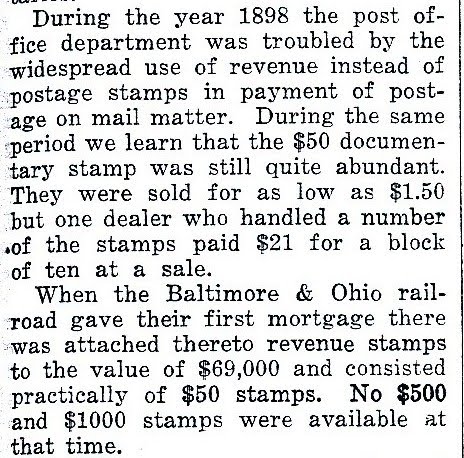
The 10 cent documentary was, according to this author, not very plentiful.  I suppose the documents on which it was used started to show up after the publication of this article?

Hmm...a stamp dealer tried to manipulate the return of tax stamps?


There isn't much of this type of philatelic journalism left: promotional, packed with facts, and quite long.  Open up the pages below and see the ads.  At least as interesting!


Wednesday, June 30, 2010

July 1, 1898: First Day of the War Tax, and Time to Print Cancels!

Some proprietary product manufacturers cancelled many stamps with the date of the first day of the tax period.  The firms H.E. Bucklin and Dr. Jayne and Sons clearly cancelled enough stamps with the date July 1, 1898, that they were using the stamps with those cancels far beyond the actual date of the cancel. 

Again, from the former collection of Henry Tolman are examples from these two companies.  Each of the pages below show only cancels from July 1, 1898, with multiple types from each company for July 1.  Mulitples for the Dr. Jayne and Son cancels show how multiple fonts were used within the same sheet.  


H. E. Bucklin  July 1, 1898 cancels


Dr. Jayne & Son  July 1, 1898 cancels

July 1 1898, The Spanish American War: The Rough Riders Storm San Juan Hill

The first day of the revenue tax supporting the Spanish American War was also the date of the best known battle of the war.  The Rough Rider's charge up San Juan Hill, Frederic Remington's famous depiction of the scene, and Teddy Roosevelt's role in the charge have made the event almost as well known as the explosion and sinking of the battleship Maine.

Frederic Remington's famous painting of the charge

San Juan Hill and Kettle Hill (which is the subject of the title art of this blog) are part of the San Juan Heights.

The battle on this day made the career of Teddy Roosevelt.  When he returned to the United States he was soon elected Governor of New York, and soon after that, nominated to be McKinley's running mate. 

Auctions: R163 one cent documentary block of 100 with IGNRR printed cancels

I regret that I did not save an image of this block, but Eric Jackson's self administered June auction was closed yesterday evening and the sale included a 10x10 block of one cent battleships with I&GNRR printed cancels.  The item sold for $376, a good price for the buyer who would use it for the showpiece that it is. 

Tuesday, June 29, 2010

Cancel for June 30: Argonaut Oil and Mining Company


AO&M Co.
ELM
6/30/1900

Manuscript cancel of Ellis LeMaster, Secretary of the Argonaut Oil and Mining Company.  Stamp part of a block of 4 from a stock certificate.


Argonaut Oil and Mining Company block of 4 from original stock certificate.  The tax on stock transactions was 5 cents for each $100 of value of stock; $2.00 in documentary stamps would have paid the tax on $4000 worth of stock.  See the certificate below.


Full Stock Certificate.  Certificate can be viewed in full by clicking on the cert and downloading the image.
$2.00 in stamps paid the tax on the $4,000 transaction.


Monday, June 28, 2010

Cancel for June 29: June 29, 1898 Bill of Lading

Yes, June 29, 1898.  Frank Sente sends in this Bill of Lading from the West Shore Railroad of the New York Central and Hudson River Railroad for a shipment by the Jacob Hoffman Brewing Company of New York.  The BOL was filled out and a tax stamp applied two days before the tax went into effect.  Not only was the tax stamp not needed, but there were few of the battleship stamps printed and distributed by June 29.  So this is a very unusual and interesting item.


West Shore RR and New York Central and Hudson River Railroad bill of lading for 70 half barrels and 75 quarter barrels of lager beer produced by Jacob Hoffman Brewing Company

Every bill of lading during the official tax period which started July 1, 1898, required a one cent documentary tax stamp

Frank Sente reportes that "by 1898 Hoffman was shipping beer upriver to Rondout(Kingston,NY) from his NYC brewery likely to supply his operation there that serviced daytrippers from NYC to Kingston Park."


Jacob Hoffman's Oriental Brewery letterhead

Saturday, June 26, 2010

Cancel for June 27: Manistee and North-Eastern Railroad


Obscured cancel for the Manistee and North-Eastern RR.

The Manistee and North-Eastern Railroad was a short line in the U.S. state of Michigan. Organized in 1887, The railroad served the northwestern quarter of Michigan's Lower Peninsula in the late 1800s and early 1900s. The railroad's main line stretched from Manistee to Traverse City.  The railroad was originally built to help exploit the old-growth timber resources in its region. Logs were carried to mills in Manistee.

The Manistee and North-Eastern was consolidated into the Chesapeake and Ohio Railway in 1955.

Friday, June 25, 2010

Cancel for June 26: Fireman's Fund Insurance Company

F. F. INS.  CO.
JUN  26  1900

R163 1 cent documentary


CANCELLED
JUL  12  1900
FIREMANS FUND INS. CO.

California-based Fireman's Fund Insurance still exists today and provides coverage to individuals and businesses all over the world.  Today the company is owned by the German firm Allianz. 

Fireman's Fund was named for an early arrangement in the firm's history when it paid 10% of its profits to the widows and orphans of firefighers.  It no longer strictly tithes 10%  though the corporate website boasts that the company still maintains a social mission to proved support to fire departments across the country.

The company issued the world's first airplane policy.

Auctions: Harmer Schau Sale 86, Lot 869 - Battleship Printed Cancels

Interesting lot under BOB collections in the current Harmer Schau sale.  It is listed as a collection of battleship proprietary cancels but it has some very interesting documentary printed cancels too.  Find the lot here.

One page of documentary printed cancels is posted online:


The image is low res and grainy by this blog's standards, but it is clear enough to show the printed cancels of 4 different railroads. 

Proprietary material is available too:


Opening or current bid (I am not sure which) is $2900. 

Wednesday, June 23, 2010

Cancel for June 23: New Home Sewing Machine Company


NEW HOME S. MCH. CO.
JUN
23
1899
Orange, Mass.


The New Home Sewing Machine Co was formed in 1882 at Orange, Massachusetts, following the reorganization of the Gold Medal Sewing Machine Co. Their machines were sold using many marques. It has been claimed that by 1884 production reached 500 machines per day. The company also boasted a considerable needle manufacturing facility, producing needles for competitors' machines as well as its own. The company was also well known for its greyhound trademark.

Reports state that in the year 1906-1907 sewing machine production was approximately 150,000, with a workforce of 743. By the 1920s the company began to lose ground against competitors, and around 1930 the Free Sewing Machine Co took control, with plant moved from Orange to Rockford, Illinois. It has been estimated that 7 million New Home machines were in use by 1937.


Video demonstration of an early 20th century New Home sewing machine:

Tuesday, June 22, 2010

June 22, 1898: The Spanish American War - The US Invasion of Cuba


The US military landing at Daiquiri, Cuba, June 22, 1898, 
from Harper's Pictorial History of the War with Spain, 1899.


United States troops landed in Cuba on this day in 1898 at sites near the city of Santiago.  The main force landed at Daiquiri while a smaller contingent went ashore at Siboney.  US citizens and businesses would not begin to pay documentary and proprietary taxes to pay for the military actions until July 1, 1898.

*****

From the 1980 movie Airplane!:

Ted Striker: My orders came through. My squadron ships out tomorrow. We're bombing the storage depots at Daiquiri at 1800 hours. We're coming in from the north, below their radar.

Elaine Dickinson: When will you be back?

Ted Striker: I can't tell you that. It's classified.

*****

When I was a kid my dad made the best frozen daiquiris.  Lime only - never strawberry or banana or anything too fruity.  And being that we lived in New Orleans, I always had a little "taste."  And if my dad would turn his head I might have another taste, and another...  The Caribbean and Cuba have given us some great things, like rum, daiquiris, Cuba Libres, and great cigars. 

Cancel for June 22: Western New York and Pennsylvania Railway

W. N. Y & P. Ry.
JUN
22
1899
J.  F.  R.

Incorporated in 1887 as the Western New York and Pennsylvania Railroad, the company was reorganized in 1895 with the Railway name.  The WNY&P Railway's independence was shortlived.  By 1900, soon after this stamp was cancelled, the Pennyslvania Railroad took over the railroad.


1900 Route Map

Monday, June 21, 2010

Bank Cancels: The Equitable Trust Company


THE EQUITABLE
TRUST COMPANY
XXX  1902


The Equitable
xxx
Trust Company.


The Equitable Trust Company of New York was a very large and successful New York bank.

Chase National Bank purchased the Equitable Trust Company of New York in 1930, and as a result became the largest bank in the world.  John D. Rockefeller Jr was the largest stockholder of Equitable at the time of the sale. 


World War I morale poster produced by The Equitable Trust Company

Sunday, June 20, 2010

Updating the Joyce/Chappell Lists: M. M. Fenner, Fredonia, New York


Dr. M. M. Fenner produced a product called Dr. Fenner's Kidney and Backache Cure.  The product was sold widely, and the bottles in which the product was sold, while collector's items today, are common enough that they are not very expensive.

Dr. Fenner was a commuity leader in Fredonia, such that in 2010, despite his death more than 100 years ago, the Fredonia Fire Department has a unit called the "M. M. Fenner Hose Company."

The cure was sold in units that required the use of two values of the battleship proprietary series.  Dr. Fenner's only made use of the 5/8c and 2 1/2c stamps.  On these two values were used two types of cancels.  Type 1 is characterized most prominently by diagonal or slanting outer vertical strokes on the Ms in the cancel.  Type 2 is characterized by vertical strokes on the Ms.  These types are known to appear within the same sheet of stamps and there is an example below.


Type 1 cancel.
The 5/8c Type 1 from 1898 is unlisted by Joyce

Type 2 cancel


Joyce/Chappell listing for MM Fenner, with descriptions of the cancel types:

To view an excel file of this list with new dates added, click the link below:


5/8c 1901 block of six.  The middle two stamps are examples of type 1, the top and bottom two stamps examples of type 2.


Complete page from Henry Tolman's MM Fenner material


Cancel for June 20: Bank of Willmar

Bank of Willmar
JUN  20  1899
Willmar,  Minn.

Now known as Bremer Bank, the Bank of Willmar was robbed by Machine Gun Kelley and his gang during The Great Willmar Minnesota Raid in 1930.  The gang stole $70,000 and wounded three people.  The town was a division point on the Great Northern Railway which helped stimulate the growth of the town during the 1800s. 

Saturday, June 19, 2010

Cancel for June 20: Bloomsburg National Bank

BLOOMSBURG NATIONAL BANK
JUN
20
1901
Bloomsburg,  Pa.

Now known as the First Columbia Bank and Trust Company, Bloomsburg National Bank opened its doors in 1899.  In 1926, the Bloomsburg Bank-Columbia Trust Company was formed when the Columbia County Trust Company, established in 1916, consolidated with the Bloomsburg National Bank. In 1990 the name of the Bank was changed to First Columbia Bank & Trust Co.  You can read more about the history of the bank here.