Friday, January 28, 2011

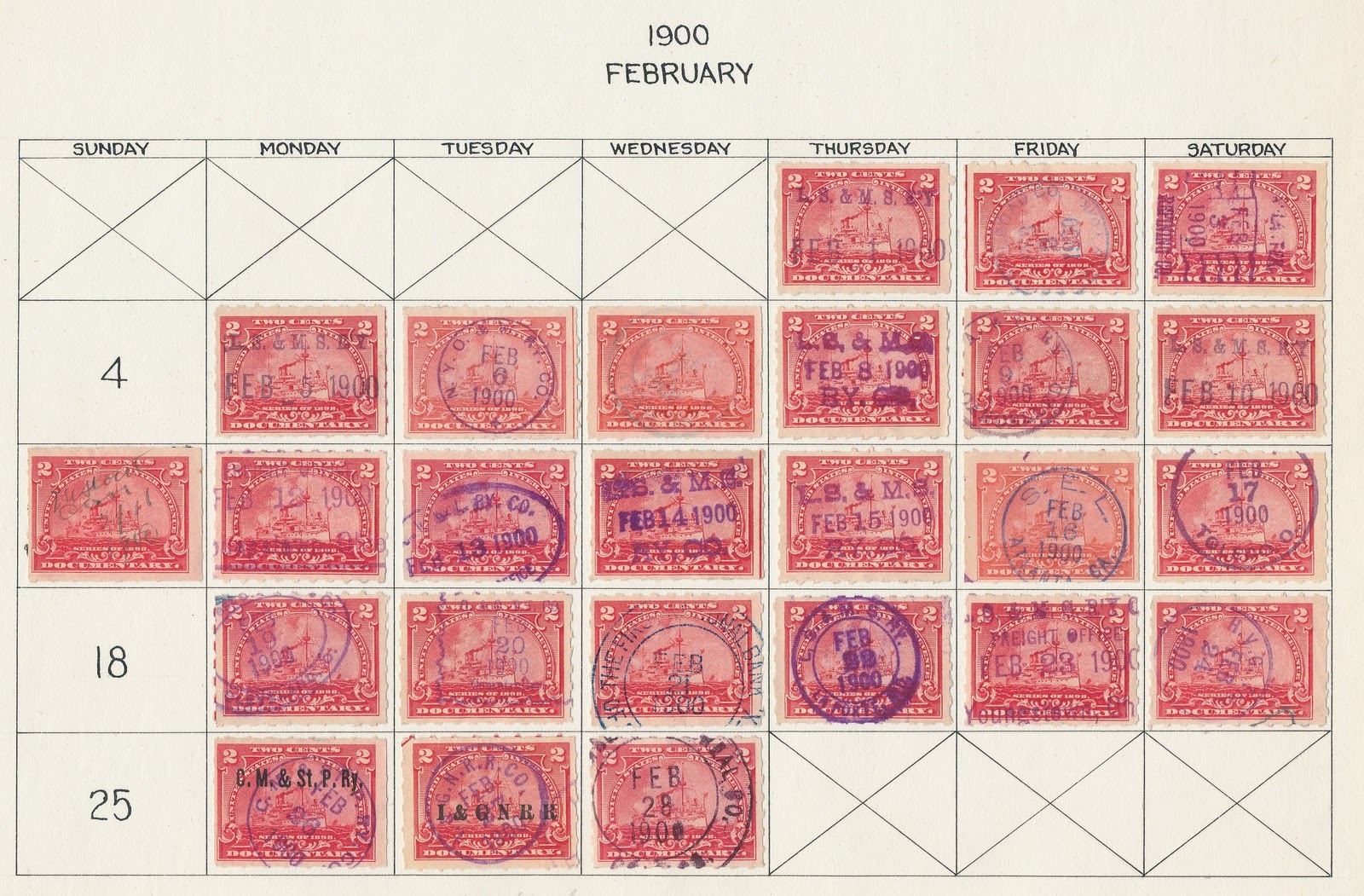
2 Cent Documentary Calendar: Third Year of Use

This is the third of three posts on the 2 cent documentary battleship calendar in which all 36 months of the calendar are posted. This post involves the third year of primary use of these stamps, from July 1900 to June 1901.


As I wrote in a previous post, I do not know who was the orginal compiler of this calendar.  It is extremely disappointing that I will likely never know and certainly will never speak with its original builder.  The source of the stamps, the time spent, the identification of certain cancels are all questions I would like to have answered. 

One aspect of a website like this is the ability to share the knowledge of collectors, not just with regard to philatelic knowledge but the history and legacies of the hobby.  Yes, we all see in auction catalogs and sales of one kind or another the comments ex-Joyce, ex-Lilly, etc., but the ongoing thoughts of collectors  are not contained in these "ex-s".  There is so much that has been lost.  But with use of the web, those so inspired can help address this hemorraghing of information. 

Further, there are many cancels in this calendar, initials in particular, for which I cannot trace any origin.  Sometimes serendipity occurs, and someone like Bob Hohertz posts a Venice Transport Company check with the initials HVG.  And then I know the source of the HVG, Treasurer cancels in this calendar.  I encourage collectors to look through these calendar pages and help decipher certain initial cancels.  For example, while I am fairly certain that the C.P. cancels from Cleveland in this calendar are those of the Canadian Pacific, what company is represented by the C.P. cancels from Omaha, Nebraska?

July 1900 to June 1901 calendar:


Thursday, January 27, 2011

Cancel for January 27: Live Poultry Transportation Company

L.P.T. CO.
JAN
27
1899

Bob Hohertz illustrated a post on January 11 with an on-check use of this cancel.  This stamp comes from the calendar that is being posted this month.


By 1897, the Live Poultry Transportation Company had over 200 rail cars for shipping live birds.

The cars were able to be set low on their wheels as the payload was relatively light, enabling greater space for carrying birds.  Note the wire mesh sides.  The wind of the moving train must have ruffled their feathers.


From Bob Hohertz' LPT draft showing birds in cages, in which the cages themselves have wings.  I guess the company wasn't satisfied that the then modern technology of railroading provided enough imagery to create a branding logo.  Instead, the birds are presented as passive, flightless things inside cages that have wings.

Tuesday, January 25, 2011

2 Cent Documentary Calendar: Second Year of Use

This is the second of three posts on the 2 cent documentary battleship calendar in which all 36 months of the calendar will be posted.  This post involves the second year of primary use of these stamps, from July 1899 to June 1900.  The calendar is nearly complete with cancels from all dates during the 12 month period except for most Sundays and July 4. 

The calendar is replete with cancels from railroads and companies that maintained their own rolling stock. 


July includes cancels from the following companies:

July 1:  Lake Shore and Michigan Southern Railway
July 3:  Ann Arbor Railroad
July 5:  Canadian Pacific Railway
July 10:  Cornplanter Refining Company
July 11:  Southern Pacific Railroad
July 12:  Michigan Southern Railroad 
July 17:  Elgin, Joliet & Eastern Railway
July 19:  Chicago, Indianapolis & Louisville Railway
July 22: New York Central & Hudson River Railroad
July 24: Merchants Despatch Transportation Company
July 25: Northern Ohio Railway
July 26:  Fairmount Coal & Coke
July 27:  Chicago, Milwaukee & St. Paul Railway
July 28:  Cleveland, Canton & Southern Railway
July 31:  Keokuk & Western Railroad


As I noted in a post about this calendar in April 2009, I originally obtained this calendar in an auction of Henry Tolman's collection by Robert Siegel.  The calendar was sold in as a single lot near the end of Part 4 of the Siegel Tolman sales.  As I wrote in that earlier post, it is not clear to me that this calendar was compiled by Mr. Tolman.  Margin notes in Tolman's hand that spell out the identification of certain cancels read like the notes of someone who is reviewing a calendar after it has been completed by another and not the notes of someone that had spent 100s if not thousands of hours putting together such a calendar. 


Just as Robert Bell marvelled at Keightly's completion of the Penny Lilac calendar for the quality of handstamp cancels, this calendar should create similar marvel.  Most cancels are clear, and while there is much repetition of one railroad (the LS&MS), there is striking variety of railroads and large industrial companies. 


Cancels from the Cleveland oil refiner Scofield, Shurmer & Teagle (Oct 4), the Central Equipment Company (Oct 17), and The American Cereal Company appear on the October 1899 page of the calendar amid a field of railroad cancels.  All of these companies likely had their railroad cars for the products: tankers for SS&T and hoppers for The American Cereal Company.


In some cases the cancels range to shipping companies, including the Detroit & Cleveland Navigation Company, whose handstamp cancel can be found in the November 18 slot.


In the next few days I will post the final year of this calendar, from July 1, 1900 to June 30, 1901.  As of July 1901 taxes were ended on bank checks and drafts, ending the primary use for the 2 cent documentary stamp.  The original compiler of this calendar did not go beyond June 30, 1901.   2 cent documentaries can be found in mixed usage into 1902 for purposes other than checks and drafts.


Monday, January 24, 2011

A Montpelier & Wells River Railroad Bill of Lading

John and I were discussing the last year of the various Spanish American War taxes, which prompted me to look at the dates on some of my bills of lading since the one-cent tax remained on them for that final year between July 1, 1901 and July 1, 1902. One that was dated in that final year was this bill used by the Montpelier & Wells River Railroad on November 8, 1901.


The railroad consisted of 38.22 miles of single track between Montpelier and Wells River in northern Vermont, plus a 3.38 mile spur to Barre. It became part of the Barre & Chelsea in late 1944. That line was absorbed by the Montpelier & Barre in 1957, which became part of the Washington County Railroad in 1980. At least part of the route has been converted rail-to-trail over the last few years.


The cancel is from the Marshfield office.


A map and schedule from 1901.

Sunday, January 23, 2011

Cancel for January 24: German American Insurance Company

GERMAN AMERICAN INS CO
JAN
24
1900

Now known as the Great American Life Insurance Company (GALIC), the German American Insurance Company was founded in 1872.  The company changed its name to the Great American Insurance Company in 1918, when World War I created a wave of anti-German feeling in the United States.  The company clearly decided to overcompensate when it chose the "Great American" moniker.

The company's home page is here.

The German-American building in New York City at the corner of Nassau and Liberty Streets.  The building housed the insurance company.

The Potter Drug & Chemical Corporation

The Potter Drug & Chemical Corporation began as Weeks & Potter sometime in the 1850's or '60's. The company used first issue revenues and four different private die proprietary stamps during the period of the Civil War proprietary taxes. The name of the company was changed to the Potter Drug & Chemical Company on January 1, 1883, and it was incorporated as the Potter Drug & Chemical Corporation on January 1, 1899.


The firm did not use private die stamps during the Spanish-American War tax period. The battleship revenue above has an indistinct cancel of P D & C C; undoubtedly better copies are available. However, the stamp has the distinction of being still attached to an original Cuticura Anti-Pain Plaster costing twenty-five cents.


The brochure that was part of the wrapping says that the plaster features, "A New, Original, and Wonderful Combination of Therapeutic Agents.

"Vastly Superior to Every Other Plaster and Pain-Destroying Compound Before the Public.

"In response to many and repeated requests of physicians, pharmacists and others with whom the CUTICURA REMEDIES have become the synonyms of all that is efficient, reliable and elegant in domestic medicinal preparations, we have, after much patient investigation and elaborate experiment, compounded and now offer to the public a Plaster containing the most potent pain-alleviating properties, combined with the choicest essences, extracts, gums and balsams of recent pharmacy and Bible history." And so on, and on, and on.

Cuticura soap can still be bought, and apparently is a good product.

Saturday, January 22, 2011

2 Cent Documentary Calendar: First Year of Use

In the current January 2011 edition of the American Philatelist is an article by Robert M. Bell entitled Keightley's Philatelic Sistine Chapel.  The article is about a calendar of the British Penny Lilac stamp that begins July 11, 1881 and end January 1, 1902.  Walter Keightly put this calendar together, and assembled a nearly complete run of cancel dates for this entire period, with 7,457 dates complete with cancels of the 7,476 possible dates.  The Penny Lilac stamp had a lengthy run of over 11 years, making the assembly of such a calendar an enormous task.  There is a scan of a page in the calendar from November 1886, with mostly clear and complete CDS cancels.

Robert Bell writes the following about philatelic calendars in general:

   There appears to be little literature about philatelic calendars.  Nothing, as far as I have found, compares to the Keightly calendar.
   James Chemi (late former editor of the The American Philatelist) discusses calendars and mentions the collection of of a Lawson Nagle.  This involved the US 3 cent orange-brown stamp of 1851-55 (Scott 10).  Nagle's calendar collection spanned only a single year, 1852, which was a leap year, and the original collector of these 366 stamps is unknown.
   Donald Landis of Madrid, Spain mentioned a calendar that he was building.  However, this calendar comprised socked-on-the-nose or hand-written cancellations from any issue or country, and he was aiming for every day since 1860, or (then) about 48,000 days.  Landis reported subsequently that his collection had reached 40,000 specimens, with many nearly complete months in his albums; in particular, July 1911 was illustrated with just one day missing.  Tangentially, we hear from Landis that there was a Bull's-eye Cancel Collectors' Club; it seems to have become defunct in 1994 but has enjoyed a successful revival since 1999 (see: http://bccc.jeffhayward.com/).
   Jerry Jensen uses the term "Date of use collection" for a calendar of mixed German issues.  Pages for the months of March, 1921, January 1894, June 1873, and August 1948 appear in his article.  The collection has specimens beginning in 1872 and had by 1992, the collecting potential of 43,000 stamps/days.  There was no measure of the completeness of the collection.


Robert Bell does not mention any attempts to complete calendars with revenue stamps, whether of US revenues or those of other countries, though the Penny Lilac is of the "postage and inland revenue" variety.  Yet there has been at least one article over the years in the American Revenuer on building this type of calendar for a US First Issue revenue stamp.  Over the past two years I have referenced a calendar in my possession of the 2 cent documentary battleship.  The calendar runs for the 36 months in which most of the 1898 tax act applied (some taxes continued for an additional year).  Virtually all days except for Sundays are complete in the calendar for the full 3 year period.  What makes the calendar most remarkable is that nearly all of the cancels come from transportation related businesses.  The calendar is dominated by railroad and related business handstamps.  For example, there are many business like linseed oil companies and other railcar holding companies. 

I am posting the first 12 months of this calendar today, and will post the remainder, by year, before the end of the month.


Thursday, January 20, 2011

Cancel for January 21: AEtna Life Insurance Company

AETNA LIFE INS. CO.
JAN
21
1899

Aetna is one of America's largest health insurers. 

Tuesday, January 18, 2011

Cancel for January 19: Austin National Bank

AUSTIN NAT'L BANK,
JAN
19
1899
AUSTIN, MINN.

What's up with this stamp?  Worn out plate?  Pale ink?  Stamp left in the sun or under flourescent light for too long?  What are the explanations for why a stamp might look like this?

In 1887 the Austin State Bank was incorporated by G. Schleuder, F.I. Crane, C.H. Davidson, and R.E. Shepard. In 1889 the Austin National Bank was organized and took over the accounts of the State Bank. Mr. Schleuder was the president of this bank from 1895 to 1898.

Cancel for January 19: Little Rock and Memphis Railroad

L. R. & M. R. R.
JAN  19  1899


In September 1898, the Choctaw, Oklahoma &amp Gulf Railroad (see a certificate of this railroad in this post from July 2010); leased and later purchased the Little Rock & Memphis Railroad. 

The LR&MRR, a held the distinction of operating over the first railroad trackage in Arkansas. The LR&M had been in and out of receivership since the late 1870s, a situation caused by Jay Gould's diversion of through traffic to his own lines. The CO&G, owned by Philadelphia investors (The Girard Trust Company of Philadelphia issued the above mentioned cert) and coal mine financiers, sought entry into Memphis to expand their market for coal produced by company mines in Indian Territory (eastern Oklahoma).

The St. Louis, Iron Mountain & Southern, a Gould railroad, bitterly opposed the CO&G entry into Little Rock because it threatened Gould's near monopoly in the area. One of the Gould tactics to discourage CO&G expansion was a refusal to allow CO&G operation over either of the existing Arkansas river rail crossings (Baring Cross and Junction bridges) at Little Rock.