

Advertisements come from the Insurance Journal of January 20, 1898


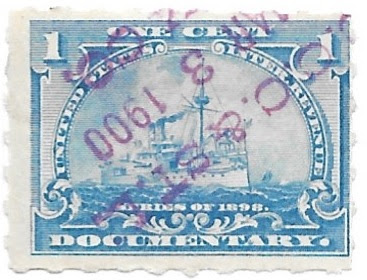
In the first year of this site, a 2 cent documentary stamp was featured with a prominent cancel "The Turners of Philadelphia". At the time I figured I was looking at a cancel by the German-American organization called The Turners, whose main purpose was to promote physical fitness. However, in the intervening years, and with my personal discovery of a 5/8 cent proprietary stamp with the same "The Turners" cancel, it is clear that The Turners of Philadelphia was a very different business that the German-American one. In fact, Philly Turners can be found in the proprietary focused Battlehsip Desk Reference data base. So today I will reprise that original post, and make a correction to the identity of the cancel on the R164.

The Turners of Philadelphia was a prominent proprietary medicine manufacturer. The Merck Report of April 1, 1898 featured a full page story regarding the firm that was originally published in the Philadelphian.

While I got the cancel ID wrong back in 2009, what's become clear is that it is possible to put together an interesting collection of battleship stamps cancelled by firms that used both proprietary and documentary stamps. Most commonly, the examples come from pharmaceutical companies that required them for the taxes on their products but also for financial and other taxed documentary transactions. Examples on this site include Johnson & Johnson and McKesson & Robbins, and now, The Turners of Philadelphia.
Far less common are organizations or firms whose primary business was not pharmaceuticals but might have used proprietaries on occasion. The Lake Shore & Michigan Southern Railway evidently used one cent proprietaries in a pinch when they likely couldn't get the documetary versions for their bills of lading.


Julius Goebel reportedly produced crucibles to hold molten glass. At the time this stamp was canceled, his operation was on Maiden Lane in New York. In the 1920s the business would be moved to 95 Bedford Street, where you can still find evidence of Mr. Goebel and his work. Three crucibles can be seen in the crest below.



Original Big 4 post from January 10, 2010:


Henry J. Schnitzer was a foreign exchange broker in New York, who would hold a seat on the New York Stock Exchange from 1916-1918 as a partner in the banking and brokerage firm Josephthal & Company.


Like last Sunday, this post covers the final set of 1898 dollar value revenue stamps, but this time only quirks involving the $2 value. In particular, quirks regarding the nature of the varnish applied to the stamps that received the wrong overprint, the overprint for the "gray" $2 stamp, #R185.
What I'm calling a varnish band appears to occur across versions of R191 that have R185's numeral overprint, including R191a (single overprint) and R191d (triple overprint), and an unlisted R191 with a quadruple overprint. Examples of these 3 stamps are featured below. As you may know, some, if not most examples of the normal versions of R190 to R194 have a square of varnish in the center of the stamps that underlays a numeral overprint to help foil cancel washing and reuse.
The post last Sunday on the tendency of these stamps to change color toward the hue of the R184 to R189 raised the prospect that the varnish square might be responsible for the color changes. Whether that is the case or not, the question prompted David Thompson's inspection of his copy of R191a, a version of R191 with a single R185 type overprint. He noted that the stamp does not have a varnish square but a varnish rectangle or band across the center of the stamp, and despite appearing unused, has no gum. A scan of his stamp follows, along with a version that helps highlight the varnish "band":


So after Dave told me about his stamp, I looked at the only R191 I have that has the R185 overprint. The stamp has the same varnish band, not square, appears unused, and has no gum. It also happens to have a quadruple overprint, with a strong image to the upper north of the main overprint, a slightly weaker one on the right, and very weak image slightly above the main 2:


I have a few dozen stamps from this series in my collection which I'll need to scrutinize. Meanwhile, this column has prompted me to examine the Scott listing for R191 and I have a couple of questions:


Henry Gurdon Marquand held a seat on the New York Stock Exchange during the Gilded Age, including the years of the 1898 Spanish American War tax period. He was extremely wealthy and had a passion for fine and expensive art, for which he built a grand Manhattan mansion in which to hang it all. And like many of New York's wealthiest at the time, he had his portrait and that of his wife painted by the go-to Gilded Age portrait artist of the time, John Singer Sargent.

Yesterday I put up Sargent's Benjamin Kissam portrait up on the right side of this site, and I started wondering how many Gilded Age brokers might have had their portraits done in oil, by Sargent or any other accomplished oil portraitist. The Marquand's were the first couple I could think of, but I'll see how many more I can find.
Meanwhile, the curious issue of Marquand cancelled stamps remains: every stamp I have ever seen cancelled by Marquand has a light, neatly applied cancel, with the stamp or stamps almost always retaining their original gum. The R188 block of 4 is one example. Here are more:


There is not much more to add, except:

Occasionally a collector of these stamps may come across a color changeling -- a stamp in which the green has begun to change, and in some extreme cases change to a color that nearly matches the so-called "gray" color of the R184 to R189 series of stamps (the color of these stamps is a warm, sepia-like tone, not a cold gray in any way). An unused copy of R191 demonstrates this phenomenon (stamp #7 below):

The back of the stamp is marked in pencil by a previous collector as a copy of R185 with an R191 overprint. The collection that it came from (I believe a different collector than the one that wrote the pencil note on the back of the stamp) also had a note from the collector on the side as an R185 with an error. The color change on this stamp is extreme and seems rare according to my limited experience. But the ink changeling phenomenon on these stamps exists, is capable of fooling relatively advanced collectors, and doesn't seem to have a clear explanation by my limited research. More common are stamps that show lesser hints of color change, like those in examples 2-5 above.
I've never seen ink change like this on any other US issues, revenue or postage. What is certainly unique about these stamps among US issues is the varnish square. Richard Friedberg figures that the varnish is somehow responsible for the color changes, and it might have been, but the evidence doesn't lend itself neatly to thinking that varnish contact made the difference. Consider stamps 3 and 4 below, where the stamps remain somewhat green closer to the varnish. And, if the varnish was the cause of a change like that in stamp #7 below, why don't we see more of these changelings?

Lastly, the $5 stamp, R192, provides an interesting opportunity to test varnish as a cause, as some of the stamps were issued without the varnish square or the overprint.

The R192a on the right never had varnish applied. Yet its color is clearly yellowing like many of the examples of R190 and R191 above. In this case the explanation must involve the nature of the green ink itself. The knowledge is likely long-gone from the BEP regarding the ink on these stamps. But I suspect the right sort of chemist could help tell us what is happening.
I have a couple of non-changeling related questions, both involving how Scott lists these issues:


