Showing posts with label R176 10 Dollar Documentary. Show all posts

Thursday, August 9, 2012

Cotton Brokers: George H. McFadden & Brother


Geo. H. McFadden & Bro.
SEP
6
1898
PHILADELPHIA., PA.


Geo. H. McFadden & Bro.
DEC
6
1898
PHILADELPHIA., PA.


Langlois scans


George H. McFadden and Brother was the largest cotton merchant in the United States during the Spanish American War period. In 1868, George H. McFadden took over his father’s business and established “Geo. H. McFadden, Cotton Merchant”. 4 years later, the firm became “Geo. H. McFadden & Bro.”

The McFadden's maintained operations in Memphis and Philadelphia.

The McFadden firm has been controlled over the last 50 years by many larger firms with an interest in the cotton business.  In 1984, Valmac Industries sold McFadden to Dunavant Enterprises.  As best as I can tell, remaining McFadden interests are today controlled by Louis Dreyfus Commodities.

Sunday, November 20, 2011

Metropolitan Stock Exchange


MET. STOCK EX.
MAR
8
1899

Dave Thompson scan


There appear to have been Metropolitan Stock Exchanges in both Boston and Chicago.  I do not know to which this cancel belongs. 

Thursday, April 21, 2011

Another Congregational Church Bill of Lading

Another Congregational Church bill of lading has surfaced. Like the bill of lading previously shown on 1898Revenues, this one too was issued by the American Express Company in Boston on June 30, 1900. It refers to "Minutes of" rather than "Report of Cong. Church", but both likely were for shipment of copies of the Report of the Second International Council of the Congregational Churches.

American Express Bill of Lading
Boston, Massachusetts
June 30, 1900
scan saved from eBay by Bob Patetta

Bob Patetta, who has provided us with numerous interesting documents, saved this scan from an October 2002 eBay auction. Unfortunately he was not the winning bidder so we don't know the current whereabouts of it, but thanks go to Bob who thoughtfully saved the image for future reference.

4,448 packages are listed, 1,744 of which presumably were turned over to the Post Office for mailing. The remaining 2,704 reports must have been shipped to different addressees as a total of $27.04 in tax was paid, 1-cent per each package to a different destination. The tax was paid by a combination of two $10, one $5, and two $1 Commerce Issues plus two 2-cent Battleship revenues.

These copies were consigned by A. Mudge & Co. More specifically, Alfred A. Mudge & Son Co., a well known Boston printer, although the Press of Samuel Usher is identified as the publisher in the report.

It's a great 1898 document and we'd like to know its current whereabouts. Hopefully, the owner is an 1898Revenues reader!

Monday, March 28, 2011

Stock Certificates - The Basic Tax Rates

The tax on stock certificates is detailed in the first paragraph of the War Revenue Law of 1898 Schedule A Documentary Stamp Taxes. Full of bureaucratic jargon, the provision is lengthy and verbose. Cutting to the chase, original issue stock certificates were to be taxed at 5-cents per $100 in face value or fraction thereof, and upon resale, any stock certificate was to be taxed at the rate of 2-cents per $100 in original face value or fraction thereof.

Wall Street brokers had lobbied Congress against taxing resales based upon their actual resale value, arguing that doing so would be tedious as clerks would have to spend extra time calculating the tax on multi-share certificates. Hence the flat 2-cents per $100 resale tax on original face value.


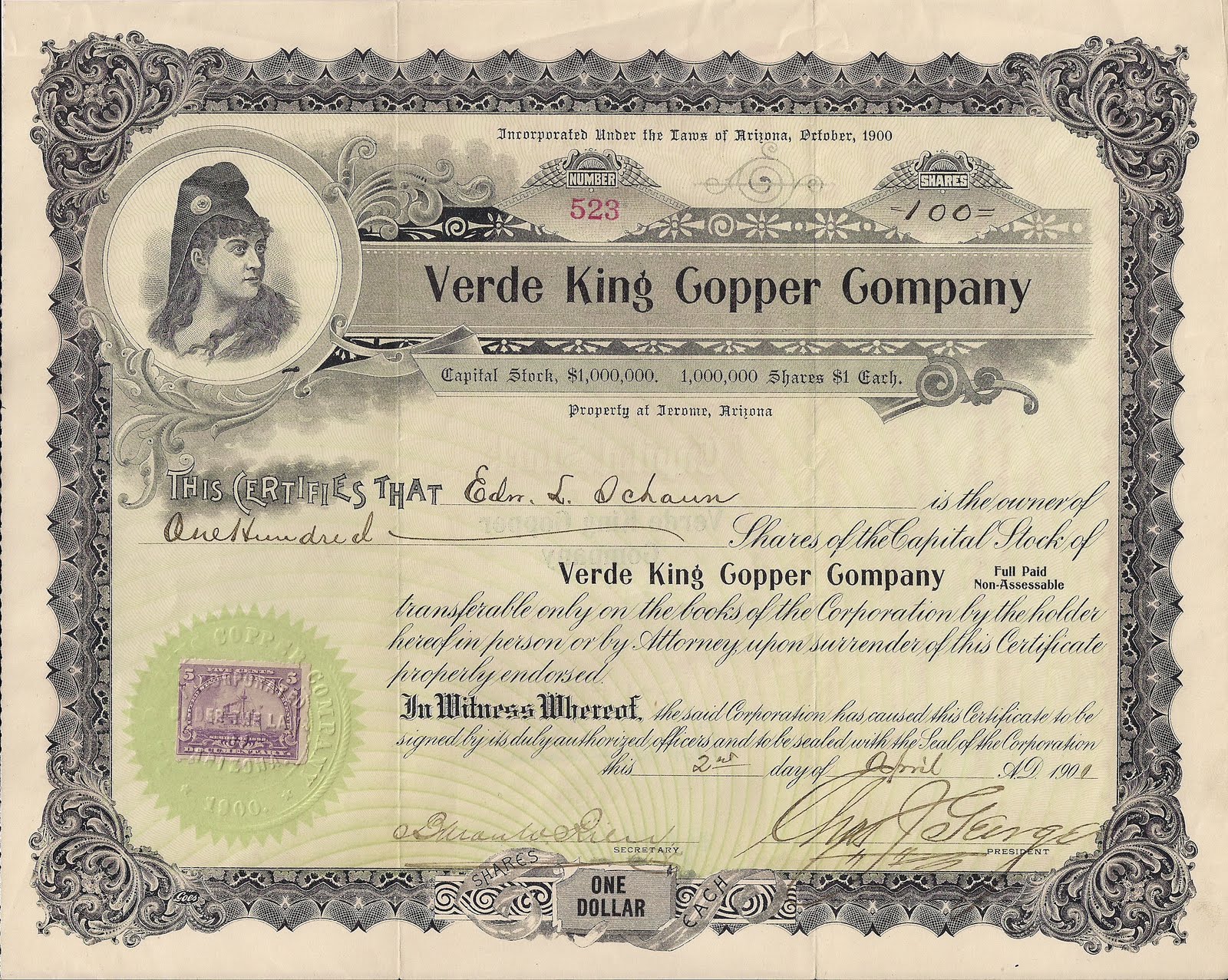
Original Issue Stock Certificate Verde King Copper Company
Jerome, Arizona Territory
April 2, 1901

At $1 per share, the 100 share certificate of the Verde King Copper Mine shown above demonstrates the 5-cents/$100 tax in its simplest form with the embossed impression of the company's seal serving to cancel the R167 5-cent battleship stamp. Although this certificate likely was issued from the company's Los Angeles headquarters, the company was incorporated under the laws of the Arizona Territory in 1900 and the mine was located in Jerome, on the other side of Mingus Mountain from Prescott, the current residence of this blogger.

Since moving to Arizona in 2004, I've kept a watchful eye out for on-document usages from the then Arizona Territory; Arizona did not become a state - last of the lower forty-eight - until February 14, 1912.

At its height the copper mine boom town boasted a population of 15,000+ and held the dubious title of "wickedest town in the west." Today's Jerome is a bit more refined; a genteel artist community peppered with B&Bs, inns, and trendy restaurants.


Choctaw, Oklahoma & Gulf Railroad Co.
Resale of Stock December 10, 1901

John previously has blogged about a printed cancel on a $1000 share certificate for the Choctaw, Oklahoma and Gulf Railroad Car Trust issued through the Girard Trust Company in 1902 and how earlier stock issues from the company were bought up to force the sale of the road in early 1902 thus allowing the formation of the new 1902 trust agreement.

The stock pictured above undoubtedly was one of those earlier stocks accumulated just prior to that 1902 sale process as it bears a resale date of December 10, 1901 and was subsequently cancelled by Girard Trust on May 1, 1902. Actually there is more going on with this stock than meets the eye; the original owner, Atlee H. Tracy, resided in Sevenoaks just outside of Kent, England. For the purpose of this blog, however, it neatly demonstrates the 2-cents/$100 tax on a resale of stock with an original value of $100 or less. The single share here originally sold for $50.


1898 Original Issue Stock Certificate
Wisconsin Telephone Company
Patetta scan

Bob Patetta kindly has provided a nice example showing BOTH the 5-cent/$100 original issue tax and the 2-cent/$100 resale tax on the same document. At $100 per share the 1000 share certificate of the Wisconsin Telephone Company shown above originally sold for $100,000. At 5-cents/$100 it was properly taxed $50. The R178 $50 Commerce issue in the upper left corner provides a hint of some of the wild, high-value stamp combinations we'll feature in upcoming blogs.

Resale Endorsement
Wisconsin Telephone Company Stock Certificate
Patetta scan

Two $10 Commerce issues on the back of this 1000 share Wisconsin Telephone Company certificate neatly document its resale at 2-cents/$100 in original value.

The Wisconsin Telephone Company was founded in 1892. Today it's part of the "new" AT&T.

Wednesday, October 13, 2010

A Spectacular Bond

When I started blogging about bonds a few days ago, I emailed Bob Patetta, who has contributed some great documents before, asking if he had any unusual bonds.

Am I glad I asked! It turns out Bob has a spectacular bond, ex
Morton Dean Joyce, written for Three Hundred and Fifteen Thousand, Two Hundred and Eighteen Pounds, Fourteen Shilling Sterling. That converts to $1,525,658.50 with the tax at 5 cents per $100 in face value, or fraction thereof, being $762.85

The $762.85 tax was paid by an interesting combination of stamps: four $50, five $30, twenty $10, twenty-nine $5, twenty-two $3, one $1, one 80-cent, and one 5-cent.


The Securities Company Consol (Bond)
New York, New York September 1, 1899
Bob Patetta

front of attachment sheet showing tax stamps
Bob Patetta scan
back of attachment sheet showing the balance of the tax stamps
Bob Patetta scan

I'm guessing this Securities Company bond was a type of investment vehicle where the assets of various investors were pooled to create a super bond. Considering the official British Government bonds of the period generally paid just 2 3/4% annual interest, the 4% offered through this bond must have looked attractive to its investors. Anyone who can shed further light on how this investment likely was structured is invited to Comment below, or email 1898revenues@gmail.com
The stamps are all cancelled with a single-line hand stamp reading, J. A. H. Macnair, C. A. , the company's named agent, and a separate single-line date stamp dated, 29 AUG 1900. There is no indication other than the lined out signatures that the bond was called, but the fact that it was not taxed until 2 days prior to September 1, 1900, one of the interest due days when the principal also could have been paid off, suggests that's what occurred thus forcing Macnair to pony up the tax nearly a year after it should have been paid.
It's hard to find on-document usages of the $3 and $30 Commerce issues. To find both on the same document is a real coup! And it's likewise hard to find on-document usages of the 80-cent Battleship.
Thanks Bob for sharing this spectacular bond. If anyone else has an unusual bond with unusual taxation, please send a scan and description to 1898revenues@gmail.com

Sunday, September 5, 2010

Cancel for September 6: George H. McFadden and Brother

R176 $10 Black Documentary


Geo. H. McFadden & Bro.
SEP
6
1898
PHILADELPHIA, PA.

George H. McFadden and Brother was the largest cotton merchant in the United States during the Spanish American War period.  In 1868, George H. McFadden took over his father’s business and established “Geo. H. McFadden, Cotton Merchant”. 4 years later, the firm became “Geo. H. McFadden & Bro.”


The McFadden firm has been traded over the last 50 years by many larger firms with an interest in the cotton business.  In 1984, Valmac Industries sold McFadden to Dunavant Enterprises.  As best as I can tell, remaining McFadden interests are today controlled by Louis Dreyfus Commodities.