Saturday, September 15, 2012

On Beyonde Holcombe: Ladd & Coffin

On Beyond Holcombe, by Malcolm A. Goldstein, appears on Sundays at 1898 Revenues:


LADD & COFFIN,
JAN
26
1899
NEW YORK.

Ladd & Coffin cancel on a non-proprietary, R164 2 cent documentary stamp. 


Ladd & Coffin Co’s battleship cancels are not only frequently seen (at least on proprietary stamps, unlike the documentary example), but come in at least four formats: small with a year date; small with a month, day and year; large with a year date; and large with a month, day and year date. The company had started much earlier in the era of the first revenues and had even issued its own private die proprietary stamps (RT26-33). Since Holcombe’s book dealt only with the medicine companies, and it was a manufacturer of perfume, it escaped Holcombe’s scrutiny. The RT stamps were ordered and used by L & C’s predecessor, Young, Ladd and Coffin. They came in four values, from 1c to 4c, and are known perforated and imperforate, as well in the b, c and d paper varieties, accounting for 24 varieties in all, most moderately uncommon, and RT32b genuinely rare. By 1898, these private die proprietary perfume stamps themselves were already being catalogued and offered to the public by stamp dealers.


Civil War era private die of Young, Ladd & Coffin


The company’s product was a line of Lundborg’s Perfumes, and its history predates the Civil War. Its founder was a Swede who emigrated to the United States, John Marlie Lundborg How he acquired his knowledge of perfume seems now lost in time. He is listed as a “perfumer” in the 1860 Trow’s Business Directory for New York City, but apparently lived in Hudson, NJ. By 1872, he had sold an interest in his business to Richard D. Young, and by 1873, the firm was reorganized as Young, Ladd & Coffin. Although an advertising brochure was issued in his name as late as 1876, he retired when the firm reorganized, and died of “softening of the brain” in Hudson in 1880 at age 57.


Richard D. Young took the premier spot in the new partnership because he was already an established businessman. Born in Pennsylvania in 1840, by 1876 he was influential enough to be a member of the New York City Board of Trade. He remained associated with Y, L & C from 1872 to 1887 when that company dissolved by “mutual consent.” He then established his own perfume manufacturing business, the R. D. Young Perfumery Co. It did not fare well, for reasons which will become readily apparent.

The bland explanation for the undoing of Y, L & C may have concealed more profound difficulties Young was experiencing. He had married Emma Bushnell, who came from an old New York City family, but after their five children had begun to mature, the marriage had gone stale. Emma had filed for a separation in 1885. Apparently, since the two were already pursuing their separate lives, she did not force him to litigate to divorce, perhaps because blatant evidence of adultery was the only acceptable proof to obtain a divorce. In 1888, Young later declared, his business difficulties caused him to go temporarily insane. He suffered from “melancholia” and was hospitalized in three different sanitariums. During this period, in the Spring of 1888, while she was exercising “undue influence” over him (according to his later account), he deeded to Emma their house together with several perfume formulas. However, by 1889, he had recovered his health. Now robust and reinvigorated, he not only sued Emma to recover the deed to the house, but also persuaded her to withdraw her separation action.

Peace did not ensue. In 1890, Emma decamped to her mother’s house in Montclair, NJ. A strange event then transpired. One of Young’s clerks, Melano Reichardt, who, coincidently, was boarding with Emma’s mother, accompanied Emma to the Hamilton Hotel in Patterson, NJ. She said Reichardt was “attentive to” her and they stopped during a normal Sunday drive merely to have dinner. Out of the same circumstances, Young shaped a different narrative. He charged that he and another of his clerks had discovered Emma at the hotel in a “compromising position” with Reichardt. She renewed her suit for separation and he cross-sued for divorce. By November, 1889, Emma was being shadowed by Young’s “private Hawkshaws,” as she called them (“Hawkshaw” was then a popular detective cartoon strip). She averred they had tried to break into her quarters and so harassed her that, in the supercharged words of the New York Times reporter, “she began to feel that life, liberty and the pursuit of happiness were but a hollow mockery.” After one detective so menaced her as she made her way to the Astor House hotel (where, she stated she was merely picking up a left umbrella), she had him arrested. The same New York Times reporter cynically concluded his article on the incident with the aside that the detective posted $300 bail “and left apparently delighted at the leniency of the court.”

When the marital cross-suits of the Youngs came to trial, Emma testified that the deed to the house was Young’s birthday present to her that year, and, further, she had abandoned the family home only after Young tried to shoot her. Young testified his “melancholia”prevented his even remembering his conveyance of the house to Emma. But the tale of Young’s degradation grew even juicier. During the divorce trial, a Grand Jury in New Jersey indicted Young and his two clerks for the crime of “conspiracy” in connection with the Hamilton Hotel incident. The indictment charged they had tried to trump up against Emma false evidence of the “in flagrante delicto” act necessary to demonstrate adultery. By then, Young’s company was a shambles. In December, 1890, Young made an assignment of his business, and in early 1891, a trade journal stated that the “stock, plant and fixtures ... of Richard D. Young, the well known manufacturer of perfumes ... had lately been sold at auction by an assignee.” Young was bankrupt. That journal sympathized that “his recent troubles are a matter of profound regret to his many friends in this part of the world.”

As Young’s criminal conspiracy trial approached, the other clerk died and Young fell out with Reichardt. In May, 1891, both went on trial in New Jersey. The prosecutor introduced a love poem which Young had written to some “Loved One.” Young claimed it predated his marriage, although the document bore the date of March 4, 1890, and refused to identify the “Loved One.” The Times reported that Young and Reichardt each tried to proclaim that he had been duped by the other and that only the other should be blamed for the conspiracy. The Times, summarized the cross-purposed defenses: “This novel spectacle has excited great interest.” Naturally, both were found guilty. Young was sentenced to pay a fine of $100, plus half the court costs, which amounted to an additional $37.50. Reichardt drew a $50 fine and the other half of the costs. After that humiliation, an initial ruling setting aside Young’s conveyance of the house to Emma was reversed on appeal, with the appellate court noting that it could only conclude from the trial evidence that Young knew perfectly well what he was doing when he deeded the house to Emma. A final court decision granted Young a “partial” divorce, while recounting the circumstances of his conviction. With Young finally divorced, convicted of criminal behavior and bankrupt, the newspapers tired of both the Youngs and they disappeared from the news. A trade journal offered one last grace note: in 1894 it related that Young had brought his 36 years of experience in the perfume business to the Crown Perfumery Co as its “American agent.” In the 1900 Census, Young’s wife listed herself as a widow and the head of her household. Apparently, neither the Times nor the industry trade journals reported Young’s death or eulogized him.

By contrast with Young, the intertwined lives of John B. Ladd and Sturgis Coffin were much more “prosaic,” although the wealth that they both amassed through their perfume partnership meant that their comings and goings were chronicled in the social columns of the New York Times. Ladd was born in New York City in August 1839. When he joined with Young and Coffin, he had been a salesman for Colgate & Co (yet another company to be explored in this series). Ladd’s wealth enabled him to amass his own collection of old masters, nineteen of which he lent to an exhibition in 1897 celebrating the opening of the Brooklyn Art Institute’s new building, now the Brooklyn Museum. In 1908, he exhibited at the Union League his collection of Dutch Masters and other more modern works by such artists as the 19th Century French artists as Corot and Boudin.

The closest tie between Ladd and Coffin was that they were in-laws. Ladd married Coffin’s sister Emily, and before his own marriage, Coffin lived with the Ladds in Brooklyn. His sister, Mrs. John B. Ladd, was the one whose name appeared most frequently in the social columns through her involvement with her many charities benefitting institutions serving the then separate city of Brooklyn and their various balls, galas and “tableaus,”(live portrayals of famous old masters). One of her other significant activities was her association with a group of prominent Brooklyn women who issued a manifesto to the New York State legislature denouncing the women’s suffrage movement, They wrote: “from a studious contemplation of the governmental principles involved, came a firm conviction that woman suffrage would be against the best interests of the State, its women and the home.” Since the broadside dates from 1894, the ladies must have had their way. Despite his wife’s now seemingly retrograde views suffrage, Ladd as well as Coffin both considered themselves reformers enough in 1902 to sign a petition in support a Citizen’s Union plan for a reform mayor and refreshed government of the now united New York City.

Coffin and his wife were also linked with many charities. Coffin was born in Poughkeepsie, NY in 1845. His father, Henry, was a well-known and prominent wholesale druggist, first in Poughkeepsie, and after 1867 in Brooklyn, who served as a trustee of the Long Island Trust Company, a director of a plate glass company and an major investor in the Atlantic Avenue Railway Company. By the time Sturgis became part of Y, L & C, his mother was already a part of the Brooklyn social scene, and the younger Coffins associated with the same charities as had his parents and his sister. In 1892, he also served on the perfumers’ committee of the drug trade industry’s effort to raise money for the construction of Grant’s Tomb, and, in 1894, he and his brother-in-law Ladd were both members of the Board of the Brooklyn Homeopathic Hospital that was called upon to fire and replace the hospital’s entire professional staff to settle a festering internal quarrel. In 1894, he was listed as among the attendees at a New York City Board of Trade meeting where the principal address concerned tariff reform, and, a month later, as both and attendee and sponsor of a $25 prize awarded at the Brooklyn Horse Show. The Times described that affair as being Brooklyn’s social equivalent of the National Horse Show at Madison Square Garden.

Over the next several years, Coffin’s name continued to be mentioned in connection with the Brooklyn Horse Show and many other society affairs. In 1903, the Times noted his daughter Natalie’s engagement to Johnston de Forest, the only son of an old Washington Square family, whose grandfather had been the first president of the New York Stock Exchange. Natalie married de Forest in October, 1904, but her health apparently was poor from the outset. After attempting to recuperate in Colorado Springs, CO, then her family’s summer home in New Canaan, and finally in Asheville, NC, she died in April, 1906. Shortly thereafter, Sturgis Coffin’s life ended tragically. In August, 1907, he died suddenly of a ‘cerebral hemorrhage” at age 62 in New Canaan. Several days later, when the coroner’s report was released, the papers revealed that the hemorrhage had been induced by a self-inflicted gunshot wound. The speculation was that he had been distraught, never having recovered from Natalie’s death. Mrs. Coffin’s name continued to grace the social columns until her own death in 1924.

Ladd & Coffin disappeared on January 1, 1910. With Coffin dead, Ladd, who was in ill-health, retired on December 31, 1909. The company was restyled as Coffin & Price. The Coffin was T. J., a nephew of Sturgis Coffin and Mrs. Ladd. Price was a W. C. Price. Both had been long-term employees of the company, and a trade journal reporting on the re-alignment speculated: “it is safe to say they will continue the business along progressive lines.” Ladd died in November, 1910, much honored by the industry and trade associations. By 1914, the company had changed its name to the Lundborg Co. By 1917, it had become strictly a manufacturer and wholesaler and had abandoned its downtown New York City address for Fifth Avenue. Circa 1930, it was still introducing new fragrances and in 1954 the company remained on Fifth Avenue. Currently, its products do not appear to be in production, although vintage bottles and advertising abound.


While in operation, the company drew singular praise from one visitor to its establishment. During the Nineteenth Century, European travelers from de Tocqueville to Dickens delighted in exploring the brave new, raw United States, and publishing their observations to enlighten their more sophisticated brethren about their strange country cousins. In 1884, an English woman, Emily Faithfull, who was investigating the position of women in American society observed:

“Another scene of female industry interested me greatly in New York. Mr. Rimmel [Eugene, 1820-1887, born French, but operated a world famous and still extant business in London after 1834] claims to have been the first have employed women in England on a large scale in the manufacture of perfumes, and Messrs. Young, Ladd & Coffin, the makers of Lundborg’s exquisite perfumes and Rhenish Colognes, are entitled to the same honour [sic] in America. ‘The rich man’s luxury is the poor man’s bread;” if scent must rank as a luxury, it certainly is one which affords work for thousands. But it is more than that, it is a sanitary agent as well, and an adjunct to the refinements of life with which high civilisation [sic] cannot dispense.”
Let us close with one further glimpse of L & C’s business as it hummed along in 1888:


Thursday, September 13, 2012

Frank W. Agan of Ludlow, Vermont


F. W. AGAN,
DEC
7
1899
Ludlow, Vt.

David Thompson scan


Mr. Agan was the inventor of an early vacuum cleaner, albeit one that required two users, one to operate the cleaning end and another to drive the wheel that powered the pump that created the suction (and to stick the expectorating end out the window). 


The following text comes from a Blog about the graduates of Vermont's Black River Academy.  The original post can be found here.

The Agan Vacuum – A Precursor of Modern Automation


(The following is the first in a series of articles on the contributions made to society and the world by alumni of Black River Academy (BRAM) in Ludlow, Vermont. While Calvin Coolidge is its most renowned alumnus, there were many others who made lasting contributions. This is an effort to recognize them. We plan to update this list of BRAM alumni monthly.)

Frank W. Agan was born in Plymouth, VT., December 18, 1868. He attended the common schools and the Black River Academy in Ludlow. June 10, 1896, he married Cora A. Safford, daughter of the late Major Darius Safford of Morrisville, Vt. She passed away August 26, 1988. In 1897, Mr. Agan commenced the manufacture of the shoddy, the first industry of the kind ever established in Ludlow.

The Agan vacuum cleaner was created by Agan in Ludlow, Vermont sometime in the late 19th or [early] 20th century. The Agan Vacuum is an important symbol of the Gilded Age. As technology and innovation spurred on the Industrial Age, wealth increased and as a consequence a new class developed. With a vast amount of buying power, many new products appeared to meet the demands of this new class, especially its women. Society demanded that women present their homes as a model of their husband's wealth and influence in the work place and with disposable income on the increase, washing machines, stoves and vacuums all represented this wealth. Meant as 'labor saving devices' these new products also opened up some ''leisure time' allowing women to spend time on volunteering in their communities and focusing on other aspects of their roles as mothers and wives. The museum has in its collection a hand operated vacuum and a power operated vacuum made by Frank.

What is fascinating about Mr. Agan's career, however, is the breadth of his interests and scope of his involvement in community affairs. He was involved in Vermont politics, narrowly being defeated for Lt. Governor in 1902 in what the New York Times described as "the hottest political campaign in the history of Vermont". He began his career in the mills of Ludlow, eventually owning a shoddy mill ("shoddy" was wool produced from reclaimed wool).

He managed to find time to be President of the Ludlow Telephone Company, a Trustee of the Village of Ludlow, a principal in a medical equipment company, a school board member, and an active Mason.

But history will best remember him for his vacuum cleaner. Meant to be used by two people, one to crank the wheel in order to generate the suction and one to clean with the wand or head of the vacuum, this labor saving device collected dirt as well as dust in one hose and transferred it to the second so that the refuse may be placed out the window. As new technology, this vacuum was an innovation of its day and it enabled women or their servants to clean rugs, furniture and hardwood floors. The non-electric wheel type vacuums, such as the Agan, were in great demand until the electric replacement came onto the market also in the early 20th century.

*******


Agan Vacuum


In their day, wheel operated vacuums approached the cutting edge of early technology. They exhibited a sophistication that was not present in earlier vacuum designs. This style of machine provided powerful and continuous suction for its user. The increase in vacuum even allowed for larger diameter hoses and bigger cleaning tools. Typically, one person cranked the wheel while another cleaned with a wand or hand tool.

Mechanical advantage was achieved through the use of belts and pulleys. The hand, or power wheel, was set into motion with a cranking handle. The large wheel drove a belt that also went around a much smaller pulley. The small pulley was fixed to a shaft which would spin a fan or pump a set of bellows. These machines were used effectively until the early electric vacuums became popular.

The Agan Vacuum.  Made in Ludlow, Vermont.

The twin set of belts gives this machine tremendous mechanical advantage. Suction is generated by a fan chamber in the center of the machine.

There is no dust collecting bag on this cleaner, but the design does include two hoses. One hose is connected to the inlet and used in the conventional way. The second hose is connected to the outlet. The operator placed the vacuum near an open window, stuck the hose end out the window, and let the device deposit the dirt outside.

Tuesday, September 11, 2012

Philadelphia Stock Brokers: Edward B. Smith & Company


This is the logo for the present firm Mogan Stanley Smith Barney.  Edward Smith's company merged with Charles D. Barney & Company in 1938 to become Smith Barney & Company.  Smith Barney became famous in the 1970s for a series of John Houseman television commercials in which he said: "Smith Barney, they make money the old fashioned way...they earn it."  Morgan Stanley Smith Barney is presently a joint venture between Morgan Stanley and Citigroup.


EDWARD B. SMITH
OCT  14  1901

Langlois scan


Monday, September 10, 2012

New York Stock Brokers: Rogers & Gould

New York Evening Post, February 6, 1892


Rogers & Gould were Edward Leighton Rogers and William S. Gould.  Charles T. Barney was a special partner.  Tomorrow's post will feature Mr. Barney's future partrner, Edward B. Smith.  They would create the firm Smith, Barney.


ROGERS & GOULD
1
14
1901
N. Y.

David Thompson scan


From New York State's Prominent and Progressive Men, Volume II, 1900:

Edward Leighton Rogers:

IT is a far cry from Smithfield to Wall Street, and from the days of Bloody Mary to the present. Yet such are the curiosities of descent that we shall find a direct ancestral link, or chain, between the two. The family of Rogers has long been a prominent one in England. It has produced many men of distinction in various walks of life. Few of these are better known than John Rogers, the fii'st of the Marian martyrs. He was a Cambridge student, the translator of the " Matthews Bible," and a London rector. Immediately after Queen Mary's accession to the throne, he preached a vigorous sermon against Roman Catholicism, which proved practically to be his own funeral sermon. He was forthwith arrested, kept in prison for some time, and then pubhcly burned at the stake at Smithfield, the first of the long line of martyrs of that reign.

Of such ancestry was the Rogers family which was at a later date transplanted from England to New England, and which has played no small part in the development of this nation. In the last generation Edward Y. Rogers of New Jersey is well remembered as one of the leaders of the bar and a prominent politician.  He was an " Old Line Whig," and then, following the lead of Horace Greeley, became a Republican, and was a conspicuous member of the National Republican Convention at Chicago in 1860, at which Abraham Lincoln was nominated for the Presidency of the United States.

The subject of this sketch, Edward Leighton Rogers, a son of Edward Y. Rogers, was born at Rahway, New Jersey, 1850, and, after being educated at private schools, he subsequently developed an inclination toward business, especially toward finance. At the age of twenty years, therefore, he sought and found an
engagement in Wall Street, and from that time to the present has been contiuiiously occupied with the fascinating operations of that great center of finance and speculation.

It was in 1870 that Mr. Kogers entered Wall Street. Five years later he became a member of the New York Exchange, and thus qualified himself for full participation in all the operations of the Street. For some years he worked alone, with gratifying success, and steadily built up a reputation for integrity and skill.  In 1885, however, he formed the firm with which he is now identified, under the name of Rogers & Gould. Mr. Rogers is the head of it, and his partners are William S. Gould and Alexander H. Tiers, with Charles T. Barney as special partner. Mr. Barney is president of the Knickerbocker Trust Company, and is a tower of strength to the firm. The firm of Rogers & Gould is well known in Wall Street, and conducts a large and profitable volume of brokerage business.

Mr. Rogers has devoted his attention, in a business way, exclusively to his Wall Street operations, and accordingly has not identified himself with any outside corporations or enterprises.  Neither has he held nor sought pubhc office, but has confined his pohtical activities to discharging the duties of a private citizen.

Mr. Rogers is not widely known as a club-man. He is, however, a member of the Century Association, one of the most desirable social organizations in New York.

Saturday, September 8, 2012

On Beyond Holcombe: Keasbey & Mattison Company

On Beyond Holcombe, by Malcolm A. Goldstein, appears on Sundays at 1898 Revenues:


K. & M. Co.
Ambler,
June 15, 1901

RB20 block of 4 with printed cancels in selvage, ex-Tolman


Collectors of battleship cancels find those of the Keasbey & Mattison Company of Ambler, PA to be among the most frequently seen and most readily available. Moreover, for connoisseurs who hold printed cancels to be the gold standard of battleship revenue collecting (with whom this author most forcefully and grumpily disagrees), the listing of the variations and errors in its printed cancels is a treasure chest that covers seven single spaced pages in the original Chappell-Joyce compilation (a listing which this author believes emphasizes the trees at the expense of the forest). Few philatelists have explored K & M’s history to understand the energy behind this cornucopia of stamps or the greater ramifications of K & M’s existence. K & M, and the personalities behind it, may provide the most quintessential and elementary case study thus far in this series of all the elements, good and bad, which make the study of the patent medicine, as well as the broader pharmaceutical, industry in the era of the Robber Barons both piquant in itself as well as relevant to today’s world of unrestricted corporate power.


THE COMPANY

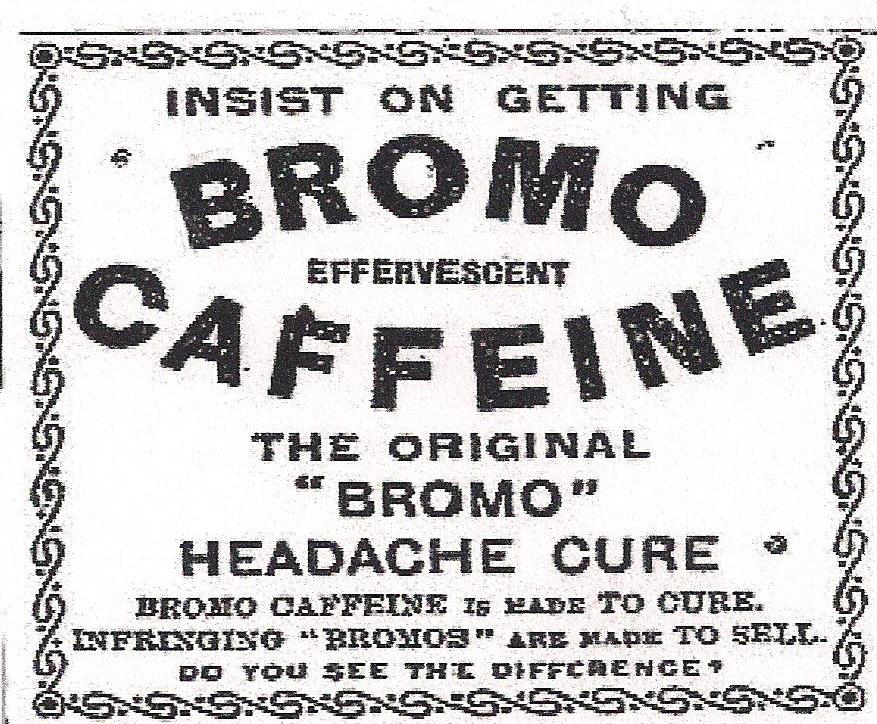
Aside from its philatelic prolificacy, the most significant fact of K & M’s long existence is it managed (if inadvertently) to successfully market products, as well as create unimaginable wealth, in two completely different and unrelated areas - patent medicine and asbestos insulation - both of which ultimately became rigorously scrutinized as generating major health hazzards. In a time when medical advertising hyperbole was unchecked, the company widely promoted its patent medicines as cures for all types of nervous exhaustion. Even if its principal product, Bromo-Caffeine, was merely a forerunner of today’s headaches remedies, it was also touted as a remedy for a “weak heart” or “sudden cardiac dropsy” (and, in fact, it may have been as good a remedy as was available at the time for heart attack relief). However, long after the patent medicine industry’s exaggerated claims were throttled and the over-the-counter narcotics barred, the company’s successors again became notorious for K & M’s second, even larger product line, asbestos insulation. Asbestos, welcomed in the nineteenth and first half of the twentieth centuries as a miraculous industrial breakthrough because of its resistance to extreme heat, electrical and chemical damage, became a nightmare for K & M’s successors as it was gradually proven to be a malign and potent carcinogen, at last fodder only for late night ads by attorneys promising rich recoveries who, even now, still endlessly trawl the air waves for victims of its poisoning.


As Athena from Zeus, the company sprang into being as a pharmaceutical laboratory in Philadelphia in 1873, as soon as its founders, Henry Griffith Keasbey and Richard V (Van Zeelust/Vanselous) Mattison, graduated together from Philadelphia’s prestigious College of Pharmacy. It achieved almost immediate success with a headache remedy marketed initially under its chemical identity as citrate of caffeine, but sold after 1881 under the trademarked name “Bromo-Caffeine,” derived from a class of compounds known as effervescent salts. These chemical combinations of acids and bases result in the release carbon dioxide, often experienced as pleasant fizzy, bubbly sensation. While K & M also marketed Salaperient for constipation, Alkalithia for rheumatism and Cafetonique for dyspepsia, Bromo-Caffeine quickly became the first source of the wealth K & M created.


K & M also manufactured carbonate of magnesia, the common laxative milk of magnesia. Mattison soon noticed that one Hiram Hanmore was purchasing copious amounts of magnesia from the company and wondered how Hanmore was using it. Upon inquiry, Mattison learned that Hanmore was combining magnesia with hemp fiber and binding the mixture to metal as insulation. However, hemp was not durable and soon burned away when the metal was exposed to the frequent high heat generated in the newer, larger steam boilers and piping systems built in the advancing Industrial Revolution. Mattison quickly discovered that when asbestos was substituted in place of hemp in the mixture, the resulting compound was an extremely stable, malleable and durable insulating material. Asbestos, a group of silicate minerals, is characterized by long crystals able to be spun into fibers. It already had a 4,000 year history as a fire resistant novelty, but had only just begun to be available in large enough quantities to be used commercially. Mattison moved decisively. First, he convinced Hanmore of the superiority of his asbestos insulation and became his exclusive supplier. Then he began to manufacture and market asbestos to the world at large. Mattison soon became known as the “Asbestos King,” and the fortune generated by asbestos was even greater than the one from the proprietary medicines.

Asbestos was not specially taxed in the Revenue Act of 1898. Rather, it was the popularity of Bromo-Caffeine that generated the demand for the battleship revenue stamps. K & M soon operated sales offices in New York City, Boston, Chicago, Cleveland and Cincinnati. It fought hard to defend its trademarked name and in more than one case successfully convinced a court that Bromo-Caffeine was a legitimate trade name or a legal trademark. In 1892, it even had a man sent to jail for criminal counterfeit and trademark infringement when he peddled his own unauthorized version of Bromo-Caffeine. The principal ruling establishing the legality of the trademark was somewhat ironic because the proof offered by K & M to establish the uniqueness of the name Bromo-Caffeine was that Mattison had created that name entirely from his imagination and the product itself, which contained, inter alia, lots of sugar, less than 2% caffeine, a great deal of bi-carbonate of soda, as well as a dash of potassium bromide, bore no resemblance to any other known chemical formula. To no avail, the challengers offered proof that there were legitimate chemical combinations of bromine and caffeine, which involved the use of the terms bromo and caffeine in some combination, and, even closer to the point, a German scientist named Schultzen denominated a certain combination of bromine, hydrogen, nitrogen and oxygen as Bromo-Caffeine in 1867 and had marketed it modestly as a chemical (but most definitely not as a headache remedy) both in Europe and the United States. That success in defending the Bromo-Caffeine trademark led K & M to push even harder to restrict its competition.

When Emerson Drug Co. (see RS 280-3, together with its own vast array of printed cancels, (a company subject to this column another day)) began have success with its headache remedy Bromo-Seltzer around 1894, K & M issued a barrage of circulars to the industry stating it was prepared to challenge Emerson’s use of the term “Bromo” as an infringement of its Bromo-Caffeine trademark. Drug associations around the country discussed the viability of K & M’s threats at their meetings. Since Bromo-Seltzer was such a good seller, the trade generated little enthusiasm for K & M’s militant position, and these meetings often turned into sessions on how to find strategies to ignore K & M’s threats. Early in 1895, a group called the United States Trademark Association published a list of some fifteen other trademarks containing the term “Bromo,” including Bromo-Seltzer, which itself had been trademarked in 1889, and asked for additions from anyone who could provide them. K & M did file its suit against Emerson, but eventually consented to settle out of court. By that time, medical reformers were already vigorously attacking Bromo-Seltzer as containing the dangerous and even deadly stimulant acetanilid in place of caffeine. K & M could always boast that Bromo-Caffeine never contained that poison.

Buoyed by the two burgeoning product lines of patent medicines and asbestos insulation, K & M soon needed to expand from its limited quarters in Philadelphia. Mattison discovered that there was a source of magnesia in the dolomite rock formations near Ambler, PA, now a suburb of Philadelphia, but then a sleepy farming village with declining prospects because its agricultural fields were played out. Ambler had one other virtue to recommend it: a connection with the local railroad. Recognizing that the combination of easy access to both raw materials and transportation suited them perfectly, Keasbey and Mattison moved the entire business to Ambler in 1882. Ambler flourished under the benign rule of K & M for the very long lifetimes of the company’s two founders.

Henry G. Keasbey

As patent medicine barons, the founders of Keasbey and Mattison could have been ordered directly from Central Casting in Hollywood. Mattison’s oversized body and personality tend to soak up most of the extant accounts about K & M. The seemingly patrician Keasbey, who has left only indirect traces of his presence, disappeared quickly from public scrutiny. Born in 1850 into the wealthy gentry, Keasbey’s family origins are now opaque because the prominent Keasbeys of the era were statesmen, attorneys and jurists from neighboring New Jersey. Since there are later claims his grandfather was a friend of Thomas Jefferson, he must have descended from a “lesser branch” of that New Jersey clan. Keasbey himself gained prominence when, at age 22, he could simply produce the $5000 to finance K & M’s founding. Between 1873 and the company’s incorporation in 1892, Keasbey stayed in the background, but must have overseen the ever expanding day to day operations of the company, since the much busier and more publicity conscious Mattison made an immediate transition from student to teacher at the College of Pharmacy, and then graduated as a doctor of medicine in 1879 from the University of Pennsylvania (although he never practiced medicine), all while, on behalf of K & M, personally selling Bromo-Caffeine one doctor at a time from coast to coast to establish it as the leader in its field, fighting the court battles to protect its name, and also developing the entire asbestos product line.

As soon as K & M incorporated (with stated capital of $2,000,000), Keasbey converted his partnership interest into stock of the new K & M, Inc. and retired from its active management, never again to take a direct role in the running of the company. He did keep tinkering for his own amusement, however, for after 1892, he patented several devices, such as improved feed-water heater, in his own name. Married in 1877 to Anna Foster, a cultivated young Philadelphian educated primarily in Paris, he became a father of four. Although he never lived in Ambler, during the years he summered there, he is remembered as the sponsor of the local baseball team and a benefactor, along with his wife, of both the Baptist Church and a mission to cater to the special needs of the Italian immigrants who worked in his factory. Rather, because of his wife’s delicate health, he and his family traveled extensively to Europe, particularly in the south of France, to find the appropriate climate to suit her precarious constitution, and she died at a villa there in 1897. After he was widowed, he continued to travel a great deal and resided in England and on the Riviera throughout his remaining years. At one time, he did establish a world renowned collection of medieval armor but sold it at auction in 1903. Thereafter, he pursued his art interests quietly, and, even now his bequests to the Metropolitan Museum of Art in New York City are listed as the source of funds used to purchase art objects. At the end of the life, when he died just days short of his 82nd birthday in 1932, beyond noting his love of medieval armor, his New York Times obituary listed only that his principal membership was the Antiquarian Society of London.

Keasbey’s children followed in his retiring, low key manner. His son Henry Turner Keasbey (1882-1953), was a painter of pastoral scenes (or merely aspired to be a painter of such scenes, according to other less charitable sources). Henry T, a bachelor, so loved agriculture and cows that he endowed a special scholarship fund for students studying dairy farming. Today this fund is administered under the auspices of the Philadelphia Foundation, an amalgam of charitable foundations dedicated to the benefit the City of Philadelphia. Henry G’s daughter, Marguerite Anna Keasbey (1878-1960), a spinster who spent the first half of her life as her father’s traveling companion, developed such ties with England that she endowed a special scholarship to permit poor English children to be educated at English universities, such as Oxford and Cambridge. It was later modified in 1981 to allow Americans also to apply to pursue post-graduate studies in England. Like her brother, she left the remaining bulk of her fortune in the care of the Philadelphia Foundation, although it took a court order issued seventeen years after her death (with all its attendant costs paid to some of Philadelphia’s most prominent law firms) finally to sort and meld her various charitable bequests.


Richard V. Mattison

Born in 1851, Mattison, the public face of K & M, was a bear of a man, standing six feet, four inches and weighing 220 pounds, and sporting a full, long flowing beard. Among the stories told about Mattison, it is said that he was obligated to grow the beard to cover the disfigurement of his lower jaw, because, in Philadelphia in 1882, he had fractured it in three places when, because of his huge bulk, he fell through a sidewalk elevator trap door while spying outside a rival’s pharmaceutical laboratory to see why the factory was operating so late at night. The jaw never set properly and hd could never again eat thick meat like steak. People, overwhelmed by his room-filling presence and commanding - one might even say domineering - manner, either loved or hated him.

When he had established his fortune, he let it be known that while his own origins were modest, his family’s history on his father’s side flowed back to the lairds of the Scottish Highlands, and on his maternal grandmother’s side to its migration from England to Pennsylvania along with William Penn on the second ship to land in the colony. He further averred that when he partnered with Keasbey, he declined his extended family’s offer of monetary help and borrowed his capital contribution. While trained as both a pharmacist and a doctor, he himself readily admitted that his true calling was business. In 1892, during the major Bromo-Caffeine trademark litigation, he was asked:

Q: In which branch of knowledge are your attainments more eminent; in the medical branch or the chemical branch?

A: My business is chiefly financial; I think it is about an even thing, medical and chemical.


Having established Ambler as the site of K & M, Mattison behaved in most energetic and dynamic fashion like the laird of the manor he had wrought. He constructed, and rented to his workers, tracts of specially designed houses, some 400 overall, graduated in their space, complexity and stone decoration, and made available depending on the worker’s position with the company. He erected Ambler’s Opera House and bandstand, saw to Ambler’s incorporation as a borough in 1887, installed gas, electricity including street lights, and a water system through organizing and heading the Ambler Electric Light Company and the Ambler Spring Water Company. As a cycling enthusiast, he dedicated a special well on his property for use by the cyclists. He was remembered anecdotally not only for feuding with the local postmaster about putting the local post office in one of his buildings and phoning the electric company to leave the streetlights on so he could take a late stroll, but also for providing coal and food to needy workers during hard times. Beyond being president of the two utility companies, as well as the land-related Upper Dublin Water Co., and the Real Estate and Improvement Co, he was also, after 1892, president of K & M, Inc. together with being chief executive of a string of other asbestos related companies: the mellifluous Asbestos Shingle, Slate and Sheathing Co; the Magnesia Covering Co; the Asbestos Co; the Asbestos Manufacturing Co; the Telenduron Co; as well as the Bell Asbestos Mines, which were located in Thetford, Quebec, and were the world’s largest. Beyond the world of asbestos, he also served as president of the First National Bank of Ambler and the Philadelphia Drug Exchange, while merely serving only as vice-president of his alma mater, the Philadelphia College of Pharmacy, as well as maintaining memberships in a variety of other professional organizations.

Mattison moved in society’s highest circles, warranting coverage of his comings and goings in the social pages of the New York Times. In Ambler, he established “Lindenwold” a 400 plus acre estate, containing two lakes, one covering six acres itself, and in 1912, he even remodeled its manor house to resemble Windsor Castle. At its peak, his payroll for the operation of Lindenwold alone amounted to over $10,000 per week. He also purchased, decorated and staffed “Bushy Park,” named in tribute to a Royal Park in London, as his summer “cottage” in Newport, RI. In 1873, he had married one Esther Dafter of Cranbrook, NJ. Two sons, Richard V. Jr. and Royal lived to stunted maturity. In honor of a daughter, Esther, who died at age 4, he erected in Ambler, at a cost of $150,000, the Trinity Memorial Protestant Episcopal Church. Because of its beautiful stained glass windows, it became known locally as the Church of the Beautiful Windows. Mattison was known to keep his eye on his pocket watch during sermons and snap it shut when he felt the rector had spoken long enough. His firm and tight grasp of the affairs of both Ambler and Trinity Church, marked him as a benevolent autocrat he was.

Mattison was also a stern father. After Richard Jr. secretly married while traveling abroad in 1904 to the orphaned daughter of “respected and refined parents” who was then living in London with her two sisters while “fulfilling an engagement on the English stage,” he was so afraid to face his father that left his bride of three days in London when he returned home. Agnes, the young Mrs. Mattison, later testified he told her he would return to bring her to his parents after he had arranged matters with his father. After six months, when he had not made good his promise to come back, she showed her pluck by following him to the United States. Junior lovingly greeted her at the boat, insisted that she use her maiden name and admit only to being his fiancee. He registered her at a Newport boarding house under her maiden name, swearing that he still needed time to convince his father to accept the marriage. While Junior initially reported back to her that his father took the news of his union extremely badly, she alleged that ultimately she met Mattison, that Mattison behaved cordially (albeit remarking about other young men’s unsuitable marriages to women below their station), permitted her to move as his son’s fiancee into Bushy Park (where she and her husband lived in adjoining rooms as man and wife, although the servants did not know), and even made the necessary announcement and arrangements for a wedding during the second week of August, 1905 to cover Junior’s prior hasty alliance.

Fate intervened. On July 30, 1905, Junior and Agnes attended a champagne breakfast aboard the U.S.S. West Virginia anchored in Narragansett Bay. Conflicting accounts ensued concerning what transpired during their visit to the ship. Agnes asserted that she fell ill during the breakfast, was tended by Junior in a young officer’s cabin, and returned with him to Bushy Park in a weakened condition. However, within the week, Junior wrote a letter to Agnes’s sisters in Scotland and included an anonymous account of the incident stating that because of her “sporting proclivities,” Agnes had drunk herself into a stupor, and was thereafter “discovered beastly intoxicated and in an otherwise disgraceful condition in the stateroom of a young ensign ... where she had been for some considerable time without [young] Mr. Mattison’s knowledge.” In Agnes’s view, Junior sent that letter, including the anonymous report, to pressure her sisters to get her to consent to his divorce from her by threatening to make public the incident.

Leaving aside the reality of events aboard the USS West Virginia, a few days after having seen her unsteadiness when she returned to Bushy Park - continued Agnes’s version of the story - Mattison peremptorily and curtly ordered Junior to permanently remove his intoxicated floozie from Mattison’s presence. She and Junior departed from Bushy Park that day. Junior related to her that his father had told him he must divorce her or be disinherited, but promised that after he settled her in a hotel in New York, he would bring his father around. Once at the “prominent” hotel, he methodically collected all her cash and then went downstairs to write some letters. The next morning she received a note saying he had already left the hotel to start making arrangements for the reconciliation, and that she should hold his bag for him when it arrived. Not only did his bag not arrive, he never returned. Her narrative proclaimed that she would have starved but for a fortuitous ten dollars she discovered at the bottom of her traveling trunk. He never resumed the marriage, and afterward dealt with her only through lawyers, who eventually arranged an extremely modest living allowance for her, but apparently also had her movements shadowed by detectives. Agnes further claimed that when the rest of her luggage was finally returned to her from Newport, the extravagant trousseau Junior had purchased for her was gone, together with all his letters to her and even their English marriage certificate.

Both parties sued for divorce in 1907, essentially trying two different cases before the court. Agnes’s argument was predicated on Junior’s harsh, cruel and abrupt abandonment of her in 1905 at his father’s behest, and the family’s machinations against her, their “consent, procurement and connivance” in obtaining evidence of adultery to support a divorce. Junior’s argument rested upon elaborate observations by a variety of detectives, bell hops and room clerks alleging a subsequent adulterous fling with a physician who treated Agnes for illness beginning six months after Junior left her. What Mattison actually knew about the formality of Junior’s liaison with Agnes, actually said to Junior about her, or ever plotted against her, was never proven, since his son’s divorce was the one litigation in which Mattison never testified. Junior, himself, never denied the 1904 English marriage nor Agnes’s account of their parting in the hotel room nor the letter to her sisters. The case of either the innocent brought low by the perfidious, heartbreaking liar goaded by his implacable father or the adulterous, gold digging hussy - depending on one’s sympathies - headlined the gossip of Newport during the 1908 season.

Although the trial judge accepted Agnes’s version of the events in 1905, he failed to find either that Junior had acted cruelly against her or that he or his father had connived to set her up for the divorce. He did find that Agnes had carried on with the doctor and granted Junior his divorce on the grounds of adultery. In 1911, the Court of Appeals (the highest appellate court in New York) reversed that ruling and remanded the case for re-trial because the trial judge had allowed into the court record, and based his ruling upon, certain evidence the Court of Appeals deemed inappropriate. A hundred years later that decision is still cited for its discussion of the rules concerning the proper use of indirect, circumstantial evidence to establish adultery. Mattison’s and Junior’s argument that adultery trumps marital cruelty was not ultimately sustained because of the higher court’s reversal of the trial judge, but since there is no report of the retrial, Junior and his father must have finally arrived at some out-of-court accommodation with Agnes. In 1914, Junior married a Philadelphia socialite named Georgette, who over her fourteen year marriage to Junior grew to share Agnes’s opinion of Mattison, since Junior, who held the title of Vice-President of K & M, was never anything more than a glorified office boy for Mattison. Junior died in 1927 at age 46, apparently of alcoholism.


Mattison persevered in his imperious ways, and business continued to boom. He outlived his own first wife and remarried in 1920. That year, K & M featured a picture of its factory taken from an airplane on the cover of the annual catalogue, and Mattison was later acknowledged as an innovator for the earliest use of aerial photography in advertising. However, at the moment when Mattison’s empire had reached its greatest extent in 1928, Junior’s second wife Georgette, still resentful of Mattison and now a stockholder herself in K & M as Junior’s widow, apparently egged Keasbey into suing Mattison for mismanagement of K & M, alleging that he was deliberately squelching K & M’s payment of its rightful dividend, was diverting K & M’s legitimate business to his own private companies and was improperly manipulating K & M’s Board of Directors to block it from calling in over a million and a half dollars of loans Mattison had taken from K & M. Perhaps Keasbey’s suit was justified, but Keasbey, as ever had no wish to engage in a prolonged fight with Mattison and the parties soon settled for $4 million which Mattison paid to Keasbey in a lump cash sum to buy him out entirely as autumn 1929 approached. The stock market crash in October, 1929 left Mattison without any ready money at hand and the ensuing Depression completed the collapse of Mattison’s outsized fortune. By 1931, the bankers keeping K & M afloat forced him to cede day to day control of K & M, and in 1934, they sold K & M to the British company, Turner & Newall Ltd for $4 million. As the financial noose closed around him, Mattison pared and pared his expenses, even vacating his beloved Lindenwold in 1931. The manor house was promptly put on the market, but stood empty for several years. Late in 1936 at age 85, he died in Ambler in a more modest home that he wisely had deeded to his now deceased second wife in more flush times located just across the street from Lindenwold’s gates. After his death that shadow of Lindenwold was itself subdivided into an eight suite apartment house. How the mighty had fallen. Mattison merited no formal New York Times obituary and there were no bequests, charities and scholarships as Keasbey’s fortune had endowed.


Perhaps the last word on the partners Keasbey and Mattison properly belongs to the author Gay Talese. In his book, Unto The Sons, he paints a keen portrait of them because some of his Italian immigrant relatives, including his father, worked for Mattison in Ambler. Talese uses Keasbey and Mattison as foils, intermingling their stories with the stories of his relatives. Describing Keasbey and Mattison near the beginning of their careers, when they were scouting Ambler as a possible site for their factory, he describes the “multimillionaire” Keasbey as a “mild mannered individual who considered Dr. Mattison a genius and rarely took issue with him,” and pictures the two of them “[w]earing dark suits and bowler hats, and carrying walking sticks as they stepped in and out of the cow dung in the weedy pastures. ... At six feet four, with broad shoulders, narrow hips and such disproportionately long thin legs that he seemed to be walking on stilts, the sternly spectacled Dr. Mattison towered over the five-foot-seven inch Mr. Keasbey, who had a round, ruddy face and muttonchops whiskers and nodded affirmatively at nearly everything he heard the talkative doctor say.” Talese continues that while people might have thought that it was Mattison who came from money rather than Keasbey, “[i]n deference to Keasbey’s wealth, and with the understanding that he would continue to underwrite his aspirations, Dr. Mattison placed Keasbey’s name in the primary position on their joint enterprise.”

The Aftermath: Long before Mattison’s death, K & M’s patent medicine manufacture had taken a secondary position to asbestos. Although Bromo-Caffeine’s formula never contained the poison acetanilid that Bromo-Seltzer’s did, Bromo-Seltzer, minus its poison, continued to grow in popularity while Bromo-Caffeine’s renown gradually waned. K & M still manufactured Bromo-Caffeine as late as 1927, and it appears to have lasted as long as Mattison remained at the head of the company. The asbestos business lasted much longer, but had much graver consequences. Turner and Newall operated the K & M facilities at Ambler under the K & M name until 1962, when its business was sold to Certain Teed Corporation and Nicolet Industries. Nicolet, which bought the asbestos production portion of K & M, ran the Ambler facility until the growing weight of 50,000 claims against it of personal injury caused by exposure to asbestos forced it into bankruptcy in 1987, and it was folded into Armstrong World Industries. Through a series of court decisions beginning in the 1980s, Nicolet and Armstrong and all their related and subsidiary companies which owned or operated K & M’s facilities were deemed to be responsible as K & M’s “successors-in-interest” for the injuries caused by K & M’s asbestos products. Whatever remains of K & M (as well as the rest of the entire asbestos industry) exists now, essentially, as a pool of money held in trust and administered by the federal courts to pay off these personal injury claims. One victim of asbestos poisoning was Talese’s own grandfather. At a time before the scientific study of asbestos hazzards and the litigation had unfolded, Talese suggests that his grandfather’s early death caused by respiratory problems directly resulted from his exposure to asbestos in Ambler.

K & M also left a lasting mark on the town of Ambler. On one hand, because of the asbestos, there is a legacy of contamination. Asbestos waste was piled as much as 30 feet high off the ground and 15 feet deep into the ground in some spots. A playground and park built over one former K & M waste dump were closed in the 1980s because of the danger posed by the contaminated ground. Several former K & M properties have been designated as EPA Superfund clean-up areas, and serious rehabilitation of the land began only in 2009. The positive legacy of K & M to Ambler was its governmental organization, as well as its utilities and solid, well-designed, well-crafted buildings. Some of the homes which Mattison conjured into being remain, as well as other public structures. While the Church of the Beautiful Windows burned in a fire in 1986, it has been rebuilt, and Lindenwold still exists as a 43 acre preserve. It has been utilized since just before Mattison’s death in 1936 as St Mary’s Villa for Children and Families, a Catholic charity’s orphanage. The house itself appears to be opened for public tours on some occasions. In the final analysis, as with the rest of the Nineteenth Century, the Patent Medicine Age itself together with the barons who created and lent their names to that era and gorged themselves upon it, it is probably best to remember and praise as much of the beautiful residuum as has survived while trying to learn and follow the monitory lessons instilled by the danger, ugliness, unpleasantness which accompanied and resulted from it. The lessons of corporate overreaching at the expense of the public and without check by the government have yet to be taken to heart.

*****

The Keasbey & Mattison printed cancel collection below is ex-Henry Tolman.  This collection of the K&M cancel varieties is incomplete, but is still quite large.


Thursday, September 6, 2012

New York Stock Brokers: Kendall & Whitlock


K. & W.
APR
8
1901

David Thompson scan


Mssrs. Kendall & Whitlock's Philadelphia correspondent apparently had a case of sticky fingers and tried to run away to Cuba.  The New York Times of January 15, 1896, gives us a bit of the story:


Wednesday, September 5, 2012

Belden Seymour of Cleveland


BELDEN SEYMOUR,
MAR
27
1899
CLEVELAND.

Langlois scan


This cancel was made by Belden Seymour, the son of another Belden Seymour, also of Cleveland.  Both were prominent businessmen in Cleveland, with the younger running businesses established by his father.  The biography below gives an indication why the younger Mr. Seymour might have cancelled this stamp:


A History of Cleveland and Environs:  The Heart of New Connecticut, Volume II
The Lewis Publishing Company, Chicago and New York, 1918


Belden Seymour the elder was one of the business men of consequence and a citizen of high social standing in Cleveland until his death thirty years ago. He was a resident of the city forty-five years, and his name is associated with many important enterprises of the time.

He was a descendant of the Connecticut family of the name. This family was first known in Norfolk, England, in 1639. His unusual Christian name was given to all the oldest sons of the family from the time of the marriage of Ruth Belden, also of Connecticut, to Lieut. William Seymour, who was the first Seymour to marry in America.

Belden Seymour was bom June 14, 1826, at the home of his grandfather known as "Comfort Hill" in Vergennes, Vermont. His grandfather also bore the name Belden. His own parents were Harry Belden and Mary Lazell (Ward) Seymour of Framingham, Massachusetts.

At the age of fourteen Belden Seymour was sent by his uncle, Hon. Edward Seymour, to live with an older uncle, Charles St. John Seymour, a merchant in New York City. There he was given a good business training, and in 1844 came west on a trip to buy furs. He stopped at Ohio City to visit his mother's brother, Horatio N. Ward, whose farm was where The Peoples Savings Bank now stands, a part of which tract later became Belden Seymour's home. To that home he brought his mother and brothers and two little sisters in 1846, and there his own children were born.

Mr. Seymour early established himself in the real estate business at Cleveland and in 1857 added a fire insurance department. Both these businesses he conducted until his death on January 17, 1889, since which time his son, Belden Seymour, has continued to keep the name and integrity of the service before the public.

The late Mr. Seymour had a big generous outlook on life and became an active and public spirited citizen, identified with all matters of civic progress. His business experience made him an acknowledged authority on real estate values. He was one of the leading promoters of the Superior Street Viaduct, and was sometimes called the "father of the viaduct."  He was one of the organizers and first directors of The Peoples Savings and Loan Association. This is now the Peoples Savings Bank Company, and its president is his only son, Belden Seymour.  He was also one of the organizers and first directors of the Citizens Savings and Loan Association, now the Citizens Savings and Trust Company, and of the Peoples Gas Company.

He became a member of St. John's Episcopal Church, for which his kinsman had given the land, and followed his father-in-law as vestryman and warden. He was always a consistent republican supporting his party and its measures invariably. Though repeatedly urged he always declined public office. In the Independent Order of Odd Fellows he was prominent and held all the state offices and some of the national ones. He was a member of the Cleveland Light Artillery and of the Union Club.

October 27, 1853, he married Eleanor Ingraham Herrick. Her father, Stephen Nelson Herrick, as a young civil engineer had come to Cleveland from Albany, New York, with Harbeck, Stone & Witt, the builders of the C. C. C. & I. Railroad. The senior member of this firm was a cousin of Mr. Herrick. The latter 's wife was Maiy Ann Brooks of East Haddam, Connecticut. As she was a niece of Richard Lord, Mr. and Mrs. Herrick on coming to Cleveland went to live with the Lords in the beautiful old colonial house Mr. Lord had built on Detroit Street at the same time his partner. Judge Barber, built on Pearl Street. It was all these relationships that identified Mr. Seymour with the lands granted to Barber and Lord by the Connecticut Land Company.

The children of the late Mr. Seymour are: Eleanor, wife of Andrew Squire of Cleveland; and Belden, who married Susan, the only daughter of John William and Ellen (Bolton) Fawcett, who came to Cleveland in 1866 from Liverpool. England. Mr. Seymour had no grandchildren.

*******

The elder Mr. Seymour was illustrious enough to have a river steamer named after him.  From the Detroit Free Press, June 24, 1859:

The new stmr. BEL. SEYMOUR, built for Capt. N.D. White, by Norton & Leland, was out in the lake for a trial trip yesterday afternoon. She proved a perfect success. The steamer is 90 ft. in length, 16 ft. beam, 3 ft. depth of hold, and draws 10 1/2 inches. She is built for the navigation of the Muskegon River, Michigan, and will be run by her owner, Captain White. The name was given in honor of our townsman Belden Seymour. - Cleve. Her., 21st.


Tuesday, September 4, 2012

Chicago Board of Trade Members: Ralph E. Pratt Company


R. E. PRATT
OCT  30  1900
CHICAGO

Langlois scan

In the 1900 CBOT Annual Report, Ralph E. Pratt was listed as a grain shipper and CBOT member #4592.


From the book Past and Present of the City of Decatur and Macon County Georgia, 1903:

On the expiration of that period [Frank Pratt, the brother of Ralph Pratt] returned to Decatur and entered into partnership with his brother Ralph E. Pratt in the grain business. In 1888 they opened a branch establishment in Chicago and in 1890 another in Buffalo, New York. Riley E. Pratt took charge of the last named. From the time of his return to Decatur Frank M. Pratt's success in business has been uniformly rapid and the enterprises of which he is at the head have assumed mammoth proportions. 

In 1890 he built the transfer elevator at Decatur, and four years later, in connection with his brother Ralph E. Pratt built a large mill for the manufacture of hominy and cereals, the latter business being consolidated in 1902 with about fourteen different concerns of the middle west engaged in the manufacture of cereals throughout Ohio, Indiana and Tllinois, under the name of the American Hominy Company, of which Ralph E. Pratt is vice president. Their headquarters are in Chicago and the business is capitalized for three million five hundred thousand dollars.


Cerealine, an American Hominy Company product


Upon the consolidation of these mills Frank Pratt formed the Pratt Cereal Oil Company, with a capital stock of six hundred thousand dollars, the principal stockholders being himself and brother Ralph E., and they built a large mill for the extraction of corn oil, it having a capacity of six hundred thousand pounds of ground corn and capable of producing sixty thousand pounds of oil per day. The ground corn is taken from the hominy mill and is that part which for a time was looked upon as refuse and regarded as of no value except for feed, but at the present time it is utilized, bringing a good profit.

The oil mill was put in full operation in September, 1903, and has become one of the most important industries of central Illinois and of the western states. The Pratt plant of the American Hominy Company is noted in milling circles as an example of cleanliness, of purity of products and the general excellence of its manufactures. It is equipped with the latest and best improved machinery, having several special features, including steel tanks for storage purposes and immense elevators.

Monday, September 3, 2012

Insurance Agents: Walter J. James


WALTER J. JAMES,
OCT
5
1900
CLEVELAND.

David Thompson scan

Sunday, September 2, 2012

Bouche Fils & Co


BOUCHE FILS & CO.
NEW YORK.

Langlois

Champagne company usage of a 4c documentary.  Why did Bouche Fils use this stamp?