Thursday, October 20, 2011

New York Stock Brokers: Tilghman, Rowland & Company


TILGHMAN, ROWLAND & CO.
MAY
8
1901
N. Y.

Dave Thompson scan


Sidell and Frederick Tilghman were both members of the New York Stock Exchange.


When I was a boy, my maternal grandparents lived in Rayville, Louisiana, in the northeast corner of the state and near the state line of Mississippi.  We would travel from my family's home in New Orleans at least twice a year to visit them.  The journey would take us due north up Interstate 55 through Mississippi, and onto a small state highway that would angle us back toward the Louisiana state line.  We would join Interstate 20 at Vicksburg, the site of a great battle, siege, and key moment in the history of the Civil War.  We would follow I-20 till the exit for Rayville.

On many occasions we would stop at the Vicksburg National Park, an extraordinary site on any Civil War buffs travel itinerary.  The northern (yankee to a Lousianan like me) monuments are massive granite and marble testimonies to the carnage at Vicksburg and the respect that individual states like Ohio and Minnesota had for their dead at the battle.  The poorer southern states built monuments of lesser grandeur out of penury.  But the sweeping effect of the well preserved battlefield and the monuments is stirring.

Thoughts of Vickburg's battlefield came rushing back to me as I conducted research on the cancel for Tilghman, Rowland & Company and the Tilghman brothers Sidell and Frederick.   The Tilghman brothers' father was a Confederate Brigadier General who was killed at Vicksburg.  And his sons built monuments in his honor at the battlefield and in the General's home town in Paducah, Kentucky.  In Vicksburg, they placed one monument at the site where he was killed in battle, and yet another more prominent monument inside the park grounds.


Brigadier General Lloyd Tilghman, CSA
Father of Sidell and Frederick Tilghman


Photo from the Mississippi Department of Archives and History and captured from this website on the Battle of Champion Hill.  This monument was created and placed at the site of General Tilghman's death by Frederick and Sidell Tilghman.  The caption for this photo on the site that this photo is taken from labels the two men kneeling near the stone as Frederick and Sidell Tilghman.  However, the caption reverses their identities, as Sidell is labelled as the one on the right.  If the photos from the King's Views of the New York Stock Exchange are to be believed (these are the photos directly below the stamp cancel above), Sidell is on the left, Frederick on the right.


Wednesday, October 19, 2011

Tuesday, October 18, 2011

New York Stock Brokers: C. W. Maury & Company


C. W. MAURY & CO.
JAN
30
1901
N.  Y.

Dave Thompson scan


C. W. Maury was a member of the Governing Committee of the New York Stock Exchange at the turn of the century. 

Monday, October 17, 2011

New York Stock Brokers: Holmes & Company


HOLMES & CO.
AUG
4
1898
NEW YORK

Langlois scan


Thomas S. Holmes, member, New York Stock Exchange
photo as he appeared in 1897


Wall Street as it appeared in 1897, from the volume King's Views of the New York Stock Exchange

Sunday, October 16, 2011

New York Stock Brokers: Dickinson, Grummon & Company


DICKINSON, GRUMMON & CO.
OCT
1
1900
New York.

Langlois scan


DICKINSON, GRUMMON & CO.
JUL
20
1899
New York.

Dave Thompson scan


Saturday, October 15, 2011

New York Stock Brokers: De Haven & Townsend


New York Tribune classified advertisement
January 1, 1903


DeH. & T.
DEC  13  190x
NEW YORK

Dave Thompson scan


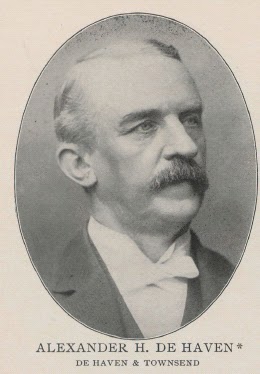
Henry Lister Townsend and Alexander DeHaven were the partners in this Philadelphia-based firm.  Mr. DeHaven had the seat on the New York Stock Exchange.  The firm lasted nearly 100 years.

Friday, October 14, 2011

New York Stock Brokers: Lehman Brothers


L. BRO'S
DEC  18  1899
NEW YORK

Langlois scan


Sigmund Lehman, member of the NYSE in 1897.


The great investment bank Lehman Brothers went bankrupt in the financial crisis of 2008 brought on by investments in collateralized debt obligations based on sub-prime mortgages.  The firm was started in Montgomery, Alabama as a dry goods store.  The brothers eventually found themselves dealing in cotton.  The Lehman Brothers interest in cotton would see them opening an office in New York, where the firm would work to set up the New York Cotton Exchange.  By the early 20th century the firm would begin to structure IPO's, and helped launch some of America's greatest companies.  Those companies included Sears, Woolworths, and B. F. Goodrich.

Thursday, October 13, 2011

New York Stock Brokers and Cancel for October 14: G. Edward Graff & Co.


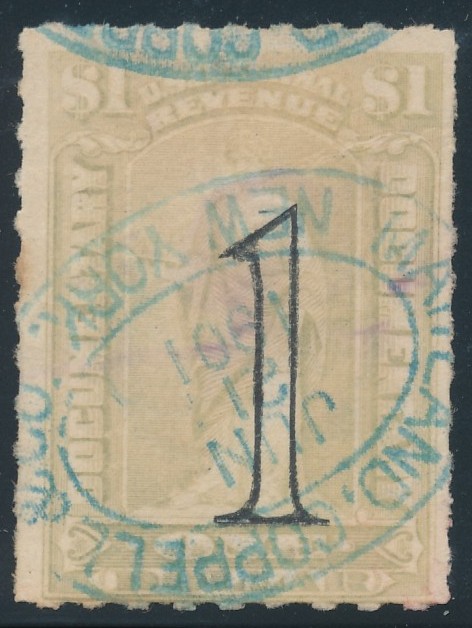
G. EDWARD GRAFF
OCT
14
1898

Langlois scan


From The New York Times, May 18, 1901:

GRAFF & CO.'S FAILURE

Recent Stock Market Panic Cause of Firm's Trouble.

Assignee Varnum Hears ex-Fire Chief Nevins is Able to Make Loss good -- Ex-Sheriff Creamer's Claim.

There was gloom in Willoughby Street, Brooklyn, yesterday over the failure of the stock brokerage firm of G. Edward Graff & Co.,  of which ex-Fire Chief Thomas F. Nevins of Brooklyn is a member.  Mr. Nevins is a close friend of Hugh McLaughlin and other Democratic leaders of Kings County, and his firm acted as brokers for the speculating politicians of Willoughby Street.  A number of the local leaders are known to be affected by the failure of the firm, but to what extent none will say.
Among the political friends of Mr. Nevins who are said to have had business relations with him are James Shevlin, Senator McCarren, ex-Senator John McCarty, ex-Congressman Clancy, ex-Sheriff Frank D. Creamer, and Hugh McLaughlin.

In speaking of the failure yesterday, Mr Nevins said:  "The collapse of the stock market last week caused our assignment.  We were carrying stock on 10 and 15 percent margins, and some of the stocks dropped 40 points, wiping out the margins and more besides.  We had to make good the difference and then failed to recover the money we put up.  In round numbers, our liabilities are $300,000 and our assets $166,000.  The assets consist of $56,000 in securities, $32,000 cash in bank, and three sums of $40,000, $29,000, and $9,000 in margins that are good."

Mr Nevins declined to give the names of the principal losers or to say who the men were who caused the assignment.

The Brooklyn office of the firm at 170 Montague Street was closed yesterday morning.  A notice was posted on the door directing callers to go to the office at 66 Broadway, Manhattan, and see the assignee, Robert T. Varnum.

A crowd of anxious speculators filled the Manhattan office of the firm all day.  Each claimant was directed by the assignee to make a written demand for his stock.  Ex-Sheriff Frank D. Creamer of Brooklyn was among thsoe who visited the office.  He was accompanied by his counsel, Charles Hyde.  It was reported that he demanded from the man in charge of the office 1,000 shares of People's Gas stock, claiming the firm held $10,000 of his money as margins on the stock and offering $100,000 cash on the spot in payment for the stock.  The man in charge, it was said, declared he know nothing about the stock and refused to take Mr. Creamer's money.  According to the report, Mr. Creamer then threatened to have the "whole crowd" arrested. 

Mr. Creamer, when seen yesterday afternoon in the Real Estate Exchange, on Montague Street, Brooklyn, denied he had made any threat of arrest a the office of Graff & Co.

"All there is to it," said he, " is that I made a demand for my stock an didn't get it.  I did not make threats in regard to arrest.

Mr. Varnum said that both members of the firm had made indvidual assignments, and he had been informed that Mr. Nevins alone is quite able to make up the difference between assets and liabilities.

As official of the Consolidated Exchange stated yesterday that Graff & Co. had no outstanding contracts on the floor at the time of their assignment.

Wednesday, October 12, 2011

Cancel for October 13: John. J. Perkins & Company

JNO. J.  PERKINS  &  CO.
OCT   13   1899                  OCT    13    1899


The John J. Perkins & Co. were wholesale bakers, confectioners and dealers in foreign fruits, nuts, fire works and "all Kinds of Fancy Groceries."  They were located at 43 Vine Street, Cincinnati, Ohio.


Tuesday, October 11, 2011

New York Stock Brokers: George P. Butler & Brother


G. P. BUTLER & BRO.
MAY  6-  1901
NEW YORK.

Dave Thompson scan

George P. Butler and Brother was opened in 1898 by George P. Butler and his brother Arthur W. Butler.  According to the New York Times the firm traded for Gould interests, at least on one occasion in 1903 in the stock of the Wabash Railroad.

Monday, October 10, 2011

New York Stock Brokers: Ransom H. Thomas & Company


R. H. THOMAS & CO.
SEP
5
1899
NEW YORK.

Langlois scan


Mr. Thomas was the VP of the New York Stock Exchange in 1897-98.  He would become the President of the exchange.


From The New York Times, October 20, 1922:

RANSOM H. THOMAS

Ex-President of New York Stock Exchange Dies in Hospital.

Ransom H. Thomas, head of the New York Stock Exchange firm of R. H. Thomas & Son, 100 Broadway, and formerly President of the Stock Exchange, died yesterday of a throat ailment in the Memorial Hospital, this city, following a three weeks' illness.  For the last six years he had been living at the Morristown Inn at Morristown, N. J.

Only recently Mr. Thomas sold his seat as a board member of the Exchange after nearly fifty years of continuous membership, for it was on Nov. 5, 1874, that he was first elected to the privileges of the floor.  Throughout this long period he was identified with the chief committees of the Exchange and at the time of his death was still President of the Stock Exchange Building Company.

Sunday, October 9, 2011

Saturday, October 8, 2011

Auctions: Scarsdale Collection Part 6, November 3, 2011, Robert Siegel Galleries

The 1898 revenue series consists of a small group of stamps compared to those in use for the civil war.  Yet the series has given revenue collectors some of the field's greatest rarities.  Siegel is conducting part 6 of its sale of the Scarsdale collection, and this sale contains the prime Scott listed rarities of the 1898 series, including the gem, R158B, the Daprix overprint on the 1c Trans-Mississippi postage stamp. 


Scott R158b

I. R.
P. I. D. & Son.

Lot 100 from current Siegel Sale 1015:  Listed for $35,000
In Siegel Sale 915 of Henry Tolman's material a copy of R158b sold for $35,000.
In the more recent Siegel 977 Whitpain sale of a more faulty R158b, the lot sold for $15,500.

From Siegel:  FINE APPEARANCE. ONE OF THREE RECORDED EXAMPLES OF THE ONE-CENT TRANS-MISSISSIPPI ISSUE WITH THE "I.R./P.I.D. & SON" PROVISIONAL OVERPRINT. ONLY TWO OF THE THREE ARE UNUSED, AND THIS IS THE ONLY EXAMPLE TO RETAIN ANY OF ITS ORIGINAL GUM. ONE OF THE GREATEST RARITIES OF REVENUE COLLECTING.


Scott R158a

I. R.
L. H. C.

AUG 17 1898 handstamp

Listed for $11,500

from Siegel:  VERY FINE APPEARANCE. A RARE EXAMPLE OF THE ONE-CENT CHAPMAN OVERPRINT. ONLY SEVENTEEN COPIES ARE RECORDED IN TOTAL. ONE OF THE GREATEST REVENUE RARITIES.

According to Scott Catalogue, the 1c Trans-Mississippi was overprinted by the Purvis Printing Company with federal government approval. They were ordered by L. H. Chapman of the Chapman Steamboat Line, which operated freight-carrying steamboats along the Erie Canal. Only 250 stamps were produced, additionally, 250 were printed reading "I.R./P.I.D. & Son", for P.I. Daprix & Son, which served different ports along the same waterway.


Scott R156
Siegel Lot 96

Cancelled:

I. R.

handstamp

M. M. L.
I. C.
7/12/98

manusript

listed for $5,750

from Siegel:  A large quantity of 1c and 2c stamps were printed with an "I.R." overprint (Scott R153, R154, R155 and R155A). Additionally, small quantities were produced in the 8c, 10c and 15c denominations. These issues mark the first time that the United States had to resort to surcharging. According to Sloane's Column (Jul. 31, 1948), the Michigan Mutual Life Insurance Co. handstamped copies of the 8c, 10c and 15c regular issues over a period of five days in July 1898. Sloane states these provisional revenues were brought to the philatelic market by J. E. Scott, a collector and employee of the company. J. E. Scott reported that the company used 41 copies of the 8c, 66 of the 10c and 28 of the 15c. The Scott Retail values support this relative mix of supply.


Scott R157

Siegel Lot 97

cancelled: 

I. R.

handstamp

M L
7/22

manuscript

listed for $4,500


Scott R158

Siegel Lot 98

cancelled:

I. R.

handstamp

M M
L I Co.
July 11/98

manuscript

listed for $6,750


Spectacular examples of less rare yet still scarce stamps are also up for auction in this sale:


Scott R180

Siegel Lot 102

listed for $1,600


Scott R181

Siegel Lot 103

Listed for $400


Scott R194

Siegel Lot 106

listed for $2,250

Friday, October 7, 2011

Thursday, October 6, 2011

New York Stock Brokers: Charles Minzesheimer & Company


C. M. MINZESHEIMER
40 EXCHANGE PL.


C. M. MINZESHEIMER & CO.
NEW YORK

Dave Thompson scans


Wednesday, October 5, 2011

Tuesday, October 4, 2011

New York Stock Brokers: Harry L. Horton & Company


H.L.H.&CO.
FEB
0   11   1
1901
< >

Langlois scan

Harry L. Horton & Company


Monday, October 3, 2011

New York Stock Brokers: J. Hugh Peters & Son


J. HUGH PETERS & SON.
JAN
1901
NEW YORK.

with FEB  7  1901 overstamp

Langlois scan


J. Hugh Peters was a member of the New York Stock Exchange. 

Sunday, October 2, 2011

Cancel for October 3: Pennsylvania Railroad's Altoona Juniata Scales


PENNSYLVANIA  R.  R.
OCT  3  1899
ALTOON JUNIATA SCALES.


Altoona - Juniata, Pennsylvania

Altoona, PA is a town created by the Pennsylvania Railroad for their shops.  Altoona operations included the repair of locomotives and the design and construction of complete locomotives.  Altoona is located close to Bellefonte, PA, the home of the American Philatelic Society.


Saturday, October 1, 2011

Note to the File

It is busy season for me with work and travel, so posts will be a bit spartan in the month of October.  Good content contributions are welcome.