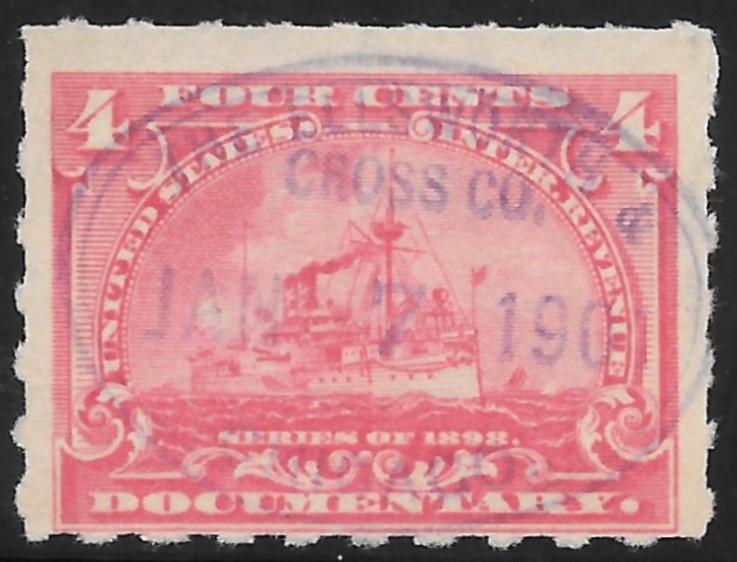
Marine Torch Co.
MAY 24 1900
An extant example of a Marine Torch
Capable of providing chemical illumination in the water, the marine torch was developed by a company in Baltimore, Maryland with the assistance of the US government and military. The marine torch was clearly a useful technology, though the article below in a British magazine comes to conclusions about its usefulness that were a stretch in hindsight.
A REVOLUTION IN NAVAL WARFARE
How the Torpedo can be rendered useless
By Philip Robertson
Illustrated by N. Wilkinson and George Soper
The invention of the torpedo, not so many years ago, completely revolutionised the method of attack in naval warfare, and has since proved itself the most formidable weapon that can be sent against a ship.
Now, however, we have to announce a new invention which bids fair to render the torpedo useless, and which puts in the hands of an attacking vessel a weapon which will place her adversary at her mercy.
The marine torch, as it is called, hails from America, and -- like most great inventions -- is a very simple affair. It has resulted from the discovery of acetylene gas.
It merely consists of a plain hollow cylinder of metal, made in sizes varying from three to eight inches in diameter and from three to five feet in length, according to the purpose for which it is required. This cylinder contains a wire basket filled with calcium carbide, a substance which, on contact with water, gives off acetylene gas, the brilliant illuminating powers of which are well known.
At the head of the cylinder are a number of burners, in close proximity to which is a small chamber containing calcium phosphide. This chemical, on contact with water, gives off phosphuretted hydrogen, which ignites spontaneously in the presence of air. Around the sides of the cylinder are some minute holes, through which the water may enter. When not in use the whole is contained in a hermetically sealed case, so contrived that it can be instantly released without the use of tools or any special mechanical knowledge.
When the marine torch is thrown over board from a boat the water enters through the holes and acetylene gas is given off in great quantities. On rushing through the burners it comes into contact with the already ignited phosphuretted hydrogen , and at once bursts into a brilliant flame of 2,000 candle power. The flame lasts from two to twelve hours, according to the size of the charge of carbide in the torch. It is too powerful to be extinguished either by spray or wind. It will even burn a few inches beneath the water, and, if so thoroughly submerged as to be extinguished, it automatically re-ignites on coming again to the surface. It will continue to do this any number of times.
The torch has been deliberately run down at sea by a vessel whose propeller sent it to the bottom , but it came up in a minute and burnt as brilliantly as ever.
The power of the light was proved by throwing a large marine torch overboard from the steamer Barbarossa, of the North German Lloyd line, when it was found to light up the ocean for a distance of twelve miles.
The naval illuminating projectile is simply the marine torch modified in shape and strength so that it may be fired in the usual way from large guns.
The history of this invention is an interesting one. The idea of constructing a marine torch to generate acetylene gas as an illuminant, which, by some device, should be automatically lighted upon con tact with water, first occurred to Colonel W. J. Wilson, acetylene gas expert, of Philadelphia.
After labouring for some months to express this idea Colonel Wilson finally made a torch comprising a light metal cylinder, weighted at one end, and with burners at the other, which he charged with carbide of calcium, devising as an ignitor a chamber adjacent to the burners containing metallic potassium, a well-known chemical which ignites spontaneously in contact with water.
However, after further experiments several difficulties arose, and the invention was found to be impracticable. The acetylene gas would not generate with sufficient rapidity to become ignited by the potassium, which instantly igniting upon contact with water was at once consumed.
At this time the United States Navy be came interested in the marine torch, and a brief investigation was made by Theodore Roosevelt, then Assistant Secretary of the Navy, with the result that Admiral O'Neill, Chief of Naval Ordnance, gave an order for three-inch shells to be constructed as soon as possible, at the price of $100 (£ 20) per dozen. The Government was extremely anxious to use them during the blockade of Santiago.
Upon making further experiments Colonel Wilson could not immediately remedy the fault with the ignitor, so he was unable to fulfil the Government's order in time for the Spanish war. However, after continuous experiments for a special period of six months Colonel Wilson finally devised a time fuse, to operate in conjunction with potassium as an ignitor.
With the improvement of the fuse ignitor devised by Colonel Wilson the torch could sometimes be ignited, but not with the requisite degree of certainty; and furthermore, when extinguished by rough weather or by accident, it was at once rendered inoperative. In consequence a company was formed in Baltimore early in 1898 for the purpose of developing a torch which would either be non-extinguishable or would re-light as often as extinguished.
After more time and further experiments, Messrs. Rose and Holmes, both electrical engineers, together invented the present ignitor for the torch, in which calcium phosphide is used. This was found to be the only chemical that would serve the purpose. Cheap in cost and efficient in action as a continuous ignitor, it proved entirely successful.
A few lumps of calcium phosphide in serted in a separate chamber devised for it at the head of the torch formed the inextinguishable "pilot light" desired. The more this chemical is submerged in water the more freely it generates phosphuretted hydrogen, which spontaneously ignites in the presence of oxygen. The "pilot light" chamber is always charged with sufficient phosphide to last, even if continuously submerged, during the whole life of the torch.
In August 1899 a patent application for this invention was filed in the United States, and in the same year a larger com pany under the name of "The Marine Torch Company" was organised by well-known business men of Baltimore, who, after thorough investigation, realised the importance of the invention and invested largely in it. Patent applications were made covering the principal countries of the world.
The company then gave its attention to a naval projectile, to be discharged from guns to distances suitable for offensive and defensive purposes, for up to this time the torches were only constructed for marine and life-saving purposes.
The American Navy manifested the same interest in the torch, in evidence of which they placed at the disposal of the Marine Torch Company, entirely free of cost, guns, powder, men, and conveyance to and from its proving grounds, at Indian Head, Maryland, as often as experiments were necessary, so that the company could have every facility to construct a perfect naval shell.
The first trial was made in April 1900, when the torch was discharged at a distance of a quarter of a mile, but the company's engineers learned that a successful marine torch was not necessarily a successful naval projectile. The need for a hollow shell, strong enough to withstand the shock of cannon, and light enough to float, presented new difficulties. Early in June the company were fortunate enough to secure the services of Philip R. Alger, Professor of Ordnance at the United States Naval Academy, Annapolis, to assist their engineers in designing and constructing the naval projectile, with the result that a trial in July marked further improvement.
In all the trials referred to the torches or shells ignited the instant they entered the water, and burned perfectly, and the projectile is considered complete by the company and by the officer in charge of the Naval Proving Station.
The company is now designing projectiles to be discharged various distances and for various purposes, and applications are being filed all over the world for patents for valuable inventions comprised in these projectiles. Some of the navies of Europe have requested demonstrations of the projectile, and the company is preparing to illustrate its importance and usefulness.
The value of the marine torch for naval operations by night will be enormous. The torpedo boat will be completely circum vented by lack of the darkness so necessary for its manœuvres. Under present methods a ship's searchlight often fails to reveal the attacking vessel, while it often invites attack by revealing the position of the ship.
The marine torch, in the form of a projectile, can be projected to a distance of several miles if necessary, and thus a vast ring of illuminated sea will surround the vessel, which will itself remain in darkness.
A warship desiring to attack another by night will only need to fire one or two of these torches at her. She will then be brilliantly lit up and will form a splendid target for the attacking vessel, which will itself be shrouded in darkness.
During a blockade, the mouth of a river or harbour can be kept constantly illuminated, rendering it impossible for any vessel to pass without detection. Similarly, in defending a port, a few torches can be occasionally projected to some distance, rendering it impossible for the hostile fleet to approach unseen.
In case of a shipwreck light is often of the utmost importance. At the wreck of the Mohegan, the great loss of life was entirely due to the absence of light. By throwing a few torches overboard the vessel at once becomes visible to passing ships or to watchers on the shore, who are thus directed in throwing life-lines and sending lifeboats.
There are many other uses to which this ingenious invention may be applied. For lighting harbours and docks, night work water fronts, repairing bridges and groynes, erecting forts, picking up boats at sea, landing mails, and coaling at night, it is equally suitable.
Its cost is not great, it is easily manipulated, and it can be recharged. Already it has attracted the attention of the great naval authorities of several countries.
One of the most valuable features of the marine torch is its remarkable simplicity. It possesses no valves or moving parts, and has absolutely nothing to get out of order or to cause failure. It can be kept for an indefinite period, as it is supplied in an air tight sealed metal case, which can be instantly opened without tools by the simple device of tearing off a strip of metal, in the same way that tins of preserved food are often opened.
It can in fact be got out of its case in thirty seconds, and in less than a minute after the need arises the torch is blazing away in the water.
We recently had an opportunity of seeing this useful device in action. It was the work of a moment to tear off the binding strip, which released the top of the case. The torch was promptly pitched out into the water, and on rising to the surface burst into flame in a way that would have seemed mysterious enough to anyone not in on the secret.
The flame burnt so fiercely that all at tempts to extinguish it were in vain until it was plunged deeply under the water. This was done repeatedly, and each time the torch relighted itself as soon as released.
It cannot be too clearly understood that darkness has been mainly responsible for the terrible loss of life and damage to property sustained in cases of shipwreck. Many ships have gone down within short distances of the shore, with life savers close at hand, simply because they were enshrouded in darkness.
All this might have been avoided had some effective means of illumination existed which would not be at the mercy of wind and water.
We are indebted to the courtesy of the European representative of the Marine Torch Company, Mr. A. F. J. Johnson, of Clevedon, Forest Hill, S.E., for much in formation about this important invention.