Showing posts with label R174 3 Dollar Documentary. Show all posts

Sunday, November 10, 2024

New York Stock Brokers: "BB & CO": Brown Brothers & Co., Brown, Bruns & Co., or Blake Brothers & Co.?

Identical corporate initials can confound the identification of firms that used 1898 revenue stamps, as the cases of H&H and AS&Co have demonstrated.  In the case today, we consider B.B & Co on the 1898 dollar values, likely used to pay taxes on stock trades.  At least three firms with these initials traded stocks on the NYSE during the 1898 tax period, and it is certain that all three of them used their initials to cancel documentary stamps.  The best known of the two was Brown Brothers & Company, a multinational firm with offices trading on the exchanges in Boston, Philadelphia, New York, and Baltimore.  Blake Brothers & Company also had members with seats in New York and Boston, while  Brown, Bruns & Company, appears to have traded only on the NYSE.  Brown Brothers would, through a merger, become Brown Brothers Harriman, one of the best known Wall Street firms of the 20th century.

A stock sale memo from Brown, Bruns & Company:  300 shares of a +$13 stock were sold, requiring $6 worth of documentary revenue stamps.  6 copies of Scott R182 were used, each with the same cancel: B. B. & CO.  Below is a single stamp from that memo:


B. B. & CO.
NOV  7  1900

A prominent B. B. & CO. cancel is used on the stamp above, much like that on the copy of R174 below:

B. B. & CO.
JAN XX 1899
BOSTON

We know the R182 stamp with the BB cancel is from Brown Bruns as the stamp is tied to a Brown Bruns memo of sale.  The $3 stamp is a bit trickier without the underlying document.  However, the cancel includes "BOSTON", indicating the stamp was cancelled in that city, where Brown Brothers and Blake Brothers had members with seats on the exchange there. 

I have mounted the R174 on page labeled Brown Brothers, but that could be in error.  This may be a Blake Brothers cancel.  

So we are left for now without any sort of evidence-basis possibility for the identity of the cancel above.  The two BB&Co cancels below show up occasionally.  The top two are in my collection:


Meanwhile, David Thompson sent the following scan awhile back:          

Brown Bruns ceased to exist and stopped trading by later 1990 or early 1901, making it less likely that the cancels on the four stamps above came from that firm.  My guess would be that one of the cancel types above belong to Brown Brothers, and the other to Blake Brothers.  Someday sale memoranda might show up that provide confirmation.

The 1905 year on the second stamp was clearly caused by an incorrect adjustment of the year date slug.  

Saturday, March 11, 2023

Cotton Brokers: J. H. Parker & Company


J. H. PARKER & CO.
COTTON EXCHANGE
N. Y.


James Henry Parker, from King's Notable New Yorkers
Parker was a president of the New York Cotton Exchange
and a member 6903 of The Chicago Board of Trade.  He was originally 
from North Carolina and served as a cavalry lieutenant in the
Confederate Army.

Saturday, January 28, 2023

Cotton Brokers: Lehman Brothers

LEHMAN BROS
NOV  16 1899


Lehman Brothers are most famous as a New York financial firm that crashed and burned during the 2008 financial crisis.  I'm not a scholar of their collapse but I would assume they speculated just a bit too much on the long side of mortgage derivatives.  But while the firm grew in the 20th century to become a major player in finance, their origins were a bit more humble, as they began as southern "cotton factors" that brokered cotton between producers and American and European industrial buyers.  

Lehman Brothers has several types of cancels that can be found in the 1898 period.  The normal circular dates stamps I would assume were part of regular New York trading activity.  But the more interesting type shown here might have been from transactions at their more southerly operations.  I'm looking for on-document Lehman Brothers examples to know.


Tuesday, January 17, 2023

New York Stock Brokers in Caricature: Elias C. Benedict


E. C. BENEDICT & CO.
FEB 23 1899

Weak cancel but still legible with close scrutiny.

Last year I first posted images from a volume called The Stock Exchange in Caricature from 1904.  There are many more brokers and their cancels that can be highlighted.  Today is Elias Benedict, friend of President Grover Cleveland, and famous for ownership of his steam powered yacht the Oneida.  The Stock Exchange in Caricature has Mr. Benedict aboard his yacht in the caricature, and the accompanying poetry refers to his friendship with Cleveland.  In 1893, Cleveland secretly had surgery to remove a cancerous tumor while aboard the Oneida.  The surgery was kept secret to prevent panic in the markets.  The story of the surgery is covered in a May 28, 2020 article in The Rotation.


In the modern media era, it is virtually impossible to imagine how much surgery on a sitting President would dominate the news cycle. Live updates through cable news, streaming services, and social media would be constant, while panels of pundits would deliver constant interpretations of what was happening in and around the White House while the President was under.

Now imagine the reaction if it was discovered a President had that surgery in secret, aboard a wealthy banker’s luxury yacht, in a bid to prevent an economic panic from worsening.

Incredibly, that all happened back in 1893 when, somewhere in Long Island Sound, President Grover Cleveland had a cancerous tumor removed from his jaw.

Despite rumors of the surgery leaking shortly after it took place, the first-ever surgery performed on a sitting president would be covered up for more than two decades before one of the surgeons eventually revealed what took place.

A plan was hatched for Cleveland to have the tumor removed while on a friend’s yacht, as it traveled from New York City to a holiday home on Cape Cod.

Though presidents as far back as Andrew Jackson (1829-1837) suffered from diseases and other ailments, only Dwight Eisenhower, Ronald Reagan, and George W. Bush joined Cleveland as those who have ‘gone under the knife’ when they lived in the White House.

Eisenhower (who also suffered from a heart attack and stroke while in office) underwent surgery to treat Crohn’s Disease in 1956, while Reagan had six surgeries during his two terms in the 1980s, including the removal of a bullet from an assassination attempt, in 1981.

More recently, George George W. Bush underwent two colonoscopy procedures in 2002 and 2007. While they were unconscious, both Reagan and Bush temporarily transferred the power of the presidency to their Vice-Presidents, George H.W. Bush and Dick Cheney, under the 25th Amendment.

That constitutional lever was not available in 1893, nor were the vast improvements in medical technology that would ensure the continuing health of future Presidents.

The road to Cleveland’s historic, and unusual, surgery began on May 5, 1893, when the President discovered a bump on the roof of his mouth. It would take a month before he finally had it checked out by his personal physician Dr. Joseph D. Bryant, who diagnosed the growth as cancerous.

“It is a bad looking tenant,” Bryant reportedly told Cleveland. “Were it in my mouth, I would have it removed at once.”

The proposed removal of the growth came at a bad time for the president. Cleveland was dealing with the start of a four-year recession, later known as the Panic of 1893, and was worried that news of him going under the knife would scare Wall Street further.

A plan was hatched for Cleveland to have the tumor removed while on a friend’s yacht, as it traveled from New York City to a holiday home on Cape Cod.

 
Yacht Oneida. Later converted to a tug, she was USS Adelante in 1918-20
Photo by USN Photograph NH 100588 (public domain via US Navy)
 

While the press was told he was enjoying a four-day fishing trip, the ‘Oneida’, an impressive steam-powered cruiser owned by prominent New York banker Elias C. Benedict, was made ready for the presidential procedure.

The yacht’s saloon was transformed into an operating theatre, with all but a harmonium that was bolted to the floor, removed. The room was completely disinfected, while a large chair, where Cleveland would be seated, was tied to the mast that came through the center of the saloon. A single bulb powered by a portable battery provided light.

Along with Bryant, five other surgeons were brought aboard, having been ferried from different piers to avoid suspicion. Dr. William W. Keen, Jr, credited by many as America’s first brain surgeon, was involved.

Just after midday on July 1, 1893, Cleveland went under anesthesia (ether), and the surgeons went to work.  According to a recent article in The Surgery Journal, cocaine solution was injected around the growth, while nitric oxide was used to manage pain.

In a 90-minute operation led by Bryant, the tumor was removed, along with five teeth, a third of Cleveland’s upper palate, and part of his upper left jawbone. All were kept for further examination.

Because the tumor was removed through Cleveland’s mouth, there would be no major scarring. The president’s famed bushy mustache made for a perfect cover for any that did exist.

Even for modern surgeons with a far more extensive range of instruments and equipment, operating at sea is a hugely difficult task. Though the president would require further surgery to install a rubber palatal obturator, the operation was a great success; evidenced by a speech Cleveland gave to Congress a month after the tumor was removed.

The press described Cleveland, who was never troubled by cancer again, dying of a heart attack in 1908, as “in perfect health” and “looking well and not the least weary” when he spoke.

Thanks to confirmation from one of Bryant’s six-strong team, Philadelphia Press journalist E.J. Edwards would report about the secretive surgery later in 1893.

Cleveland denied Edwards’ reportage and even launched into a smear campaign against him. In 1917, Keen would write about what happened, finally proving Edwards right.

Regardless of Cleveland’s cover-up and the risks involved on the ‘Oneida’, Matthew Algeo, who wrote The President Is a Sick Man about the incident, described the first ever surgery on an American president as an “extraordinary achievement in American medicine.”

“The doctors took incredible risks. I mean, it was really foolhardy,” Algeo told NPR, in 2011.

“I talked to a couple of oral surgeons [while] researching the book, and they still marvel at this operation: that they were able to do this on a moving boat; [that] they did it very quickly. A similar operation today would take several hours; they did it in 90 minutes.”

Wednesday, October 15, 2014

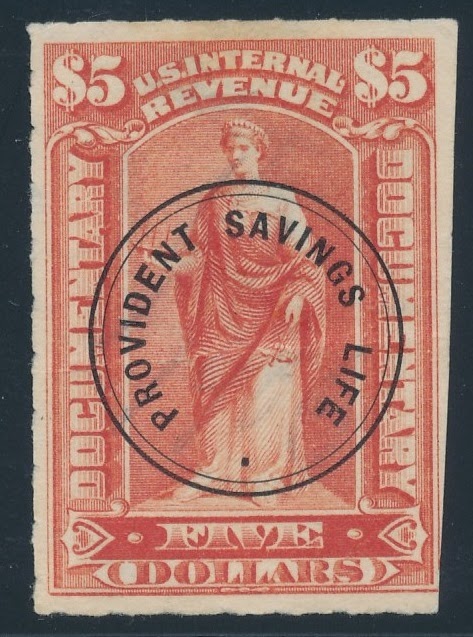
Documentary Printed Cancels: Provident Savings Life Update


Red and black Provident Savings Life cancels on 1898 series revenue stamps.  All are printed cancels except for the bottom right stamp, which displays a handstamp cancel.  Five different documentary values are shown here with Provident Savings Life printed cancels.  Are there more?


Provident Savings Life cancels have featured on this website over the years.  New examples continue to emerge and expand the list of the use of printed cancels on 1898 documentary revenue stamps. The standard reference for documentary printed cancels, the Fullerton List, only covers documentary printed cancels by railroads and express companies.  Provident Savings Life and Assurance Company is the only known insurance company to use printed cancels.

In addition to the stamps seen above that are found in my collection, David Thompson sent in a scan of the R170 pair below:


R170 Pair
David Thompson scan

Several years ago I had an email discussion with Frank Sente regarding the status of these cancels and whether they were printed are not.  This post from 2010 includes some of that discussion, and the argument was made then that these cancels were printed.  The above pair of stamps does a fine job of presenting proof of their status as having been printed, which the orientation and the precision, placement and clarity of the cancels makes clear.  One hitch though is that the separation between the cancels is not proportional to the stamp dimensions.  The cancel on the right stamp above is centered to the left relative the the stamp on the right.

Below are larger versions of the stamps shown above.  I've included three copies of R170 in the stamps above because of color issues with the cancels.  There are two red and one black, and between the reds, there is a clear color difference.


R170 roulette, orange-red printed cancel


R170 roulette, red printed cancel


R170 roulette, black printed cancel


R172 roulette, black printed cancel.   

This stamp has been featured in the stamp montage at the top of this website for years.


R173p hyphen-hole, red printed cancel


R174p hyphen-hole, red printed cancel


R175 black printed cancel


R175 roulette black handstamp cancel

All of the examples of Provident Savings Life printed cancels that I have seen with a date have shown a 1900 year date.  Where are other years of the 1898 series?  Even if the firm did not begin printing cancels until 1900, shouldn't there be 1901 examples?  Or did they simply run out and chose to print no more, necessitating the production of the handstamp illustrated immediately above?

A question I have is why these cancels, now shown on many documentary values, are orphans?  By orphans I mean their apparent neglect by established collectors and catalogs.  Fullerton and others raised the status of the documentary railroad and express printed cancels; while the proprietary printed cancels have always had a special place in the revenue hobby.  Where have these stamps and their cancels been?  Have they just been ignored?  Does anyone know of an old philatelic article on the subject or a collector that may have had a small collection of these?

The small collection above began with the R170, and has been pieced together over several years through multiple purchases and one gift from Bob Hohertz.

I am always looking for new Provident cancels like these, on new stamp values or with new colors.  If you have examples, please write 1898revenues@gmail.com.

Sunday, April 7, 2013

New York Stock Brokers: J. S. Bearns & Company


J. S. BEARNS & CO.
XXX
XX
1899
NEW YORK.

Langlois scans


J. S. BEARNS & CO.
SEP
20
1901
NEW YORK.


J. S. Bearns memorandum of sale 100 shares of the Baltimore & Ohio Railroad @ 98 1/4 to Barton & Frieres.


Mr. Bearns would be suspended for one year from the floor of the New York Stock Exchange for maintaining accounts for employees of other NYSE firms without those firms written permission.  The New York Times told the story on June 10, 1904:


Thursday, January 24, 2013

Finally A $3 Ocean Passage Ticket -- The Pacific Steam Navigation Company(PSNC)

Frank Sente is back with this post on Ocean Passage Tickets.

It's been nearly two years since we last blogged about Ocean Passage Tickets, and I'm now pleased to report that an example demonstating the $3 tax rate has surfaced.  Now examples are known for all three tax rates: $1 for tickets not exceeding $30; this $3 example for tickets costing more than $30 and not exceeding $60; and $5 for tickets costing more than $60.

Pacific Steam Navigation Company Steamer Colombia  

On March 6, 1901, J.(ohn) O.(scar) Meyerink, a commission merchant from San Francisco, booked first class passage from San Francisco to Punta Arenas on the Pacific Steam Navigation Company Steamer Colombia. 

The Pacific Steam Navigation Company Ocean Passage Ticket
San Francisco, California to Punta Arenas, Costa Rica
March 6, 1901   

At first I assumed the destination, Punta Arenas, referred to the Chilean port city by that name in the Strait of Magellan.  However as I began to research the document and the various travel endorsements penned upon the back side where the $3 stamp is located (see image below), I'm now quite certain that Meyerink's ticket instead was for Puntarenas, then a major port city on the west coast of  Costa Rica.

According to this destination and rate chart for the Pacific Steam Navigation Company as published in the Pacific Line Guide to South America, the company's routes did not extend south of Valparaiso, Chile and note that the reduced cabin rate for "Punta Arenas", Costa Rica is listed as $40, the price of this ticket.  Flip back a page in the rate chart, and you'll see that the rate previously had been $80.  Apparently the Pacific Steam Navigation Company, a British firm, was having a rate price war with the better established and more popular Pacific Mail Steamship Company, a U.S. firm, but that's another story.  I also was particularly interested to note mention of  "U.S. Revenue Stamp Additional" in the heading of the PSNC rate chart.


Reverse of PSNC Ticket
$3 R174 Commerce Issue tied by blue double ring cancel of
The P.S.N.C. Co. and C.S.A. de V.
MAR
6
1901
San Francisco

stamp and cancel detail
(double click to enlarge)
 
The stamp is damaged, creased, and has a cut cancel, but hey, it's the only example of a $3.00 ocean passage usage that's ever been reported, and only the ninth ocean passage ticket recorded from the Spanish American War tax era.
 
Five separate endorsements appear on the reverse side of the ticket.  First, a typed endorsement at right reading:
 
Stop-over between San Francisco and Corinto (Nicaragua)
good for three (3) months.
Balfour, Guthrie & Co.
Signature
Genl Agts.
 
That stop-over provision was standard practice for the firm, applicable to every ticket sold, as it appears as one of the purchase conditions stated on their rate chart.
 
NOTE:      For a map showing the location of Meyerink's various stopover
locations that are detailed in the following text, go to the end of this blog.  
 
The red boxed handstamp at the top seems to be a ship purser's marking in Spanish documenting the first leg of Meyerink's journey from San Francisco to Champerico, a Guatemalan port town. We don't have other examples to compare to, but it appear to read as follows:
 
De San Fc. (San Francisco?) a Champerico (Guatemala)
por "Colombia" illegible Z2? or 32?
Signature CONTADOR (PURSER)
 
I'm guessing it was applied to the ticket when the Steamer  Colombia arrived at Champerico and Meyerink disembarked. The handwritten endorsement to the left of the red boxed handstamp also appears to be in the purser's hand and as part of it extends across the left edge of the box, it likely was written directly after the boxed endorsement was completed.  It appears to read as follows:
 
Good for P.S.N.Co
steamer only from Champerico
to Punta Arenas. Signature
26/3/01 (March 26, 1901)
 
Nine days later it seems that Meyerink traveled further down the coast of Guatemala from Champerico to San Jose aboard the Chilean C.S.A. de V. steamer Tucapel. The relevant endorsement which appears to the right of the $3 tax stamp reads:

Champerico a San Jose
v.(ia)  Tucapel  3
9/4/901 (April 4, 1901) Signature
  
Compania Sud-Americana de Vapores
Chilean Steamer Tucapel

Built in 1900 and primarily a cargo ship, the Tucapel, laden with oranges, sank off the coast of Chile in 1911.

The final ticket endosement, to the left of the cancel tying the $3 tax stamp to the ticket, documents travel from La Union, El Salvador to Corinto, Nicaragua, both ports of call on the PSNC route chart, via the steamer Chile.  The endorsement in green ink reads:

La Union to Corinto
por "Chile" v. 4
May 3/01
Signature

How Meyerink got from San Jose, Guatemala to La Union, El Salvador is unclear.  Perhaps by land transporation, but I suspect by sea via an undocumented PSNC steamer voyage.  I'm betting that sometime between April 4, when he left for San Jose, Guatemala and May 3 when he left La Union, El Salvador there was another voyage between those locales where Meyerink showed his ticket and the ship's purser simply allowed him to embark and travel without bothering to endorse the ticket. That's conjecture on my part, but I doubt that land travel between San Jose and La Union would have been easy and it would have added to his expenses. 

So why did this ticket survive?  Generally, when one traveled they surrendered their ticket to the ship's purser upon boarding.  In this instance as Meyerink had the opportunity to make stop-overs on his voyage to Punta Arenas, he either was allowed to keep his ticket after it was properly endorsed, or it was returned to him at each point of disembarkation so that he could reboard another vessel to continue his voyage. 

While Meyerink's ticket was written for travel to Punta Arenas, Costa Rica I suspect his final destination all along was Corinto, Nicaragua.  The typed endorsement allowing for stop-overs specifically refers to Corinto, not Punta Arenas.  And if one looks carefully, it appears the handstamped word "Corinto" appears underneath "Punta Arenas" on the face of the ticket. 
       
faint "Corinto" underneath "Punta Arenas" on ticket

Again, while simply conjecture on my part, I suspect that when Meyerink bought the ticket he specified a final destination of Corinto and in the course of purchasing the ticket a helpful agent pointed out that the price of a ticket to the further port of Punta Arenas, Costa Rica was the same $40 fee as for the Nicaraguan port of Corinto.  So why not have the ticket written for Punta Arenas so that should Meyerink so decide he could have the opportunity to travel to that further destination?  Per PSNC's rate chart, tickets from San Francisco to Corinto, San Juan del Sur, and Punta Arenas all cost $40.

Thus when he disembarked in Corinto, Meyerink was allowed to keep his ticket as it still allowed him the opportunity to travel on to Punta Arenas.  I'm betting he did not travel beyond Corinto, Nicaragua.

Further, in seeking information about J. O. Meyerink, I discovered he was a stamp collector!  His name appeared in the March 1893 Secretary's Report of the American Philatelic Association (became American Philatelic Society in 1908) as a reinstated member.  APS confirmed that Meyerink originally joined in 1891 and became a stockholder in 1893 after the APA incorporated.  He apparently let his membership lapse in 1894.  That he was a collector, I'm sure gave him added incentive to keep this document , not only as a souvenir of a trip, but also because it had that $3 tax stamp on it.  Thank goodness for stamp collectors!

I found him listed in several San Francisco directories at 428 Sansome Street as a shipping and commission merchant, one of which indicated he was a fruit wholesaler.  An 1895 suit against a California salt manufacturer who delivered inferior salt through Meyerink to a Guatemalan firm and an 1894 report of dealings with a Guatemalan coffee plantation offer confirmation of his Central American business dealings and connections. 

His listing in the 1900 census indicated he was born in Germany in 1862, immigrated  in 1880, and became a U. S. citizen in 1892.  In 1884 he married Katie Meyer and they had four children between 1887 and 1895.  Apparently he died sometime before 1910 as he doesn't appear in that census, but Katie, listed as a widow, and the four children are included in the 1910 census.

Most assuredly this was a business trip to either visit existing merchant contacts or to establish new business connections.  It must have been a fancinating trip and a great time to be living in San Francisco.       

Central America Map showing the location of the
five ports referenced on Meyerink's ticket:
1. Champerico, Guatemala
2. San Jose, Guatemala
3. La Union, El Salvador
4. Corinto, Nicaragua
5. Puntarenas (Punta Arenas), Costa Rica

Anyone having knowledge of other taxed ocean passage tickets is invited to report them, with scans if possible, to 1898revenues@gmail.com.


Thursday, July 5, 2012

New York Stock Brokers: John Bianchi


OCT 28 1898
JNO.  BIANCHI.

Thompson scan


JUN 3  1902
JNO. BIANCHI

Langlois scan


Tuesday, May 29, 2012

New York Stock Brokers: Wood, Huestis & Company


WOOD, HUESTIS & CO.
JAN
24
1899
NEW YORK.

David Thompson scan, somebody else's scuff


NY Evening Post
February 5, 1897


Friday, May 11, 2012

New York Stock Brokers: Johnson & Wood


JOHNSON & WOOD
OCT
5
1898
NEW YORK.


David Thompson scan & enhancement


Tuesday, March 13, 2012

New York Stock Brokers: Talbot J. Taylor & Company

New York Tribuine, December 1898


T.  J.  T.  &  CO.
NOV  25  1899
NEW YORK

David Thompson scan