Showing posts with label Cancel of the Day. Show all posts

Wednesday, November 14, 2012

Oil Companies: The Standard Oil Company - John Rockefeller and Ida Tarbell


What was the Standard Oil Company?  Standard Oil was established in 1870, became the largest oil refiner in the world, and was broken up for anti-trust reasons by the Supreme Court in 1911.  John D. Rockefeller was the founder and chairman of the company, and with his control and ownership became the richest man in  the world.

Standard Oil and John Rockefeller became famous, and in some quarters infamous, for the firm's and its chairman's voracious appetite for its competition.  Rockefeller managed to undercut, weaken, and then find ways to control, buy-out, or destroy competition.  These behaviors would ultimately stimulate the work of muckraking journalists, and lead to anti-trust litigation that would break up the firm.  

The first great American investigative journalist, Ida Tarbell, would essentially establish the craft of investigative journalism through her work on the case of Standard Oil.  

John D. Rockefeller
1839-1937

For all the approbation cast upon Mr. Rockefeller for his aggressive business practices, Rockefeller was one of the greatest philanthropists in history and his legacy still benefits the world today.  Rockefeller lived a long time: 98 years.  He retired from business while still in his sixties, giving him more than 30 years to practice and structure formal philanthropy.  As one of the richest men in history, combined with his extended "retirement", John Rockefeller ultimately became a boon to the pursuit of the arts and sciences in the United States and throughout the world.

Ida Tarbell
1857-1944


Though published as a book, Tarbell's original work on Standard Oil appeared in a magazine called McClures, serialized in 19 parts.  McClures was quite popular in turn of the century United States, and distinguished itself by publishing a series of muckraking articles, including Ray Baker's investigation of United States Steel.


The famous 1904 Standard Oil octopus with a grip on everything within its reach, including the Congress, and with its eyes on its next target, the White House.

Tuesday, November 13, 2012

Oil Companies: Producers Oil Company Limited


P. O. Co. Ltd.
JUN  11  1900


From The Official Railway Equipment Register of 1901:


The Producers Oil Company represented a group of independent oil producers long in the sites of John Rockefeller's Standard Oil.  For years the company maintained its independence despite constant hostile takeover attempts by Rockefeller. 

By 1897, Standard Oil interests owned a majority of Producers' stock.  But the voting and controlling shares of the firm remained with the forming owners of the company, and legal actions by Standard to seize control through majority ownership were rebuffed by the courts.

The travails of the Producers Oil Company were documented by Ida Tarbell in her muckraking classic, The History of The Standard Oil Company.

*****

The year of this cancel, Producers Oil Company became part of a larger holding company called the Pure Oil Producing Company.   Eventually Pure Oil would become a national name brand in the petroleum industry.  The company was independent and successful through the mid-1960s, when it was absorbed by Union Oil, which in turn branded itself Union 76.  Union 76 was the property of Unocal, which merged with Chevron in 2005.

Tuesday, May 1, 2012

Insurance Companies: Maryland Casualty Company

MARYLAND CAS. CO
MAY
2
1902

Langlois scan


Corporate brochure marking the company's 50th anniversary
Founder John Stone looks like Robin Williams as Theodore Roosevelt in the movie Night at the Museum

Sunday, April 15, 2012

Collector of Internal Revenue Seventh District of Indiana


APR  22  1899
D. W. Henry
Collector Int. Rev. Seventh Dist. of Indiana

Bart Rosenberg scan

D. W. Henry became a Judge and a community leader in Terre Haute, Indiana.

As today is the day your US Federal Income Taxes are due, it seemed appropriate to use this scan of a block of 4 sent by reader Bart Rosenberg.  In the normal course of Mr. Henry's professional duties as Collector of Interneral Revenue, you would think that he would have been exempt from taxes.  Perhaps this block was cancelled and used for a personal transaction.  Unfortunately, we can't know unless we can find an on document example from Mr. Henry that contains a similar block and cancel.

Tuesday, March 6, 2012

State Savings Bank, Detroit


State Sav. Bk. Detroit.
MAY
4
1901

Dave Thompson scan

The State Savings Bank was based in Savoyard Center in Detroit.  The building is in the National Register of Historic Places.


State Savings Bank, Detroit
-or-
Savoyard Center

Sunday, March 4, 2012

Swift and Company Banking Department


SWIFT AND COMPANY
MARCH  4  1901
CHICAGO.
BANKING DEPARTMENT.

Dave Thompson scan


The Swift meat-packing company revolutionized the meat business.  Gustavus Swift developed refrigerated rail cars, and processes for fully utilizing the by-products of dressed meat production.  Upon Gustavus Swift's death in 1903, his firm was valued at more than $125 million.  Clearly, the business was large enough to have a "banking department".  I don't know what this department did but would like to know.  If a reader can provide any information, please write to 1898revenues@gmail.com


Gustavus Swift

Swift's daughter Annie May Swift died while she was a student at Northwestern University in Evanston, Illinois.  Her father established Northwestern's School of Oratory in her memory which would become the School of Speach.  I am a graduate of Northwestern, and spent 100s of hours in the basement of Annie May Swift Hall at the controls of WNUR, the student run radio station at Northwestern.


Annie May Swift Hall at Northwestern University
Home of WNUR 89.3 FM

During my years at Northwestern I never associated Swift meats with Annie May Swift Hall.  My research for this site and this stamp made this association for me.  Soon after I left Northwestern I joined the Peace Corps, and spent two years in Liberia helping to run a radio station near the Guinea border in the town of Voinjama.  Many years later I am still in Africa, though now far across the continent in Kenya.  So Mr. Swift's  donation to Northwestern was in part responsible for where I live today.  Thank you Mr. Swift.

Tuesday, January 10, 2012

Cancel for January 11: Jacob Hoffmann

Jacob Hoffman signed check


JacHoff
January 11/1900

manuscript cancel by Jacob Hoffmann


Sunday, December 4, 2011

New York Stock Brokers: H. Content & Company


H. CONTENT & CO.
DEC  20  1901
NEW YORK


H. CONTENT & CO.
MAY  2  1901
NEW YORK

Dave Thompson scans


Saturday, December 3, 2011

Wednesday, November 30, 2011

Railroad Presidents: Henry Fink, Norfolk & Western Railway


N.  &  W.  Ry.  CO.
DEC  1   1899
NEW YORK


The Norfolk & Western was a Roanoke, Virginia-based railroad that served primarily to haul West Virginia coal to the Atlantic coast.  It prospered through its own business and through mergers with successful railroads and coal haulers like The Virginian.  Remnants of the N&W still remain vital today as components of one of the major railroads in the United States, The Norfolk Southern.


Map showing the Norfolk & Western's mainline from West Virginia thru Roanoke and into Norfolk, Virginia on the Atlantic coast.


Henry Fink, President of the Norfolk & Western Railway


From the June 2, 1901  New York Times:

THE OUTLOOK FOR THE SOUTH

President Henry Fink of Norfolk and Western declares that in his opinion the greatest development during the next century in any part of the country will be in the South, which, he believes, has a wonderfully prosperous future before it.  Along these lines, President Fink says:

"The South is an empire in itself.  In my opinion the next century will see it develop far beyond all present expectations.  And why should not this be?   It is a magnificent country, with a fine climate and rich in its natural resources.  All it needs is capital and enterprise, and both of these it will surely get to the full in due time.  Indeed, in the last few years there has been a wonderful development and progress all through the south.  Time there was that the south was altogether an agricultural country.  Now it is this, and more.  It is fast becoming a manufacturing section, and promises to soon show great strength in this respect.

"There has recently been--and it is worth noticing at this time--great improvement in the legislation of the Southern States.  Some years ago railroads and other corporations were troubled with all kinds of hostile legislation.  Now a reaction is settling in.  The people are taking a more intelligent view of matters, and are not so much governed by demagogues. [ed. note: I am from Louisiana.  Huey Long, the ultimate demagoge, was about to emerge on the southern and national scene] The policy pursued now is one of live and let live; it is an enlightened policy, in short.  [ed. note:  I guess Fink forgot about Jim Crow, poll taxes, and all manner of unenlightened practices; Plessy vs. Ferguson was only 5 years old when he spoke to The New York Times] Hence, corporations and institutions generally can now proceed with every fair chance to succeed.  And so it is that I have the greatest faith in the future of the Southern country.  I have spent the best part of my life there, and I appreciate its recent astonishing progress.

"I have heard it declared in some quarters that the recent panic in Wall Street may, after al, have been due more to unfavorable general conditions that was supposed.   I do not see how this can be.  General business conditions are excellent and are just as good now as they were before the panic.  As a matter of fact, there never was in my opinion any justification for the very high prices of some securities in the stock market, and for that reason the panic was a good thing in forcing quotations down to a proper level.  It would have been better, however, if prices had not tumbled so suddenly but had reached their proper level gradually.

Tuesday, November 22, 2011

Monday, November 14, 2011

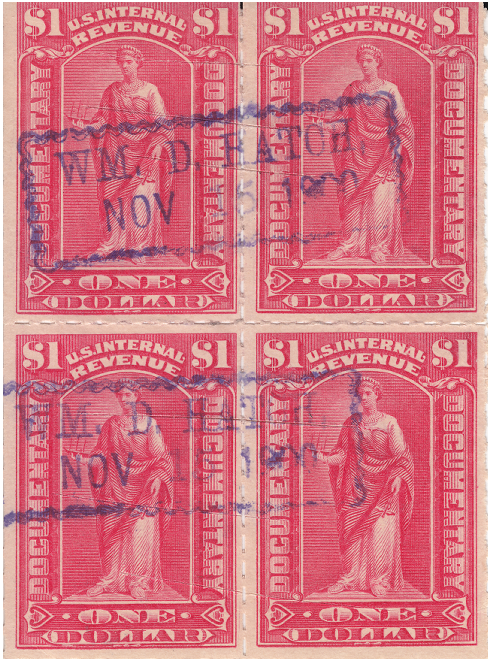
Cancel for November 15: William D. Hatch

WM. D. HATCH
NOV  15  1900

Dave Thompson Scan


D. HATCH
24  1901

Langlois scan

William D. Hatch was a member of the brokerage firm Hatch Brothers with his brother Horace Hatch until the firm's collapse in 1895.  Horace was the member of the firm with the seat on the NYSE at the time of the collapse.  By 1900 William was in business for himself. 

Saturday, November 12, 2011

Cancel for November 13: National Bank, La Crosse

Nat. Bank
NOV
13
1899
La Crosse.


John M. Levy started the first bank in La Crosse in 1855. Soon after, the Green Bay Bank was organized, but both failed in the Panicof 1857. Gysbert van Steenwyk established the Batavian Bank in 1861 and re-organized it in 1883 as a national bank. The First National Bank became a competitor in 1863 but failed in 1875.20 A group of wealthy citizens, G.C. Hixon and Judge S.S. Burton among them, saw the need for another bank. They organized the La Crosse National Bank and started operations on January 3, 1877. It was capitalized at $100,000 and opened for business on the corner of Second and Main Streets. Hixon became president and a member of the board of directors. The directors obtained a new charter in 1896 designating it as the National Bank of La Crosse. Sixty years later their successors changed its name to the First National Bank of La Crosse.

From A SKETCH OF GIDEON COOLEY HIXON: LA CROSSE LUMBERMAN, A Seminar Paper Presented to the Faculty of the Graduate School Wisconsin State University at La Crosse, In Partial Fulfillment of the Requirements for the Degree, Master of Science in Education by Drucilla Kathleen Munson, July 1967

Friday, November 11, 2011

Cancel for November 12: St. Louis Dressed Beef & Provision Company


ST. L. D. B. & P. CO.
NOV
12
1898

The St. Louis Dressed Beef & Provision Company was part of group of midwestern meat packers that colluded to fix markets and prices for their dressed beef. 

Wednesday, October 26, 2011

Cancel for October 27: R. M. A.


R.  M.  A.
OCT   27   189X
ST.  LOUIS.


What was RMA in St. Louis?

Thursday, October 13, 2011

New York Stock Brokers and Cancel for October 14: G. Edward Graff & Co.


G. EDWARD GRAFF
OCT
14
1898

Langlois scan


From The New York Times, May 18, 1901:

GRAFF & CO.'S FAILURE

Recent Stock Market Panic Cause of Firm's Trouble.

Assignee Varnum Hears ex-Fire Chief Nevins is Able to Make Loss good -- Ex-Sheriff Creamer's Claim.

There was gloom in Willoughby Street, Brooklyn, yesterday over the failure of the stock brokerage firm of G. Edward Graff & Co.,  of which ex-Fire Chief Thomas F. Nevins of Brooklyn is a member.  Mr. Nevins is a close friend of Hugh McLaughlin and other Democratic leaders of Kings County, and his firm acted as brokers for the speculating politicians of Willoughby Street.  A number of the local leaders are known to be affected by the failure of the firm, but to what extent none will say.

Among the political friends of Mr. Nevins who are said to have had business relations with him are James Shevlin, Senator McCarren, ex-Senator John McCarty, ex-Congressman Clancy, ex-Sheriff Frank D. Creamer, and Hugh McLaughlin.

In speaking of the failure yesterday, Mr Nevins said:  "The collapse of the stock market last week caused our assignment.  We were carrying stock on 10 and 15 percent margins, and some of the stocks dropped 40 points, wiping out the margins and more besides.  We had to make good the difference and then failed to recover the money we put up.  In round numbers, our liabilities are $300,000 and our assets $166,000.  The assets consist of $56,000 in securities, $32,000 cash in bank, and three sums of $40,000, $29,000, and $9,000 in margins that are good."

Mr Nevins declined to give the names of the principal losers or to say who the men were who caused the assignment.

The Brooklyn office of the firm at 170 Montague Street was closed yesterday morning.  A notice was posted on the door directing callers to go to the office at 66 Broadway, Manhattan, and see the assignee, Robert T. Varnum.

A crowd of anxious speculators filled the Manhattan office of the firm all day.  Each claimant was directed by the assignee to make a written demand for his stock.  Ex-Sheriff Frank D. Creamer of Brooklyn was among thsoe who visited the office.  He was accompanied by his counsel, Charles Hyde.  It was reported that he demanded from the man in charge of the office 1,000 shares of People's Gas stock, claiming the firm held $10,000 of his money as margins on the stock and offering $100,000 cash on the spot in payment for the stock.  The man in charge, it was said, declared he know nothing about the stock and refused to take Mr. Creamer's money.  According to the report, Mr. Creamer then threatened to have the "whole crowd" arrested. 

Mr. Creamer, when seen yesterday afternoon in the Real Estate Exchange, on Montague Street, Brooklyn, denied he had made any threat of arrest a the office of Graff & Co.

"All there is to it," said he, " is that I made a demand for my stock an didn't get it.  I did not make threats in regard to arrest.

Mr. Varnum said that both members of the firm had made indvidual assignments, and he had been informed that Mr. Nevins alone is quite able to make up the difference between assets and liabilities.

As official of the Consolidated Exchange stated yesterday that Graff & Co. had no outstanding contracts on the floor at the time of their assignment.

Wednesday, October 12, 2011

Cancel for October 13: John. J. Perkins & Company

JNO. J.  PERKINS  &  CO.
OCT   13   1899                  OCT    13    1899


The John J. Perkins & Co. were wholesale bakers, confectioners and dealers in foreign fruits, nuts, fire works and "all Kinds of Fancy Groceries."  They were located at 43 Vine Street, Cincinnati, Ohio.


Friday, October 7, 2011

Sunday, October 2, 2011

Cancel for October 3: Pennsylvania Railroad's Altoona Juniata Scales


PENNSYLVANIA  R.  R.
OCT  3  1899
ALTOON JUNIATA SCALES.


Altoona - Juniata, Pennsylvania

Altoona, PA is a town created by the Pennsylvania Railroad for their shops.  Altoona operations included the repair of locomotives and the design and construction of complete locomotives.  Altoona is located close to Bellefonte, PA, the home of the American Philatelic Society.