Showing posts with label Cancels: Cotton. Show all posts

Sunday, January 19, 2025

Cotton Broker Cancels: Forwood & O'Neill of Paris, Texas


Forwood & O'Neill,
1899
PARIS, TEXAS.

R. Forwood and Augustine Hughes O'Neill were partners in this firm .

Saturday, January 18, 2025

Cotton Broker Cancels: Henry Hentz & Company


from Cotton Facts by Alfred B. Shepperson, 1901

H. HENTZ & CO.
OCT
12
1899
N. Y.

H. HENTZ & CO.
DEC
14
1899
N. Y.

Thursday, January 16, 2025

Cotton Broker Cancels: Cox and Callender of New York

from Cotton Facts by Alfred B. Shepperson, 1901

COX & CALLENDER
DEC
5
1898
NEW YORK.

Tuesday, January 14, 2025

Cotton Broker Cancels: Baily & Montgomery of New York


from Cotton Facts by Alfred B. Shepperson, 1901


Baily & Montgomery
???
New York


Saturday, January 11, 2025

Cotton Broker Cancels: Louis De Gumoens & Son of New York

L. DE GUMOENS & SON
AUG
21
1900
NEW YORK

from Commerce & Finance, January 6. 1915

L. DE GUMOENS & SON
MAR
18
189?
NEW YORK


L. DE. GUMOENS & SON
JUN
13
1900
NEW YORK

Thursday, January 9, 2025

Cotton Broker Cancels: W. A. Short of Helena, Arkansas


    W. A. Short & Co.
OCT 10 1900
HELENA, ARK.


In 1885 Mr. and Mrs. William A. Short came to Helena from Mobile, Alabama.

Mr. Short had been engaged by the Howell Cotton Company of Little Rock, Arkansas to conduct a branch of their business in this city.  In 1888, W. A. Short started his own cotton business and two years later changed the firm's name to W. A. Short and Company.  In 1895, W. A. Short and Y. F. Harrington formed a business in cotton second to none in this part of the country.  Their business totaled over $5 million for the season of 1902-03.  W. A. Short and Company invaded other markets, establishing branch offices in Pine Bluff, Brinkley, Newport, Cotton Plant, Clarendon, Forrest City, Holly Grove, Marianna, Memphis, and Osceola.  A newspaper from 1904 printed the following: "W. A. Short and Y. F. Harrington have a genius for organization and are men of ability, industry, and wide capacity.  In fact, they are among the leading business spirits of Helena, Arkansas."

Tuesday, January 7, 2025

Cotton Broker Cancels: H. & B. Beer of New Orleans

H. & B. BEER
DEC 11 1900
NEW ORLEANS

from Commerce & Finance, January 6, 1915

Thursday, April 27, 2023

Baily & Montgomery, Commission Merchants


BAILY & MONTGOMERY,
MAR
5
1900
NEW YORK.

from the Commercial and Financial Chronicle, March 5, 1898:


from Savannah Naval Stores Review, February 13, 1904:


Saturday, March 18, 2023

Cotton Brokers: Weld & Neville


WELD & NEVILLE
DEC
4
1900
HOUSTON, TEXAS

Weld & Neville was a unit of the large American cotton broker Weld & Company, with branches in Liverpool, New York, Boston, Houston and Bremen.


1909 Advert for Weld & Co., one of the largest importers of cotton into Liverpool in the late ninetweenth and early twentieth centuries. (Source of advert: Auguste Bruckert, Cotton Pamphlet
relating to the Liverpool Cotton Market, Liverpool: 1909, page 112):

Saturday, March 11, 2023

Cotton Brokers: J. H. Parker & Company


J. H. PARKER & CO.
COTTON EXCHANGE
N. Y.


James Henry Parker, from King's Notable New Yorkers
Parker was a president of the New York Cotton Exchange
and a member 6903 of The Chicago Board of Trade.  He was originally 
from North Carolina and served as a cavalry lieutenant in the
Confederate Army.

Saturday, February 11, 2023

Cotton Brokers: Mohr, Hanemann & Company


William Mohr was a president of the New York Cotton Exchange and a principle of Mohr, Hanemann & Company with his partner, New Orleans-based Edward Hanemann.   William Mohr was of German ancestry, and during World War I was subject to slurs and the estrangement of friends due to the war.  He apparently took his own life as a result. My middle name is of German ancestry, and the story passed to me is that that side of my New Orleans-based family took to referring to themselves as French Alsatian rather than as German during WWI. 


New York Times, June 22, 1918:


Saturday, January 28, 2023

Cotton Brokers: Lehman Brothers

LEHMAN BROS
NOV  16 1899


Lehman Brothers are most famous as a New York financial firm that crashed and burned during the 2008 financial crisis.  I'm not a scholar of their collapse but I would assume they speculated just a bit too much on the long side of mortgage derivatives.  But while the firm grew in the 20th century to become a major player in finance, their origins were a bit more humble, as they began as southern "cotton factors" that brokered cotton between producers and American and European industrial buyers.  

Lehman Brothers has several types of cancels that can be found in the 1898 period.  The normal circular dates stamps I would assume were part of regular New York trading activity.  But the more interesting type shown here might have been from transactions at their more southerly operations.  I'm looking for on-document Lehman Brothers examples to know.


Thursday, January 12, 2023

Cotton Brokers: Gwathmey & Company


GWATHMEY & CO.
AUG
15
1899
New York


GWATHMEY & CO.
SEP
30
1899
New York

from Bradstreet's, March 11, 1893


from The Commercial & Financial Chronicle, July 4, 1903:

Tuesday, December 20, 2022

Bill of Exchange Fragments: American Cotton Company

 Reverse side of document fragment:


AMERICAN COTTON CO.
OCT
17
1899
NEW YORK.

Front of document fragment with British five shilling tax stamp:


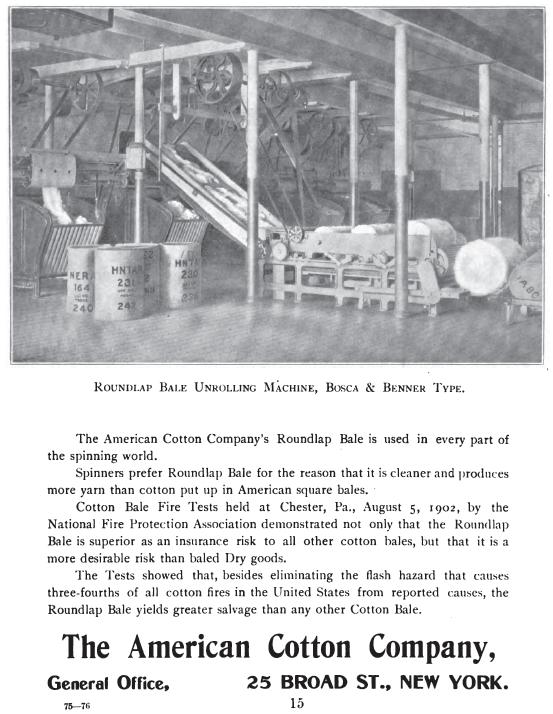
Advertisement from Transactions of the New England 
Cotton Manufacturers Association, #76, 1904.

The American Cotton Company became embroiled in political squabbling between democratic Senator J. K. Jones and Theodore Roosevelt.


Sunday, October 23, 2022

Cotton Brokers: Gassner & Company


GASSNER & CO.
FEB  9 190x
New Orleans, La

For years I've had the Degas painting, Cotton Exchange, posted on this website.  The painting was done in my home town of New Orleans, a major cotton center and port.  Degas spent parts of 1872 and 1873 in the city.  The painting shows men examining cotton samples at a large table, presumably to make decisions regarding large purchases of cotton for industrial buyers, both domestic and overseas.  Others in the painting are individually examining cotton samples, reading a newspaper, or engaging in other cotton trade functions.

It is possible that one or more of the men in the painting were conducting business on behalf of Gassner & Company, a Liverpool-based cotton merchant.  I'm no expert in the tax laws of 1898, so I am not sure of the exact types of taxes this $1 stamp might have paid.  However, Gassner would have been active buyers, warehousers, and shippers of cotton.  The process, likely including exchanging pounds for dollars, would have involved taxable events.  If the stamp was still on its document, the use of the stamp would be clear.  But for now, we have an interesting relic of the cotton trade in New Orleans.


Sunday, January 20, 2013

New Orleans Stock Brokers and Cotton Factors: H. Abraham & Son


H. ABRAHAM & SON,
6
JUN
1901.
New Orleans.

David Thompson scan


The Abraham building at 833 Gravier Street in downtown New Orleans.  To view other Cotton Factor posts on this site, click on the Degas painting from New Orleans in the right column of this page.

Thursday, August 23, 2012

Cotton "Factors": Heard Brothers


Cotton Exchange, New Orleans, 1873, by Edgar Degas

Cotton Factors, or businessmen that bought and sold cotton and acted as middlemen for cotton growers, were a mainstay of the southern cotton economy.  Some of the gentlemen in the Degas painting above were no doubt cotton factors.


RN X7 imprinted check drawn on the account of Heard Brothers

Bob Hohertz scan


The Heard Brothers, cotton factors, bought and sold cotton and manufactured and sold fertilizer, but as Harold Woodman writes, the cotton factor did more than just act a middleman for cotton: 

From King Cotton and His Retainers: Financing and Marketing of the Cotton Crop of the South by Harold D. Woodman:

"Although the factor served as the planter's banker, factorage houses were not banks in the real meaning of the word; that is, unlike commercial banks, factors did not have the power to create money either through note issue or deposit loans.  They did, as has been shown, often open a line of credit to a customer, allowing him to draw on them as funds were required.  In doing so, however, they merely loaned money on hand (their own funds or those being held for a planter) or they borrowed from other sources.  In the former case they could be compared to modern savings and loan associations or credit unions; in the latter case, they acted much as do present day finance companies.  The factor, then, was the planter's banker only in a very general sense: he handled his funds, arranged his credit, and paid his bills.

Thursday, August 16, 2012

Cotton Buyers: Smith & Coughlan


RNX7 imprinted sight draft charged to Clifton Manufacturing in Clifton, South Carolina for 100 bales of cotton for $4809.26

Bob Hohertz scan


Bob Hohertz heeded my call last week for cotton-related material and sent in this scan of a draft from Smith & Coughlan, cotton buyers.  A little history on this firm is found below.  Smith & Coughlan had shipped by rail 100 bales of cotton to Clifton Manufacturing in South Carolina, and charged Clifton Mfg $4809 through this draft.

From  the
HISTORICAL AND STATISTICAL REVIEW; MAILING AND SHIPPING GUIDE
(Illustrated)
Birmingham, Anniston, Gadsden, Huntsville, Decatur, Tuscaloosa and Bessemer

THEIR MANUFACTURING AND MERCANTILE INDUSTRIES, HISTORY, PROGRESS, AND DEVELOPMENT

NEW YORK AND BIRMINGHAM
Southern Commercial Publishing Company.
1888.

SMITH & COUGHLAN, Birmingham and Gadsden. — No class of commercial business advances a city more than those who advance the farming interests of the country, and thereby the producing supply. This is done more particularly by the commission men of the city. The firm heading this sketch bas been in operation about five years, and have a ripe experience in the handling as well as in the markets for selling the fleecy staple.

With ample cash to buy, Messrs. Smith & Coughlan are prepared to make liberal advances on cotton. They have another office at Gadsden, Alabama, in connection with the cotton business.  Mr. F. G. Smith is a native of Nashville, Tennessee. He has been engaged in the steamboat business for many years.  He is well known in the city as President of the South Anniston Land Company.  His partner, Mr. J. H. Coughlan, is a native of Boston.

Their long experience in the business, with their extensive correspondence and acquaintance with the cotton markets of the world, has fitted them to realize good prices for cotton, which brings them the most liberal orders. The firm is a leading one in the cotton trade, and is entitled to the confidence of the readers of the history of Birmingham, who have orders of cotton to give, and desire a good firm, possessed of executive ability in this line of business.

This is but a brief account of a firm which, in every way, is worthy of the success it has attained, and the esteem in which it is held by the entire communitv.


CLIFTON MANUFACTURING:

From the Textile History website:

Clifton Manufacturing Company was incorporated January 19, 1880 with a capital stock of $200,000 (1). Mills at this time were normally built along rivers where a change in slope gave opportunity to harness water power.  With prior experience downstream on the Pacolet River, Edgar Converse, a native of Swanton, Vermont, organized cotton mill at Hurricane Shoals. The noted engineering firm of Lockwood Greene was selected to design the mill. Clifton Mill No. 1 (named or the cliffs overlooking the Pacolet), began manufacturing in 1881 with 7,000 spindles, 144 looms and 600 operatives, who lived in the nearby mill village. (2)

The company prospered and authorized another mill in August 1887. The new mill, named Clifton No. 2 was located just downriver on Cannon’s Shoals. Construction began in 1888 and began production in 1889 with 21,512 spindles, a three-fold increase over No. 1. Early products for these mills included sheeting, drills, and print cloth.

In May 1895, management authorized a third mill to be located just north of mill No. 1. This mill, Clifton No. 3, would have 34,944 spindles and 1092 looms. Albert H. Twichell succeeded Edgar Converse as president of Clifton Manufacturing upon the death of Mr. Converse in May, 1899. Clifton No. 3 opened in 1900.

he Flood of 1903:  A devastating flood on June 6, 1903 tore through the valley and caused havoc. One witness said of Clifton No. 3, “The five-story, 50,000-spindle mill trembled for a while, then gave way, a wall of water rose 40 feet in minutes. Mill No. 1 was next in line. The entire mill village within 100 feet of the river was destroyed. One-third of the mill disappeared. When the water reached No. 2, it took away half the four-story mill.” (3)

Sources:


1. Teter, Betsy Wakefield, editor. 2002. Textile Town Spartanburg County, South Carolina, Hub City
Writers Project, Spartanburg ISBN 1-891885-28-6 Appendix.
2. Mike Hembree, The Birth of Clifton – Boom Town on the Pacolet
3. William M. Branham, The Flood of 1903 –Terror Along the Pacolet River p 77