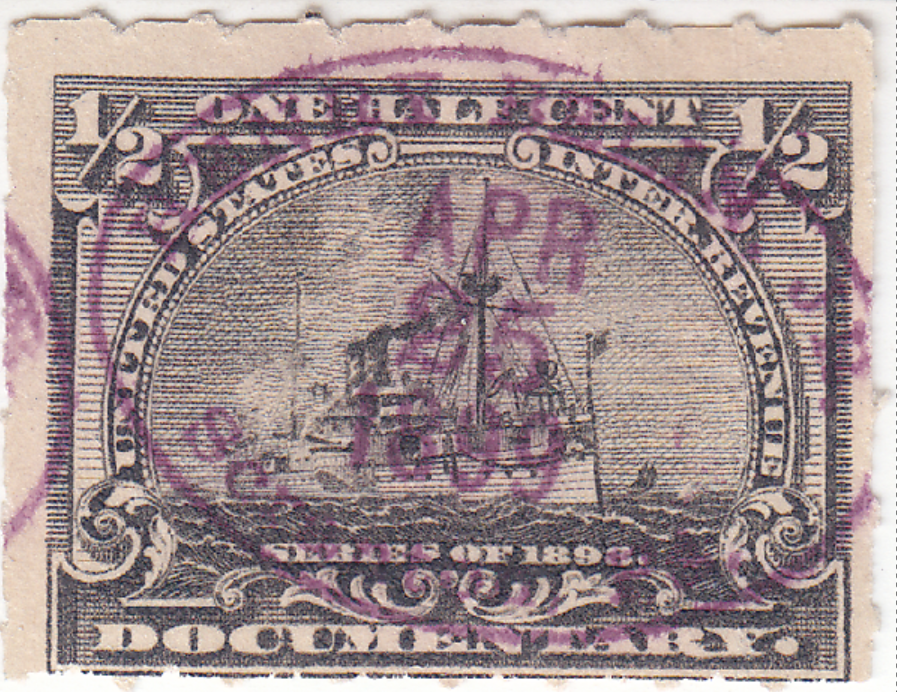
Showing posts with label R162 1/2 Cent Documentary Battleship Gray. Show all posts

Sunday, September 28, 2014

Documentary Printed Cancels: Is the C.E.C. Found on Half Cent Gray Documentaries a Charles E. Cornell Printed Cancel?

Yesterday I posted stamps canceled by Dr. Fahrney & Son, a proprietary medicine company based in Maryland.  Dr. Fahrney used printed cancels on the 5/8c proprietary and 1/2c documentaries.  Today is presented Charles E. Cornell, who used printed cancels on the 5/8c proprietary, and, if the initials are any indication, on the 1/2c documentary as well.  Additional confirmation is needed for the 1/2c documentaries, as all we have is a match with the initials, C.E.C., though not the type font.  Courtesy of Frank Sente, we have multiple examples of the 1/2c documentary.


Based in New York, Charles E. Cornell made a variety of soaps and skin products.  


C.  E.  C.
August,   1899

Langlois scan, ex-Tolman


Below are three examples of 1/2c documentaries with August 6 1900 dates and C. E. C. printed cancels.  Are these by Charles E. Cornell?:


C.  E.  C.
Aug.  6th  1900

Langlois scan


C.  E.  C.
Aug.  6th  1900

Sente scan


C.  E.  C.
Aug  6th  1900

Sente scan

Sometime ago, Frank Sente sent the stamp above with an off-center C.E.C. cancel that includes perpendicular to the stamp printed letters at the upper right.  He offered the following comments in an email:  

"I have a gray 1/2 cent documentary with what I believe is a printed cancel that also bears some extraneous printing on it. I always figured it had been placed on the document BEFORE it was printed and picked up some of the printing either because it wasn't properly placed on the document to begin with, or the printing went a bit askew.  Look at the upper right corner of the right of the R162, 1/2 cent just above. See the extraneous lettering? Another stamp with presumably printed C. E. C.cancel is provided for comparison. Puzzling n'est-ce pas??

Saturday, September 27, 2014

Documentary Printed Cancels: Dr. Fahrney & Son


Dr Fahrney's shop window display
Library of Congress 


Dr. Fahrney, like Mrs. Winslow, liked to make medicine from morphine.  One of the pusher's, excuse me, Doctor's, favorite active ingredients was morphine.  And the company put it in products like Dr. Fahrney's teething syrup.  Nothing like a 2 year old junkie.  The 1898 tax period became a peak period for these companies, just before the crash induced by the progressive era and pure food and drug laws.

We are now left with the remnants of these companies.  Bottle collectors that contained these nostrums stay busy with Dr. Fahrney & Son's material.  And revenue collectors the same.  In the case we have today, Frank Sente and Ron Lesher sent in scans of Dr. Fahrney cancels.  The 5/8 cent stamp immediately below would be expected: a proprietary stamp that was used on a proprietary medicine bottle.  But below the proprietary stamp is Ron Lesher's find of a 1/2 cent documentary stamp with a similar Dr. Fahrney cancel.


Dr. Fahrney & Son
2 23 1899.
Hagerstown,  Md.

Sente scan


Dr. Fahrney & Son
8  9  1900
Hagerstown,  Md.

Lesher scan

Why did Dr. Fahrney produce printed cancels on 1/2c documentaries?  One theory is that they might have been used on combination with 1/8c proprietary stamps to produce a 5/8 cent total.  Whatever the case, we now have another documentary printed cancel, and one that joins the series that includes stamps canceled by proprietary medicine companies.  

In the coming day, there will be a post on Charles E. Cornell, who also used printed cancels on 5/8 cent stamps, and appears to have done the same on 1/2 cent documentaries.

Thanks to Frank and Ron for sending these scans several years ago.  I finally pulled them out of the warehouse after matching the C.E.C. proprietary and documentary cancels for Charles Cornell, and I figure we might have a pattern of some kind.

Sunday, September 7, 2014

Florin Benedict Had Issues Getting to School as a Child

According to David Thompson, Mr. Florin Benedict was a Justice of the Peace for Winchester, Litchfield County, Connecticut.  But as a child he went to school in nearby Winsted, Connecticut. David couldn't find much information about Mr. Benedict, and neither could I. Yet from the stamp below with his name on it, we can guess that he probably dealt in insurance of some kind, as most of the 1/2 cent documentaries were used for insurance taxes.


FLORIN BENEDICT,
FEB
21
1900
WINSTED, CONN.

David Thompson scan and highlight


But I did find one very personal item about Mr. Benedict at the website of the Colebrook Historical Society.  Colebrook is about six miles north of Winsted.  And the Colebrook Historical Society has preserved a few public records, one of which tells us that when Master Florin Benedict was a school boy, he managed in one academic period of 79 days to be tardy for 6 and absent for 25.  Either he was something of a truant, he was sick often, or more likely, there were lots of things to do at home to keep things running.  I prefer to believe the latter, and that the farm work just had to be done.

From the records of the Colebrook Historical Society, Florin's name was in a list of many other boys that I did not paste into this post:

1872 to 1874 (As per a note attached written by Homer P. Deming dated 1948.)

Attendance Record

BOYS                       Tardy       No. Days Attendance (of 79)

Florin Benedict        6               54

No. Boys 27

Wages of Teacher $56.00

Whole No. of Scholars 40

Aggregate Attendance 2660 Days

Length of School – 16 Weeks (80 Days)

No. Scholars Over 16 – 9 (Boys 6; Girls 3) 

Sunday, May 5, 2013

Insurance Agents: Ferguson & Wallace


Ferguson & Wallace,
MAR
29
1899
Saginaw, M.


Ferguson & Wallace,
APR
6
1899
Saginaw, M.

scans by David Thompson


Ferguson & Wallace were William Wallace and Frank A. Ferguson.  Based in Saginaw, Michigan, their  company sold insurance and surety bonds. 


Monday, August 1, 2011

Henry Belin Jr. Part 2

A few days ago, Dave Thompson sent in this scan of stamp cancelled by Henry Belin Jr.:


HENRY BELIN, JR.
APR
25
1899
Scranton, Pa.

 
Back in January 2010, I first posted a cancel by Henry Belin Jr.   At the time I knew that Belin was an executive for DuPont, but didn't know why he might have been using his own handstamp cancel.  Below is the stamp I posted in 2010, with a much clearer cancel than the one above on the 1/2 cent stamp:

HENRY BELIN, JR.
JAN
24
1899
Scranton, Pa.

The presence of this cancel on Dave's 1/2c stamp practically confirms that Belin was involved in the insurance business.  Almost all half cent stamps were used for paying taxes on insurance, and it appears that the half cent stamp above received Belin's cancel while still in its intact pane and not on the document.  Belin or his firm were likely issuing multiple policies that called for half cent stamps, and they cancelled half cent stamps in bunches.

Tuesday, May 10, 2011

Cancel for May 10: B & P


B.  &  P.
MAY 10 1901

Stylized but unknown cancel.  Need some help identifying this one. 

Wednesday, May 4, 2011

Bank Check Tax Paid with 4 R162 Gray Half Cent Battleships

When it rains it pours!  An inquiry into the scarcity of the use of half cent gray battleships on checks has produced multiple examples.  Here are a few more:


Bob Hohertz scan


Bob Patetta scan


Bob Patetta scan.  Stamps on reverse.


stamps from the check immediately above

Bank Check Tax Paid with 4 R162 Gray Half Cent Battleships

This past Saturday I ran a post on a check from Dave Thompson written by a J. W. Grim of Harissonburg, Virginia, upon which Mr. Grim had applied a block of 4 half cent stamps.  I asked questions about how freqently this might have happened, and whether there might be other examples.  3 replies came in, with Frank Sente and Bob Patetta providing new examples. 

It seems that Mr. Grim frequently used half cent stamps on his checks, and did so over a long period of time.  Perhaps he was an insurance broker that sold lots of policies that required half cent stamps, and those were the stamps available in his office.  Whatever the case, here are two more examples:

Dave's check is from 1899, the top check from 1900, and bottom from 1901

The bottom check has a 2 cent documentary remnant.  Frank believes that the bank or someone from Barber & Perkins possibly placed the stamp on the front of the check, not noticing the half cent stamps on the reverse side.  The person then tried to remove the stamp.

The reverse sides of the checks above.

Does anybody out there know the story of Mr. Grim of Harissonburg, Virginia?


A non-J. W. Grim example


Reverse side, endorsed by Ethel Smith

Saturday, April 30, 2011

Bank Check Tax Paid with 4 R162 Gray Half Cent Battleships

Dave Thompson has sent a recent barrage of interesting material to post on the site.  The most interesting is a check made out to a prominent maker of proprietary medicines, Gilbert Brothers & Company, based in Baltimore. 

Check front from November 22, 1899. 

The front of the check is unremarkable, though there might be an interesting story if I could make out the signature.  Whatever the case, the reverse side of the check is the special part:

R162 block of 4 to make up 2 cent check tax

Bob Hohertz, a co-blogger at this site, is an expert on checks of this period and beyond.  I would want to know what he could tell us about how scarce this usage might be.  Any help Bob?


Gilbert Brothers advertisement

At the time of the cancel above, the firm was located at 9 North Howard Street in Baltimore before moving to Lombard Street in 1913, as in the advertisement immediately above.  The company made a line of products named for someone named Yager, including Yager's Sarsaparilla, which was one it most popular products. 

Perhaps Malcolm might uncover an interesting story about this firm in a future On Beyond Holcombe post.

Wednesday, March 23, 2011

Position Dot (?) on the Half Cent Stamp in Yesterday's Post

Rereading yesterday's post I focused a bit on the stamp.  I've recently received a deluge of examples of so-called postion dots on the battleships, and I've become accustomed to looking for these near the top center of the stamp.  Yesterday's stamp presents an example of a dot in the center of the L in HALF at the top of the stamp. 


These so-called dots are everywhere once I start looking for them.  Is it the case on postage stamps that these dots were always so carelessly placed or not burnished off the plate?  What gives?  I understand that the Bureau was busy.  Is this the only explanation?

In the coming week I will post a few more examples of these kinds of dots.  Stay tuned.

Monday, March 21, 2011

Cancel for March 22: West Jersey Title

West Jersey Title
3/22   1899
& Guaranty Company


The West Jersey Title & Guaranty Company was incorporated in 1888 by William Casselman. His brother-in-law, Thomas French, was a prominent Camden attorney, whose firm is still in business today, as Capehart Scatchard Attorneys at Law. The firm acquired the property at the southeast corner of 3rd and Market Streets in Camden NJ in 1889, and was still at that location as late as 1947. By 1959 the company had moved to 518 Market Street. Around 1974 the firm was absorbed by the Continental Title Insurance Company, and moved its offices to Pennsauken NJ. In 1995 the firm became the to Commonwealth Land Title Insurance Company of New Jersey.

During its heyday, West Jersey Title also engaged in real estate and banking throughout South Jersey, including the the West Jersey Title and Guarantee Bank of Woodbury, NJ. West Jersey Title acquired the Montgomery Stafford Farm East shortly after a railroad station was established at Laurel Springs NJ, and was instrumental in advertising and developing the area which became the Borough of Laurel Springs.


Monday, February 28, 2011

Cancel for March 1: Helmholz & Remick

Helmholz & Remick
MAR
1
CHICAGO.

Frederick Helmholz and Frank Remick were partners in a firm with a seat on the Chicago Board of Trade.

Friday, August 20, 2010

R161 Used on a Check

I recall how excited I was about 10 years ago when I obtained my first on-document usage of R161, the 1/2-cent Orange Documentary. I had been searching for one for at least that long. And I was thrilled to find a second usage just last year. But my jaw literally dropped when I opened the scan of the check shown below provided by fellow 1898 revenue collector Bob Patetta.

The 1/2-cent battleship documentaries were issued specifically for use on insurance-related documents as the tax on most insurance policies, other than life insurance, was 1/2-cent per dollar of premium paid. To find both the R161 Orange and R162 Gray 1/2-cent values used together on a check with an R163 1-cent battleship to pay the two-cent bank check tax is extremely unusual.

The battleship revenues were the most colorful stamps of their era and usages featuring more than one denomination can be visually attractive. This one is simply stunning. Thanks, Bob, for sharing it.


George C. Arnold Worsted Yarns Check
Providence, R.I. November 4, 1898

The small strip of tape on the back of the check likewise is unusual. Its red color highlights the $200$ security punch used to confirm the amount of the check.

George C(arpenter) Arnold was a life-long resident of Rhode Island whose ancestors first arrived in 1635 and were associates of Roger Williams. Subsequent ancestors fought in the American Revolution and George, himself, was an officer in the Rhode Island Militia.

Arnold was engaged in the worsted yarn business for more than twenty-five years and also served as an officer or director in several other Providence businesses. He was interested in numismatics and geneology. A brief biographical sketch can be found in the
1919 SAR National Yearbook.

Bob Patetta has provided two other R161 uages that we'll show in coming days. The census of reported on-document usages of the R161 1/2-cent orange documentary stands at seven. If you are aware of additional usages please email us, with scans if possible, at
1898revenues@gmail.com

Tuesday, August 17, 2010

Cancel for August 18: Liverpool & London & Globe Insurance Company

L. & L. & G.
AUG
18
1898
INS.  CO.

A cancel for the Liverpool &. London & Globe Insurance Co. Ltd.  At the time of this cancel the L&L&G had operated in the United States for 50 years.

Wednesday, April 14, 2010

Cancel for April 15: Concordia Fire Insurance Company


CONCORDIA FIRE INS. CO.
APR
15
1901
MILWAUKEE, WISC.


George Brumder, President of Concordia Fire Insurance Company from 1897 to 1909.  Brumder was a successful publisher in Milwaukee, especially for the German speaking community.

Monday, November 30, 2009

Cancel for December 1: Woodworth - Hawley Co.


Woodworth - Hawley Co.
DEC
1
1898
Buffalo, N.Y.

Woodworth-Hawley was an insurance company located at 7 West Seneca at the Chamber of Commerce in Buffalo.

In the newspaper the Buffalo Express of Saturday, March 29, 1919, Woodworth-Hawley took out two large adverts on page 5.  The lower ad on the page is an amusing one, and consists of a reproduction of a hand-written note that reads as follows:

Dear John: -
I had an awful accident yesterday with the Automobile.  Will tell you all about it when you come.  I'm your black-eyed Mary now.  Hope my eyes will be blue again before you get home.

I telephoned Woodworth-Hawley Co., Chamber of Commerce Building, Seneca 18, and they were perfectly nice about it.  They told me not to worry or send for you.  They atended everything promptly and pleasantly.  It is terrible to have an accident but it helps awfully when the insurance is alright and we don't lose any money or be bothered and worried by a lawsuit.

I am counting the days until you come.  Love and kisses from Junior and your
                                                         Mary

P.S. Doctor says there won't be any permanent scars.

Friday, May 8, 2009

Half Cent Documentary Gray: Uses


Not too exciting here. I've got a bunch of G. Rosenblatt cancels on other values. All of these cancels are from companies that can be googled and for which information can be readily found. Old insurance company legal proceedings and news clippings may be interesting to some though. What was Concordia's liability from the Great Chicago Fire?
Like I've written before, cancels don't show nearly as well on the gray version of this stamp. These are dated 1899 or 1901. You should never find one dated 1898. The gray colored stamp was not issued until 1899.
The second and third stamps are scans from a stock page, which explains the lines through the center of each stamp.

Sunday, May 3, 2009

Half Cent Documentary: Multiples

Multiples of the orange and gray half cent documentaries. This orange block of four has rather poor centering, but it is what I have. The gray is very fine though.


Plate blocks of the battleship stamps are somewhat scarce. Plate material from the first, second and third revenue series was not regularly preserved or collected and such blocks are not priced in Scott.
Scott also does not price battleship plate blocks, though there is much more battleship plate material out there for the collector, whether plate number singles, blocks like the block below, or blocks that include the Bureau of Engraving and Printing imprint.

Thursday, April 30, 2009

Battleship Revenues: Half Cent Documentary

When the Bureau of Engraving and Printing began producing the battleship series of tax stamps, the half cent documentary was orange. This is a great color for highlighting cancels and hence great for the cancel collector. However, there was trouble. Every stamp in the documentary series up to the 80 cent stamp had the exact same design as the half center, as did all 12 values of the proprietary series. The Bureau spread the available colors across all these stamps. Even then they ended up with piles of stamps that all looked the same.
This was particularly the case with the 3/8 cent proprietary stamp. Compare the two side-by-side stamps below. At first and second glance they look the same. The inevitable confusion wasn't just accepted. The Bureau went so far as to pick another color for the half cent stamp, and so they went with gray.

And so we end up with the stamp below, one that is dignified but one that left cancels obscured.