Sunday, January 13, 2013

New England Railroads: Bricks on the Central Vermont Railway


C. V. RY. CO
JUL
19
1901
AMHERST, MASS.

Langlois scan


Bill of lading for a load of bricks from the Marcy & Gardner Brick Company.  Amherst, Mass. was on the New London section of the C.V. RY.


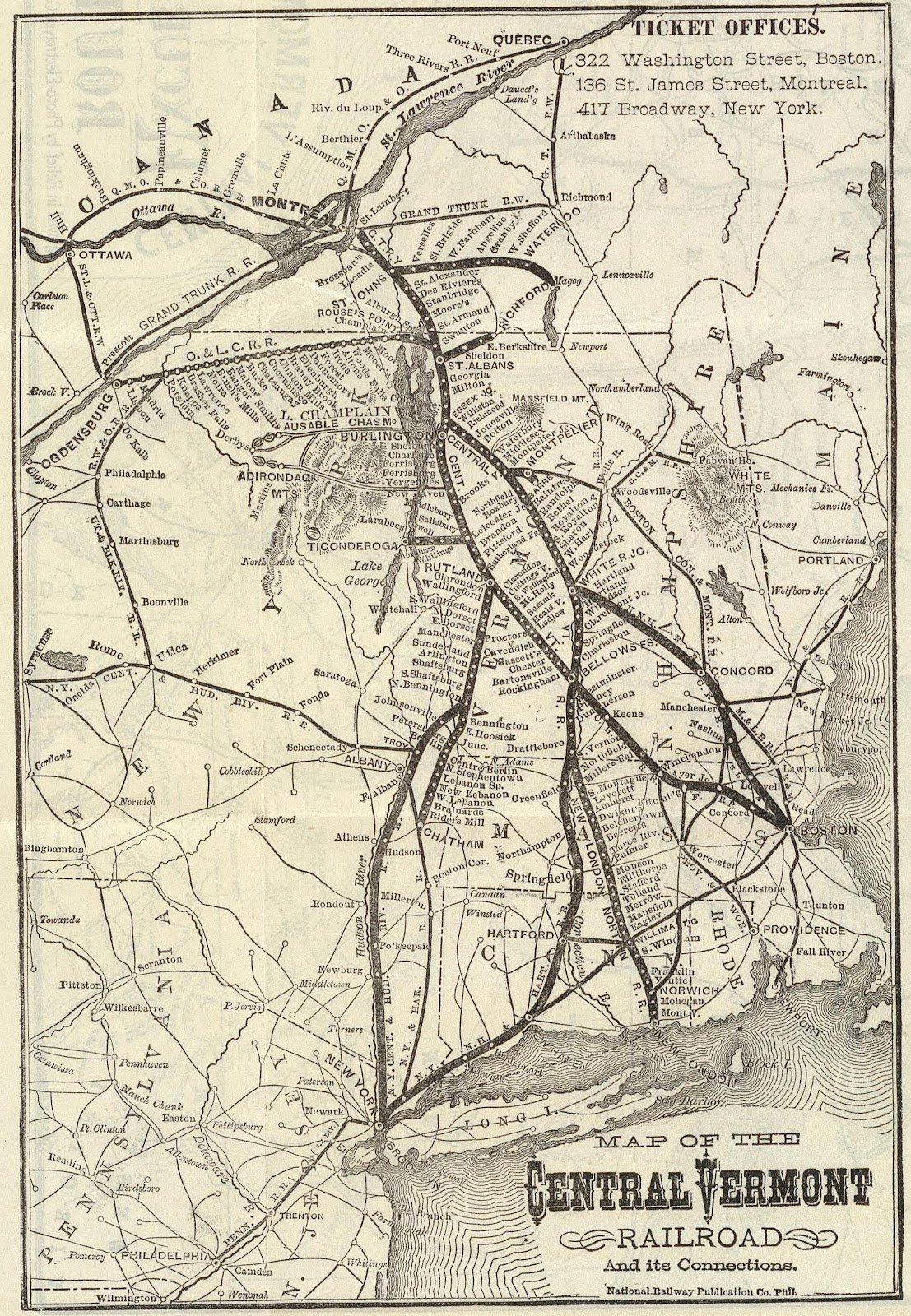
1879 C.V. RR map showing the CVRR and its connections tying together Montreal, Boston, and New York

On Beyond Holcombe: A Documentary Diversion to Noble & Mestre, Brokers


NOBLE & MESTRE
MAY
21
1901
NEW YORK.


Malcolm Goldstein returns to 1898 Revenues for 2013, but the first edition of the year is on a business that used documentary stamps, not the proprietary series.  In December I posted several stamps canceled by the firm Noble & Mestre with little information about the firm.  Malcolm took the cue and sent in this history:


Henry G S Noble (1860-1946) and Alfred Mestre (1860-1929) began as fraternity brothers and classmates and grew to be family and business partners.  They became fraternity brothers in the Nu Chapter of Delta Kappa Epsilon which was at City College (or College of the City of New York as it is more formally styled), graduated together from City College in 1880, became brothers-in-law in 1882 when Noble married Mestre’s sister, Clemencia, and entered partnership together when they opened Noble & Mestre, their stock brokerage business on the New York Stock Exchange in 1885. Each achieved formidable success in his own right.

Noble’s name came first in the partnership because he grew up in the world of wealth and privilege that surrounded the New York Stock Exchange.  He was a grammar school classmate of Charles Even Hughes, who ended his own long and distinguished career as Chief Judge of the United States Supreme Court. Immediately upon graduation from City College, Noble became a clerk at the brokerage firm of Henry G Stebbins & Son, and in 1882 himself  became a member of the New York Stock Exchange when he purchased his grandfather’s seat on the Exchange.  His grandfather just happened to be Henry G Stebbins.  Stebbins himself had acquired the seat on the Exchange in 1831, and had served as President of the Exchange in the years 1851, 1858 and 1863.  Noble became a governor of the Exchange in 1897.  In 1902, he left the firm that had borne his name to became a partner in the brokerage firm of DeKoppet & Doremus, an “odd lot” broker, which dealt principally in stock orders of less than 100 shares. When the Senate conducted an investigation into the trading practices of the Exchange in 1914, Noble testified as the Exchange’s spokesperson, assuring the Senate of the Exchange’s trading integrity.  Shortly thereafter, he was elected President of the Exchange in May, 1914. 

In furtherance of the principles he had enunciated during the Senate hearings, as President of the Exchange, he served as nominal plaintiff in litigation brought by the Exchange to stamp out “bucket shop” brokerage operations. As defined by the United States Supreme Court, a “bucket shop” was “an establishment, nominally for the transaction of stock exchange business ... but really for the registration of bets ... on the rise and fall of the prices of stock ....” In other words, “bucket shops” advertised themselves as brokerage houses to place buy and sell orders for stock, but they did not actually buy and sell the stock that the transactions required, and merely treated the orders as bets.  The determination of the bet followed the actual course that the validly made stock transactions took.  In one set of lawsuits, the Exchange attempted to enforce its contracts with the major telegraph companies requiring them to deliver such stock trade information only to brokerage houses authorized by the Exchange to receive such information and prohibiting the telegraph companies from releasing such information to any brokerage houses not specifically authorized by the Exchange to receive such information.  In a second group of lawsuits, the Public Service Commission of Massachusetts and a barred brokerage house attempted to persuade the state court to order the telegraph companies, because of their status as state regulated common carriers, to provide stock quotation information to any interested party without regard to the proprietary nature of the information. The cases were consolidated before the 1917 term of the United States Supreme Court, and the decision rendered by Justice Oliver Wendell Holmes vindicated the Exchange’s position entirely against both the state commission and the barred brokerage house.

Noble served five consecutive terms as President of the Exchange until May, 1919, particularly during the entire duration of the participation of the United States in World War I.  He thus became a wartime President of the Exchange, just as his grandfather had been. He then returned to DeKoppet & Doremus where he remained a full partner until 1927.  Thereafter, he reduced his interest in that company, but continued to hold his seat on the Exchange until 1938, when he transferred the seat to his own grandson, Henry Stebbins Noble, and finally retired.  At the time of his retirement, it was noted that John D Rockefeller had been older than Noble when he died the previous year in 1937, but even then Noble had longer continuous service on the Exchange than Rockefeller.  In all Noble was a member of the Exchange for 56 years, and for 37 of them, he was a governor of the Exchange.  When Noble died in 1946, the “Noble” seat on the  Exchange had been held in the same family for 115 years.


Alfred Mestre was cut from somewhat different cloth than Noble.  He was born in Cuba of Cuban parents in 1860.  His father was a professor of law at the University of Havana in Cuba, until the Spanish government of Cuba exiled him in 1869 for advocating too vociferously on behalf of Cuban independence.  Mestre’s father then brought the family to the United States, and, although an attorney in Cuba, was obliged to attend Columbia Law School in order to qualify to practice law in the United States.  The story is told that when legendary Columbia Law School Professor Theodore Dwight asked Mestre’s father  too complicated a question in English, the father would respond in Latin and the discussion would continue in Latin, to the great amazement and amusement of the rest of the law class.  Joseph Mestre graduated in 1876 and soon created a lucrative law practice serving South American clients as part of the firm Olcott, Mestre & Gonzalez.  He died at age 54 in 1886. Alfred and his younger brother Aurelius both attended City College.  Alfred graduated with Noble in 1880 and Aurelius graduated in 1881. As noted above, their sister Clemencia became Noble’s wife in 1882.  While Noble immediately entered the brokerage business, Mestre followed in his father’s footsteps and attended Columbia Law School from which he graduated in 1882. He tried the practice of law for a year with his father’s firm, but thereafter spent a year in Europe, then returned to Cuba where he married Maria Villa Urrutia of Havana in 1883.  In 1885, he joined with Noble and the two launched the successful stockbroking business of Noble & Mestre. In the meantime, Mestre’s brother ultimately returned to Cuba to manage the family’s estates and, later, as a volunteer attached to General Joseph Wheeler’s staff during the Spanish-American War in 1898 played a vital role in negotiating the Spanish surrender of Santiago, Cuba.  Unfortunately, he also contracted a disease during the Santiago campaign that broke his health and killed him in 1899.  Alfred Mestre and Henry Noble continued their partnership until 1902. Thereafter, Mestre conducted his own business in his own name as Alfred Mestre & Co. Elected to the Board of Governors of the New York Stock Exchange, he subsequently resigned in 1914 because he found he had become too busy as a market specialist in Reading Railway stock.  He retained his seat on the Exchange until 1925 and died in 1929.


Ruins of Alfred Mestre's Sheffield Island Mansion


While Noble’s only notable outside interest seems to have been his membership in the New York Yacht Club, Mestre enjoyed his wealth more.  Around 1909, he seems to have commissioned a specially designed 40 foot inboard cruiser which drew the attention of Forest & Stream Magazine. In 1912, he built a mansion on Sheffield Island, located in the Norwalk Islands chain off the coast of Connecticut.  Grand in its day, sadly, it burned down in the 1940s long after it had passed out of his family’s hands.  Only picturesque views of the ruins remain.

Thursday, January 10, 2013

New England Railroads: Old Colony Railroad


O.  C.  R.  R.
APR   1  1899


Dividend check for the Old Colony Railroad Company

Langlois scans

The Old Colony Railroad primarily served the state of Massachussets.  In the early 1890s, the New York, New Haven, and Hartford Railroad leased in its entirety the OCRR.


Wednesday, January 9, 2013

New England Railroads: Boston & Maine Railroad


BOSTON & MAINE R. R.
SEP
15
1900
BOSCAWEN, N. H.

Langlois scan


Boston & Maine RR for a shipment of something(?) to a Rosenberg Brothers.


Boston & Maine sytem map from 1898


Tuesday, January 8, 2013

New England Railroads: Boston & Providence Railroad

B & P. R. R.
Oct. 2, 1899


Boston & Providence Check from October 2, 1899.

The Boston & Providence was one of the first railroads in the United States of America.  It began construction in late 1832 to connect Boston with Providence, Rhode Island. 


Boston & Providence Railroad Depot, Boston

Monday, January 7, 2013

New England Railroads: Boston & Albany Railroad


B.  &  A.  R.  R.
JAN     8     1901
WESTFIELD, MASS.


The Boston & Albany was a key piece of the Vanderbilt's New York Central System connecting Boston to the New York Central's mainline heading west. The New York Central and Hudson River RR ran from New York to Albany up the Hudson River Valley and then turned west at Albany for the journey to Buffalo, connecting with the LS&MS in Buffalo for the trip to Chicago.  The map below place Albany at the center of the map, with the B&A heading east from Albany and the NYCHRRR running south and west.


Sunday, January 6, 2013

New England Railroads: A January Tour

Over the next two weeks or so this site will highlight railroads operating in New England at the turn of the century.  By 1898, New England was thickly criss-crossed by a network of railroad track and railroad companies.

Big and dominant railroads like the New York Central controlled assets in the region, like the Boston and Albany, but smaller independent lines prospered as well, like the Rutland.

Railroads featured:

Boston & Albany Railroad
Boston & Providence Railroad
Boston & Maine Railroad
Old Colony Railway
Central Vermont Railway
Maine Central Railroad
St. Johnsbury & Lake Champlain Railroad
New York, New Haven & Hartford Railroad
Rutland Railroad

*****

For all those that have sent emails over the past week and a half, sorry for the unresponsiveness.  The day after Christmas the family and I traveled to Egypt.  We've just returned, after an all night flight from Cairo to Nairobi via Khartoum.  I will catch up on emails over the next few days.  I am swamped with work correspondence too, so stand by.  Hope you are having a great new year!


Friday, January 4, 2013

The Pennsylvania Steel Company


The Pennsylvania Steel Company was originally organized in Pennsylvania in 1865.  Affiliated with the Pennsylvania Railroad, the main plant in Steelton, PA, manufactured steel rails and other railroad material.  


THE PENNSYLVANIA STEEL CO.
APR
27
1901

Langlois scan

In January 1901, a plan of financial reorganization was adopted and the company was reincorporated with a much larger authorized capital base.   The stamp above was likely used on documents associated with this reorganization.  

In 1916 the Pennsylania Steel Company was merged with other firms to form Bethlehem Steel.

Thursday, January 3, 2013

The Lorain Steel Company


The Lorain Steel Company produced a variety of steel products but specialized in rails for the railroad industry.


THE LORAIN STEEL COMPANY.
FEB
4
1901


Langlois scan


Lorain Steel freight yard in Johnstown, Pennsylvania

Wednesday, January 2, 2013

Lackawanna Iron & Steel Company


Lackawanna Iron & Steel Company: Scranton blast furnaces.  In 1902, the Lacakawanna Iron & Steel Company moved from Pennsylvania to New York.


The L. I. & S. Co.
MAR
4
1901
N.  Y.

David Thompson scan

Could this have been a tax stamp on a bond floated to pay for the move of the steel plant?

The Lackawanna Steel Company existed as an independent company from 1840 to 1922, and then as a part of Bethlehem Steel from 1922 to 1983.  The firm was founded by the Scranton family, and the city of Scranton, Pennsylvania grew around the company's original location.  When the company moved from Scranton to near Buffalo, New York, the town of Lackawanna, New York was in turn founded.  The company was, for a period, the second largest steel company in the world.

Tuesday, January 1, 2013

Wheeling Steel & Iron Company

The Wheeling Steel and Iron Company was formed in 1892.  A history of the founding of the firm and its component companies can be found below.  Wheeling Steel and Iron was formed in the foremost steel making region of the United States, a place where the energy for steel production, coal, was plentiful.  Oddly, iron ore couldn't be found anywhere near cities like Wheeling or Pittsburgh.  Though iron ore had to be imported from places like the Minnesota iron range, western Pennsylvania, western New York, and eastern Ohio were on top of the coal and much closer to end users of the finished material than northern Minnesota.  

In the coming days this site will feature a several stamps canceled by steel companies.  


W. S. & I. CO.
FEB
23
1901
WHEELING, W. VA.

David Thompson scan


The former Wheeling Steel & Iron building in downtown Wheeling, West Virginia.  The original photo can be found at Historic Wheeling.


From "History of Wheeling City and Ohio County, West Virginia and Representative Citizens," by Hon. Gibson Lamb Cranmer, 1902. 
 
THE WHEELING STEEL & IRON COMPANY, whose extensive operations class it among the foremost concerns in the steel and iron industry in the United States, was formed by the consolidation of the Benwood, Belmont and Top mills and the Wheeling Steel works, and was incorporated April 16, 1892.  The founding and development of the component plants of this  
corporation are as follows: 

The Missouri Iron Works, Wheeling's first iron mill, were built in 1834, by Philip Shoenberger and David Agnew, and were located on a  portion of the present site of the Top Mill.  They were operated with varying success until 1857, never having more than 14 nail machines.  In 1847 E. M. Norton and others organized the Virginia Mill, for the purpose of manufacturing nails exclusively.  It was located on the present site of the Baltimore & Ohio Railroad depot, and started with  40 machines.  It was subsequently moved to Benwood, affording the railroad company more room.  The new mill was sold under a decree of the court in 1864, and reorganized as the Benwood Iron Works, E. M.  Norton serving as president.  About this time Cyrus Mendenhall entered  the company, and it thus acquired his blast furnace and 50 acres of land at Martin's Ferry, Ohio.  

In 1883 a monster union steel plant, intended to furnish nail slabs for their factories at Wheeling, was contemplated, and nearly all the corporations secured amendments to their charter, permitting them to invest in incidental industries.  The Benwood company had projected and begun a plant of this kind for its own use, but before much progress had been made in its construction the Belmont and Top mills were enlisted in the project. The original plans were changed and the capacity enlarged, and in August, 1886, the first steel was made by this concern, which was known as the Wheeling Steel Works.  The plant is very advantageously situated with respect to transportation facilities, being located near the south end of Benwood, about 200 yards north of the railroad bridge, and between the lines of the Baltimore & Ohio and Ohio River railroads.  The various buildings are of iron, and are equipped with the best machinery obtainable for the production of soft steel of a high quality.  The capacity is 700 tons per day.  The works are well supplied with railroad tracks for  receiving raw material and shipping steel, the corporation owning three locomotives to handle the rolling stock.  This is one of the finest Bessemer steel plants in the country. 

The Belmont Mill was started in 1849, when E. M. Norton and others withdrew from the Virginia Mill.   Mr. Norton, with William Bailey, S. H. Woodward, Henry Wallace, C. B. Doty, Holstein Harden, F. D. Norton, William Hay, Hugh McGiven and John Wright formed a partnership under  
the name of Norton, Bailey & Company, and bought from Joseph Caldwell for $1,600 two acres of land, on which they built a mill with 18 nail machines.  Operations were begun in the fall of 1849 with E. M. Norton as president and William Bailey as manager.  Henry Moore was admitted as a partner about that time.  Important improvements, relating to the handling of iron, introduced just at this juncture, made this an auspicious time to establish a nail factory.  The Belmont Mill, under  
skillful management and with its new processes, had two years of notable success.  Messrs. Bailey and Woodward and a number of others sold their interests in the Belmont Mill to Henry Moore and started the LaBelle Iron Works in 1852.  The firm of the Belmont Mill then became Norton, Acheson & Company.  Joseph Bell became actively connected with the firm in 1853, and by the year 1860 the mill had increased its capacity to 80 machines.  In the year 1863 the partnership arrangement of the company expired by limitation, and the mill property was sold at public auction for $127,000, Henry McCullough, of Pittsburg, being the purchaser.  The company was reorganized under the title of McCullough, Acheson & Company.  M. B. Cox also at this time became a member of the company, and after a brief existence the title of the company was changed to Robert Lehr & Company, and still later to the Belmont Iron Works, with Henry Moore as president.  In the fall of 1865 the title was again changed to the Belmont Nail Works Company, under which operations continued until June 30, 1879.  In 1874, 110 machines were in operation, and it was the largest factory in Wheeling, and the third, in size, in the United States. In the fall of 1872 the company commenced a blast furnace, which was completed in the spring of 1874.  It was a model of its kind and stands on the river front, near the mill, in the sixth ward of Wheeling, on the Baltimore & Ohio, Ohio River and Cleveland, Lorain & Wheeling railroads.  The present plant,   which occupies two full blocks on Main street, between Twenty-fifth and Twenty-seventh streets, has 152 machines, and an annual capacity of 350,000 kegs of steel nails and spikes.  It was one of the first companies to resume work after the strike of 1885. 

The Top Mill, or the Wheeling Iron & Nail Company, is located in North Wheeling on the site of the first iron works established in the city.  A few years after its inception Mr. Agnew succeeded to the business of  the firm, and conducted it until 1840, when he failed in business.  The mill was taken by the former manager, Mr. Grassemer, and the head bookkeeper, Mr. Tallant, who were succeeded by E. W. Stevens, in 1845.  The latter came here from Pittsburg and enlarged the nail department of the plant.  He induced the Norton brothers to come to Wheeling.  The mill was still owned by Mr. Shoenberger, and later Johnson, Sweeney & Company and other firms operated it.  It was burned to the ground in 1857, and the last named firm failed.  It never had more than 14 nail  machines, and its capacity was 700 kegs of nails per week.  In the early days of the War of the Rebellion the Belmont company leased the mill and it was occupied for several years in the manufacture of gunboat plates.  The Shoenberger heirs sold the mill in 1864 to Acheson, Bell & Company for $44,000, the purchase including about 50 acres of land, with a river frontage of three-quarters of a mile.  The new owners added the manufacture of bar iron, and a site for a nail  factory was also secured by grading out the side of a hill.  In 1865 the mill suffered from a disastrous boiler explosion.  The same year Moses B. Cox and the Brockunier brothers were added to the firm, and in 1866 the Wheeling Iron & Nail Works were established.  The nail factory  was enlarged, and by the end of that year was running 40 machines.   

In 1869 there was somewhat of a change in the ownership of the concern, and the company was reorganized with John P. Gilchrist as president; C. D. Hubbard, secretary; and Adam Dodson, vice-president.  In September, 1871, the mill was entirely destroyed by fire, but preparations were at once made for rebuilding, the company remodeling the entire plan of the works.  All the latest improvements in machinery and arrangement of the departments were adopted, and every defect which experience had pointed out was remedied in the construction of the new works.  By the summer of 1872 the mill was ready to resume operations with 105 machines.  In 1878 a blast furnace was completed and was developed to a daily capacity of 100 tons of pig iron.  The officers of the company prior to the incorporation of the Wheeling Steel & Iron Company were C. Russell Hubbard, president; Henry H. Hornbrook, vice-president; and Hon. C. D. Hubbard, secretary.  These gentlemen, with Messrs. John P. Gilchrist, George K. Wheat, William A. Isett and Dr. T. H. Logan, composed the board of directors.  The Top Mill occupies over six acres of ground, and all its buildings are most substantial.  A valuable coal tract is included in its property, although natural gas is the fuel utilized in the entire plant of the Wheeling Steel & Iron Company.  

The Wheeling Steel & Iron Company was formed April 16, 1892, and C. Russell Hubbard was elected president, and Joseph Dorsey DuBois, secretary, on August 21, 1892.  Frank W. Bowers was elected secretary in April, 1899.  The directors are C. Russell Hubbard, William F. Stifel, George K. Wheat, Joseph Dorsey DuBois, George Wise, A. J. Clarke, Edward Hazlett, Henrey H. Hornbrook and William A. Isett.  The general offices of the company are at No. 11 Fourteenth street, and all business is directed from this office.


Monday, December 31, 2012

Happy New Year!


FREIGHT OFFICE
L.S.&M.S.RY.
JAN    1   1900
SO. CHICAGO
ILLS.

Cancel from the South Chicago freight office of the Lake Shore & Michigan Southern Railway. 


*****

Here is to a better 2013.  The end of the Mayan long count calendar did not bring an end to the world, nor will the fiscal cliff.  But we did experience a terrible tragedy with the assault rifle deaths of elementary school children in Connecticut.  

I learned to shoot as a kid, and owned my first shotgun by the age of 12 (20 gauge Remington).  Assault rifles, especially the M4 carbine and AK47, have been a constant presence for me in some of the places I've worked like Afghanistan and west Africa.  I appreciate the appropriate use and possession of assault rifles, especially when they are used for practical reasons and in the hands of trained soldiers in places where they've saved my life like Liberia.  But for the life of me I can't figure why we treat guns like glamorous objects and symbols of freedom in the continental United States.  And why do we venerate the things to the point where a Wayne LaPierre of the National Rifle Association could make a dystopian recommendation to put armed guards in all of our schools?  Lanza, the Connecticut mass murderer, would have been smart enough to have taken out the guard first before using his Bushmaster human killing machine on the children.   The NRA, gun makers, and people that glorify these things should be ashamed, not so much for supporting the right to own guns, but for promoting them as something they are not.

I once owned a home in Chevy Chase, Maryland that my wife and I had purchased in 1999 after we returned from a six year stint in Liberia during the midst of the country's civil war.  During October 2002 while we were residents in the house, the Washington area, of which Chevy Chase is a neighborhood, was terrorized by a sniper, who murdered 10 people over a three week people with a Bushmaster XM-15 rifle.  The sniper was taking people out in parking lots, bus stops, and gas stations.  People lived in fear throughout the region.  

After about ten days from the start of the murders, I received a call in Chevy Chase from a friend named Brownie Samukai who called from western Tanzania in East Africa near the country's border with the nation of Burundi.  Brownie, who is now the Minister of Defense in Liberia, was at the time a security official for the United Nation High Commission for Refugees.  He and some of his colleagues had been watching CNN reports on the sniper, and as he had my number in Chevy Chase on his phone, he decided to call me to make sure I was OK and to find out how we were coping.  I have never quite gotten over the irony of a security official calling me from east Africa to make sure I was OK in the United States from people on the rampage with a military weapon.  For six years in Liberia I lived with the ever present threat of AK47s, .50 cals, and M60s, which all shot up my house and office in 1996 and nearly got me.  Brownie was in Liberia then too, and I think both of us thought we would be just a bit safer out of Liberia by 2002.  So Brownie got a job with the UN, and I went back to Washington.  But one of Bushmaster's fine and efficient killing products, which can be bought freely in the United States, made everyone in the capital city of the United States watch their back at all times, everywhere, for nearly three weeks.

I am certain that more than a few readers will mumble something to the effect that guns don't kill people, people kill people, and all that.  These are shallow thinkers.  There is a reason we all don't have anti-aircraft guns at home.  At some point our society has drawn a line.  The question is where and why, and why do the people that defend assault rifles not protest their lack of ability to acquire high caliber guns like anti-aircraft guns?  As a society we have already drawn a line.  

The line needs to start with values, and the glorification of assault rifles as an aspect of manliness and machismo.  Consider the the advertisement below that might have been read by Adam Lanza:


Above is an advertisement for a Bushmaster rifle, written and paid for by those that want you to think that your manliness is equated with owning one of these things.  What?  The numbers of dead in Connecticut are part of a much larger tally of dead that the current stories don't mention.  I've seen way more children and other innocents cut apart by rifles like these in Liberia and Sierra Leone to know that manliness has nothing to do with the people firing these things.  So many of the murders in those countries were committed by children themselves, shooting unarmed people.  Their AK47s hardly made them men, only effective murderers.  How much more of a man is Adam Lanza now that he has killed all these children?  I accept the fact that we are always going to have guns like these made by companies like Bushmaster.  But mass marketing like this?  Shame.

*****

In 1978 the British band Gang of Four recorded the song Armalite Rifle.  I was something of a punk rockphile back then, and this song was one of my favorite records as a high school kid.  


Saturday, December 29, 2012

David Thompson's 2 Cent Documentary Block of 6 with Double Transfer

There are not too many fly-speckers out there in philately anymore, especially for the battleship revenues, for which fly specks, e.g. double transfers, plate scratches, layout lines among others, are quite common.  But David Thompson keeps his magnifying glass handy and his scanner to more closely examine his battleships.  We don't report every new finding on this site, but occasionally there is an interesting item.  Today we present an R164 block of six with two fly-speckable stamps, one with a plate scratch and the other with a double transfer.  See the upper right and middle right stamps in the block below.


 Below:  Upper right stamp with double transfer.  David has marked the clear DT points with white arrows:


 Upper right stamp with double transfer showing across "TWO CENTS":


 Middle right stamp with plate scratch noticeable in the right margin.


Friday, December 28, 2012

Need Some Help with Whitmay (?) Mills

Today we have a cancel from a firm that appears to be "Whitmay" Mills.  Problem is that neither David Thompson, who sent in this scan, nor I can find anything about this mill, or a person with the this name.


Two questions for the crowd out there in internet land.  Does this look like, and is the manuscript cancel indeed Whitmay Mills, and if so, can you tell us anything about it?  We've thought of Whitney Mills, but it just doesn't look like Whitney.

Thursday, December 27, 2012

Metellus L. C. Funkhouser of Montgomery & Funkhouser


Metellus L. C. Funkhouser, photographed as a Major in the US Army.   As a Captain, Metellus saw action in the Spanish American War.  Montgomery & Funkhouser was a Chicago-based insurance agency.


MONTGOMERY & FUNKHOUSER
SEP
10
1900
CHICAGO

Langlois scan


The retired Major Funkhouser would become involved in Chicago law enforcement. As 2nd Deputy Police Commissioner he would have responsibilities to clean up aspects of organized crime in Chicago.  His status was such that a contract was put out on his life in 1914. 

I can't get over the name Metellus L. C. Funkhouser.

Tuesday, December 25, 2012

Chicago Board of Trade Members: C. A. Jennings of The N. K. Fairbank Company


C. A. JENNINGS,
NOV  23   1899
CHICAGO.

Langlois scan


Mr. Jennings was with the N. K. Fairbank Company, a manufacturer of lard and soaps.  He was member #6007 of the Chicago Board of Trade.


The N.K. Fairbank Co. no doubt maintained a registered trader on the CBOT to purchase contracts for some of the primary inputs for the consumer products that it manufactured including soap and baking products.  They prospered in a city with great meat packing companies like Armour where meat packing by-products were plentiful.   The company had factories in Chicago, St. Louis, Montreal and Louisiana and had international offices in the United Kingdom and Germany. Gold Dust Washing Powder was one of the most successful cleansing product lines in twentieth century North America.


Monday, December 24, 2012

Merry Christmas from 1898 Revenues


Christmas Card from the Luedinghaus-Espenschied Wagon Company

Merry Christmas from the management and staff of 1898 Revenues:


******


Luedinghaus-Espenschied Wagon Company bill of lading on the Steamboat Sydney for "One Farm Wagon complete, with seat", for $800.

Bog Hohertz sent in this scan following yesterday's L-E Wagon Company post.  Thanks Bob!


Sunday, December 23, 2012

Luedinghaus-Espenschied Wagon Company

In March last year, Frank Sente published a post on an export bill of lading on the Louisville & Nashville Railroad for a shipment by the Luedinghaus-Espenschied Wagon Company.  Frank pointed out the rarity of export bills of lading and the reason behind the rarity in that post, and I recommend clicking the link to read Frank's contribution. 

Today, however, we feature a stamp that likely came from a more common domestic bill of lading fromt the L. E. Wagon Company.  The stamp below is off document, but I am certain that I have a couple of L. E. Wagon BOLs from Henry Tolman's collection, with cancels similar to the one below, regrettably all in storage in northern Virginia, waiting for my return from Kenya.  For now, I will focus on the single below and the L. E. Wagon Company:


L. E. WAGON CO.,
APR
20
1900
ST. LOUIS.

Langlois scan


An L. E. Wagon Company product from 1894

Luedinghaus-Espenschied, based in St. Louis, Missouri, built wagons of all types, including wagons suitable for travel out west from the gateway city of St. Louis.  L-E was manufacturing wagons by by 1850s, and they equipped 1000s trekking west to find new homes in the great expanse from the prairies to the pacific.  

The Coachbuilt website provides the following background on Luedinghaus-Espenschied:

Louis and Henry Espenschied of 148 Broadway, St Louis, Missouri were German natives who first opened a St Louis blacksmith shop in 1843. They soon expanded to wagons and by the 1850s were making large numbers for pioneers heading west.

Henry passed away in the early 1850s, but Louis continued, renaming the firm the L. Espenschied Wagon Co. Mormon records indicate that for the great migration of 1853, the settlers purchased fourteen wagons for $58 apiece from Louis Espenschied in St Louis for their westward trek to the great Salt Lake. During the civil war Espenschied received a large contract for wagons and wheels for the Union Army.

Hanna F. Arensmann married a young carriagemaker named John Henry Luedinghaus on May 9, 1858 in St. Louis. Money was given to young John Henry from his in-laws to form the Arensmann-Luedinghaus Wagon Manufacturing Co. soon after.

By the 1870s both firms were specializing in heavy commercial and farm wagons and they decided to join forces in 1880 as the Luedinghaus & Espenschied Wagon Co.

Louis Espenschied died in 1887, but his sons and Luedinghaus kept the business going, which survived into the 1930s making heavy wagons, trailers, commercial bodies and motor trucks (Luedinghaus Truck of the 1920s).

Thursday, December 20, 2012

New York Stock Brokers and Financiers: Henry Marquand & Company


Henry Marquand
by John Singer Sargent

Marquand was a wealthy financier and railroad director.  He was best known as a philanthropist and a patron of the arts.  As shown here, both he and his wife were painted by the great American painter John Singer Sargent.


HENRY MARQUAND & CO.
JAN 16 1901
NEW YORK.

Langlois scan


Mrs. Henry Marquand
by John Singer Sargent


Wednesday, December 19, 2012

New York Stock Brokers: Noble & Mestre

Noble & Mestre cancels are common on 1898 revenue series stamps, yet there are no photos of Mssrs Noble or Mestre in this site's favorite NYSE 1898 reference, King's Views of the New York Stock Exchange.  Also, I cannot find much in the way of history of any kind on this firm.  So if you know anything, please write to 1898revenues@gmail.com.


NOBLE & MESTRE
??
??
??
NEW YORK.


NOBLE & MESTRE.
DEC
7
1900
NEW YORK.


NOBLE & MESTRE
MAY
14
1901
NEW YORK.


NOBLE & MESTRE.
MAY
21
1901
NEW YORK.


NOBLE & MESTRE.
APR
19
1901
NEW YORK.

Langlois and Thompson scans