- Home
- About
- Documentary Printed Precancels
- The Fullerton List
- NYSE Brokers 1898-1902 A thru K
- NYSE Brokers 1898 - 1902 L thru Z
- Insurance Agents
- Insurance Companies
- CBOT
- Railroads
- On-document Uses with Frank Sente
- Revenue Stamped Paper with Bob Hohertz
- On Beyond Holcombe with Malcolm Goldstein
- Graded Stamps
Sunday, October 17, 2010
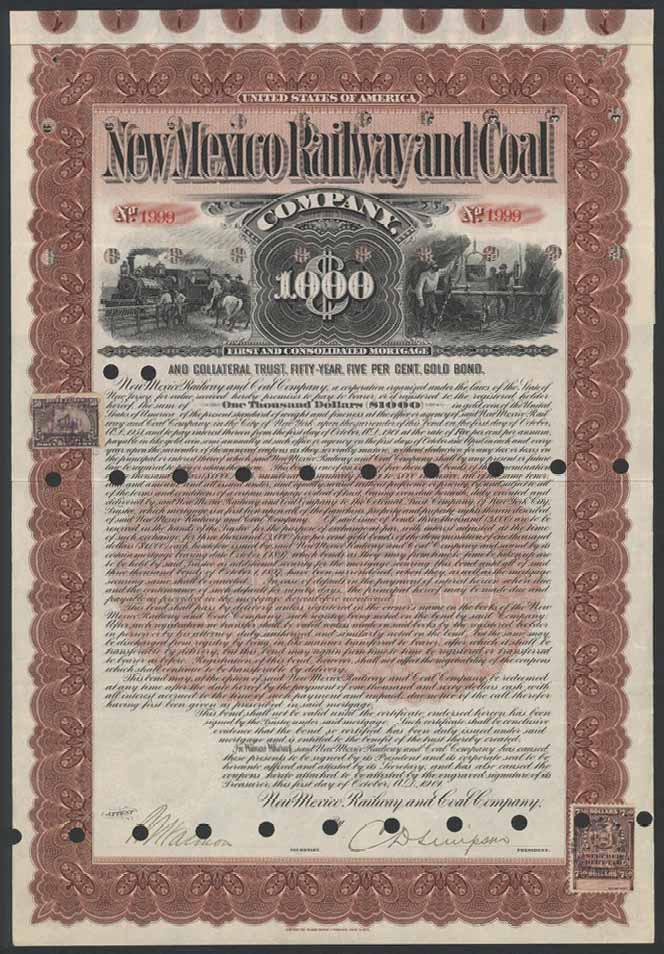
A Bond with Battleship and New York State Secured Debt Tax Stamps
Saturday, October 16, 2010
The Fullerton List: Railroads 70 and 85
Examples of the cancels, when available, are posted.
RR070: The Kansas City, St. Joseph & Council Bluffs Railroad
From the historical information at the back of the Fullerton Catalog: This road is a consolidation of the Platte County, the Atchison & St. Joseph, the Weston & Atchison, the Missouri Valley, the St. Joseph & Council Bluffs, and the Council Bluffs and St. Joseph railroad companies. The Platte County was chartered February 24, 1853 and was consolidated with the first three above listed lines as the Missouri Valley RR on March 6, 1867. This line and the remaining lines above were consolidated under the new name as above on July 11, 1870. Consolidated into the CB&Q (RR020) in 1880.
Fullerton lists two types, on only the 1ct denomination:
Type 1: One line of plain type caps and lower case letters 24.75mm long. Caps 2mm high. Undated.
1ct Pale Blue a. Normal (1) Roulette
(2) HH
as. Varieties (1) "B" broken at top, roulette
(4) No period after second R of "R.R.", HH
Type 2: Same as type 1 except length is 23.25mm.
1ct Pale Blue a. Normal (1) Roulette
No image for type 2
RR085: The St. Louis, Keokuk & Northwestern Railroad
From the historical information at the back of the Fullerton Catalog: A reorganization on July 1, 1875 of the Mississippi Valley and the Western RR opened under the new name as above on September 11, 1879. The Keokuk & Northwestern was nominally leased but practically owned by this line which has itself been controlled by the CB&Q (RR020) since 1884.
Fullerton lists two types on cancel on only the 1ct denomination:
Type 1: One line of plain type caps and lower case letters 24.5mm long. Caps 2mm high. Undated.
1ct Pale Blue a. Normal (1) Roulette
(2) HH
as. Varieties (1) Two periods after "L" roulette
(3) Without period after second R, roulette
(4) Wtihout period after second R, HH
Type 2: Same as above except 22mm long.
1ct Pale Blue a. Normal (1) Roulette
as. Varieties (1) Diamond shaped period after the 2nd R, roulette
(3) Period after comm after "St.", not after "L", roulette
Friday, October 15, 2010
Bonds with Battleship and New York State Mortgage Endorsement Stamps
Until Mahler's definitive works about these stamps most collectors, myself included, had scant knowledge about them and little understanding of how they were used. I feel fortunate, over the years, just to have acquired a number of bonds bearing stamps from both the 1898-1902 Spanish American War federal tax era and New York's 1911-1920 personal property tax era.
So just how did it come to pass that some mortgage bonds taxed during the Spanish American War era also have NY State property tax stamps affixed? The story is too long and involved to tell here, so I invite readers to read Mike Mahler's four articles about them on the American Revenue Association's website. It's a fascinating story and Mahler tells it with clarity and profuse illustrations.
Let's look at the bonds that show the 1898 federal stamps and the earliest of New York's stamps, the Mortgage Endorsement issues. Mahler’s census of usage of the New York Mortgage Endorsement stamps on mortgage bonds total about 700 including some anecdotal usages. Of those only three bonds are also known with a 50-cent 1898 Battleship stamp.
I’m pleased to show all three combo usages below. For the specific article about usages of the Mortgage Endorsement issues shown in this blog, go here.
100-Year, 3 1/2%, $1000 Gold Bond of 1897
Issued February 10, 1899 -- Michael Mahler scanDetail showing R171 50-cent Battleship with cds reading:
N. Y. C. & H. R. R. R. Co.
FEB/10/1899 -- from Michael Mahler scan
Detail from Bond Face Showing Green NY Mortgage Endorsement Stamp
Cancelled in New York County SEP 27, 1912
from Michael Mahler scan
I only showed scan details for the bond above as the full face is exactly the same as the bond below, also from the 1897 New York Central and Hudson River Railroad Company bond offering. This one features the later orange NY State Mortgage Endorsement stamp that replaced the green issue in 1915. It also benefits from having both stamps on its face.
It was originally sold on September 15, 1898, about 5 months prior the the example above and in this instance the R171 50-cent Battleship revenue was affixed and cancelled by the Trustee for the bond offering, the Central Trust Company of New York. Apparently by February 1899, when the bond shown previously was sold, the NYC & HRR company itself was handling sales.
100-Year, 3/12 %, $1000 Gold Bond of 1897
Issued July 15, 1898
Detail Showing Orange NY Mortgage Endorsement Stamp
Cancelled in New York County DEC 23, 1915
and
R171 50-cent Battleship with decipede cancel
reading: C. T. Co./JUL/15/1899/OF NEW YORK
Vignette of Cornelius Vanderbilt II, President of NYC&HR
who died September 12, 1898, three days prior to the issuance of this bond
Mohawk and Malone Railroad
100-Year, 3 1/2%, Gold Bond of 1902
Issued April 9, 1902
Michael Mahler scan
Detail of Cancel
M. & M. RY. CO.
APR 9 1902
from Michael Mahler scan
The orange New York State Mortgage Endorsement stamp on the Mohawk and Malone bond was cancelled May 26, 1919 in Oneida County, NY.
Thursday, October 14, 2010
The Fullerton List: Railroads 65, 75, 80, 90, 95 and 105
Examples of the cancels, when available, are posted.
I've grouped these six railroads as the final five in the Fullerton Catalog plus an unlisted railroad that were a part of the Gould railroad holdings. The MOPAC was one of the most important railroads in the Gould's empire, along with the I&GNRR and the St. Louis and Southwestern.
Railroad experts and historians are needed to help clarify these associations. If you are one of these experts and can shed light on these railroads and their connections, please contact us at 1898revenues@gmail.com.
RR065: The Kansas City, North Western Railroad Company
From the historical information at the back of the Fullerton catalog: Chartered December 30, 1895 to take over the property of the Kansas City, Wyandotte & Northwestern RR. On January 1, 1897 the Kansas City & Beatrice RR owning the lines from Summerfield, KS to Virginia, Nebraska (20.6 miles) was merged into this company. The property is controlled by the interests of the MOPAC (RR75).
Fullerton lists a single type on a single denomination:
Type 1: A 14.5mm diameter semi-circle of plain type all caps 2mm high. Undated.
1ct Pale Blue a. Normal (2) HH
No image available
RR075: The Missouri Pacific Railway Company
From the historical information at the back of the Fullerton catalog: The original Missouri Pacific Railway Company was incorporated October 21, 1867 as the successor to the Pacific RR of Missori. On August 11, 1880 this company consolidated with the St. Louis & Lexington RR, the Kansas City & Eastern RR, the Lexington & Southern RR, the St. Louis & Arkansas RR, the Missouri River RR, the St. Louis Cansas & Arizona RR, and the Leavenworth, Atchison & Northwestern RR. Later consolidations included the Kansas & Colorado Pacific Railway, the Central Branch Railway, the Rocks County RR, the Nevada & Minden Railway, the Kansas & Southwestern Railway, the Le Roy & Caney Valley Air Line RR, and the Boonville, St. Louis & Southern Railway. Absorbed the St. Louis, Iron Moutain, & Southern Ry in 1915.
Fullerton lists a single type on two denominations:
Type 1: A 16mm diameter semi-circle of plain type all caps 2mm high. Undated.
1ct Pale Blue a. Normal (1) Roulette
(2) HH
av. Invert (2) HH
as. Varieties (1) Split period after "CO."
2ct Carmine Rose a. Normal (1) Roulette
(2) HH
RR080: The St. Louis, Iron Mountain & Southern Railway
From the historical information at the back of the Fullerton catalog: This line was a result of the consolidation on May 6, 1874 of the Cairo & Fulton and St. Louis & Iron Mountain, and Cairo, Arkansas, & Texas RR. The southern portion of this line was built by the I&GNRR (RR055). Now (1951) it is completely owned by the MOPAC (RR075).
Fullerton lists one type on a single denomination:
Type 1: A 16mm diameter semi-circle of plain type all caps 2mm high. Undated. Overprint varies in color from orange red to carmine.
1ct Pale Blue a. Normal (1) roulette
(2) HH
aw. Double (2) double Not Verified
RR090: The St. Louis, Southwestern Railway Company
From the historical information at the back of the Fullerton catalog (combines RR090 & 095): The Texas & St. Louis Railway organized November 12, 1881 in Missouri, was reorganized on April 15, 1886 in Arkansas and Missouri to become the St. Louis, Arkansas & Texas Railway. Finally reorganized again on January 12, 1891 in to companies to conform to the corporation laws of Texas. The latter road (RR095) is completely controlled by the former (RR090) and both total 1500 miles of rail.
Edwin Gould, a son of Jay Gould, was the Vice-President of the railroad in 1891 at the time of its reorganization to conform with Texas corporation law.
Fullerton lists one type on the 1 cent stamp:
Type 1: A 16mm diameter semi-circle all caps 2mm high. Undated.
1ct Pale Blue a. Normal (1) Roulette
(2) HH
RR095: The St. Louis, Southwestern Railway Company of Texas
Fullerton lists on type only:
Type 1: A 16mm diameter semi-circle all caps 2mm high. Undated. Printed in red ink.
1ct Pale Blue a. normal (1) roulette
(2) HH
Wednesday, October 13, 2010
A Spectacular Bond
Am I glad I asked! It turns out Bob has a spectacular bond, ex Morton Dean Joyce, written for Three Hundred and Fifteen Thousand, Two Hundred and Eighteen Pounds, Fourteen Shilling Sterling. That converts to $1,525,658.50 with the tax at 5 cents per $100 in face value, or fraction thereof, being $762.85
The $762.85 tax was paid by an interesting combination of stamps: four $50, five $30, twenty $10, twenty-nine $5, twenty-two $3, one $1, one 80-cent, and one 5-cent.
New York, New York September 1, 1899
Bob Patetta
Bob Patetta scan
Bob Patetta scan
Tuesday, October 12, 2010
The Fullerton List: Railroad 60, The Kansas City, Fort Scott & Memphis Railway, aka "The Memphis Route"
Examples of the cancels, when available, are posted.
RR060: The Kansas City, Fort Scott & Memphis Railway -or- "Memphis Route"
A post with a bit more detail on this railroad can be found here. By early 1901 the KC,FS&MRy would become a part of the St. Louis & San Francisco, known as The Frisco, though by late 1901 Gould interests would predominate. There is no evidence to date that The Frisco used printed cancels, while Gould railroads clearly did.
From the historical information at the back of the Fullerton Catalog: Originated as an independent line of the Missouri River, Fort Scott & Gulf, which was originally the Kansas & Neosho Valley RR. The evolution is a bit hazy but a consolidation of the KCFS & Springfield and the KC, Springfield & Memphis occured April 23, 1888. The KCFS&S was formed by a consolidation of KCFS&Gulf RR, Rich Hill RR, Southeastern & Memphis RR, KC&Missouri RR, Short Creek & Joplin RR, and the Memphis, Kansas & Colorado Ry on February 8, 1888, in the state of Kansas. In 1917 all 920 miles wre controlled and operated by the St. Louis-San Francisco Ry.
Perhaps the most important historical information on this railroad for the printed cancel collector is the fact that the Memphis Route was controlled by the Goulds late in the history of the 1898 tax period. As many (perhaps all?) Gould railroads used printed cancels, this would explain the Memphis Route's use of the cancel only later in the tax period: the railroad appears to have only used the cancels on hyphen-holed stamps.
From The New York Times, December 22, 1901:
GOULDS GET ANOTHER ROAD.
---------
Report that the Kansas City, Fort Scott and Memphis Has Changed Hands.
KANSAS CITY, Mo., Dec. 21.--A report is current here that George Gould, working with Nathaniel Thayer, has secured the controlling stock in the Kansas City, Fort Scott and Memphis Railroad, and that the Memphis system will be taken out of the hands of the St. Louis and San Francisco, which has operated it for the the past several months, and will be made an independent property, in which the Gould interests predominate.
According to this report, Thayer, who has long been one of the principal stockholders on the Memphis system, was dissatisfied with the operation of the property by the "Frisco", believing that the latter road had taken Memphis route equipment for use on Frisco lines, leaving lines of the Memphis system unprovided for and had otherwise used the Memphis property for the benefit of the Frisco.
It is said that Mr. Thayer and Mr. Gould conferred with the result that Thayer agreed if Gould would buy enough Memphis stock to give his own and the interests represented by Thayer control, that the property would be turned over to Gould management, and that this plan has been followed out.
Only one type on two denominations:
Type 1: One line of serifed caps and lower case letters within quotation marks 27.5mm long. Caps 2mm high.
1ct Pale Blue a. Normal (2) HH
2ct Carmine Rose a. Normal (2) HH
Monday, October 11, 2010
Bonds - Michigan Central Railroad 1902 Gold Bond
Long term railroad bonds appear to have been a popular investment at the turn of the 19th century. The security of a first mortgage on the company's tangible property must have added to their popularity as opposed to less secure investments in stocks. The Michigan Central mortgaged the best part of its 270 mile route from Detroit, Michigan to Kensington, Illinois along with its terminal properties and any future acquisitions for this 50-year 3 1/2% coupon bond.The 5-cent per $100 tax was paid with a single 50-cent battleship cancelled with a light blue circular datestamp of the M.C.R.R. Co. The stamp was further defaced with a three line cut-cancellation. This is late in the tax period; the tax on bonds and all other documentary taxes were repealed as of June 30, 1902.
M. C. R. R. Co.May
1
1902
Sunday, October 10, 2010
The Fullerton List; Railroad 55, The International & Great Northern Railroad
Examples of the cancels, when available, are posted.
RR055: The International & Great Northern Railroad
The I&GNRR was featured on this site in a post on February 27 of this year. I've learned a little more about this railroad since that time, for while I reported than that the I&GNRR was bought out by the MOPAC in the 1950s and merged with the MOPAC, the two lines have always been run as if they were the same company. Indeed, the I&GNRR and the MOPAC were the cornerstone of Jay Gould's and the Gould family's railroad empire. Gould was active in railroads in the southwest from St. Louis to Texas, including other major lines like the Cotton Belt, which also issued printed cancels on the 1898 battleships.
From the historical information as the back of the Fullerton Catalog: A consolidation on February 19, 1872 of the Houston & Great Northern and the International RR, both Texas lines. The I&GNRY was incorporated in Texas August 10, 1911, as successor to the I&GNRR due to foreclosure. The line was purchased in 1924 by the Texas & Mexico Railway but is now solely owned and operated by the MOPAC (RR075).
The Texas & Mexico and the MOPAC were Gould lines.
Handstamp cancels: Fullerton lists three types of cancels in the I&GNRR section, including the catalog's only handstamp cancel. In keeping with site policy regarding handstamps and the battleship proprietary series, I will omit this entry in my listing here. Apparently there is an I&GNRR handstamp that looks somewhat like the type 1 printed cancel, and on this basis Mr. Fullerton probably felt obliged to include the cancel. The cancel is Type HS-1, is a bold and large set of I&GNRR initials 21mm long. This is not a printed cancel.
There are two major types of printed cancel, on three different denominations of battleship stamps and on R154, the green Franklin IR overprinted stamp.
Type 1: One line of serifed caps 2.5mm high and 20.75mm long without punctuation. Undated.
1ct Pale Blue a. Normal (1) Roulette
(2) HH
av. Invert (2) HH
2ct Carmine Rose a. Normal (1) Roulette
(2) HH
5ct Lilac a. Normal (1) HH
Unlisted by Fullerton:
10ct Dark Brown a. Normal (1) roulette
There appear to be numerous remainders of the I&GNRR 1 cent stamps, as this block can be added to a block of 100 recently sold in one of Eric Jackson's self-run auctions.
Type 2: One line of serifed caps 2mm high and 17.5mm long without punctuation. Undated.
1ct Green - Perf 12, 1895 Regular Postage Issue overprinted "I.R." in 1898.
a. Normal
Saturday, October 9, 2010
Corporate Bonds - The Patchogue Ice Manufacturing And Cold Storage Company
That initial Schedule A paragraph goes on to define taxes on both the initial sale, and on any resale, of stock certificates (we'll cover those taxes in subsequent posts). But there is no mention about any tax on the resale of bonds.
I'm not a student of financial history and there simply may not have been a resale market for bonds at this time. But it always has seemed odd to me that the law specifically taxed both the sale and resale of stock certificates, while only taxing the initial sale of bonds. We'd welcome comment from anyone who could share additional information or insight about the investment bond market circa 1900, and why only the initial sale of bonds was taxed.
I've found only scant information about the Patchogue Ice Manufacturing and Cold Storage Company whose $100 bond appears below. The company, according to its seal, was incorporated in 1898 and apparently was created via this $15,000 (later raised to $20,000) ten-year bond offering.
Only the first three annual interest coupons have been clipped on the several examples I've seen suggesting the company either was sold or closed in 1902. Can anyone offer further information about the disposition of the company and the fate of its founding investors?
It does clearly illustrate the basic 5-cent per $100 rate with a single five cent battleship documentary affixed next to the corporate seal, properly cancelled with the initials of its secretary and date of 12-28-98.
Although it exhibits ornate scrollwork, the bond is not engraved, but appears instead to simply have been litho-printed on a generic stock form devoid of any defining vignettes. It nonetheless was nicely designed with the type having been set specifically to accomodate the placement of the corporate seal and the necessary tax stamp; a nice touch not found on some of the more elaborate, engraved bonds we'll show in future posts.Friday, October 8, 2010
The Fullerton List; Railroad 50, The Hannibal & St. Joseph Railroad
Examples of the cancels, when available, are posted.
RR050: The Hannibal & St. Joseph Railroad
The Hannibal and St. Joseph Railroad was formally acquired by the Chicago, Burlington, and Quincy Railroad in 1883.
From the historical information at the back of the Fullerton Catalog: Chartered February 16, 1847. Building started 1853. Road opened June 25, 1858. Operated from Hannibal to St. Joseph, Mo. (206 miles), Palmyra, Mo to Quincy, IL (15 miles) and Cameron to Kansas City, Mo. (55.5 miles). Consolidated in 1882 with the CB&Q.
One type only on two denominations:
Type 1: One line of plain type caps and lower case letters 19.5mm long. Caps 2mm high. Undated.
2ct Carmine Rose b. Normal (2) HH
Thursday, October 7, 2010
Bill of Lading - Illinois Central Railroad
The handwriting has faded, but clearly 1 box, 3 bundles, and 3 sacks, or a total of 6 items were shipped from Paducah, Kentucky to Bearden, Arkansas. As per the endosement in the lower left corner the shipment was routed via Memphis where it then had to be transferred to the Cottonbelt Railroad(St. Louis Southwestern Railway) for eventual delivery in Bearden. The transfer to another rail line was not subject to tax; the initial bill of lading, and the 1-cent tax thereon, covered the shipment from its origin in Paducah to its final destination in Bearden.
RECEIVED BY THEIllinois Central R. R. Co.
PADUCAH, KY.
IN APPARENT GOOD ORDER
AUG 23 1898
AND SUBJECT TO CONDITIONS NAMED
IN ITS BILL OF LADING.
Per (signed by J.F. Donovan)