- Home
- About
- Documentary Printed Precancels
- The Fullerton List
- NYSE Brokers 1898-1902 A thru K
- NYSE Brokers 1898 - 1902 L thru Z
- Insurance Agents
- Insurance Companies
- CBOT
- Railroads
- On-document Uses with Frank Sente
- Revenue Stamped Paper with Bob Hohertz
- On Beyond Holcombe with Malcolm Goldstein
- Graded Stamps
Monday, September 20, 2010
The Fullerton List: Railroad 25: The Chicago, Fort Madison & Des Moines Railroad
Sunday, September 19, 2010
Another Bank Check With Postage Use Corrected
At a quick glance the check illustrated below is just another example of a check bearing a 2-cent postage stamp in payment of the check tax that was not honored until a corrective 2-cent revenue stamp was added.
The postage as revenue usage was nice, but it was the payee that drew my attention and piqued my interest. Not 2nd Lt. Lanning Parsons personally, but rather the reference to the 9th Calvary. The 9th Cavalry, I knew, was a Buffalo Soldier unit that saw action in the Spanish American War. I wondered where this check might have been written? Denver, the location of the bank upon which it was drafted didn't make sense, nor did Los Angeles where it was cashed.
I started with Wallace Sabin, the payor and Lanning Parsons, the payee. Sabin spent a 40 year career as a contract surgeon with the Army. Lt. Parsons graduated from West Point in 1896 and retired on disability. He later taught military science and tactics at various institutions. From his career notes I learned that in 1899 when this check was written he was stationed at Ft. Apache, Arizona Territory. The 9th Calvary it turns out was stationed there in 1899 in between stints fighting in Cuba and the Philippines.
Could the check possiby have been written there? I became very interested in what the pen-cancel hidden under the revenue stamp might show. Because of the red ink bank cancel I was reluctant to remove the stamps and my quest remained dormant.....for a while.
I asked my former collegue at APS, Mercer Bristow, for assistance. Using a crimescope and working from the back side of the check, he was able to highlight the text of the pencancel. He then reverse-printed the result and, voila, the check indeed was written at desolate Ft. Apache where Contract Surgeon Sabin did his best to pay the tax by using a postage stamp.
What remained was to determine how the check ended up at the First National Bank of Los Angeles. As shown on the back of the check, Lt. Parsons made the check payable to a third party, J. V. Vickers, who cashed it in Los Angeles.
Vickers was an entrepreneurial rancher and businessman. With two partners he operated a successful ranching operation in Arizona, the Empire Land and Cattle Company, from headquarters in Los Angeles. The disposition of the check finally made sense.
Because of a collapse the Kansas City beef market in 1898 Vickers began scaling back his Arizona operations. Perhaps he was trying to sell beef to the Army at Ft. Apache in 1899.
Hyphen Hole 14 Variety
Below, from JW's collection, is a presentation of how this variety came to exist. Exactly how this is a "slippage" issue according to Scott I am not sure. The R163 sheet below shows how there can be a transition from proper HH perfs to HH14s within the same sheet.
Saturday, September 18, 2010
1 Cent Documentary Roulette Varieties
Realigned Roulette:
Friday, September 17, 2010
Bank Checks - Postage Not Accepted for Tax
When the Citizens National Bank check illustrated below was presented to the C.C.S. Bk. (Capital City State Bank) of Des Moines, that bank required a proper tax stamp before cashing it.
The use of a 2-cent Trans Mississippi postage stamp seems particularly odd in this instance. Although dated July 14, 1898, just two weeks into the taxation period, one would have expected C. F. Fox, manager of the Postal Telegraph-Cable Company to know that use of a postage stamp to pay the check tax was improper. His company certainly must have had tax stamps available by this time to pay the taxes on telegraphic dispatches and money wires. Anyway, J. Gibron, the payee, likely paid the two cents for the correct revenue stamp to be added before collecting his $10.
detail of stamps on Citizens National Bank checkpostage stamp is pen-cancelled 7-14-1898, the same date as the check
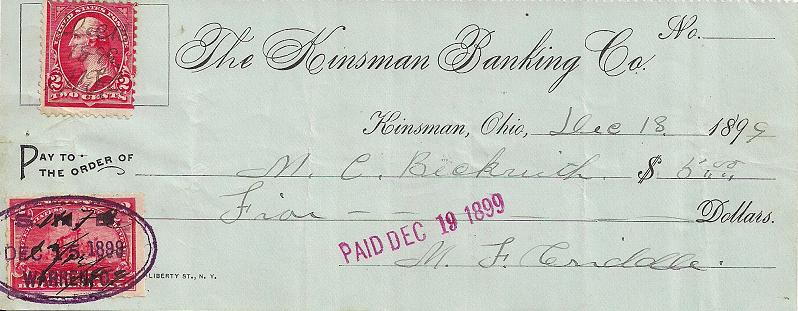
The following Kinsman (Ohio) Banking Company check is dated December 13, 1899, nearly 18 months into the tax period. Given the late date, it's not surprising that the use of a postage stamp was rejected. However, that someone would attempt to use a postage stamp 18 months into the tax period also suggests the use of postage stamps still was often tolerated.
Kinsman Banking Co. Check December 13, 1899In this instance however the payee, M. C. Beckwith, probably didn't pay the tax. Instead the check likely was held until the payor, M. F. Cridelle, paid for the corrective 2-cent revenue stamp. Looking carefully at the detail of the stamps below, one notes that the added revenue stamp bears the initials of the payor, M.F.C., although not in the hand of either Cridelle or Beckwith, whose signature appears on the back of the check.
Because the revenue stamp also bears a December 15, 1899 S.N.B. oval cancellation from the Second National Bank of Warren, Ohio where Beckwith presented it for payment, a bank clerk probably added the revenue stamp after receiving word that Cridelle paid the 2-cents. Interestingly the added revenue stamp was also pencancelled December 13 although it likely wasn't added until December 15, the date of the S.N.B. handstamp.
The bank's cost to collect the the tax likely exceeded 2-cents. Trying to avoid such processing costs, rather than ignorance of the tax laws, might in part explain why some banks allowed checks bearing postage stamps to clear unquestioned.
Thursday, September 16, 2010
Cancel for September 17 or 20?: International Paper Company
Cancel for September 16: Becker Brewing and Malting Company
From the Becker Brewing and Malting Company records of the Utah State University Libraries:
The Becker Brewing and Malting Company (BBMC) was founded in 1890 in Ogden, Utah, by the Becker family and was located on the southwest corner of 19th Street and Lincoln Avenue. Gustave L. Becker was president and treasurer, and his father, John S. Becker was secretary. Albert E. Becker, Gustave’s younger brother, became vice president in 1893.
The company manufactured and sold various kinds of beer, over time expanding its manufactures to include near beer, soft drinks, including “Zest,” ice, and related products. The company sold to a regional market, including the states of Utah, Nevada, Idaho, Oregon, Colorado, Arizona, and California. A few sales were made as far away as Illinois and Pennsylvania. In 1906, BBMC became agents for the Anheuser-Busch Brewing Association.
By the mid-1910s BBMC’s operations began to be challenged by local and state laws restricting the sale of alcohol. As Utah began passing Prohibition laws forbidding the sale or consumption of alcoholic beverages, the Becker family examined alternatives. In 1917, BBMC began the production of “Becco,” a very low alcohol (0.3% by volume) near bear. That same year BBMC split its operations. The Ogden operation was renamed the Becker Products Company, and the Becker Brewing Company, which took over beer production, was established in nearby Evanston, Wyoming, which was still a “wet” state. When national Prohibition laws took effect in 1920, however, the Becker companies ceased all beer production. These two businesses operated independently for some years, and apparently remained separate entities even after national Prohibition ended in 1933. By 1968, both Becker companies had ceased operations.
Wednesday, September 15, 2010
Cancel for September 16: P. F. Harper & Company
Cancel for September 15: Des Moines Insurance Company
Tuesday, September 14, 2010
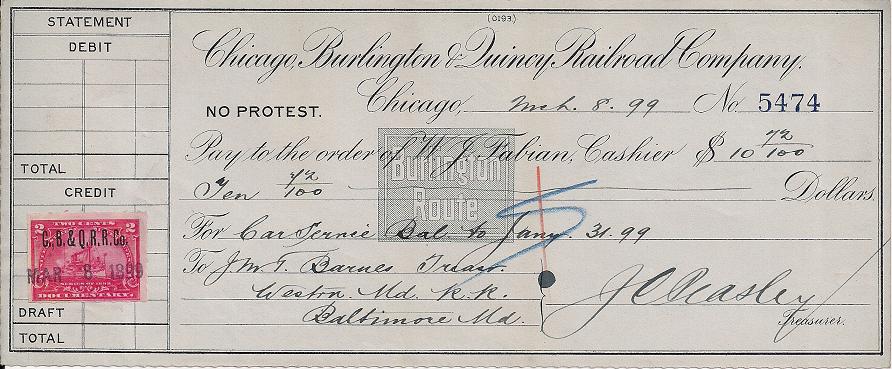
The Fullerton LIst: Railroad 20, The C, B. & Q. R. R., or the Chicago, Burlington & Quincy Railroad
RR020: The Chicago, Burlington & Quincy Railroad
Fullerton lists three types of this cancel, with multiple varieties, especially of type one.
Type 1 includes cancels on both R163, the one cent documentary battleship, and R164, the two cent:
One line of plain type caps and lower case letters 20.5mm long, caps 4mm high. Normally with elongated upright periods. Undated.
1ct Pale Blue a. Normal (1) Roulette
(2) HH
aw. Double cancel (2) HH
as. Varieties: (1) Low period after Co, roulette
(2) Low period after Co, HH
(3) High period after Co, roulette
(4) High period after Co, HH
(5) Smeared period after Co, HH
(6) Without period after Co, HH
Type 1 continued:
2ct Carmine Rose a) Normal (1) Roulette
(2) HH
as) Varieties (2) Low period after Co, HH
Is the cancel below another unlisted cancel? It appears to be a 2 cent roulette high period. Or are my eyes fooling me.
Wow - a major color difference from the previous scans, which might have something to do with Frank Sente's scanner relative to mine. This stamp comes from the following check, sent in by Frank:
Type 2: One line of plain type caps 2mm high and 23.5mm long. Undated. Initials read R. R. CO.
1ct Pale Blue a. Normal (2) HH
as. Varieties: (2) Two periods after 1st C, HH
(4) Comma after 1st R of R.R., HH
(6) Comma after O of CO, HH
September 14, 1901: President William McKinley Dead; Theodore Roosevelt Sworn In
Sunday, September 12, 2010
The Fullerton List: Railroads 05 to 15
All the railroads in this post were a part of the Burlington railroad family. The Burlingtons used printed cancels for many of their railroads.
This post begins an effort to breakown the list by railroad.
RR005: The Burlington & Missouri River Railroad in Nebraska
From the historical information at the back of Fullerton's catalog: Chartered 12 May 1869. Operated from Pacific Junctions west to Kearney, Nebraska in 1870. Purchased the Omaha & Southeastern RR August 1, 1871. 856 miles of rail consolidated into the CB&QRR (RR020) in 1880.
Fullerton lists a single type: Two lines of plain block type, all caps 2.x mm high; RR initials 24mm long; line of 19 dots 26mm long; "IN NEB" 14.5mm long. Lines of type 10.5mm apart. RR initials and dots 7.5mm apart. Periods normally square.
1c Pale Blue a) Normal (1) Roulette
(2) HH
av) Invert (3) HH invert
2ct Carmine Rose a) Normal (1) Roulette
(2) HH
RR010: Chicago, Burlington & Kansas City Railway
From the historical information at the back of Fullerton's catalog: Used CB&QRR tracks from Viola to Burlington (25miles) and Wabash, St. Louis & Pacific tracks from Moulton to Bloomfield. Taken over by the CB&QRR (RR020) when it consisted of 228 miles of rail.
One type only: one line of plain type in caps and lower case letters 21.5mm long, caps 2mm high. Undated.
Type 1: 1 cent Pale Blue
a. Normal (1) Roulette
(2) HH
1c pale blue only, roulette
Below is an example of a CB&N handstamp:
Saturday, September 11, 2010
Cancel for September 12: Muller, Schall
The Fullerton List: A Catalog of Railroad Company , Street Railway Company and Express Company Printed Cancellations on the 1898 U.S. Revenues
In July 1952, Richard Fullerton of Dayton, Ohio, published a list of known printed cancellations on the battleship revenues by railroads and express companies. By November of that year he had compiled an addendum of additional cancel types. The cover to Eric Jackson's 1992 reprint of this list is above. The reprint consists of a mere 13 pages of printed cancel listings, in keeping with the short collecting field of documentary printed cancels.
Fullerton was aided in his list by some of the notable US revenue collectors of the time, including Morton Dean Joyce, Henry Tolman, and Clarence Chappell, among others.
The list of proprietary printed cancels is endless in comparison to this list, but the printed cancels on the documentary stamps are at least as interesting and in some cases highly elusive. In the coming days I will post scans of those cancels available to me from this list.
Fullerton limited his list to railroads, street railways and express companies. He numbered each of the companies by 5s, leaving lots of room for new companies and their cancels in the case of new discoveries. Those companies that made his list include:
Railroads (21):
RR 005 Burlington & Missouri River Railroad in Nebraska - 5 collectable types/varieties
RR 010 Chicago, Burlington & Kansas City Railway - 2 collectable types/varieties
RR 015 Chicago, Burlington & Northern - 1 collectable type/variety
RR 020 Chicago, Burlington & Quincy Railroad Company - 18 collectable types/varieties
RR 025 Chicago, Fort Madison & Des Moines Railroad - 1 collectable type/variety
RR 030 Chicago, Milwaukee & St. Paul Railway - 6 collectable types/varieties
RR 035 Chicago, North-Western Railway - 14 collectable types/varieties
RR 040 Chicago, St. Paul, Minneapolis & Omaha Railway Company - 6 collectable types/varieties
RR 045 Fremont, Elkhorn & Missouri Valley Railroad - 9 collectable types/varieties
RR 050 Hannibal & St. Joseph Railroad - 3 collectable types/varieties
RR 055 International & Great Northern Railroad - 8 collectable types/varieties
RR 060 Kansas City, Fort Scott & Memphis Railway - 2 collectable types/varieties
RR 065 Kansas City, North Western Railroad Company - 1 collectable type/variety
RR 070 Kansas City, St. Joseph & Council Bluffs Railroad - 6 collectable types/varieties w/addendum
RR 075 Missouri Pacific Railway Company - 6 collectable types/varieties
RR 080 St. Louis, Iron Mountain & Southern Railway - 3 collectable types/varieties
RR 085 St. Louis, Keokuk & Northwestern Railroad - 8 collectable types/varieties
RR 090 St. Louis, Southwestern Railway Company - 2 collectable types/varieties
RR 095 St. Louis, Southwestern Railway Company of Texas - 2 collectable types/varieties
RR 100 Sioux City & Pacific Railroad - 2 collectable types/varieties
Street Railways (2):
SR 005 Detroit & Wyandotte Street Railway Company - 1 collectable type
SR 010 Union Street Railway Company - 1 collectable type
Express Companies (3):
EX 005 Adams Express Company - 4 collectable types/dates
EX 010 American Express Company - multiple types/varities w/addendum
EX 015 National Express Company - 5 collectable types/dates
There are non-railway and express firms that used printed cancels on the documentary stamps, including financial firms. The companies in Fullerton's list and those using printed cancels that are not listed will be explored in the coming days.
The Fullerton list reprint is available for purchase at Eric Jackson's web site.
Friday, September 10, 2010
American Philatelist, August 1998: Remembering the Maine by Frank Sente
Each page is downloadable by clicking on the image of the page. In coming days a downloadable .pdf file of the article will be added to the column on the right.