Friday, July 9, 2010

Cancel for July 10: Coliseum Company

COLISEUM COMPANY,
JUL   10   1899
CHICAGO.

Cancel by the Chicago Coliseum Company during the first year of the Coliseum's operation

Postcard of the Chicago Coliseum

Located at 1513 South Wabash in Chicago, the Coliseum operated from 1899 to 1982, and until the Chicago Stadium was opened in the late 1920s, the Coliseum was Chicago's most important large convention hall. 

The building hosted every Republican National Committee convention from 1904 to 1920, and Teddy Roosevelt's Bull Moose Party convention in 1912.  The building was for a brief period the home of the Chicago Blackhawks.  The promoter Leo Seltzer invented roller derby to help fill seats in the Coliseum.  And it was the home to an NBA franchise known as the Chicago Zephyrs, which moved after its first year  in 1962 to Baltimore to become the Bullets.  The franchise is now known as the Washington Wizards.

The Coliseum was demolished in 1983 when I was a sophomore at Northwestern University.

Photo of the interior of the Coliseum during preparations for the 1912 Republican National Convention held June 18-22.

Cancel for July 10: Teutonia Insurance Company

TEUTONIA
JUL   10   1899
INS. CO.

A New Orleans-based national insurance company. 

TEUTONIA INS. CO.
JUL  19  1900
New Orleans.

Wednesday, July 7, 2010

Power of Attorney and Stock Transfer Taxes: The Mexican Telephone Company

Fellow collector Rick Lokos sent in scans of a couple of stock certificates from The Mexican Telephone Company, a firm in which J. P. Morgan was on the Board of Directors by 1886.  Rick sent in the scans to inquire about the nature of the taxes paid on the transfer of these certificates.

I am still learning about these types of transactions and the likely taxes that were paid on them.  So I called in an expert instead of relying on myself and sent the scans to Frank Sente, who happens to have his own Mexican Telephone Company stock certificate, which can be found as the third set of images below.

Frank's explanations regarding the nature of the transfer taxes follow:

Certificate #1, front
from Rick Lokos

Certificate #1, back
from Rick Lokos

Howard Temple sold his 100 shares in the Mexican Telephone Company ($1,000) on March 17, 1899, during the tax period. Because the sale was transacted via a POWER of ATTORNEY, TWO separate taxes applied. 20 cents was charged for the sale of stock at 2c per $100 in original value or fraction thereof AND 25 cents was charged for the tax on a power of attorney. Hence a total of 45 cents was affixed. The usage of the 40 cent documentary is unusual. Not exactly rare, but uncommon. Attached is a similar stock from my collection showing a similar taxation [this is certificate #3 below]. Mine perhaps shows the 2 taxes more clearly with a 25 cent documentary for the power of attorney and a nice line pair of the 10 cent documentary paying for the 100 share stock sale.

Certificate #2, front
from Rick Lokos


Certificate #2, back
from Rick Lokos

I find Sarah Wood's 120 share document to be the more interesting of the two. When she sold her 120 shares she too did so via a power of attorney, but note that her sale transaction is dated June 30, 1898, the day BEFORE the War Tax took effect. As such no taxes on either the power of attorney or the sale of the stock applied to Sarah's sale.

So why the 24 cents in tax on the back of this one??? I can think of two possible explanations. But first note that the stamps were cancelled by Estabrook of Boston on March 14, 1899 during the tax period. So.....

1. I suspect there was a SUBSEQUENT direct sale (with no power of attorney involved) by Estabrook on March 14, 1899 and that sale was properly taxed 24 cents at 2c per $100 in original value or fraction thereof. This presumes that Estabrook Co. somehow had acquired the 50 shares Sarah had sold to R.L. Day & Company as she had split her sale on June 30 only selling 70 shares to Estabrook, not all 120.

2. Less likely, during an internal audition in March 1899 some Estabrook employee may have thought the stock should have been taxed previously and added the stamps then.

NB: When I researched my 1998 AP article on documentary usages I recall a writeup in the NY Times about the NYC courts being overwhelmed with transactions on June 30, 1898 by realtors and other businesses trying to get paperwork done that day in advance of having to pay taxes on July 1, 1898. Sarah was either lucky or prudent to have her sale accomplished on June 30, 1898.


Certificate #3, front
from Frank Sente


Certificate #3, back
from Frank Sente


Thanks to Frank for his guest appearance today!

Cancel for July 8: Illinois Central Railway


I.  C.  RY.  CO.
JUL
8
1898

Ugly stamp.  Big railroad.  


Tuesday, July 6, 2010

Cancel for July 7: William P. Clyde & Company, General Agents

WM.  P.  CLYDE & CO., Gen. Agents
JUL
7
1898
N.Y.

There is much behind this cancel.  My research for this post, no more than a glance at the veneer of William P. Clyde & Company and its business, reveals a complex history.  William P. Clyde & Company controlled a large shipping company that bore the name Clyde Shipping Lines.  And a ship, probably built and named for a family member of the original founders of the firm with the name William P. Clyde, carried former Confederate States of America President Jefferson Davis from Georgia to Fort Monroe in Virginia after the end of the Civil War.


Clyde Shipping Lines ran services primarily along the east coast of the United States and into the Carribean.


A Clyde Lines postcard.

The Clyde Line was established in 1844 by Thomas Clyde, connecting Philadelphia with other east coast ports. The headquarters moved to New York in 1872. Besides connecting the northeast and southeast, the line also served the West Indies, especially Dominican Republic, after 1870s.

The company was purchased in 1907 by Charles W. Morse's Consolidated Steamship Lines, which collapsed in 1908. Clyde Line was then taken over in 1911 by the Atlantic, Gulf & West Indies Steamship Lines, a combine of a number of lines, but the Clyde Line name and flag continued in use until 1932, when Clyde was combined with the Mallory Line name to form the Clyde-Mallory Line.

Monday, July 5, 2010

Cancel for July 6: Missouri Pacific Railway

LOCAL TREASURERS OFFICE
JUL   6   1898
THE MO. PAC. RY.
ST. LOUIS, MO.


A great MOPAC cancel on an R155 paying the tax on a Boatman's Bank check.

One of the great US railroads, the MOPAC was one of the first railroads built west of the Mississippi.  It merged with many smaller railroads including the International and Great Northern to create a large and sprawling railroad. 


MOPAC and affiliated railroads route map, 1885


MOPAC printed cancels are relatively common on the one cent battleship documentary


Frank Sente sent in this MOPAC check.  Close up of stamp and cancel below.

Cancel for July 6: W. R. K.


W. R.  K.
JUL     6   1899

Fancy handstamp WRK.  Need help identifying the firm or individual.

Sunday, July 4, 2010

Updating the Joyce/Chappell Lists: Anglo-American Drug Company and Mrs. Winslow's Soothing Syrup

An advertising poster that was a part of Anglo-American Drug Company's sales pitch to mothers of young children.

Anglo-American Drug Company, the producer of Mrs. Winslow's Soothing Syrup, had no shame.  They put morphine in a bottle, added ingredients to help it taste good, and sold it to mothers to give to their teething and colic-y children.   Some children OD'd on the stuff, but many more were raised as addicts.  Google Mrs. Winslow's and find the stories.  Some are quite disturbing.  Fortunately, the drug was taken off the market in the US around 1911, though it remained for sale in the UK until 1930.  No doubt there were many adult addicts of this concoction.

As a father of twin seven year olds, I can't even imagine pouring a spoon of this stuff and administering it to my kids.  So handling these stamps, where each one came from and represents a bottle of this poison that might have been administered to children, gives me great pause. 


Mrs. Winslow's was first sold in 1849.  The advert above was published circa 1900, and stated the price was 25 cents per bottle.  The tax for all proprietary articles sold for more than 15 cents and up to 25 cents was 5/8 cent.  Mrs. Winslow's was only offered in one size bottle and so Anglo-American only ordered printed cancels on 5/8 cent stamps. 


Mrs. Winslow's
Soothing Syrup.
1899.
Type 2

According to the Joyce list below, there were only two types of Mrs. Winslow's printed cancels, and a limited number of collectable types from the series:

Below is a link to an excel file of this list.  As of this time this list contains no additions to the original Joyce dates and types.


ex-Tolman Mrs. Winslow's printed cancels

Saturday, July 3, 2010

Cancel for July 4: B. S. Bank


B. S. BK,
JUL
4
1900

Happy Independence Day!

What needs to be written about the B.S. Bank? 

Friday, July 2, 2010

Updating the Joyce/Chappell Lists: The Centaur Company

"Ripped" cancel taken from a 1/4cent proprietary battleship.
This is the design for all Centaur Company printed cancels.

The Centaur Company produced one of the best known fancy cancels used on the battleship proprietary series. President Charles Fletcher's signature is prominently placed at an angle across the face of the stamp, with the name of the company in the upper left corner.  This cancel can be found on several proprietary values, including the 1/4c, 5/8c, 1c. and 1 1/4c stamps. 

According to Joyce and Chappell, there are three types of Centaur Company cancels.  Of those cancels, type 1 includes all the printed cancels while types 2 and 3 include handstamp varieties.  I find this confusing, and not useful for compiling an updated list of the printed cancels, mostly since types 2 and 3 are not printed cancels.  So for the purpose of compiling this list, and as a policy to be applied for the lists of cancels for future company lists, I will omit handstamp cancels from the revised listings.

Joyce used a protocol for including cancels based on Chappell's original criteria.  From the introduction to Chappell's original list: "Only the printed and typed cancels will be given consideration in this list.  The only exception being those few firms who also had private die stamps in this period.  The handstamps of these few companies are of general interest and I feel they should be included."   The Centaur Company produced its own private die stamp, hence Chappell and then Joyce included Centaur handstamps in their list of types.  But the handstamps they listed are not printed, and may not be exhaustive, and by virtue of being handstamps are prone to innumberable types and subtypes.   I figure that if a new list is of printed cancels, we should keep it that way, and let others who have done more work on the subject of proprietary handstamps handle those cancels.

Thus, I will not include those handstamps -- a much more thorough listing exists of handstamps in the Battleship Desk Reference (BDR), including the handstamps of firms that issued private dies and used printed cancels. 

This means I will dismiss types 2 and 3 in the list below, and focus only on cancel type one, the printed cancels.  This practice will have implications for many other firms, including whether or not there will be a need to renumber the types.  For example, the first few Antikamnia types listed by Joyce and Chappell are handstamps.  If those are removed from the new lists, do the revised lists start with the type originally assigned by J/C or should the type numbers be reassigned?  Whatever the choice, for me the goal is to minimize confusion for those who come to collect these cancels and want to make sense out of them without too much difficulty.

The original Joyce/Chappell list:


Below is a link for an updated Centaur Company printed cancel list.   Unlike previous cancel lists posted on this site, no additional dates to the Joyce/Chappell list have been added.  However, as pointed out above, cancel types 2 and 3 have been omitted.


I am very interested in establishing whether there are other dates that were unreported by Joyce.  Please review the list and submit unknown dates if you have have them.

Below are the Centaur pages from my collection (ex-Tolman) and those of Frank Sente.  Between us we present the majority of Centaur printed cancels listed by Joyce.

Langlois, ex-Tolman Centaur cancels


Frank Sente's Centaur cancels.


1 1/4 cent bottom plate block; Centaur '99 red ink printed cancel.  Scarce in any condition, even more so with Centaur printed cancels.

Thursday, July 1, 2010

Battleship Boosterism: The Weekly Philatelic Gossip from 1928


I've always had a soft spot for antique philatelic journalism (doesn't everybody?).  The Weekly Philatelic Gossip stopped publishing in 1961, but is the source for some great early work on 1898 revenues, including articles on cancels on the battleship series.

The paper was published in the town of Holton, Kansas..  Holton is due north of Topeka about halfway to the Nebraska state line.  The current town has just a little over 3000 residents, but for several generations the Weekly Philatelic Gossip came out of this small Kansas town and was one of the most important publications in philately.  At the end of this post I've included the full pages of the 1928 article I am about to review, and if you download these pages you can see the advertising that came to the Gossip from dealers all over the United States.

The editor of the Gossip in mid-1928 selected the battleship revenues as the subject for a front page article given to boosterism and a sales pitch for battleship stamps coupled with available facts on the series.  Below is most of the article in sequential order, cut into sections so I can comment as you read along.  Enjoy!


"The Battleship That Caused A War" hardly indicates the content of the article, which is about the battleship series of revenue stamps and not the Battleship Maine that exploded in Havana Harbor in Cuba and accelerated the call for war with Spain in the United States.  There is some writing about this ship, however...


I can't argue with the author's statement that what he calls the "Sleeper Set" of US revenues should be in every collection due to their history.  This site is much about the history of this set, and about the companies that used these stamps.  If by sleeper he means the set receives Rodney Dangerfield, "no respect" treatment, I agree with that too...


Maybe I'm missing something.  While the comment about these stamps being within the reach of everyone remains true 82 years after the printing of this article, I am not sure the claim about the fine quality of the set holds relative to other classic sets.  The Columbians?  Trans-Mississippi?  


Yes!  Get your battleship revenues now before it is too late.  As he says, the old fellows are no more in the making.   I don't think anyone has to worry too much, though.  Here we are, 82 years after this article, and the old fellows are still fairly cheap.  Collecting styles have made the plate blocks valuable, but most of the singles remain cheap.  Oddly, he never mentions the differences between rouletting and hyphen hole perforations and the relative scarcity of some hyphen hole values.


"The half cent orange is very rare.  The writer has never seen a copy, unused, and does not know how many of them were issued"  I think the author needed his own copy of Elliot Perry's book.  Then he could have known how many were issued.  Meanwhile, here is one used...


A journal like the Weekly Philatelic Gossip prospered at a time of high interest in stamp collecting and an otherwise illiquid market in information about stamps.  Here courtesy of the internet, is proof that the 1/2 cent orange does indeed exist...


Interesting catalog numbers.  There is only one number for 1/2 cent value, so there is no differentiation between the orange and grey stamps. 

Scott doesn't use this range of numbers for revenues anymore.  The company gave up the practice decades ago, even before the USPS started putting cartoon fish and other sorts of nonsense on stamps, bloating the numbers of stamps issued for modern collectors and requiring Scott to assign hundreds of new numbers every year.  Of course now all the revenue numbers begin with R. 


The 10 cent documentary was, according to this author, not very plentiful.  I suppose the documents on which it was used started to show up after the publication of this article?

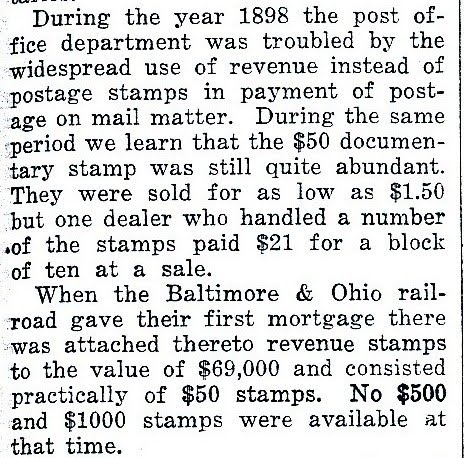
Hmm...a stamp dealer tried to manipulate the return of tax stamps?


There isn't much of this type of philatelic journalism left: promotional, packed with facts, and quite long.  Open up the pages below and see the ads.  At least as interesting!